Lab Chapter 16

0.0(0)
Studied by 0 people
call kaiCall Kai
learnLearn
examPractice Test
spaced repetitionSpaced Repetition
heart puzzleMatch
flashcardsFlashcards
GameKnowt Play
Card Sorting

1/31

encourage image

There's no tags or description

Looks like no tags are added yet.

Last updated 6:30 AM on 4/7/26
Name
Mastery
Learn
Test
Matching
Spaced
Call with Kai

No analytics yet

Send a link to your students to track their progress

32 Terms

1
New cards

How does air enter the respiratory tract?

Through a Naris. Before air passes through the nasal cavity, air enters the respiratory tract through this. This is the primary entryway for air.
2
New cards
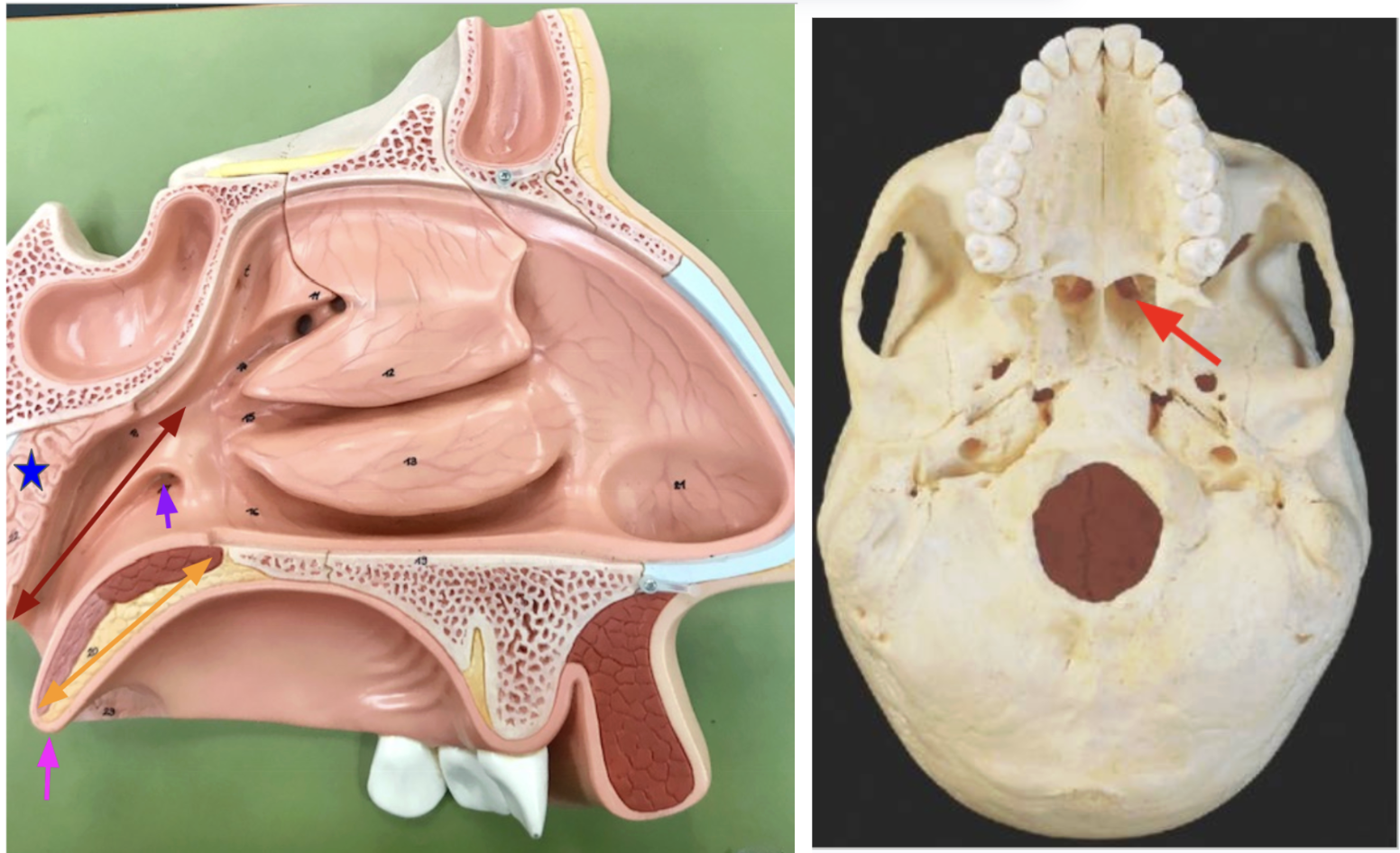
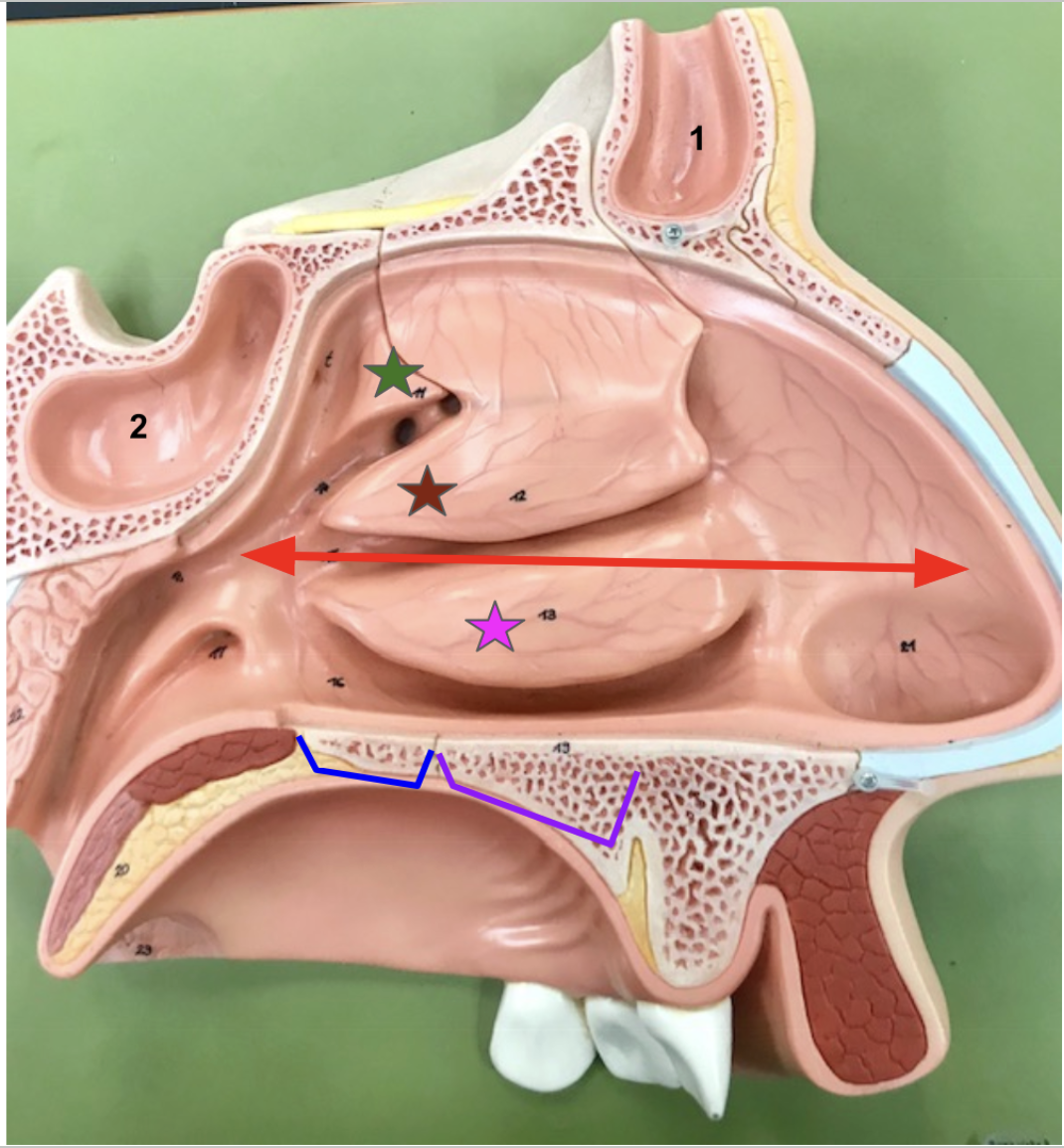
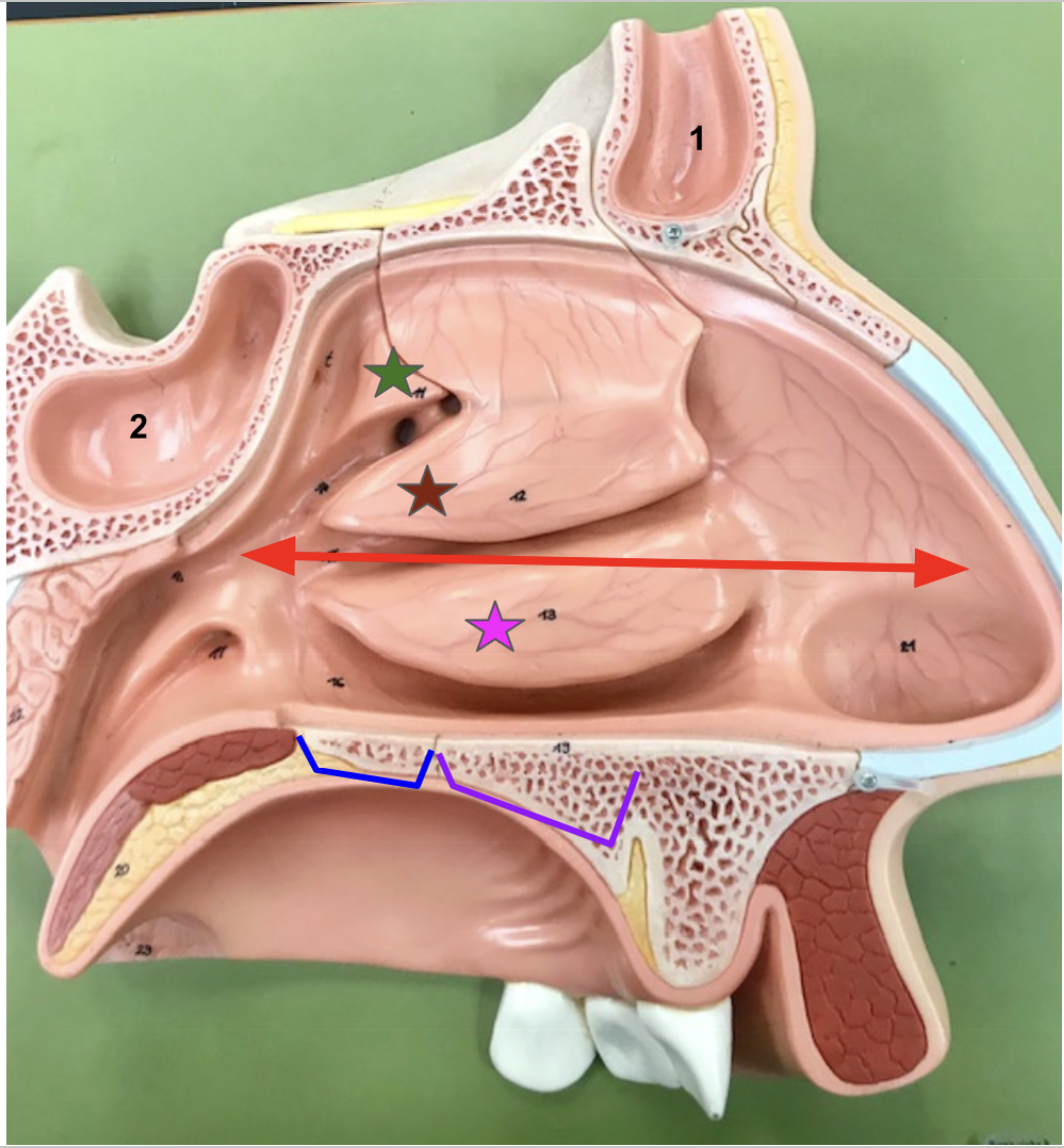
<p>Identify. Function of stars &amp; numbers?</p>

Identify. Function of stars & numbers?

Red: nasal cavity (notice how it stretches from the nostril to the nasal pharynx)

3 stars are the nasal conchae. Create turbulence (swirling air around) and help filter humidify, and warm air through nasal hairs and nasal mucus, which comes from the sinuses (#1&2).

  • Green: Superior nasal conchae of ethmoid bone

  • Red: Middle nasal conchae of ethmoid bone

  • Purple: Inferior nasal conchae

Branches represent the hard palate (bony area) composed of:

  • Palatine process of the maxilla (Blue)

  • Horizontal process of the palatine bone (Purple )

Sinuses: contain nasal mucus

#1: Frontal sinus

#2: Sphenoid sinus

  • Ethmoid and maxillary sinuses (not visible)
<p>Red: nasal cavity (notice how it stretches from the nostril to the nasal pharynx)</p><p>3 stars are the nasal conchae. Create turbulence (swirling air around) and <strong>help filter humidify, and warm air</strong> through nasal hairs and nasal mucus, which comes from the sinuses (#1&amp;2).</p><ul><li><p>Green: Superior nasal conchae of ethmoid bone</p></li><li><p>Red: Middle nasal conchae of ethmoid bone</p></li><li><p>Purple: Inferior nasal conchae</p></li></ul><p>Branches represent the hard palate (bony area) composed of:</p><ul><li><p>Palatine process of the maxilla (Blue)</p></li><li><p>Horizontal process of the palatine bone (Purple )</p></li></ul><p>Sinuses: contain nasal mucus</p><p>#1: Frontal sinus</p><p>#2: Sphenoid sinus</p><ul><li><p>Ethmoid and maxillary sinuses (not visible)</p></li></ul><p></p>
3
New cards
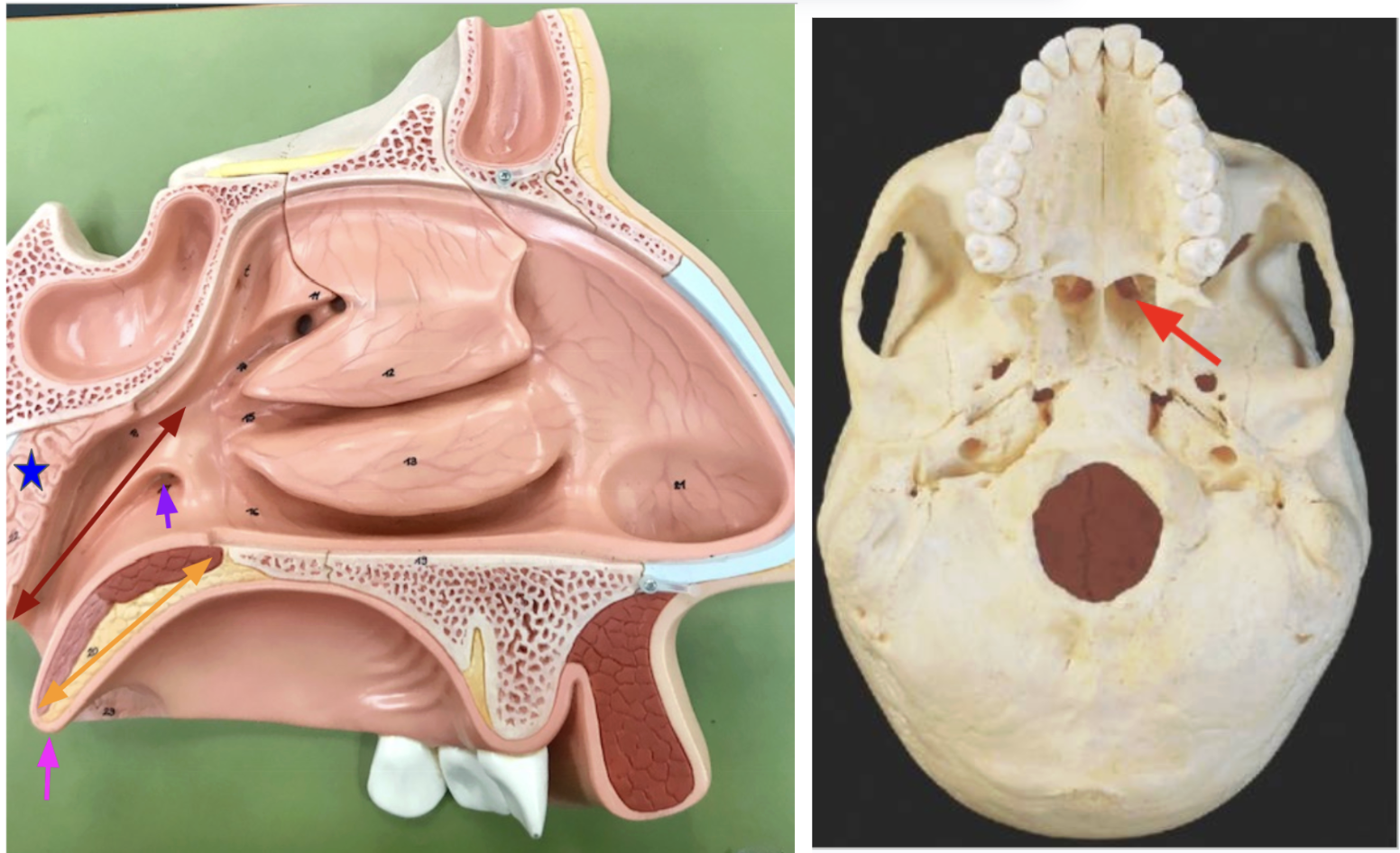
<p>Identify. Function of pink and purple</p>

Identify. Function of pink and purple

Dark Red: Nasopharynx

Bright red: posterior nasal apertures

Yellow: Soft palate (tissue area)

Pink: Uvula - Prevents food from entering the nasal cavity when eating (bc it raises upward).

Blue: Pharyngeal tonsils

Purple: Auditory tube - Connect the ear, nose, and throat
<p>Dark Red: Nasopharynx</p><p>Bright red: posterior nasal apertures</p><p>Yellow: Soft palate (tissue area)</p><p>Pink: Uvula - Prevents food from entering the nasal cavity when eating (bc it raises upward).</p><p>Blue: Pharyngeal tonsils</p><p>Purple: Auditory tube - Connect the ear, nose, and throat</p>
4
New cards
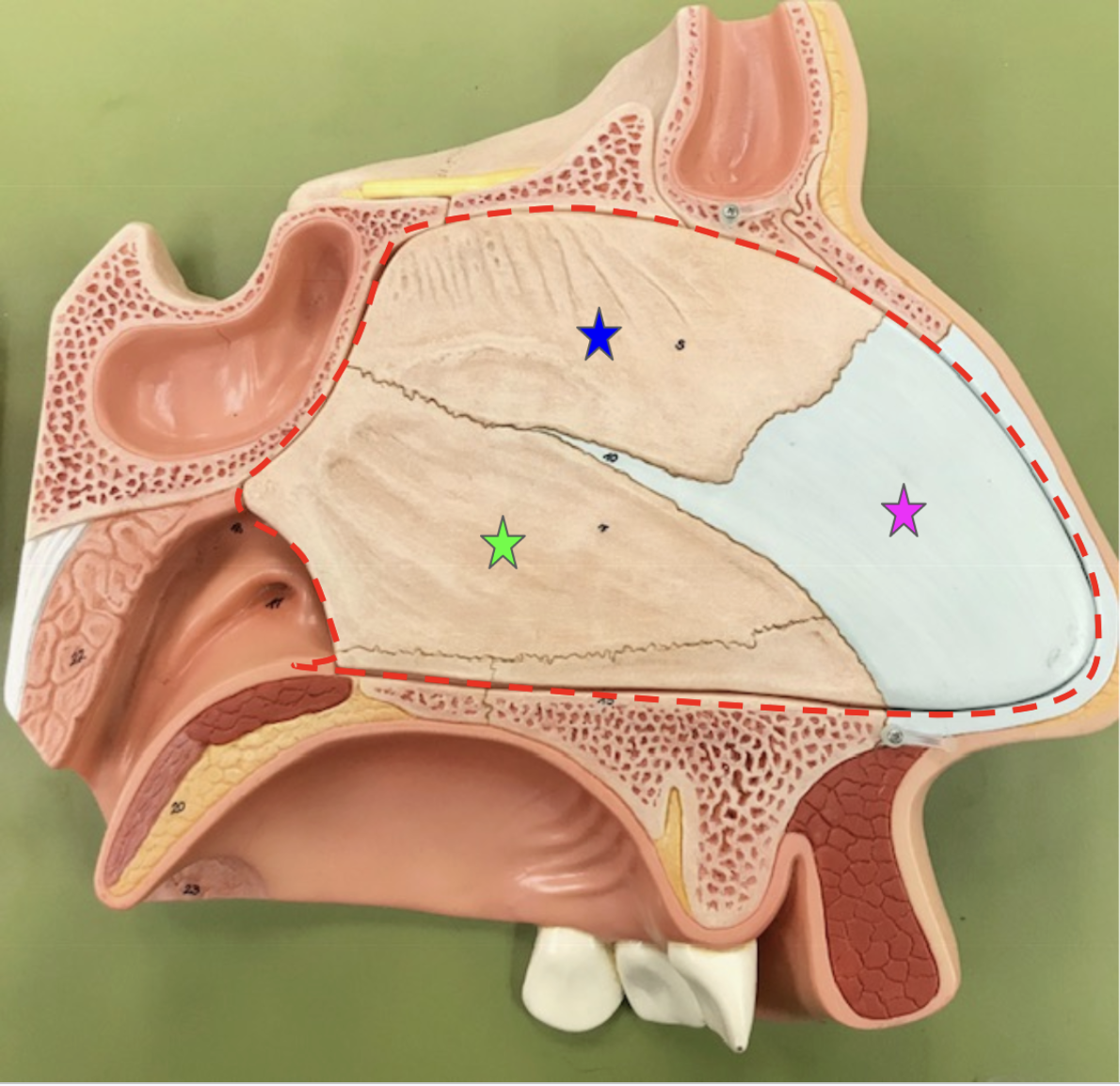
<p>Identify. Function of red.</p>

Identify. Function of red.

Red area: Nasal septum - divides the nasal cavity into left & right

Broken into 3 parts: pink, blue, & green stars

- Anterior portion of nasal septum:

  • Pink: Septal cartilage

Posterior portion of nasal septum: (bony portion)

  • Blue: Perpendicular plate of ethmoid bone

  • Green: Vomer

<p>Red area: Nasal septum - divides the nasal cavity into left &amp; right</p><p>Broken into 3 parts: pink, blue, &amp; green stars</p><p>- Anterior portion of nasal septum:</p><ul><li><p>Pink: Septal cartilage</p></li></ul><p>Posterior portion of nasal septum: (bony portion)</p><ul><li><p>Blue: Perpendicular plate of ethmoid bone</p></li><li><p>Green: Vomer</p></li></ul><p></p>
5
New cards
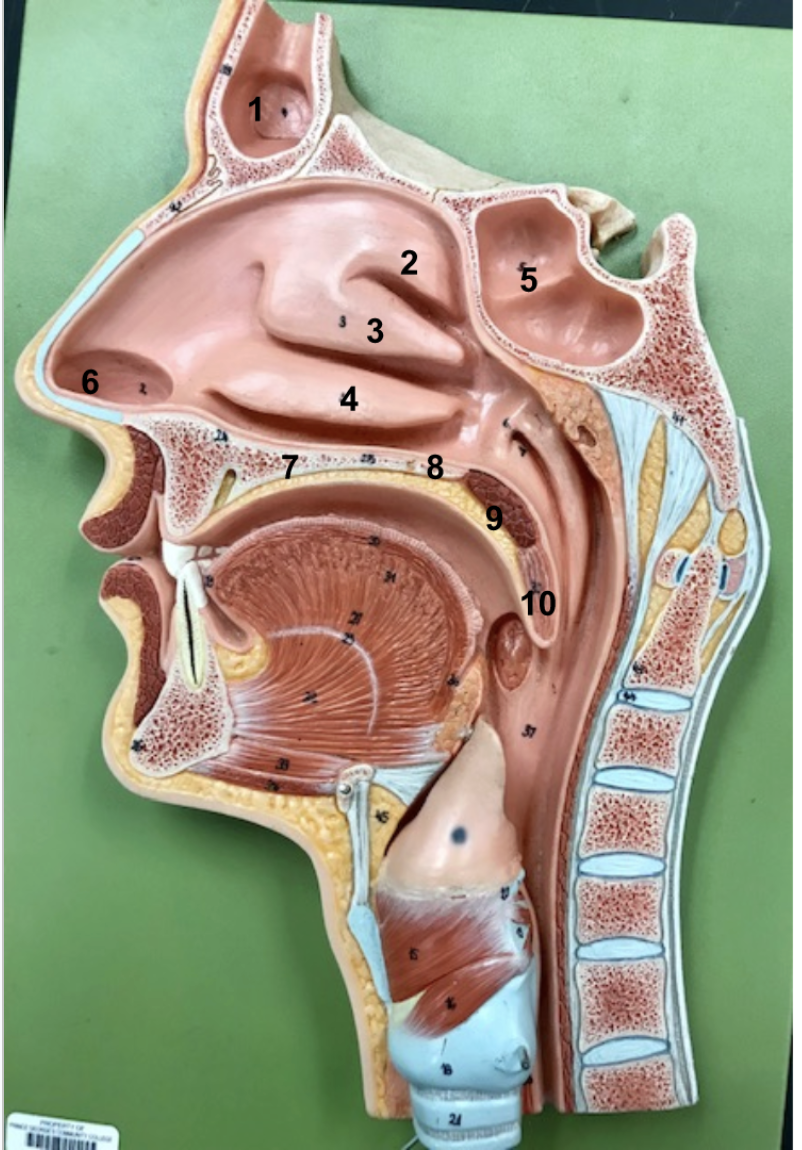
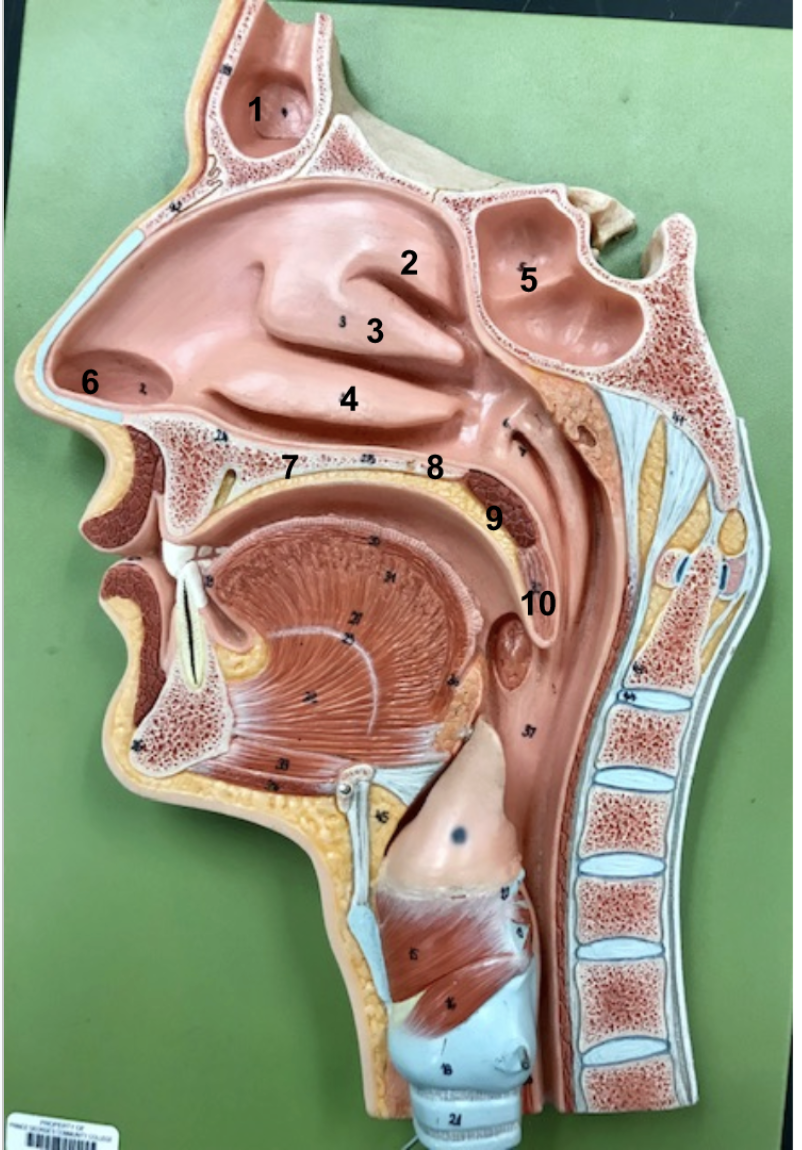
<p>Identify</p>

Identify

  1. Frontal sinus

  2. Superior nasal concha of ethmoid bone

  3. Middle nasal concha of ethmoid bone

  4. Inferior nasal concha

  5. Sphenoid sinus

  6. Vestibule (just within naris)

  7. Palatine process of maxillary bone

  8. Horizontal plate of palatine bone

  9. Soft palate

  10. Uvula

<p></p><ol><li><p>Frontal sinus</p></li><li><p>Superior nasal concha of ethmoid bone</p></li><li><p>Middle nasal concha of ethmoid bone</p></li><li><p>Inferior nasal concha</p></li><li><p>Sphenoid sinus</p></li><li><p>Vestibule (just within naris)</p></li><li><p>Palatine process of maxillary bone</p></li><li><p>Horizontal plate of palatine bone</p></li><li><p>Soft palate</p></li><li><p>Uvula</p></li></ol><p></p>
6
New cards
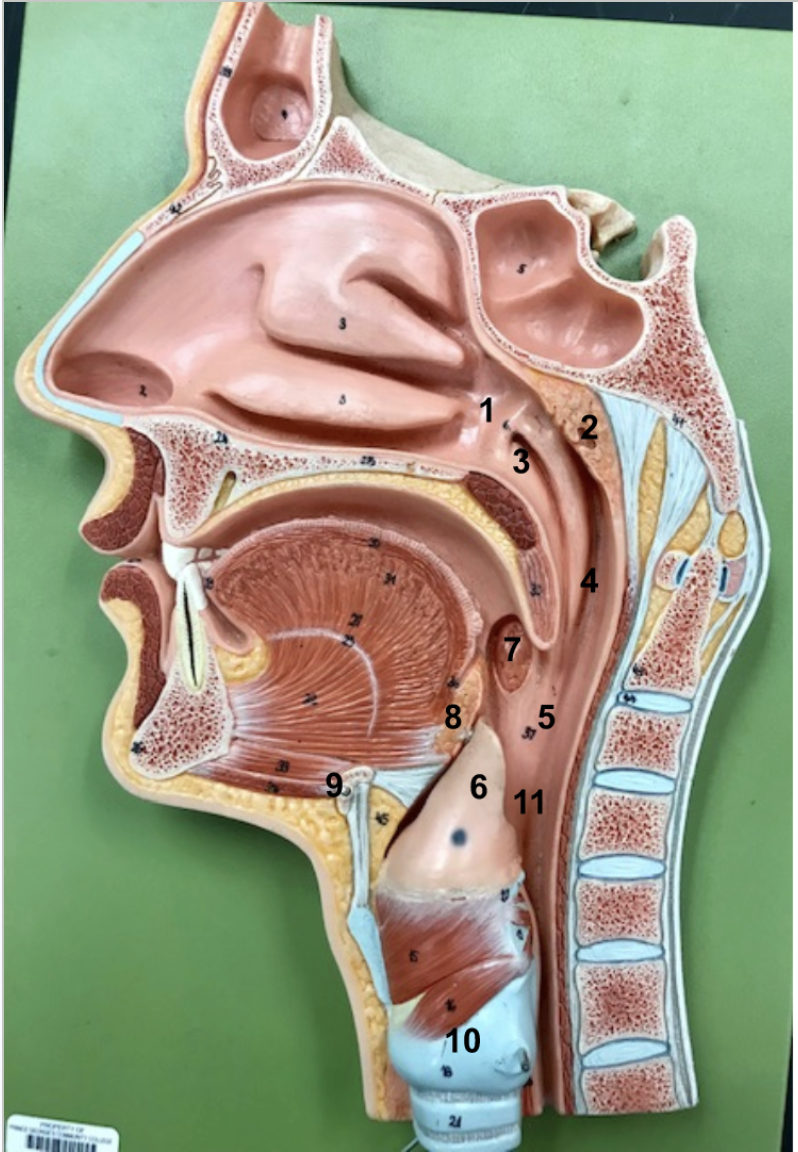
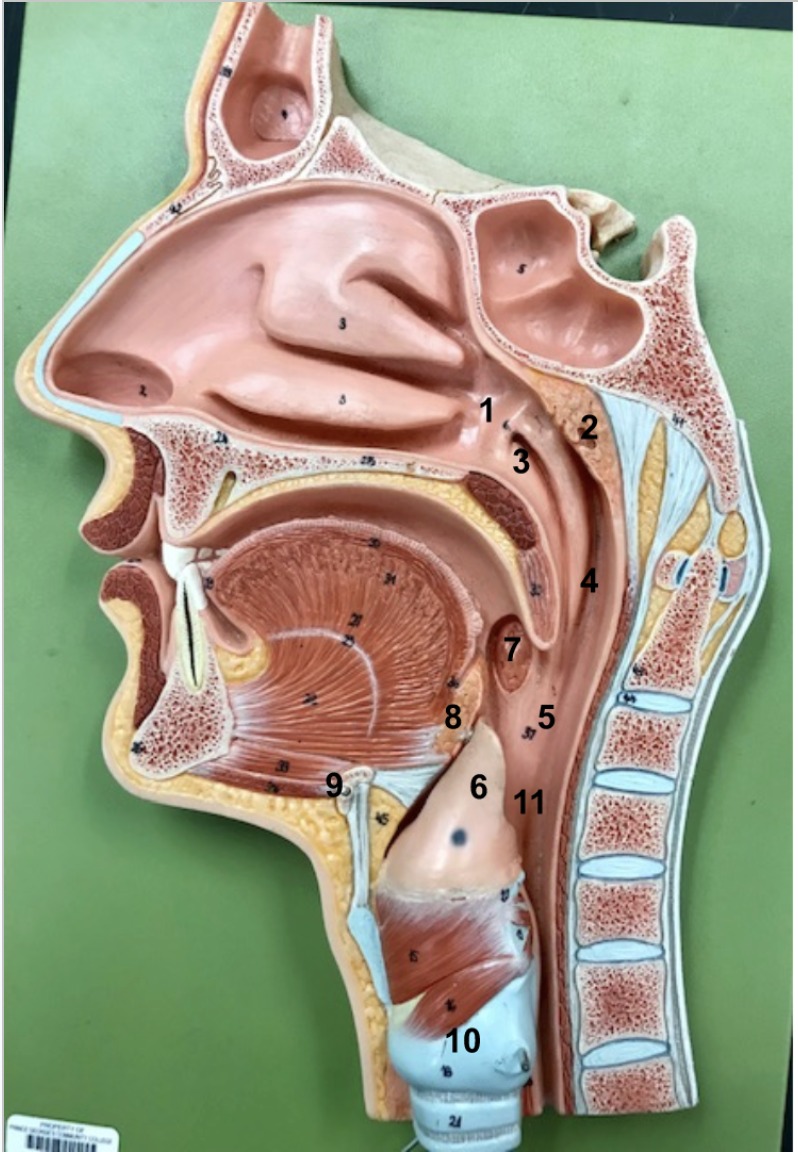
<p>Identify. Function of 9.</p>

Identify. Function of 9.

  1. Posterior nasal aperture

  2. Pharyngeal tonsil

  3. Opening to the auditory tube

  4. Nasopharynx

  5. Oropharynx

  6. Epiglottis (covers the opening to the larynx when swallowing)

  7. Palatine tonsil

  8. lingual tonsil

  9. Hyoid bone (anchors many laryngeal structures)

  10. Cricoid cartilage (major laryngeal cartilage)

  11. Laryngopharynx

- Notice the trachea and larynx are infront (anterior), esophagus in the back (posterior, it looks flat but when you eat it expands). From the pharynx, air travels down the front, food travels down the back.
<ol><li><p>Posterior nasal aperture</p></li><li><p>Pharyngeal tonsil</p></li><li><p>Opening to the auditory tube</p></li><li><p>Nasopharynx</p></li><li><p>Oropharynx</p></li><li><p>Epiglottis (covers the opening to the larynx when swallowing)</p></li><li><p>Palatine tonsil</p></li><li><p>lingual tonsil</p></li><li><p>Hyoid bone (anchors many laryngeal structures)</p></li><li><p>Cricoid cartilage (major laryngeal cartilage)</p></li><li><p>Laryngopharynx </p></li></ol><p>- Notice the trachea and larynx are infront (anterior), esophagus in the back (posterior, it looks flat but when you eat it expands). From the pharynx, air travels down the front, food travels down the back.</p><p></p>
7
New cards
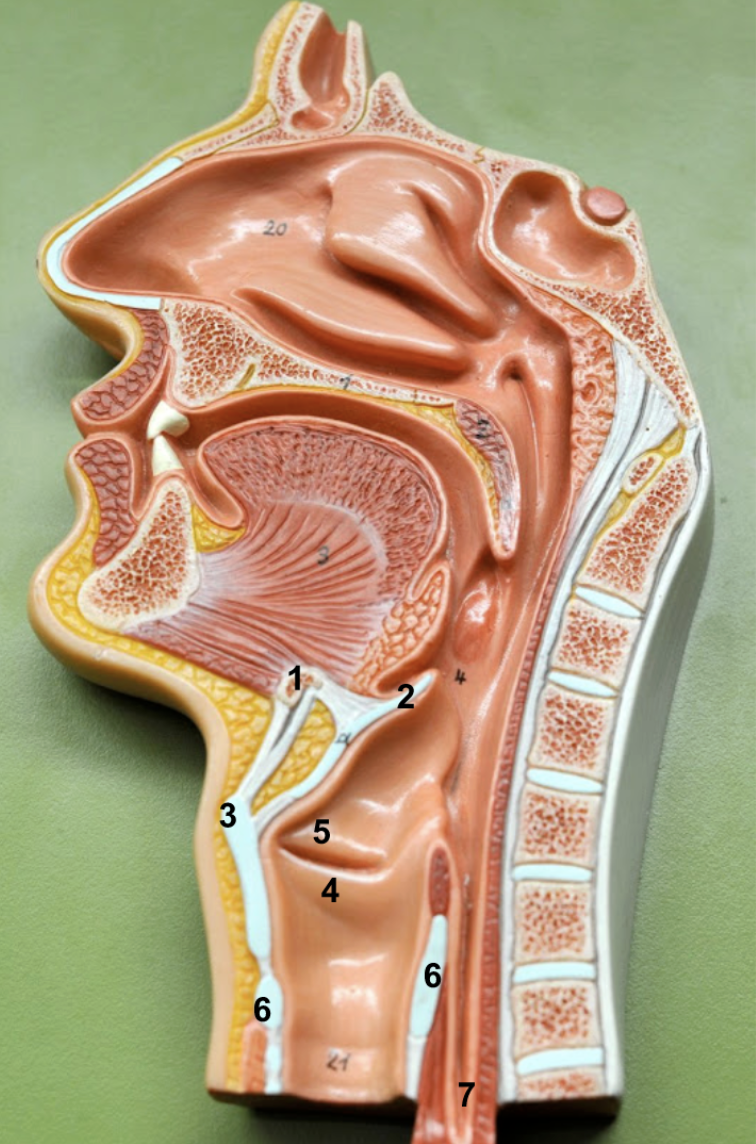
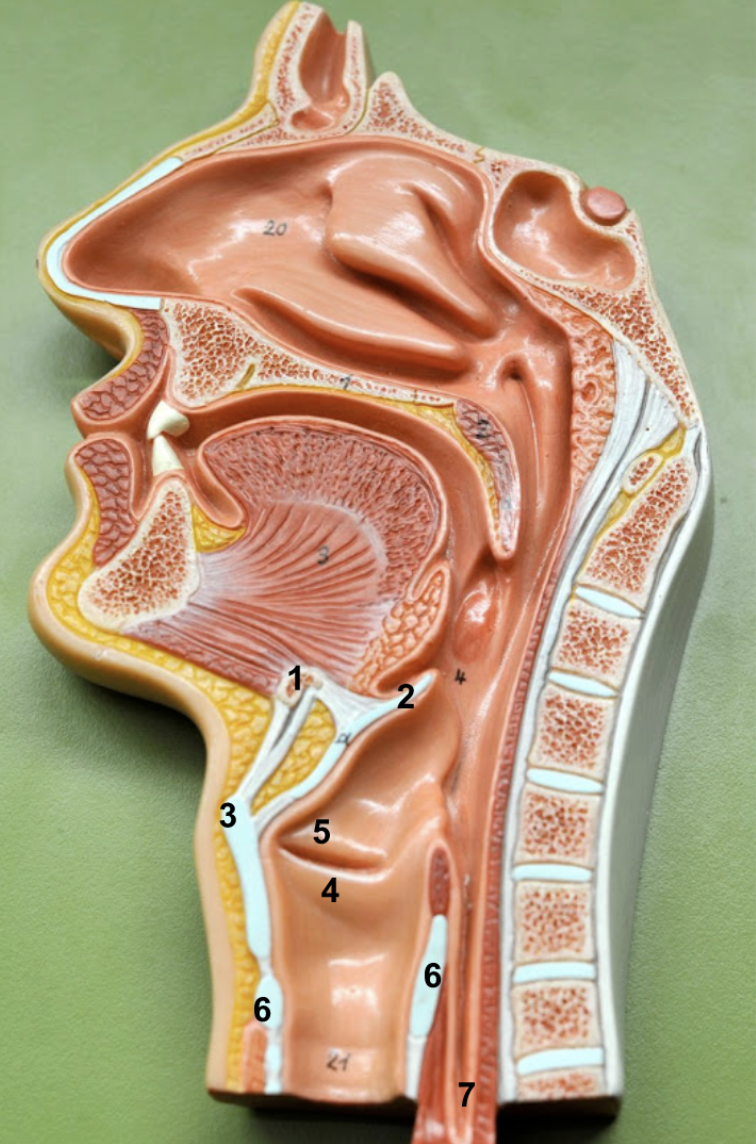
<p>Where does sound production come from?</p><p>Identify. Function of 2, 4 &amp; 5.</p>

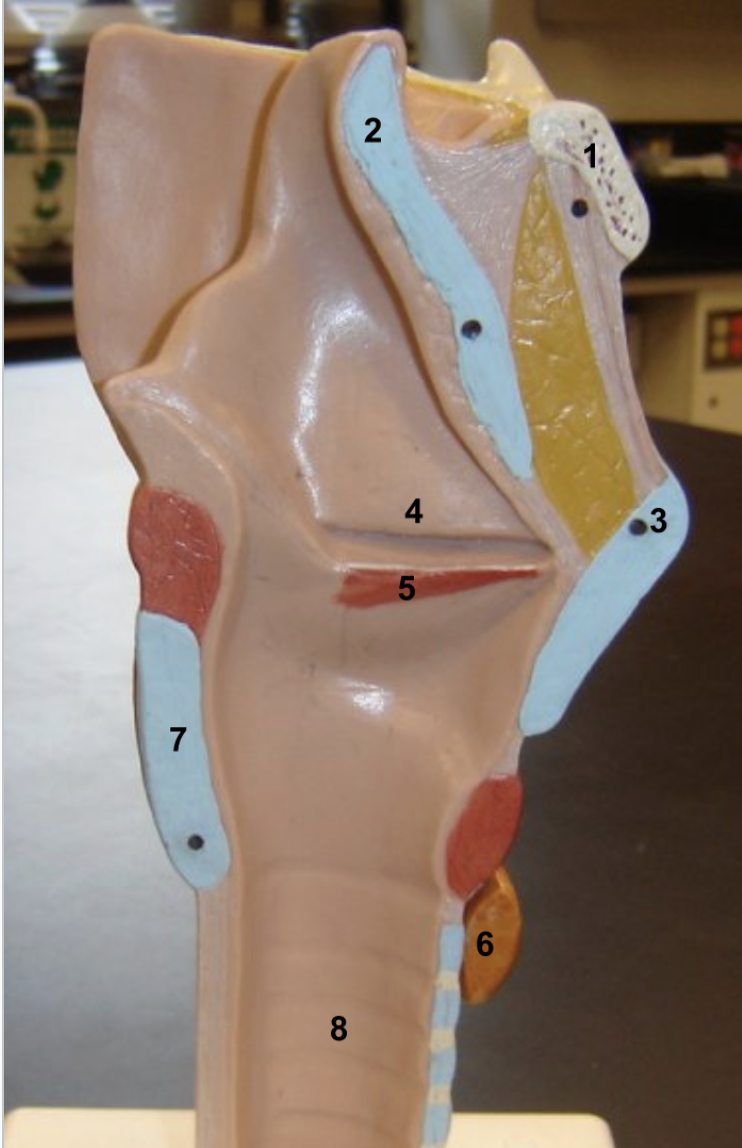
Where does sound production come from?

Identify. Function of 2, 4 & 5.

- Sound production comes from the larynx (it is our voicebox), which this image depicts. As air moves in and out sound is created.

  1. Hyoid bone

  2. Epiglottis: Helps prevent choking. Opens when breathing, closes when swallowing food.

  3. Thyroid cartilage (largest laryngeal cartilage)

  4. True vocal cords - vibrate when air rushes past to produce sound. It is called true bc it has muscle.

  5. False vocal cords - protect the vocal folds (true vocal chords). It is called false bc it lacks muscle.

  6. Cricoid cartilage (visible in both the anterior and posterior larynx)

  7. Esophagus

<p>- Sound production comes from the larynx (it is our voicebox), which this image depicts. As air moves in and out sound is created.</p><ol><li><p>Hyoid bone</p></li><li><p>Epiglottis: Helps prevent choking. Opens when breathing, closes when swallowing food. </p></li><li><p>Thyroid cartilage (largest laryngeal cartilage)</p></li><li><p>True vocal cords - vibrate when air rushes past to produce sound. It is called true bc it <u>has</u> muscle. </p></li><li><p>False vocal cords - protect the vocal folds (true vocal chords). It is called false bc it <u>lacks</u> muscle.</p></li><li><p>Cricoid cartilage (visible in both the anterior and posterior larynx)</p></li><li><p>Esophagus</p></li></ol><p></p>
8
New cards
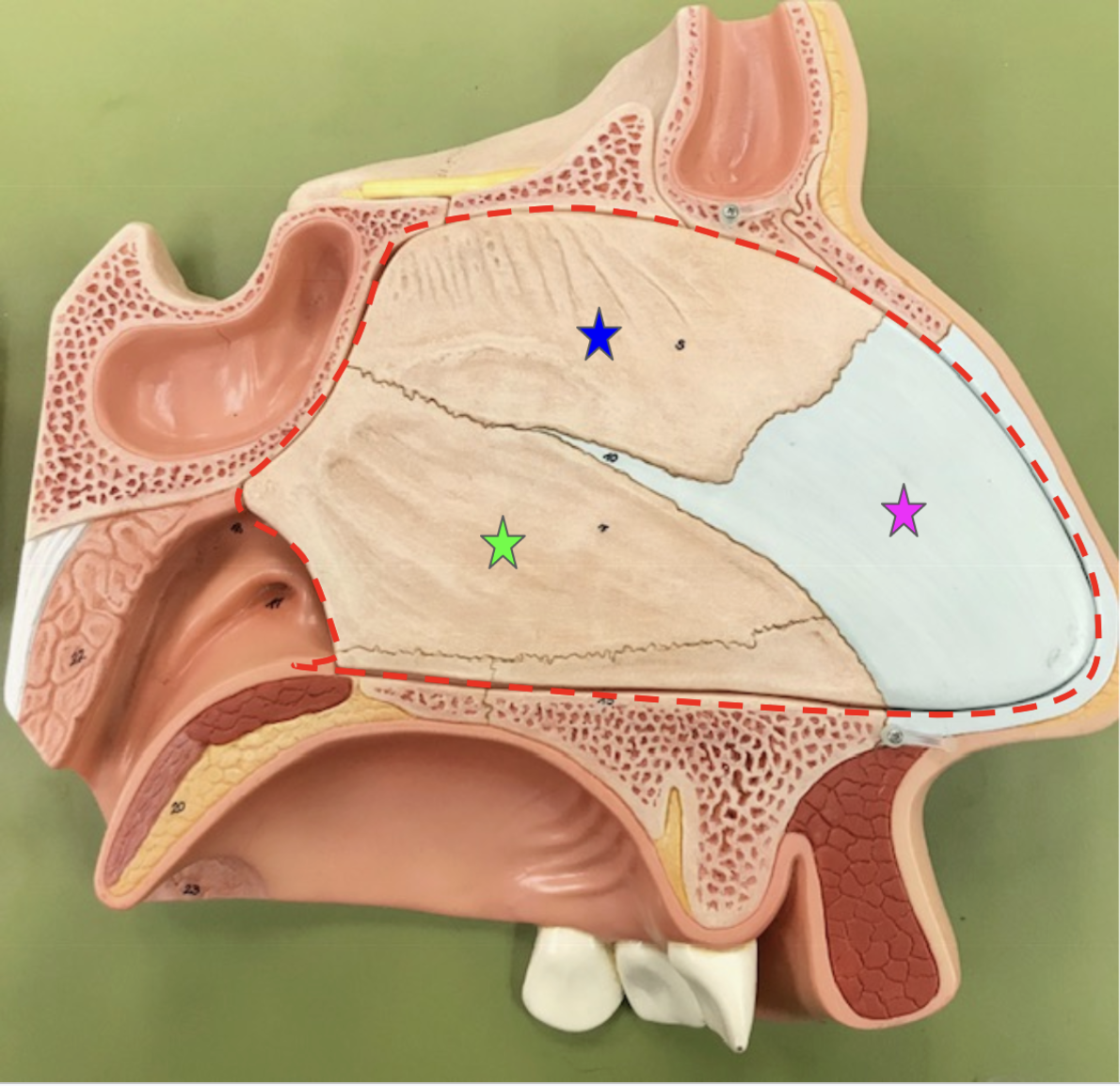
<p>This image depicts what? Identify</p>

This image depicts what? Identify

Depicts the nasal septum

  1. Perpendicular plate of ethmoid bone

  2. Vomer

  3. Septal cartilage

9
New cards
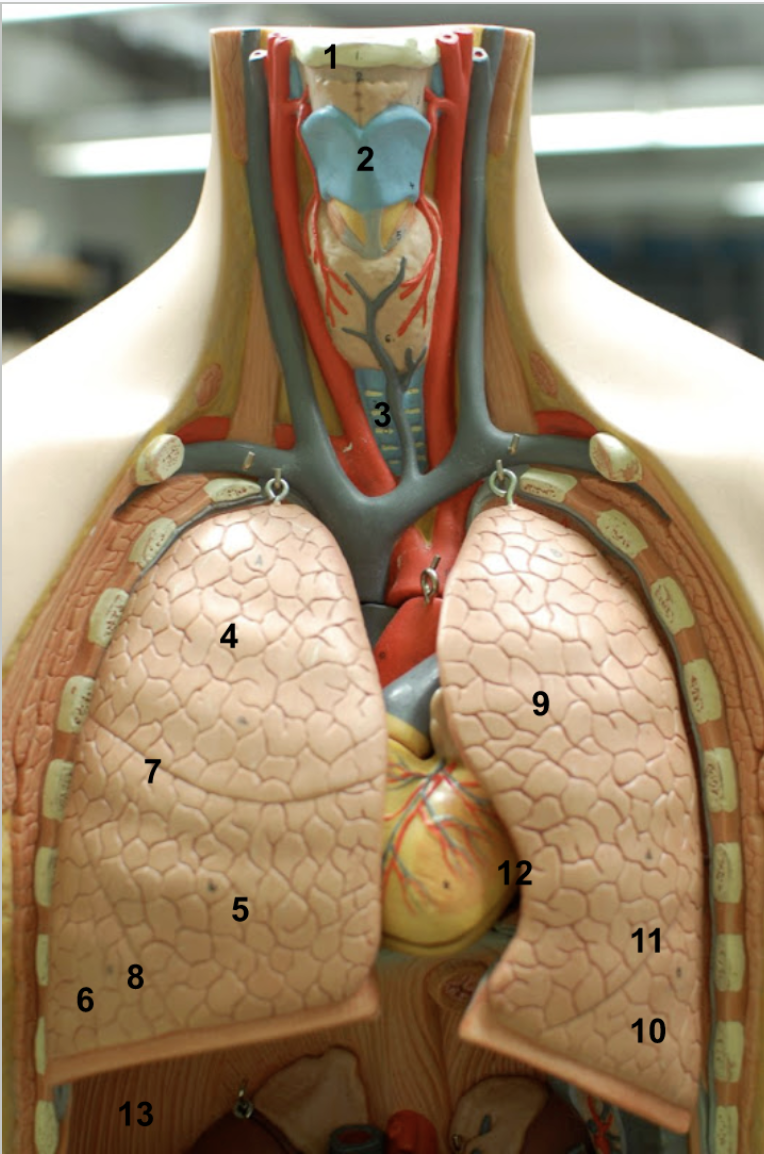
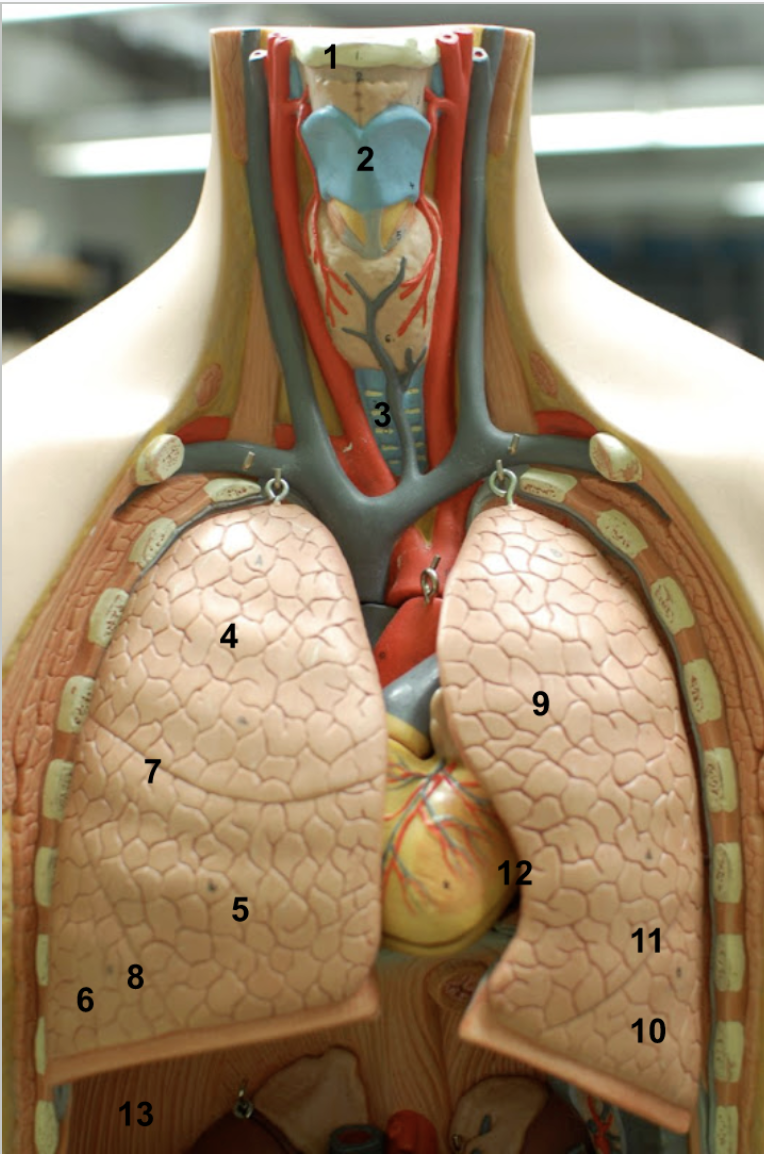
<p>Identify 1-13. Function of 7, 8, &amp; 9</p>

Identify 1-13. Function of 7, 8, & 9

  1. Hyoid bone

  2. Thyroid cartilage

  3. Trachea

  4. Superior lobe of right lung

  5. Middle lobe of right lung

  6. Inferior lobe of right lung

  7. Horizontal fissure of right lung - separates the right superior and right middle lobes of the lung

  8. Oblique fissure of right lung - separates the right middle and right inferior lobes

  9. Superior lobe of left lung

  10. Inferior lobe of left lung

  11. Oblique fissure of left lung - separates the left superior and inferior lobes

  12. Cardiac notch

  13. Diaphragm

<ol><li><p>Hyoid bone</p></li><li><p>Thyroid cartilage</p></li><li><p>Trachea</p></li><li><p>Superior lobe of right lung </p></li><li><p>Middle lobe of right lung</p></li><li><p>Inferior lobe of right lung</p></li><li><p>Horizontal fissure of right lung -  separates the right superior and right middle lobes of the lung</p></li><li><p>Oblique fissure of right lung - separates the right middle and right inferior lobes</p></li><li><p>Superior lobe of left lung</p></li><li><p>Inferior lobe of left lung</p></li><li><p>Oblique fissure of left lung - separates the left superior and inferior lobes</p></li><li><p>Cardiac notch</p></li><li><p>Diaphragm</p></li></ol><p></p>
10
New cards

Compare the lobes & fissures of the left and right lung. Why are the lobes like this?

Right lung

  • 3 lobes (superior, middle, and inferior)

  • 2 fissures: Horizontal fissure (separates superior and middle lobe), Oblique fissure (separates the middle and inferior lobe)

Left lung

  • 2 lobes (superior and inferior)

  • One fissure: Oblique fissure which separates the superior and inferior lobes

- There are more lobes on the right than left bc the heart is situated more towards the left side of the heart. Nd this creates an indentation in the left lung (cardiac notch).

11
New cards

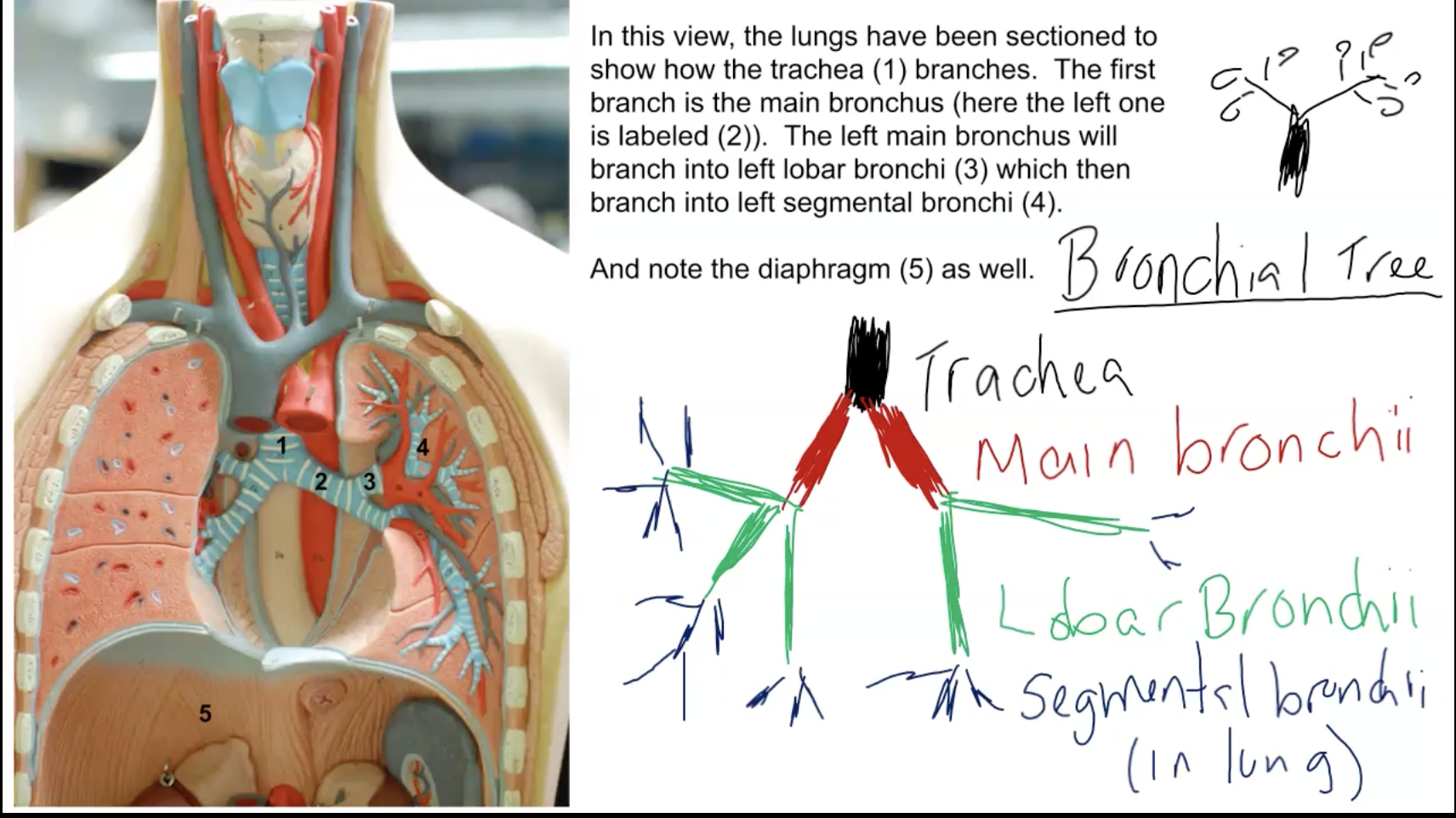
What is the bronchial tree?

Trachea > main bronchus > lobar bronchi > segmental bronchi

  • Trunk: Trachea.

  • This branches into two parts left & right main bronchus, which carry air to each lung.

  • These split into left & right lobar bronchi which carry each to each lobe of the lung. The left only has superior & inferior lobar bronchi, while the right has superior, middle, and inferior lobar bronchi.

  • These split into left & right segmental bronchi which carry air deep within the lung.
<p>Trachea &gt; main bronchus &gt; lobar bronchi &gt; segmental bronchi</p><ul><li><p>Trunk: Trachea. </p></li><li><p>This branches into two parts left &amp; right main bronchus, which carry air to each lung.</p></li><li><p>These split into left &amp; right lobar bronchi which carry each to each lobe of the lung. The left only has superior &amp; inferior lobar bronchi, while the right has superior, middle, and inferior lobar bronchi.</p></li><li><p>These split into left &amp; right segmental bronchi which carry air deep within the lung.</p></li></ul><p></p>
12
New cards
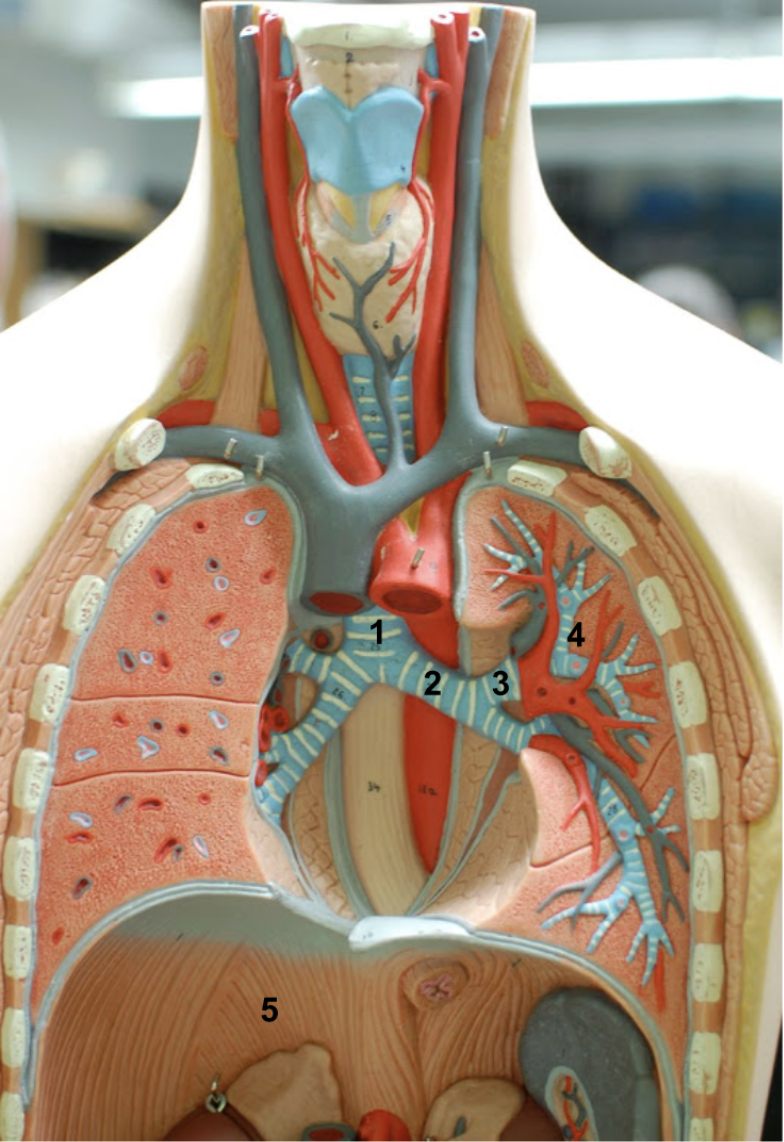
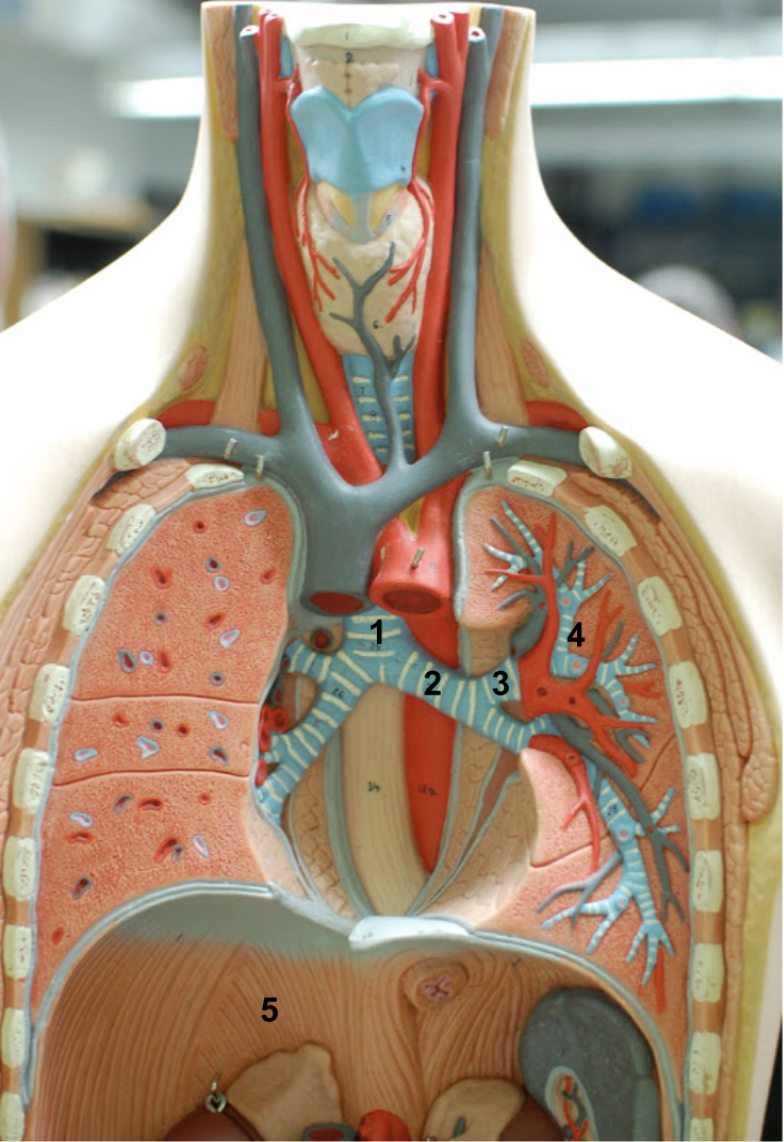
<p>Identify</p>

Identify

  1. Trachea

  1. Left main bronchus.

  2. Left superior lobar bronchi

  3. Left segmental bronchi

  4. Diaphragm

<ol><li><p>Trachea</p></li></ol><ol start="2"><li><p>Left main bronchus.</p></li><li><p>Left superior lobar bronchi</p></li><li><p>Left segmental bronchi</p></li><li><p>Diaphragm</p></li></ol><p></p>
13
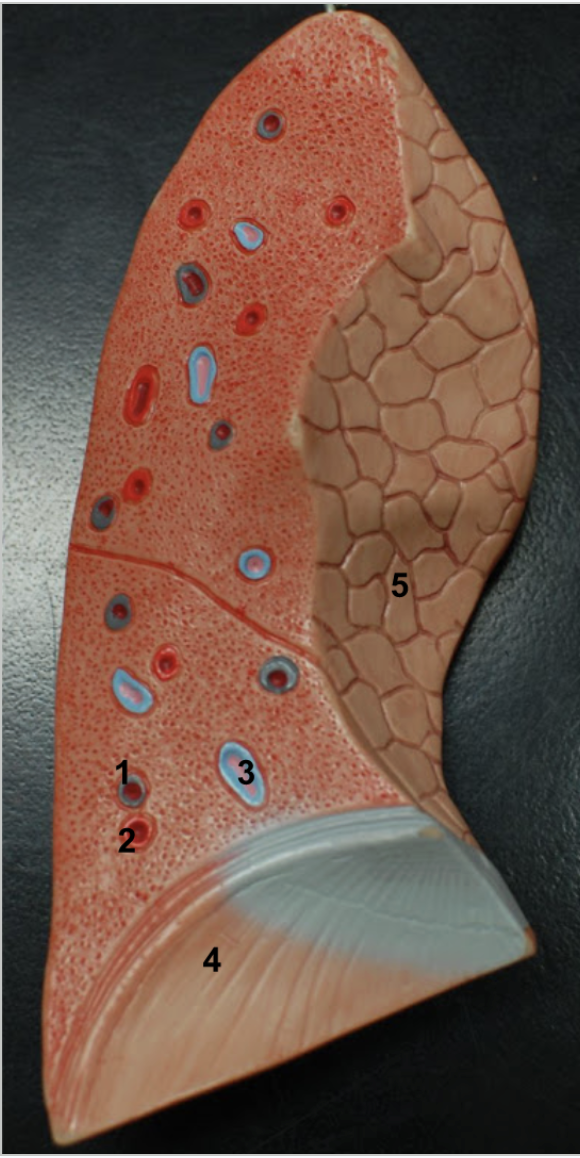
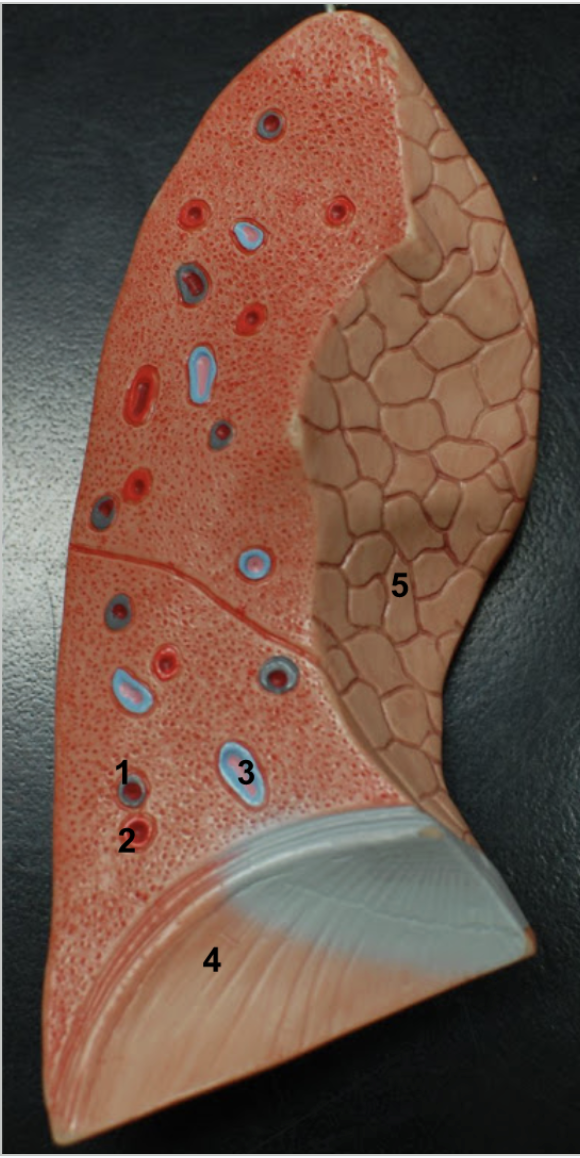
New cards
<p>This is an image of the left lung. Identify</p>

This is an image of the left lung. Identify

Recall that the colors switch in the lungs. So blue is an artery and red is a vein.

  1. Pulmonary artery

  2. Pulmonary vein

  3. Segmental bronchus

  4. Diaphragm

  5. Mediastinal surface

<p>Recall that the colors switch in the lungs. So blue is an artery and red is a vein.</p><ol><li><p>Pulmonary artery</p></li><li><p>Pulmonary vein</p></li><li><p>Segmental bronchus</p></li><li><p>Diaphragm</p></li><li><p>Mediastinal surface</p></li></ol><p></p>
14
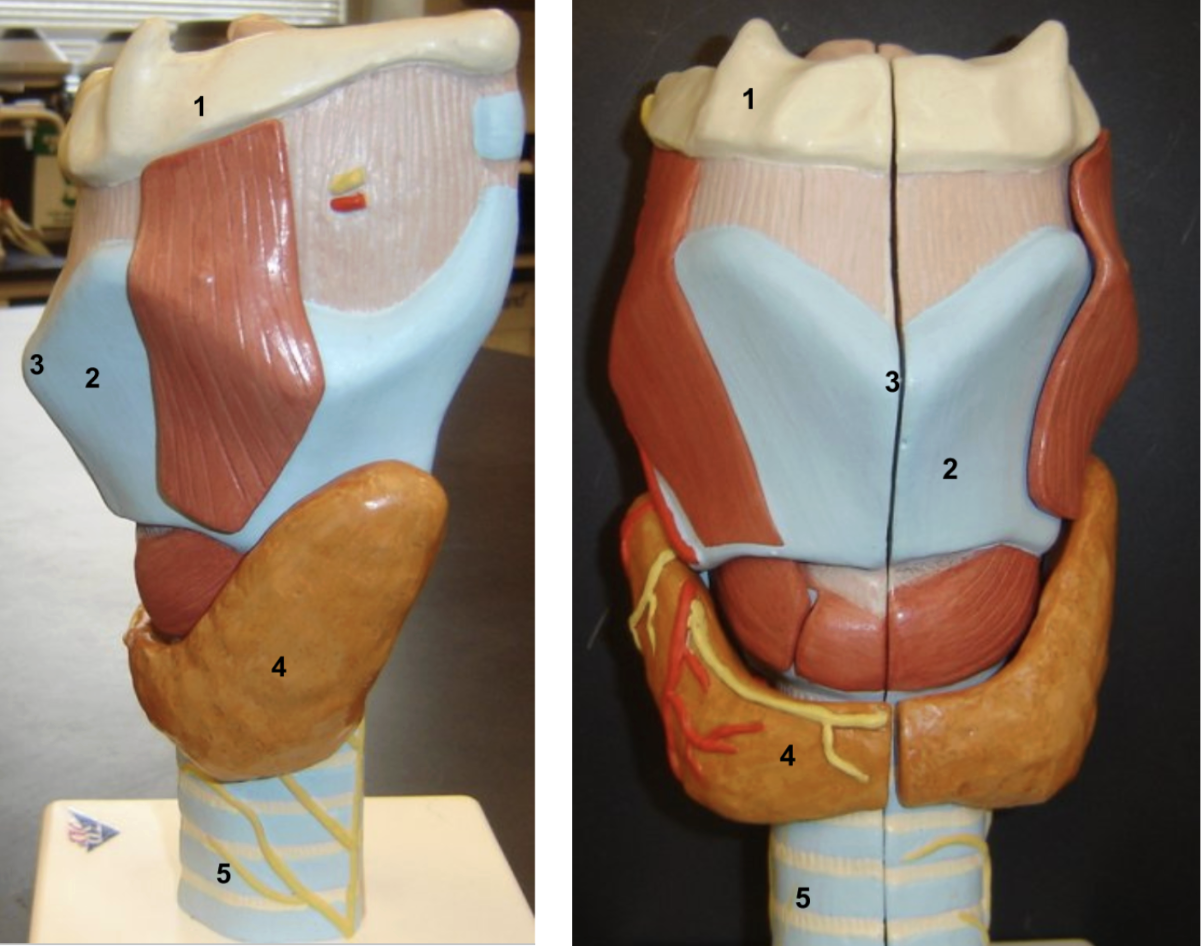
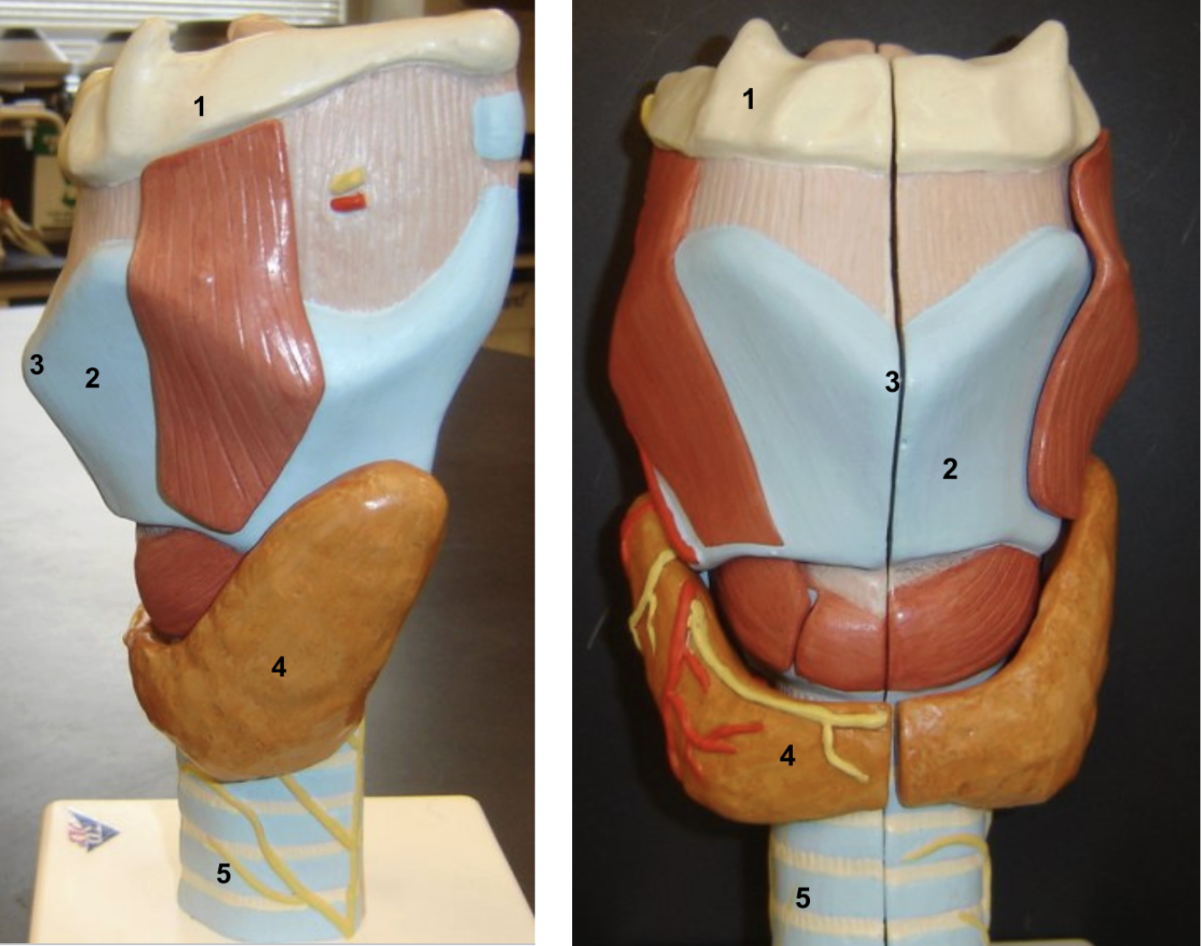
New cards
<p>Identify</p>

Identify

  1. Hyoid bone

  2. Thyroid cartilage (2).

  3. Laryngeal prominence

  4. Thyroid gland (covering the cricoid cartilage)

  5. Trachea

<ol><li><p>Hyoid bone</p></li><li><p>Thyroid cartilage (2).</p></li><li><p>Laryngeal prominence</p></li><li><p>Thyroid gland (covering the cricoid cartilage)</p></li><li><p>Trachea</p></li></ol><p></p>
15
New cards

True or false: Only males have a laryngeal prominence.

False. Both male and females have one, but males typically have a larger one.
16
New cards
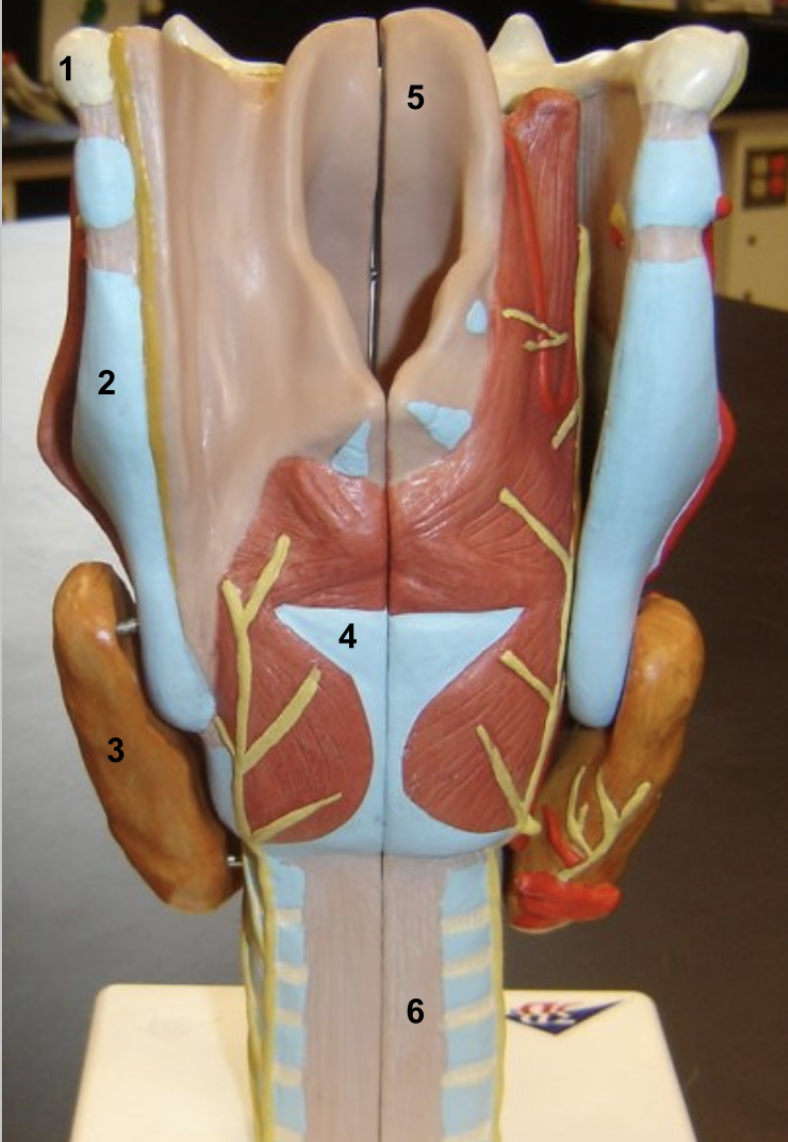
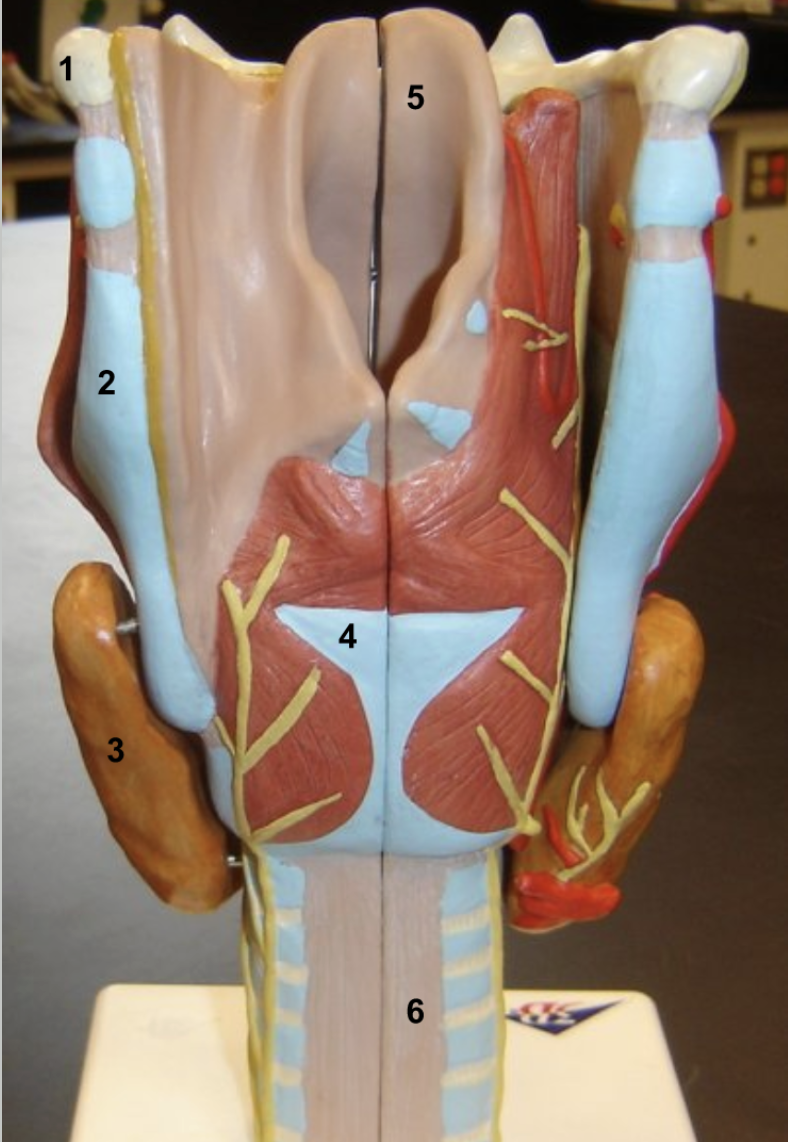
<p>Identify. How do number 2 &amp; 4 differ, how are they similar? How does #5 differ from the two?</p><p>How does the arrangement of cartilage on #6 aid in function?</p>

Identify. How do number 2 & 4 differ, how are they similar? How does #5 differ from the two?

How does the arrangement of cartilage on #6 aid in function?

  1. Hyoid bone

  2. Thyroid cartilage

  3. Thyroid gland

  4. Cricoid cartilage

  5. Epiglottis

  6. Trachea

- Thyroid cartilage does not fully encircle the larynx (The word "thyroid" refers to its shield-shaped structure), while the cricoid cartilage does encircle the larynx entirely. Both are composed of hyaline cartilage and help keep the airway open. The epiglottis is composed of elastic cartilage and covers the larynx during swallowing.

- The cartilage of the trachea is C-shaped and does not fully encircle the tube. The lack of cartilage in the posterior trachea (replaced primarily by muscle) makes the trachea flexible and able to expand during swallowing.
<ol><li><p>Hyoid bone</p></li><li><p>Thyroid cartilage</p></li><li><p>Thyroid gland</p></li><li><p>Cricoid cartilage</p></li><li><p>Epiglottis</p></li><li><p>Trachea</p></li></ol><p>- Thyroid cartilage does not fully encircle the larynx (The word "thyroid" refers to its shield-shaped structure), while the cricoid cartilage does encircle the larynx entirely. Both are composed of hyaline cartilage and help keep the airway open. The epiglottis is composed of elastic cartilage and covers the larynx during swallowing.</p><p>- The cartilage of the trachea is C-shaped and does not fully encircle the tube. The lack of cartilage in the posterior trachea (replaced primarily by muscle) makes the trachea flexible and able to expand during swallowing.</p><p></p>
17
New cards

Why is the trachea always open?

Due to the tracheal cartilage. It keeps it open at all times because we always need air.
18
New cards
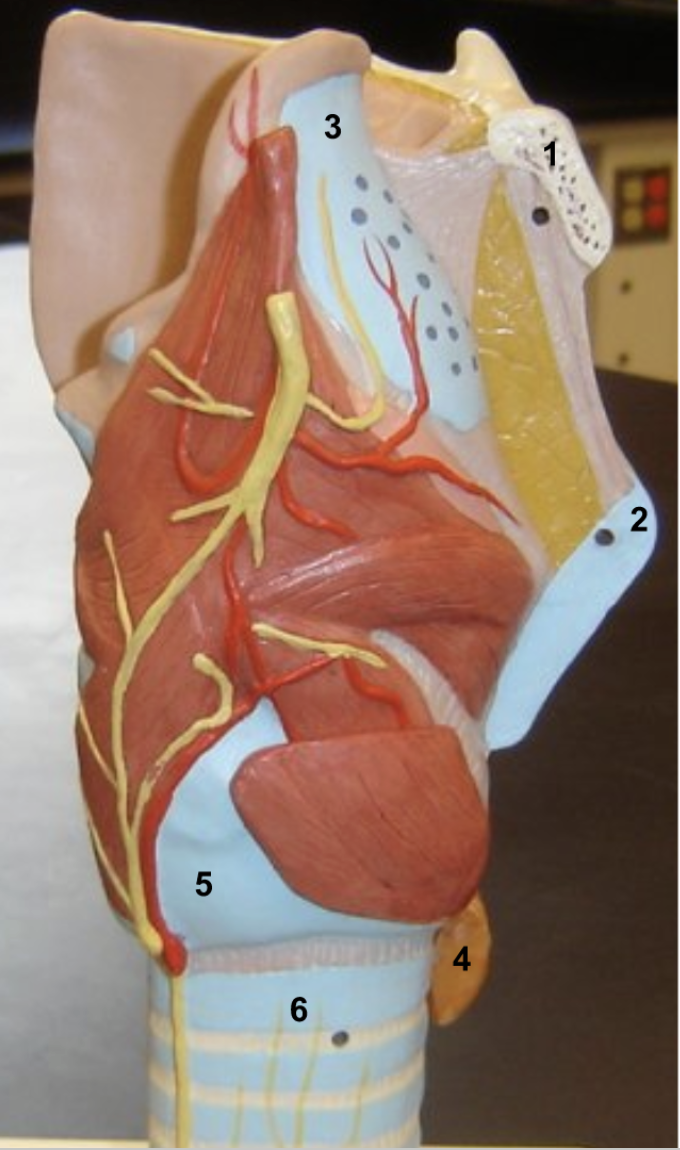
<p>Identify</p>

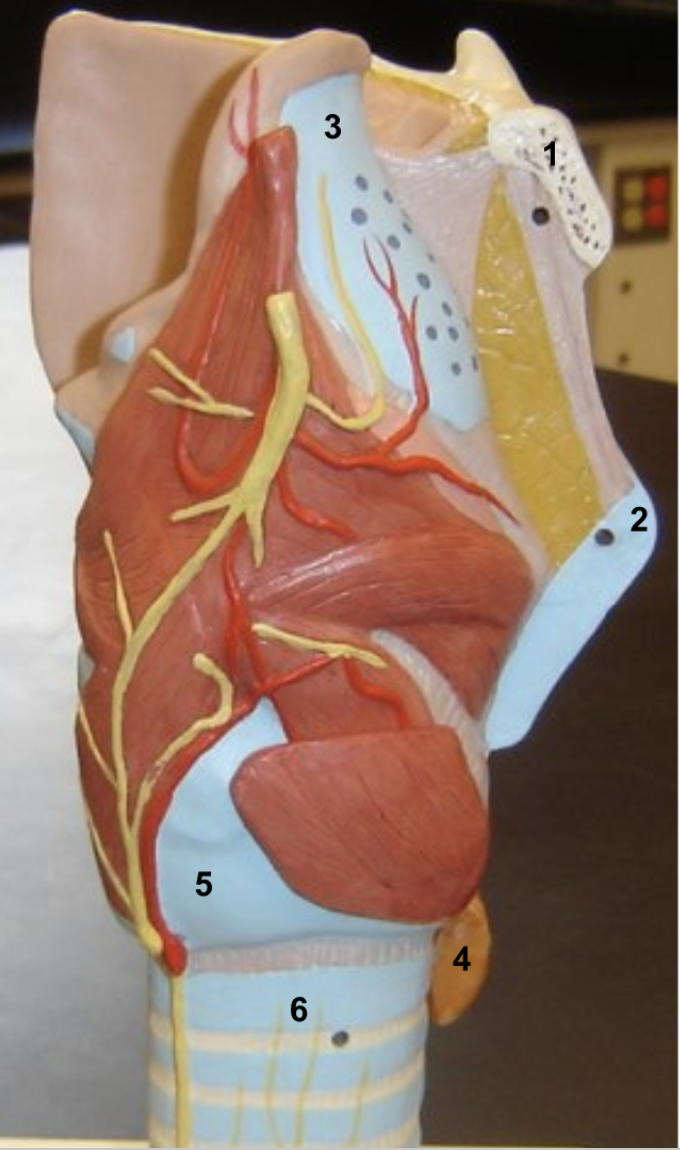
Identify

  1. Hyoid bone

  2. Thyroid cartilage (notice the Laryngeal prominence)

  3. Epiglottis

  4. Thyroid gland

  5. Cricoid cartilage

  6. Trachea

<ol><li><p>Hyoid bone</p></li><li><p>Thyroid cartilage (notice the Laryngeal prominence)</p></li><li><p>Epiglottis</p></li><li><p>Thyroid gland</p></li><li><p>Cricoid cartilage</p></li><li><p>Trachea</p></li></ol><p></p>
19
New cards
<p>Identify</p>

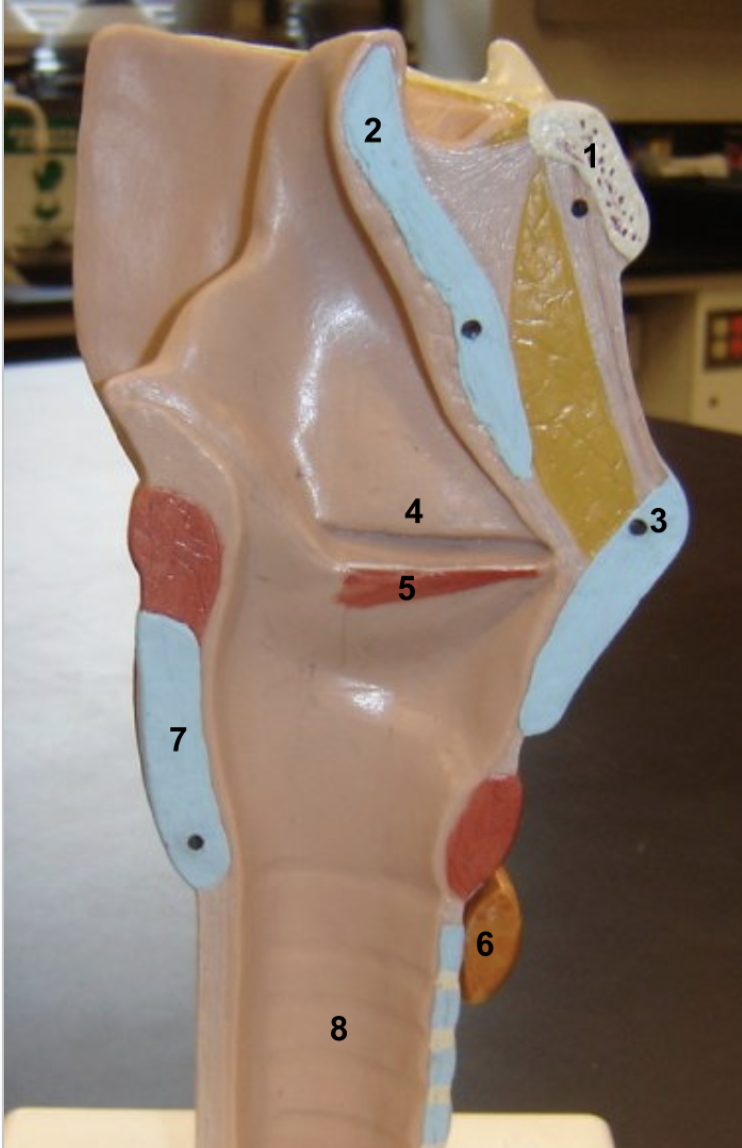
Identify

  1. Hyoid bone

  2. Epiglottis

  3. Thyroid cartilage (laryngeal prominence)

  4. False vocal cord (Vestibular fold)

  5. True vocal cord (vocal fold)

  6. Thyroid gland

  7. Cricoid cartilage

  8. Trachea

<ol><li><p>Hyoid bone</p></li><li><p>Epiglottis</p></li><li><p>Thyroid cartilage (laryngeal prominence) </p></li><li><p>False vocal cord (Vestibular fold) </p></li><li><p>True vocal cord (vocal fold)</p></li><li><p>Thyroid gland</p></li><li><p>Cricoid cartilage</p></li><li><p>Trachea</p></li></ol><p></p>
20
New cards
<p>Identify</p>

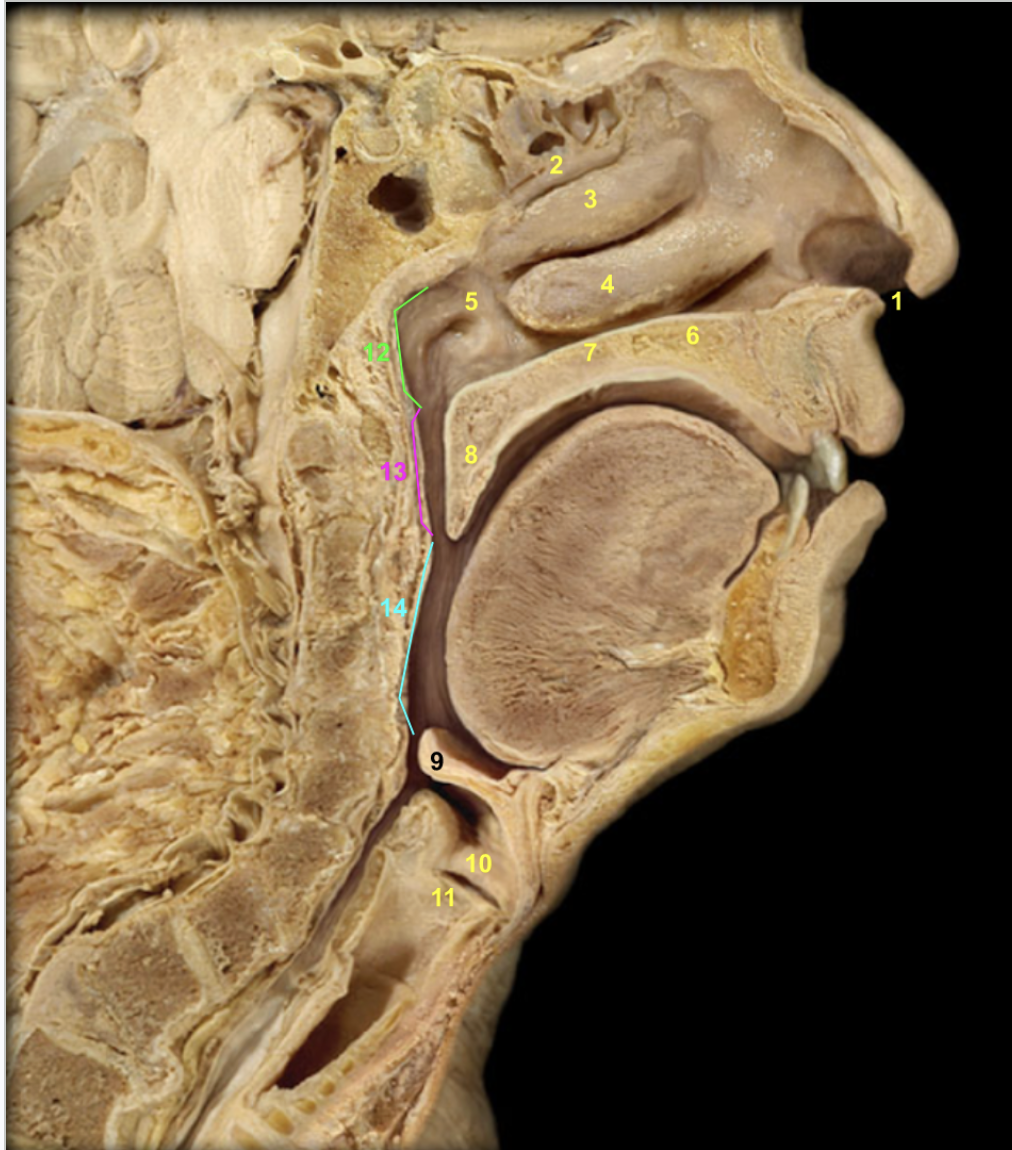
Identify

  1. Naris

  2. Superior nasal concha of the ethmoid bone

  3. Middle nasal concha of the ethmoid bone

  4. Inferior nasal concha

  5. Opening to the auditory tube

  6. Palatine process of the maxillary bone

  7. Horizontal plate of the palatine bone

  8. Uvula

  9. Epiglottis

  10. False vocal chord/Vestibular fold

  11. True vocal chord/Vocal fold

  1. Nasopharynx

  2. Oropharynx

  3. Laryngopharynx

21
New cards
<p>Identify</p>

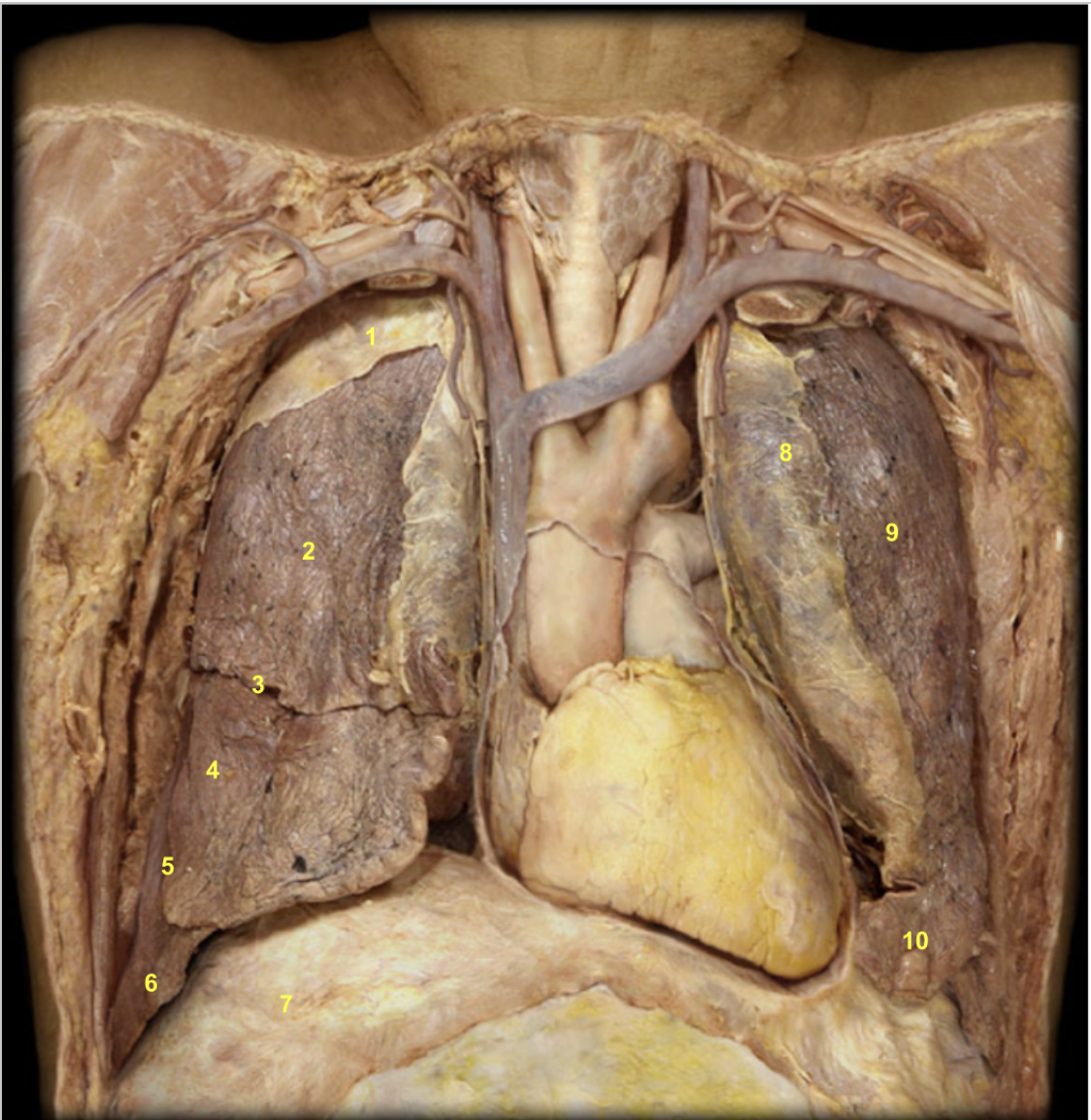
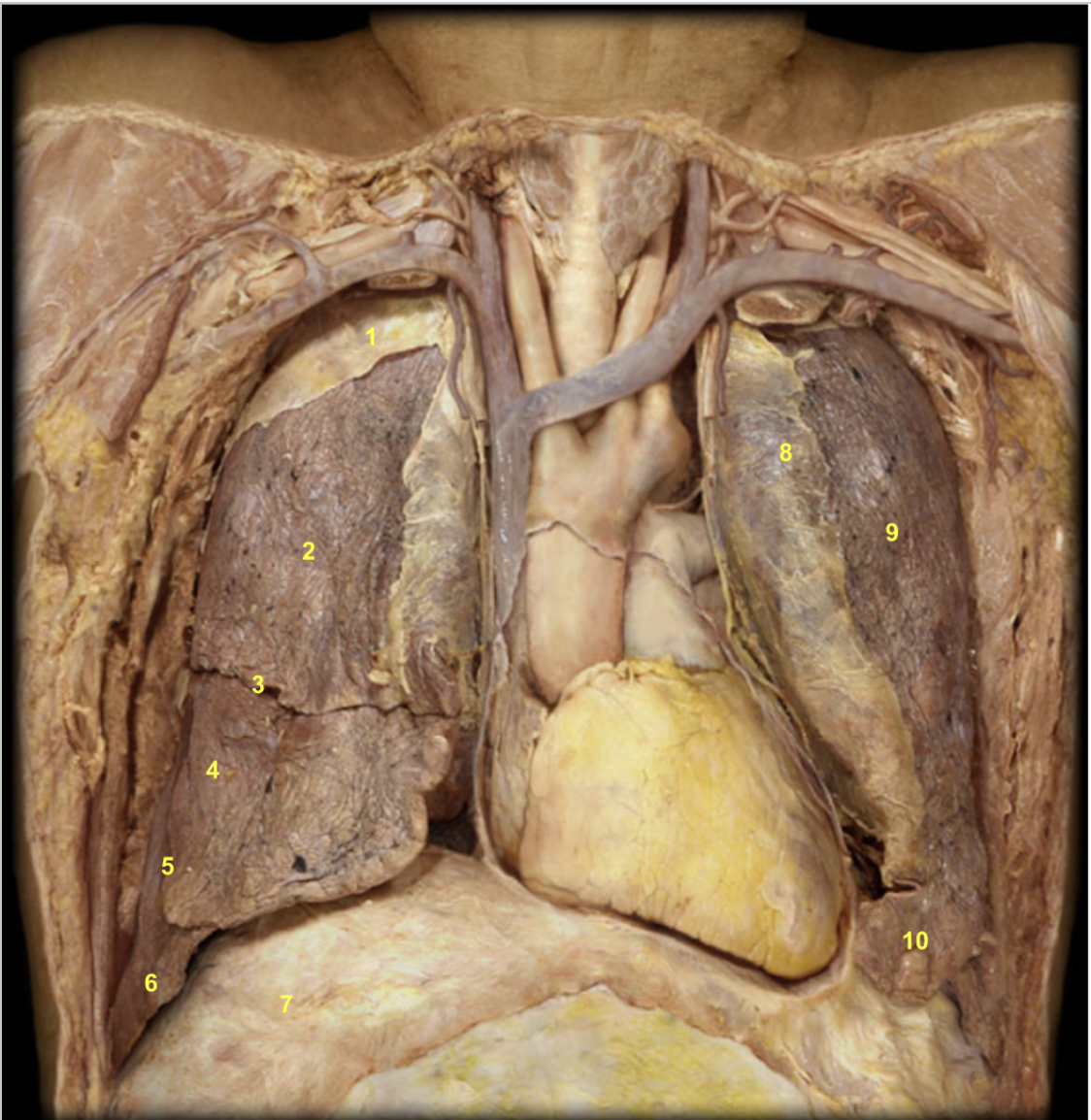
Identify

  1. Parietal pleura of right lung

  2. Superior lobe of right lung

  3. Horizontal fissure of right lung

  4. Middle lobe of right lung

  5. Oblique fissure of right lung

  6. Inferior lobe of right lung

  7. Diaphragm

  8. Parietal pleura of left lung

  9. Superior lobe of left lung (covered by visceral pleura)

  10. Inferior lobe of left lung

<p></p><ol><li><p>Parietal pleura of right lung</p></li><li><p>Superior lobe of right lung</p></li><li><p>Horizontal fissure of right lung</p></li><li><p>Middle lobe of right lung</p></li><li><p>Oblique fissure of right lung</p></li><li><p>Inferior lobe of right lung</p></li><li><p>Diaphragm</p></li><li><p>Parietal pleura of left lung</p></li><li><p>Superior lobe of left lung (covered by visceral pleura)</p></li><li><p>Inferior lobe of left lung</p></li></ol><p></p>
22
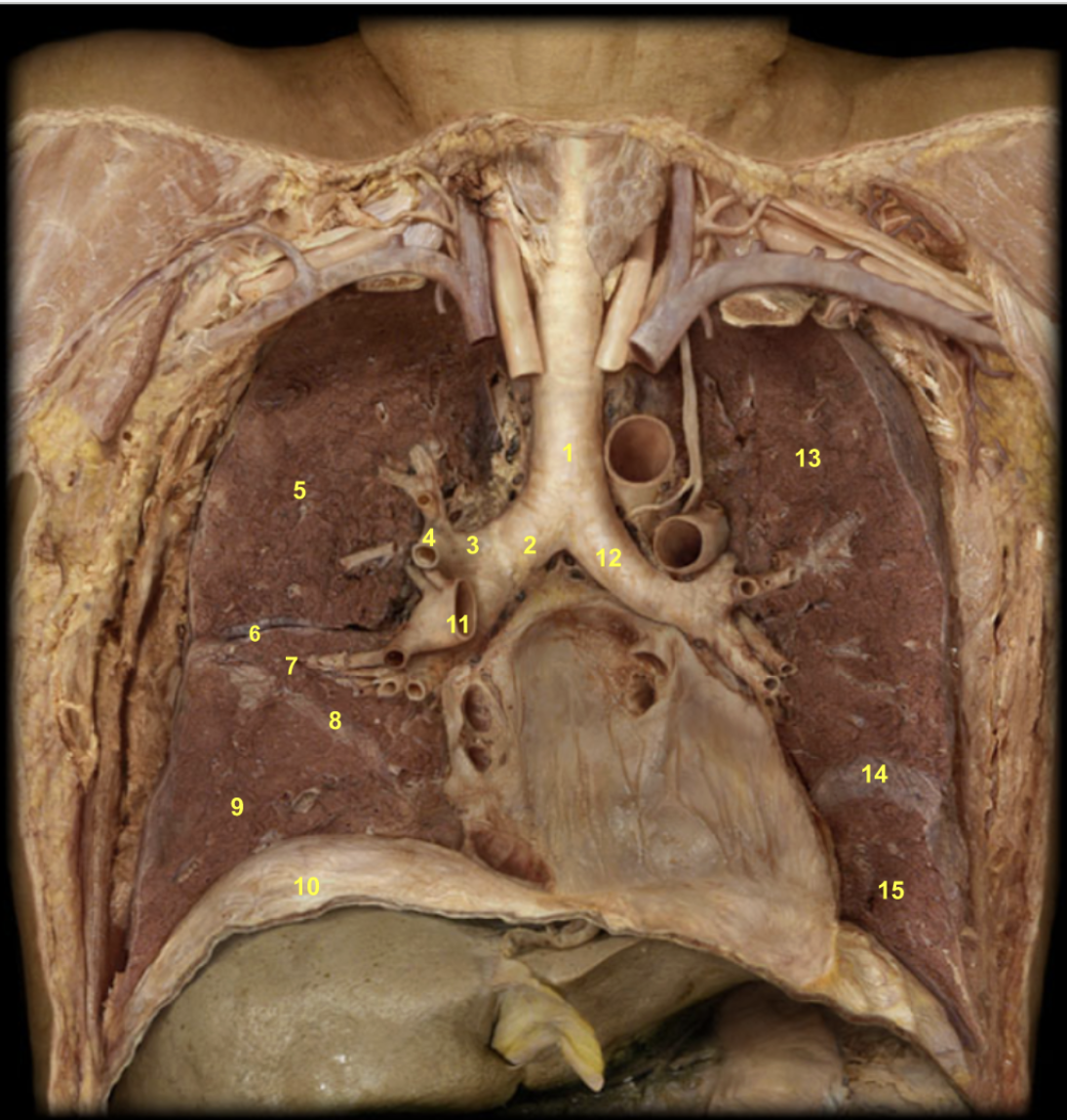
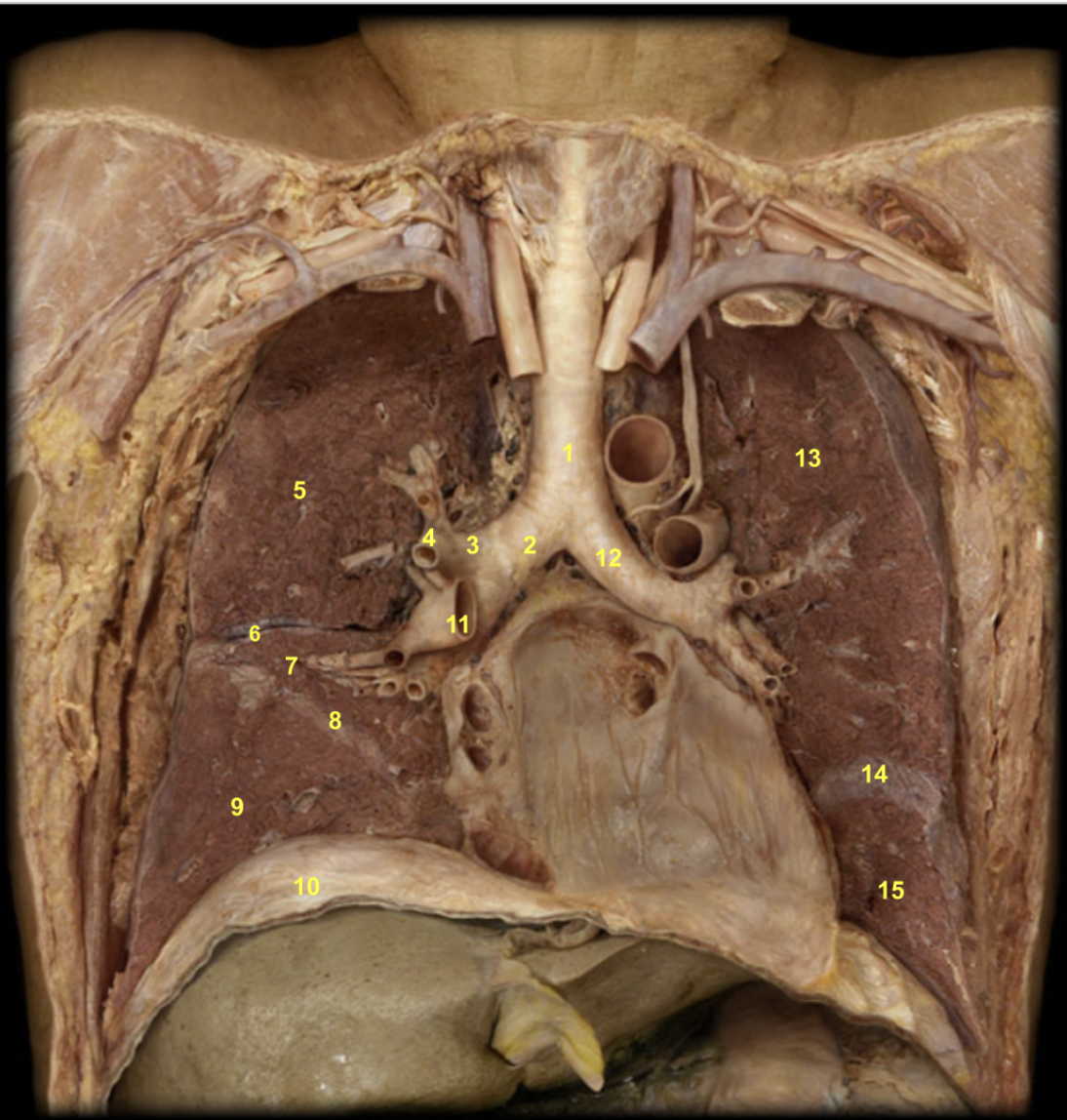
New cards
<p>Identify</p>

Identify

  1. Trachea

  2. Right main bronchus

  3. Right lobar bronchus

  4. Right segmental bronchus

  5. Superior lobe of right lung

  6. Horizontal fissure of right lung

  7. Middle lobe of right lung

  8. Oblique fissure of right lung

  9. Inferior lobe of right lung

  10. Diaphragm

  11. Right pulmonary artery

  12. Left main bronchus

  13. Superior lobe of left lung

  14. Oblique fissure of left lung

  15. Inferior lobe of left lung

<ol><li><p>Trachea</p></li><li><p>Right main bronchus</p></li><li><p>Right lobar bronchus</p></li><li><p>Right segmental bronchus</p></li><li><p>Superior lobe of right lung</p></li><li><p>Horizontal fissure of right lung</p></li><li><p>Middle lobe of right lung</p></li><li><p>Oblique fissure of right lung</p></li><li><p>Inferior lobe of right lung</p></li><li><p>Diaphragm</p></li><li><p>Right pulmonary artery</p></li><li><p>Left main bronchus</p></li><li><p>Superior lobe of left lung</p></li><li><p>Oblique fissure of left lung</p></li><li><p>Inferior lobe of left lung</p></li></ol><p></p>
23
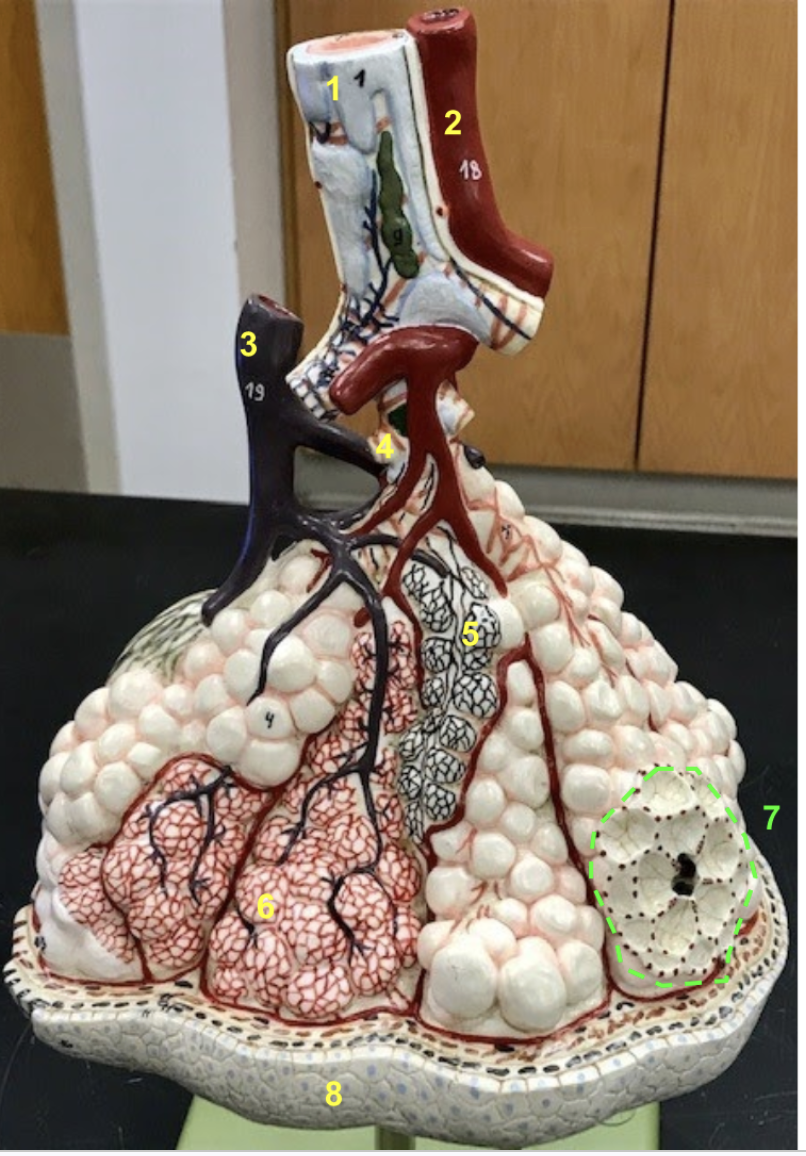
New cards
<p>Identify. Relation between 5 &amp; 6. Function of 5. </p>

Identify. Relation between 5 & 6. Function of 5.

Remember in the lungs, the colors are switched for arteries and veins.

  1. Small bronchus

  2. Pulmonary vein

  3. Pulmonary artery branch

  4. Terminal bronchiole (the last airway structure w/o alveoli)

  5. Alveoli (notice how it is encased by elastic fibers in an alveolar duct)

  6. Pulmonary capillaries (notice how they sit on top of the alveoli)

  7. Alveolar sac (cluster of alveoli).

  8. Visceral pleura

- Alveoli is the site of diffusion. Gas exchange occurs between alveolar air and pulmonary capillary blood.
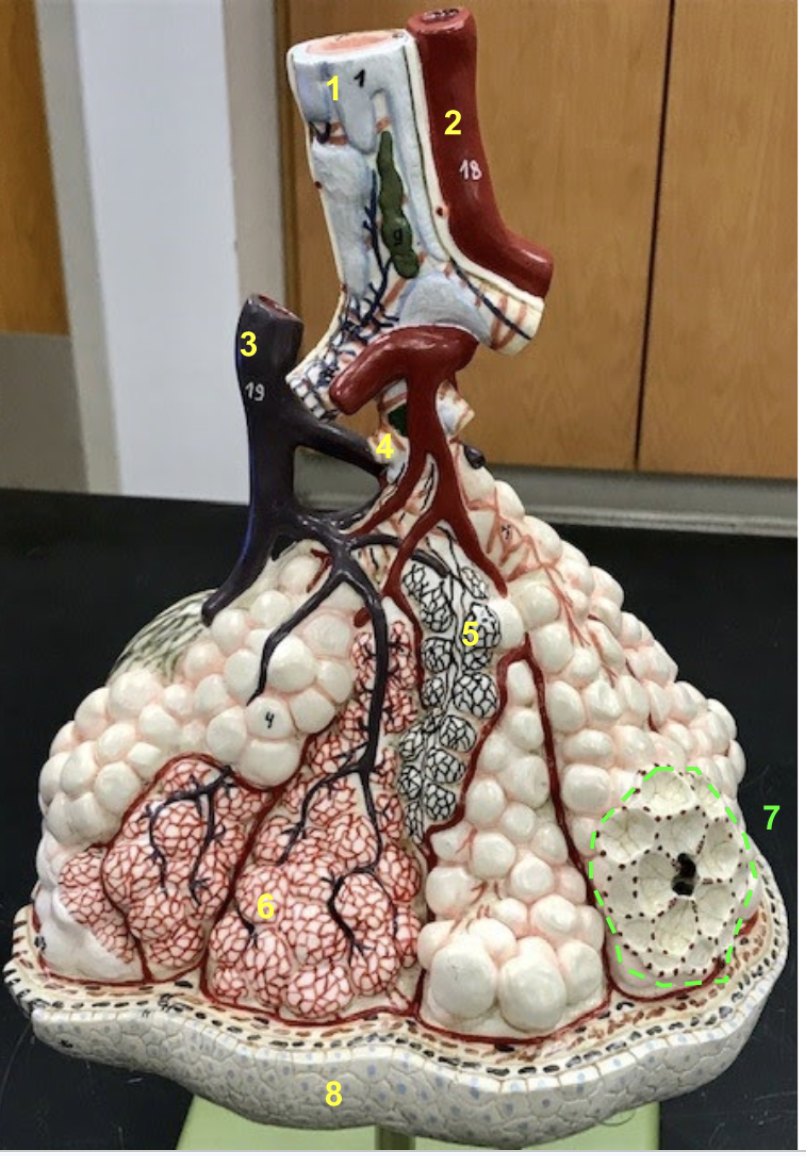
<p>Remember in the lungs, the colors are switched for arteries and veins.</p><ol><li><p>Small bronchus</p></li><li><p>Pulmonary vein</p></li><li><p>Pulmonary artery branch</p></li><li><p>Terminal bronchiole (the last airway structure w/o alveoli)</p></li><li><p>Alveoli (notice how it is encased by elastic fibers in an alveolar duct)</p></li><li><p>Pulmonary capillaries (notice how they sit on top of the alveoli)</p></li><li><p>Alveolar sac (cluster of alveoli).</p></li><li><p>Visceral pleura</p></li></ol><p>- Alveoli is the site of diffusion. Gas exchange occurs between alveolar air and pulmonary capillary blood.</p><p></p>
24
New cards
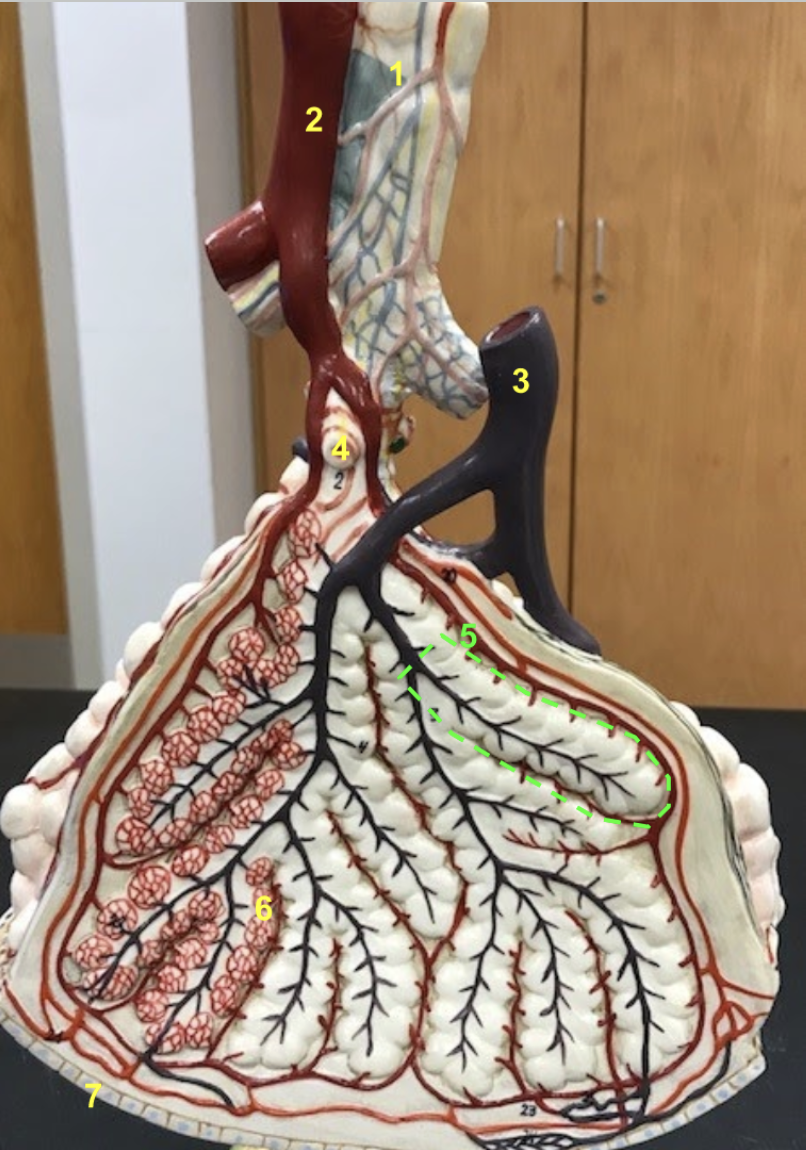
<p>Identify</p>

Identify

1. Intrapulmonary bronchus

2. Pulmonary vein branch

3. Pulmonary artery branch

4. Terminal bronchiole

5. Alveolar duct

6. Alveolus with pulmonary capillaries

7. Visceral pleura
<p></p><p>1. Intrapulmonary bronchus</p><p>2. Pulmonary vein branch</p><p>3. Pulmonary artery branch</p><p>4. Terminal bronchiole</p><p>5. Alveolar duct</p><p>6. Alveolus with pulmonary capillaries</p><p>7. Visceral pleura</p>
25
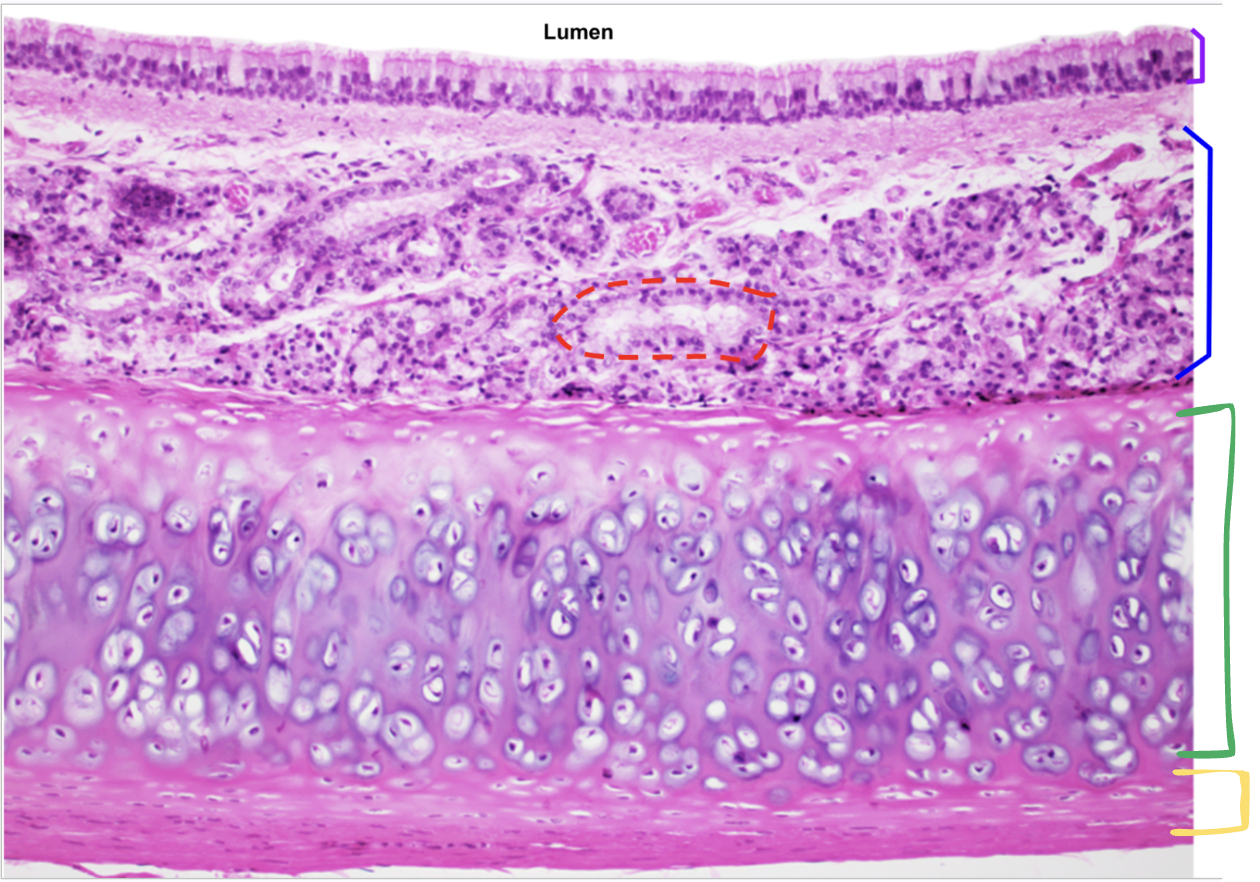
New cards
<p>This image represents what organ? Identify each label</p><p>Function of green and yellow?</p>

This image represents what organ? Identify each label

Function of green and yellow?

What is the

Red: Seromucous glands

Purple: Mucosa (made of Pseudostratified ciliated columnar epithelium with goblet cells)

Blue: Submucosa (contains various things like nerves, arteries, veins, glands, etc)

Green: Cartilage - strengthens the trachea and keeps it open.

Yellow: Adventitia. The adventitia is sticky which keeps the trachea in place and allows it to stick to neighboring structures.
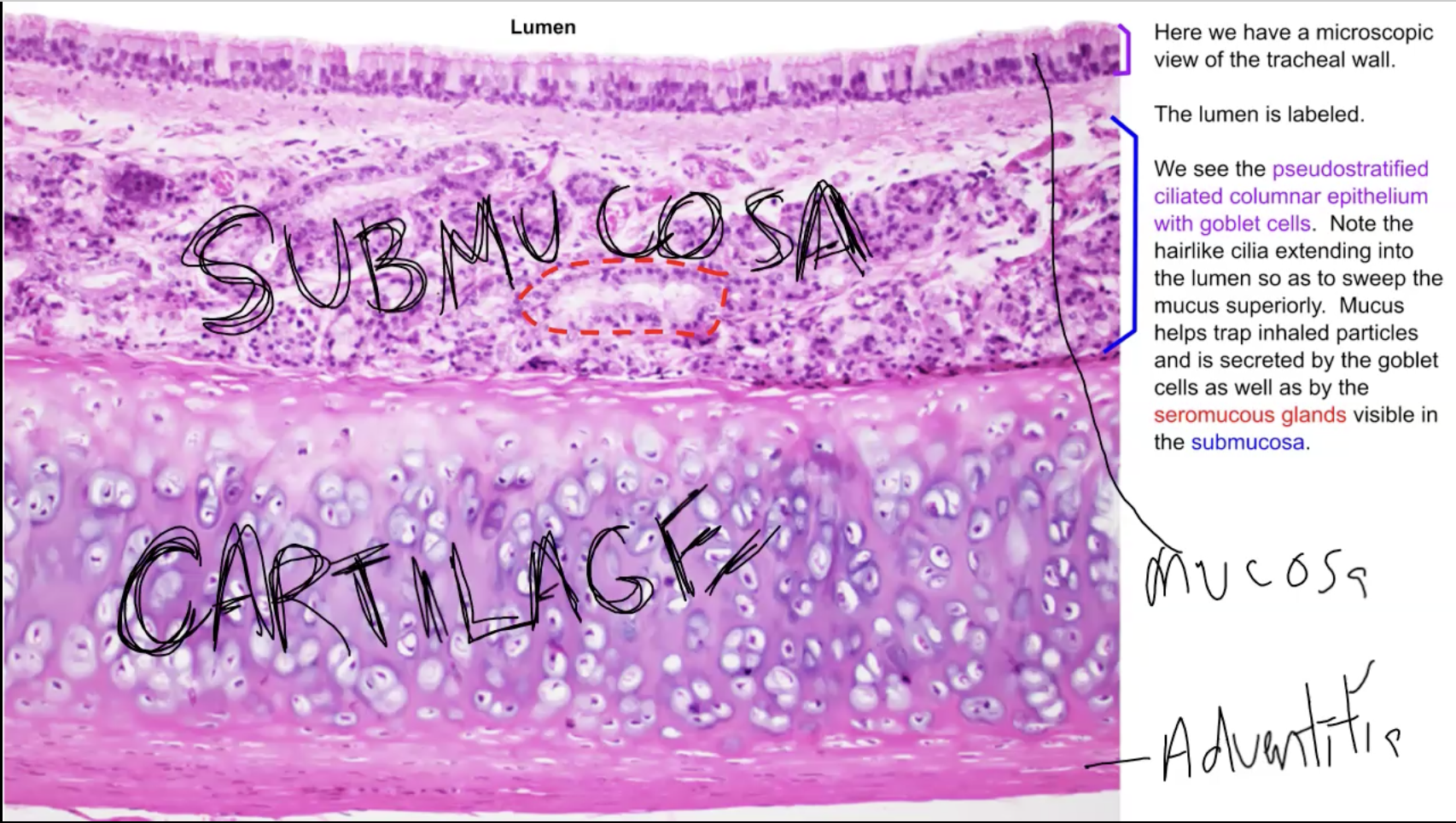
<p>What is the</p><p>Red: Seromucous glands</p><p>Purple: Mucosa (made of Pseudostratified ciliated columnar epithelium with goblet cells)</p><p>Blue: Submucosa (contains various things like nerves, arteries, veins, glands, etc)</p><p>Green: Cartilage - strengthens the trachea and keeps it open.</p><p>Yellow: Adventitia. The adventitia is sticky which keeps the trachea in place and allows it to stick to neighboring structures.</p><p></p>
26
New cards
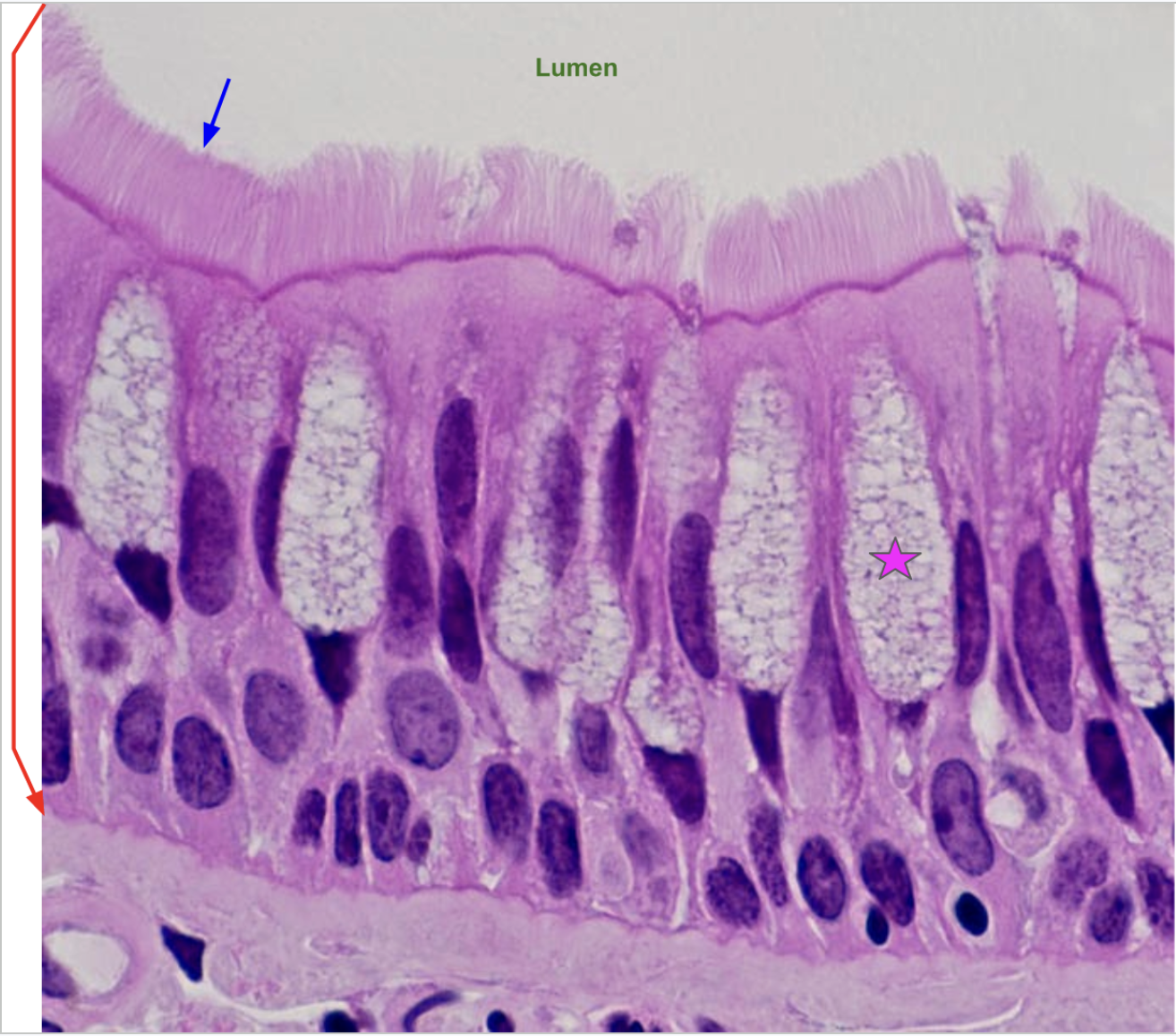
<p>What is this image? Identify labels. Function of star?</p>

What is this image? Identify labels. Function of star?

The mucosa of the trachea

Red: Pseudostratified ciliated columnar epithelium.

Blue: Cilia

Star: Goblet cells - make mucus
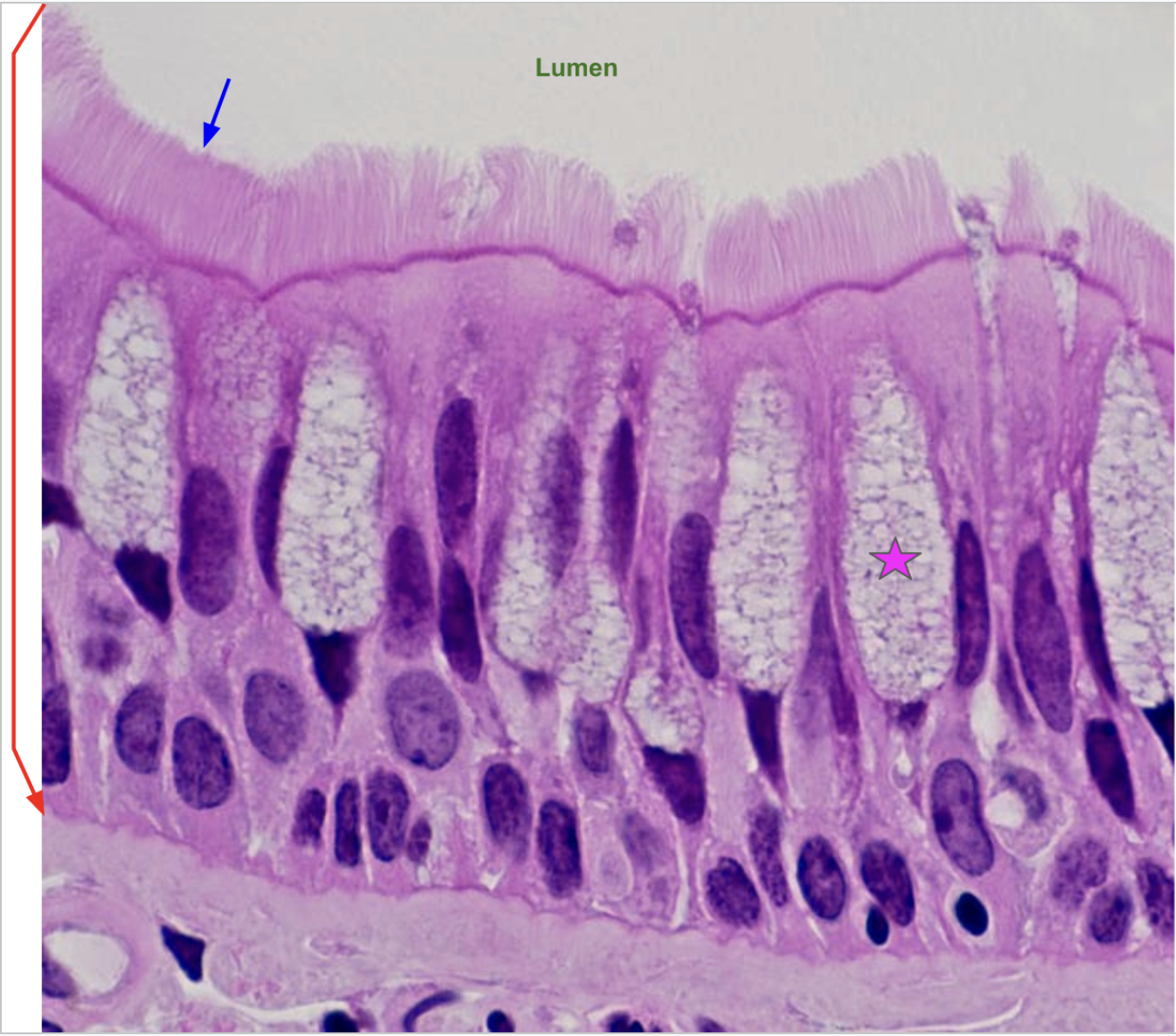
<p>The mucosa of the trachea</p><p>Red: Pseudostratified ciliated columnar epithelium.</p><p>Blue: Cilia</p><p>Star: Goblet cells - make mucus</p>
27
New cards
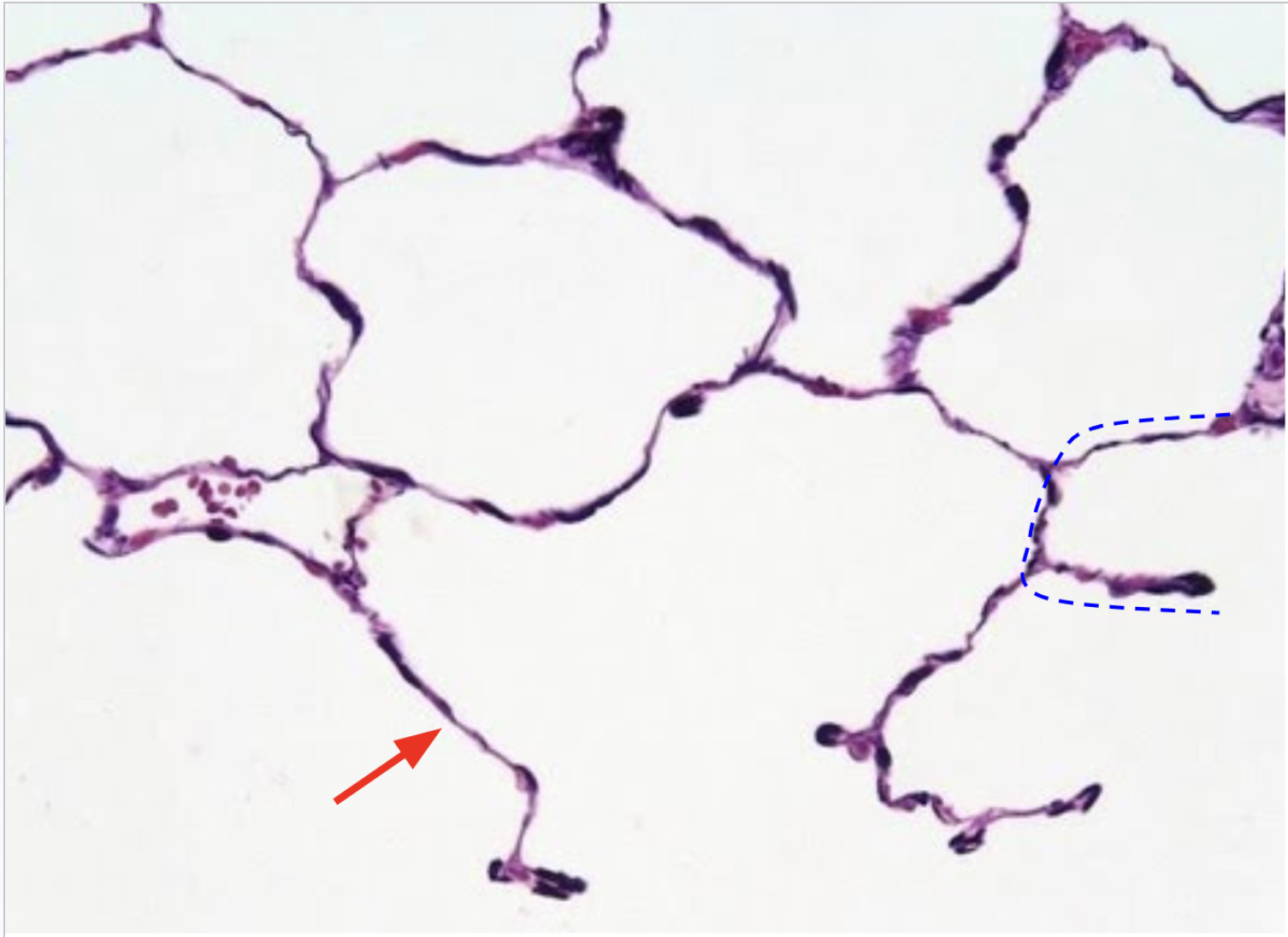
<p>This image depicts what? Identify labels. Function?</p>

This image depicts what? Identify labels. Function?

Aveoli in the lungs

Red: Simple squamous epithelium

Blue: Aveolus - function is diffusion
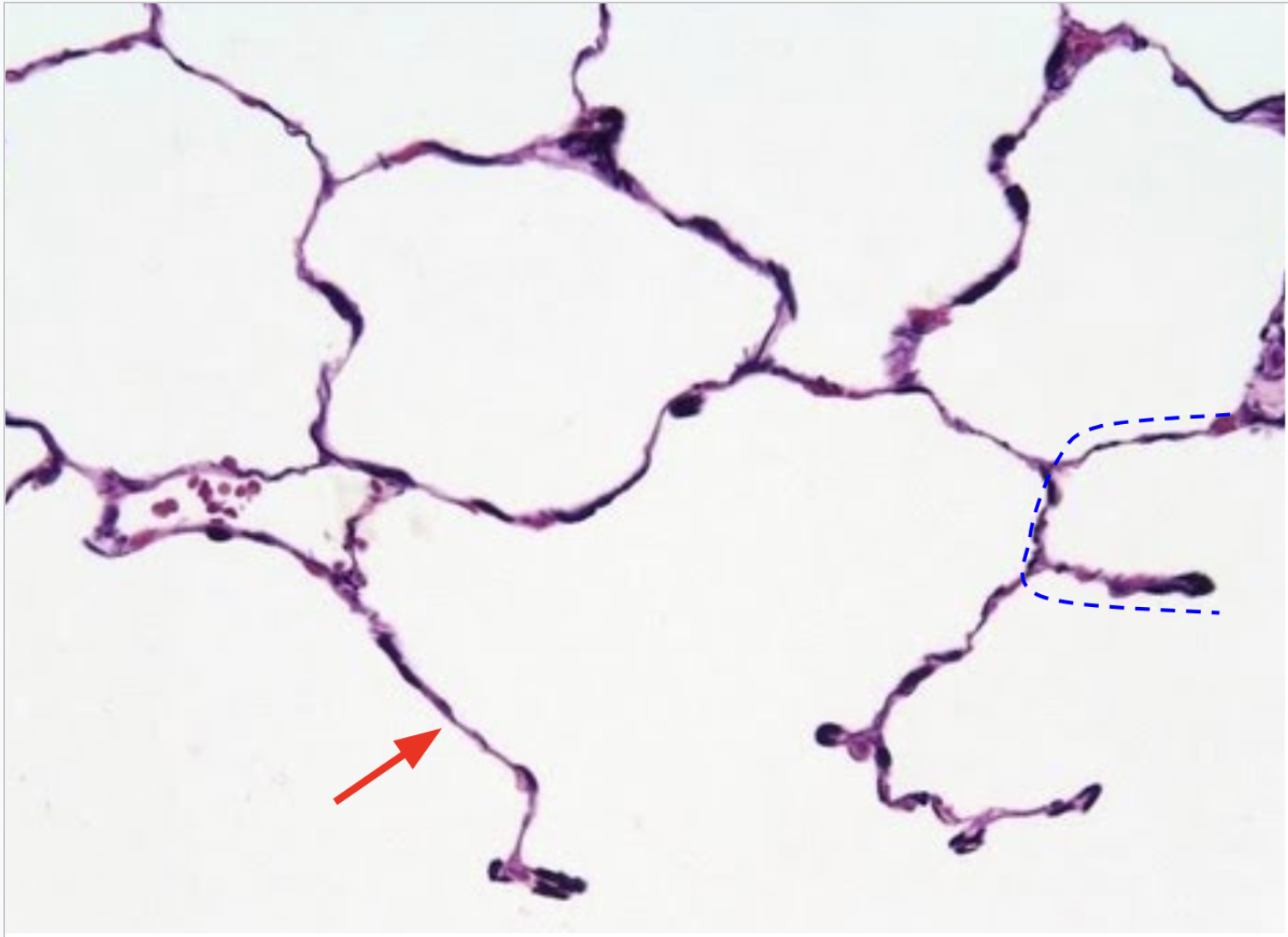
<p>Aveoli in the lungs</p><p>Red: Simple squamous epithelium</p><p>Blue: Aveolus - function is diffusion</p><p></p>
28
New cards

Smoking can cause an increase in mucus production and a decrease in cilia function. Explain why this combination can be so detrimental to one’s health?

Without cilia, it becomes difficult to move the excess mucus superiorly to the pharynx where it can be swallowed. Pathogens can build up in the mucus and chronic infections may result.

29
New cards

Why is the epithelium lining the nasopharynx different from the epithelium that lines the oropharynx and laryngopharynx?

Bc the nasopharynx is not a passageway for food/drink and thus lacks the need for the protection provided by the stratified squamous epithelium.

  • Nasopharynx – pseudostratified ciliated columnar epithelium (only one layer, respiratory epithelium)

  • Oropharynx & Laryngopharynx – stratified squamous epithelium (several layers)

30
New cards

What two structures are involved in routing food and liquid away from the respiratory passages?

Soft palate/uvula and the epiglottis

31
New cards

If an individual was born with O-shaped tracheal cartilage, what activity would be difficult?

Swallowing because the esophagus would be unable to expand anteriorly when eating large food.

32
New cards

Lois has an obstruction of her right main bronchus. How would this affect the carbon dioxide levels in her right pulmonary veins?

It would increase. This is bc less oxygen will be able to reach the blood in that lung, so more CO2 will buildup.

Explore top notes

note
Color Theory
Updated 1285d ago
0.0(0)
note
QNX (RWB GUIDE)
Updated 1362d ago
0.0(0)
note
Verbal Forms
Updated 678d ago
0.0(0)
note
States and Institutions
Updated 1217d ago
0.0(0)
note
Color Theory
Updated 1285d ago
0.0(0)
note
QNX (RWB GUIDE)
Updated 1362d ago
0.0(0)
note
Verbal Forms
Updated 678d ago
0.0(0)
note
States and Institutions
Updated 1217d ago
0.0(0)

Explore top flashcards