5) Innovation and Design
 Call Kai
 Learn
Learn Practice Test
 Spaced Repetition
 Match
Match Flashcards
 Knowt Play
1/78

There's no tags or description
Looks like no tags are added yet.
Name | Mastery | Learn | Test | Matching | Spaced | Call with Kai |
|---|
No analytics yet
Send a link to your students to track their progress
79 Terms
product life cycle
a description of the presence or behaviours of a product in the market place over time
key stages of the product life cycle
launch
growth
maturity
decline
planned obsolescence (built in)
a policy of planning/designing a prdocut with an artificially limited useful life
style/fashion obsolescence
designers alter product aesthetics to reduce appeal of older styles and encourage more frequent purchases
functional obsolescence
reduction in the usefullness or desirability of an object
tech obsolescence
is a form of function obsolescence: due to rapid tech advancements
predictability
the ability to anticipate when a product will become outdated, especially in fast moving tech industries, based on regular patterns of innovation and product replacement
unpredictability
the difficulty manufacturers face in accurately forecasting a products life span due to uncertain consumer demand, especially during the development phase
product versioning
the practice of offering multiple models of the same product at different price points to appeal to varrying customer preferences and percieved value
target market
the sectors and segments
target audience
a specific group of people within the target market
market analysis
evaluates the economic viability of a proposed design by addressign potential users, market demand and associated costs
economic viability
an activities ability to sustain itself financially over time
fixed costs
remain constant regardless of output
variable costs
fluctuate with production volume
user needs
ivolves identifying essential product requirements to meet market expectations and consumer demands
Moslows hierarchy of needs
a motivational psychology theory
list of Moslows hierarchy of needs
psychological needs
safety needs
love and belonging
esteem
self actualisation
inventor
a lone inventor is an individual, often isolated, who is dedicated to creating a novel product that challenges the status quo
product champion
an individual usually working within an organisation who develops enthusiasm for a particular idea and ‘‘champions’’ (influences) it within the organisation
entrepeneur
one who can take an invention to market, often by financing the development, production and diffusion of a product into the market place
act of insight
a sudden image of a potential solution being formed in the mind (usually after a long period of time)
adaptation
applying an exiting technology or solution form one field to create a new product or solve a problem in another.
consumer pull
when a new idea is needed as a result of demand from the market place and designers often produce ideas for products in response to market forces.
tech push
when scientific research and tech advances, they drive the development or redesign of products, often due to new materials, processes, or manufacturing methods.
transfer
where a tech, manufacturing process or material is transferred to another field to provide the bass for an invention
chance
an unexpected discovery that leads to new ideas
diffusion
the process by which an innovation is communicated thorugh certain channels overtime among the participants in a social system
4 elements of diffusion
innovation
communication channels
time
social system
innovation (element of diffusion)
new product
communication channels (element of diffusion)
how message spreads
time (element of diffusion)
speed of adoption of the innovation
social system (element of diffusion)
interrelated stakeholders that are enagged in the process.
social roots of consumerism
lie in the ideology that promotes the continual acquistion of goods and services, often beyond basic needs as a marker of social and economic value
influence of social media on diffusion of innovation
enables consumers to raise brand awareness, rally for support or opposition and promote new products through platform
Rogers 5 characteristcs
relative advantage
compatibility
complexity
obersvability
trialability
Rogers 5: relative advantage
how imposed an innovation is comapred to previous generations
Rogers 5: compatibility advantage
how compatible is the innovation with an individual life
Rogers 5: complexity
if the innovation is difficult to use, one is less likely to adapt to it
Rogers 5: observability
the extent of the innovation being visible to others.
Rogers 5: trialability
to what extnet can innovation be explored
invention
discovering a principle and the process of discovery (a technical advance leading to a novel product
invention (definition)
the creation of new onjects, ideas, or systems usefull im achieving certain objectives.
inventors resposibility
to have an idea and put it into practice
drivers for invention
desire to make money or help others
scientific or technical curiosity
personla interest
motivation
creativity
constructive dicontent
lone inventor - ‘creative champion’
an individual who is so commited to the invention of a novel product, they often become isolated because they are so obsessed.
Intellectual property (IP)
the legallly recognised exclusive rights to creations of the mind
copyright
trademarks
patents
patent pending
signals a field patent and warns the potential copiers of future legal and financial consequences
trademarks (TM) and service mark (SM)
distinguishes products and services from other providers
copyright ‘C’
gives creator control over how their original work is used and stored, so they can earn from it
registered trademark ‘R’
shows the source of goods or services and gives the owner exlusive legal rights to use it
shelved tech: cost effectiveness
shows that the technology exists but isnt used until its affordable for consumers, often delayed to protect patents or due to high production costs
shelved tech: social reasons
can delay technology adoption due to market resitance, safety concerns or cultural and religious beliefs
shelved tech: technological factors
delays products when the core science exists but the ‘tech’ isnt advanced enough for practical use
shelved tech: timing or strategic release
strategically releasing products to avoid market confusion and maximise success
innovation
the act or business of putting an invention in the marketplace and making it a success (they should make a difference)
innovations fail reasons
marketability
financial support
marketing
needs
price
resistance to chnage
risk
kick starters and other crowdsourcing platforms
raise funds online from many people to support a project, product or service.
sustaining innovation
a company improving their already existing product to further generations till it reaches the end of its life-cycle
innovation: feature additions or fixes
new generations of product could seem more progressed due to feature fixes/additions, similar to apply iphones (camera)
innovation: cost reductions
as product scales grwo, raw materials costs decline, and design improvements simplify production or allow for cheaper materials
innovation: product line expansions
offering different (adittional) sizes, colors, etc.
disruptive innovation
simple, low cost products that transform markets by displacing existing solutions and attracting ppreviously overlooked cusotmers
process innovation
the implementation of a new or signficantly improved production or delivery method: including changes in technqiues, software or/and equiptment
architectural innovation
modifies the structure or configuration of a product by reordering existing components without altering the core technologies
modular innnovation
maintain the architecture but modify the modules software
configural innovation
change is made in technology and organisation.
involves assembling predefined components in allowed ways to meet specific requirements and constraints through selection, alocation and interfacing.
Innovation diagram
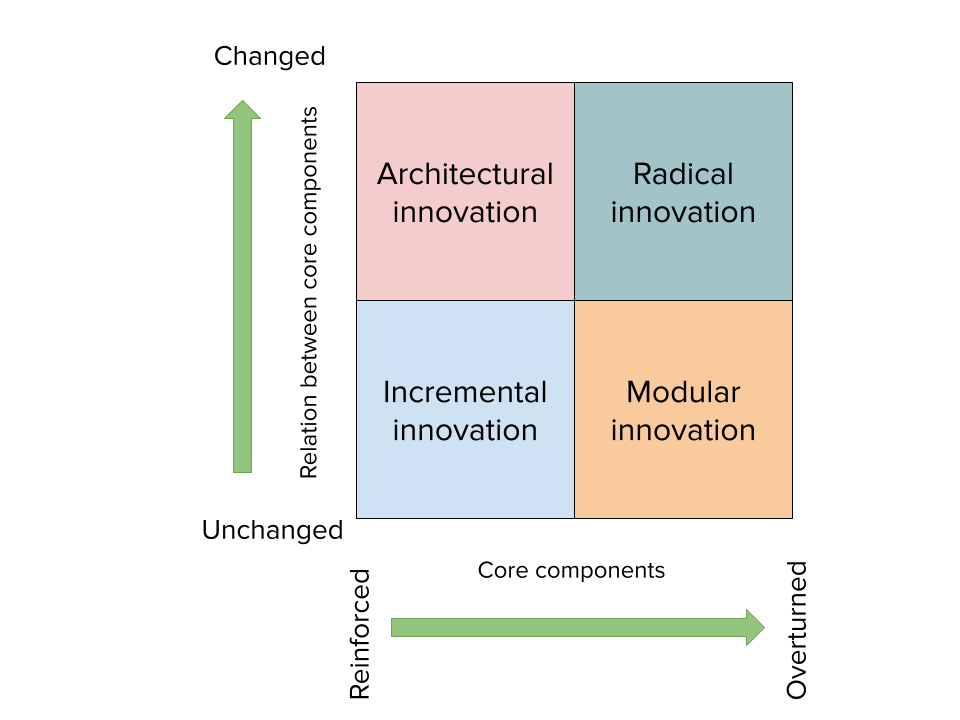
diffusion of innovation
a theory to explain how, why and at waht rate new ideas and technoloy spread through cultures
Rogers 5 stages of diffusion
knowledge = awareness
persuasion = interest
decision = evaluation
implementation = trial
confirmation = adoption
suppression
the delayed adoption of an innovation due to factors like patent disputes, resistance from established players and institutional inertia that protect existing technologies and slow disruptive change
SWOT Analysis
A strategic planning framework: Strengths (internal advantages), Weaknesses (internal disadvantages), Opportunities (external favourable factors), Threats (external unfavourable factors). Used to evaluate a product, company, or design concept in its market context. Strengths and weaknesses are internal; opportunities and threats are external.
PEST / PESTLE Analysis
A framework for analysing the macro-environmental factors affecting a design or business: Political, Economic, Social, Technological, Legal, Environmental. Used to identify external forces that could influence product development, market entry, or design decisions. PESTLE adds Legal and Environmental to the original PEST model.
BCG Matrix (Product Portfolio Analysis)
A framework for analysing a company's product portfolio: Stars (high market share, high growth — invest), Cash Cows (high share, low growth — exploit), Question Marks (low share, high growth — decide), Dogs (low share, low growth — divest). Helps companies allocate resources across products based on market performance.
The Design Process Stages
Brief → Research → Specification → Ideation → Development → Testing → Evaluation. Brief: client outlines the problem. Research: investigate user needs, context, existing solutions. Specification: define measurable criteria the design must meet. Ideation: generate multiple concepts. Development: refine chosen concept. Testing: verify against specification. Evaluation: assess success and identify improvements. The process is iterative not strictly linear.
Design Brief vs Design Specification — The Distinction
Design brief: a broad statement from the client describing the problem to be solved, the target user, and general requirements — qualitative and open-ended.
Design specification: a detailed, measurable list of criteria the final design must meet — function, size, materials, cost, safety, ergonomics. The brief is the starting point; the specification is the testable standard against which the final design is evaluated.
Stakeholder Analysis
The process of identifying all individuals and groups who have an interest in or are affected by a design — users, clients, manufacturers, retailers, regulators, communities, the environment. Analysing their needs, influence, and potential conflicts allows designers to balance competing requirements and manage expectations throughout the design process.
Push vs Pull Marketing
Push marketing: the manufacturer pushes products toward consumers through advertising, promotion, and retailer incentives — creating demand. Pull marketing: consumer demand pulls products through the supply chain — manufacturers respond to expressed needs. In design: technology push creates products from new technology then finds a market; market pull designs products in direct response to identified consumer needs.
Open-Source Design
A design philosophy where product designs, plans, and specifications are made publicly available for anyone to use, modify, and distribute. Encourages collaborative development and rapid iteration. Examples: RepRap (open-source 3D printer), Arduino (open-source electronics platform). Challenges include quality control, intellectual property, and commercial viability.
Explore top notes

Explore top flashcards
