UCSD - PSYC 3 Final
 Studied by 0 people
 Call Kai
 Learn
Learn Practice Test
 Spaced Repetition
 Match
Match Flashcards
 Knowt Play
1/52

There's no tags or description
Looks like no tags are added yet.
Name | Mastery | Learn | Test | Matching | Spaced | Call with Kai |
|---|
No analytics yet
Send a link to your students to track their progress
53 Terms
Aphasia
A condition in which language functions are severely impaired.
Expressive Aphasia
The inability to produce language (despite being able to understand language)
A person with expressive aphasia will exhibit effortful speech
Speech generally includes important content words, but leaves out function words that have only grammatical significance and not real-world meaning, such as prepositions and articles.
Semantic aspect of language is okay, but have trouble with syntax
TIP TO REMEMBER: The name was to do with what the person with this condition has a hard time doing
- Therefore, a patient with expressive aphasia has difficulty expressing him/herself with words
Receptive Aphasia
Inability to understand spoken or written words
Demonstrate fluent speech, which is characterized by typical speech rate, intact syntactic abilities, and effortless speech output
Produce a large amount of speech without much meaning
Syntax is okay, but semantic is compromised (hard time making sense themselves, and understanding meaning on the speech of others)
TIP TO REMEMBER: The name was to do with what the person with this condition has a hard time doing
Receptive aphasia patient has a hard time receiving messages properly
Word Frequency Effect
We respond more rapidly to high frequency words (ex: book, banana) than to low frequency words (ex: plunging, dwarf)
Lexicon
All the words you know
Rayner & Duffy (1986)
EXPERIMENT:
Participants were given list of sentences with high frequency words and sentences with low frequency words
RESULTS:
Significantly longer eye-fixation on low frequency words, than in high frequency words
- Takes longer to access the meaning of low frequency words
- Slower reading
CONCLUSION:
Personal past experiences with words, influences our ability to access their meaning
Demonstrates word frequency effect!!!
Instructional Approaches to building Vocabulary
Immersion: Place children in environment rich with words
Drawback --> You might learns words wrong, or might just not know what it means
Direct Instruction: Vocabulary test
Drawback --> So slow
Brabham et. Al (2002)
Reading aloud to kids
Group 1: Teacher reads story → Students learn 1 to 2 new words
Group 2: Teacher conducts discussions before and after story → Students learn 3 to 4 new words
Group 3: Interactive (discussion throughout the story) → Students learn 5 new words
Immersion works → Works even better with interaction and context
Parsing
Grouping of words into phrases
Garden Path Sequence
Way to study how people parse sentences
Sentence that misleads you
Seems to mean one thing in the beginning, but ends up meaning another → Temporary ambiguity
Ex: After the musician played the piano left stage
Seems like is going to be a sentence about the musician but is actually about the piano
Garden Path Model of Parsing
Sentences are parsed on rules of syntax first
Semantic factors can cause re-analysis at a later stage
Ex: The dog attentively reads Dr. Seuss's book
- Although the syntax is undoubtedly correct, this phrase has semantic conflicts --> Dogs don't read
Late closure
In parsing, when a person encounters a new word, the parser assumes that this word is part of the current phrase.
We try to keep the length of the phrase as long as possible by trying to make every new word that we read make sense within the meaning of the phrase we already constructed so far
EX:
After the musician played the piano left the stage
- we initially read it as "After the musician played the piano" because until then, it makes syntax sense
- Then we realize that it starts making no syntax sense after the word "piano" if we keep on adding the new words to the pre-existing phrase, so we divide the phrase into two
Constraint-based model of parsing
People use multiple facets of prior knowledge to make predictions about how a sentence should be parsed
Includes syntax, meaning, prior knowledge about sentence construction etc
EX: The spy saw the man with the binocular → Ambiguous sentence
The bird saw the man with the binocular → Not ambiguous anymore
- Meaning of words affects the ambiguity of sentences
- Takes longer to read sentence structures that are uncommon
Slip procedure (Motley & Baars, 1976)
Speech error elicitation technique
EX:
(Read silently): dead bug, dog bone, dust bell, doll bed
(Read aloud): barn door
Error --> Barn door, darn bore
Regularities in "Slip of The Tongue"
GRAMMATICALITY EFFECT:
Errors often occur within the same grammatical class
- We substitute the right noun, for a wrong noun, or a right verb for a right verb --> Never a noun for a verb
Ex of Error: I am stuttering psychology
I am studying psychology
CONSONANT-VOWEL RULE:
Errors often occur within a same phonological class
- We erroneously substitute vowels for vowels, or consonants for consonants --> Never a vowel for a consonant
EX of Error: Rule of rum
Rule of thumb
LEXICAL BIAS EFFECT:
Errors that include real words are more likely to occur than errors with non-words
EX: Nice dot instead of nice dog --> More likely to occur than --> Nice jot instead of nice dog
Speech Errors
Can help us infer what the building blocks in different stages of language production are
Language Production Model (Levelt, 1989)
Message: Conceptual information
Lexicon: Your mental dictionary
- Contains grammatical (gender, number etc) and word form information (phonological info)
Functional Processing: Role assignment
Positional Processing: Which slot is it going into in the sentence
Articulation: Actual output (speech)
Tip of The Tongue Phenomenon
The temporary inability to remember the name of something you know, accompanied by partial recall and a feeling that retrieval is imminent
Ex: Negocio de moer pimenta - famoso pilão
Structural Priming
Exposure to one structure increases the likelihood of production of that same structure again (even when there are simple alternatives) even when semantic content changes
EX: The boy gives a present to the girl
The teaches shows the map to the student
- Sentence frames can be planned independently of words
Self-Monitoring
- Speech errors are very rare
- Although our production system might be very accurate, there must be some monitoring mechanism that helps us detect and prevent errors before they occur
EVIDENCE:
TABOO CONDITION: We are much less likely to make a mistake that makes up a taboo word
- Indicates that we have at least some self-monitoring before articulation
Statistical Learning
- We start learning about speech sounds (prosody) even before birth
- Infants (7-month-olds) are able to extract abstract rules from limited input
DeCasper & Spence (1986)
- Evidence for Statistical Learning
Experiment:
Pregnant women read aloud a short story everyday for the
final 6 weeks of pregnancy.
Result:
- Babies preferred the story that they were exposed to in the womb (measured by the sucking on pacifier), even when the story is told by someone other than their mother.
Habituation Paradigms
- Babies attend to novel (new, unfamiliar) things
- Eventually, they get bored by repetition
- If they suddenly regain interest, they identified
something new has occurred
EX: ABA stimuli
ga ti ga
li na li
ga ti ga
li na li
(Baby is interested for a while, until it gets familiar and boring)
ba du ba
( Baby still uninterested because stimuli still follows a same, know, structure that already became boring)
wo fe fe
(Baby is interested again once now the stimuli is not ABA but ABB patterned)
Critical Period Hypothesis
Hypothesis --> Ability to acquire language is biologically linked to age (There is a critical period for the acquisition of language)
- There is an ideal period for language acquisition (first few years of life) and if language is not acquired during this period, it is basically impossible/extremely hard to be acquired at all
Evidence: Feral children (Ex: Children)
Resguardas:
Vocabulary, articulation and pragmatics --> Can be improved through practice regardless of age
Grammar --> Is what separates human language from animal communication --> Seems to be impossible to acquire after the critical period
Problem Solving
Cognitive processing aimed at achieving a goal when the solution is not immediately obvious
Types of Problem Solving (Gestalt Psychologists)
Reproductive Problem Solving: Using past strategies → Ex: Algebra problems (you follow a rule and it gets you to the solution)
Productive Problem Solving: No access to prior strategy → This is where insight occurs → Ex: Lily pad problem
Insight
When you move from not knowing the solution to a problem to, all of a sudden, knowing how to solve it
- Occurs by a processed called RESTRUCTURING
Restructuring
Process of changing how you understand, or mentally represent a problem
- Aids in the process of finding a solution
Behaviorists Approach on Insight Problem Solving
Insight problems are solved through trial and error's accidental success
Transfer and Problem solving
TRANSFER --> Ability to use prior knowledge to solve a new problem
2 types of transfer:
POSITIVE: When prior knowledge aids the process of finding a solution to the new problem
NEGATIVE: When prior knowledge makes the process of getting to a solution even harder
Functional Fixedness
The tendency to perceive the functions of objects as fixed → Mindbug that constricts our thinking
We tend to think of objects as only in terms of their normal, typical or "fixed" functions
Ex: We don't think about using a matchbox as a candleholder because matchboxes typically hold matches, not candles
Metcalfe et al (1986)
EXPERIMENT:
2 groups of participants:
- Group 1 is given insight problems
- Group 2 is given non-insight problems
Asked -> "How close are you to solving?" to both
RESULTS:
Non insight group (2) : Strong correlation between prediction and progress
Insight Group (1) : Weak correlation, non-gradual progress
CONCLUSION:
Solution to insight problems seems to occur suddenly
Luchins (1942)
Used the water jug problem to study the effect of mental sets on problem solving
EXPERIMENT:
21 cup jug
121 cup jug
3 cup jug
How do you get 100 cups?
2 groups:
Group 1) Were given 6 problems with some solving procedure and then were given the water jug problem
Group2) Straight to the water jug problem
CONCLUSION:
Pre-conceptions about solution procedure influence problem solving
Problem Solving by Analogy
Solving new problems by applying the same solution procedures from problems that you already know how to solve
Duncker (1945)
EXPERIMENT:
Candle problem --> Participant had to find a way for the wax of the candle not to drop on the floor --> Were given matches, candle and a box filled with tacks
Solution: Pin the box to the wall, place the candle inside the box
2 ways to present a problem:
Pre-utilization → Show the tacks in the box
No pre-utilization → Show tacks outside of the empty box → Twice as likely to get to the solution
Why is it a hard solution to think of? --> We see the tack box strictly by the eyes of the function it has at that moment (to store the tacks) --> Functional Fixedness --> However, when the tacks are presented to the participants outside of their box, it is way easier to visualize that they can exercise a different function
EVIDENCE FOR FUNCTIONAL FIXEDNESS
Procedures in Analogical Problem Solving
3 procedures
Base Problem
Method Principle
Target Problem
Gick and Holyoak (1980)
EXPERIMENT:
- Tumor problem
Too strong of a ray --> Destroys tumor but also destroys healthy tissue around it
Too weak of a ray --> Doesn't destroy healthy tissue, but doesn't destroy the tumor either
How do we save the patient?
3 groups:
Group 1) Read the tumor problem only --> 10% could solve
Group 2) Read fortress problem and its solution first and then move on to solve tumor problem --> 30% solving rate
Group 3 ) Were told to use fortress problem as a hint for the solving of the tumor problem --> 75% solving rate
Structural Similarity
Causal relations among some of the main components are shared by both problems
That's what we should be focusing on to successfully solve a problem
Surface Similarity
The surface details of a problem (specific elements) --> If they are similar or not between 2 different problems
Anchoring
Heuristic: When estimating a quantity or probability, people start
from an initial value (or anchor) and adjust in the desired direction
Bias: The adjustment is usually insufficient such that the final estimate
is too close to the initial value
Representativeness Heuristic
A mental shortcut whereby people classify something according to how similar it is to a typical case (prior knowledge)
Bias: Conjunction fallacy --> Neglect of sample size; neglect of base rates; misconceptions of chance
Example: Linda is a bank teller vs. Linda is a bank teller and an active member of the feminist movement
Conjunction Fallacy
Mindbug that make people think that the probabilities of A and B happening together can be bigger than A or B --> WRONG
The fallacy is that with more and more pieces of information, people think there is a higher probability that all are true
The combined probability of two events is always less than the independent probability of each event → It's always more probable that any one state of affairs is true than is a set of events simultaneously
EX: Maria is a very feminine girl. Since she was little her favorite color was always pink. Her favorite type of clothes are dresses and skirts. Which state of affairs is more probable?
Maria's favorite pattern is pled
Maria's favorite pattern is floral and stripes
We might be more inclined to choose (2) once, from the information that we received before the question, we think we know many things about Maria that might make it more probable for her to like floral patterns, for example. However, if we had to choose, the most probable answer, it would be (1) since the independent probability of Maria's favorite pattern being pled is greater than the combined probability of her favorite patterns being both floral and stripes
Availability Heuristic
Mindbug in which the items that are more readily available in memory are judged as having occurred more frequently
- Affects our estimates because memory strength and frequency of occurrence are directly related
- Frequently occurring items are remembered more easily than infrequently occurring items, so you naturally conclude that items for which you have better memory also have been more frequent → That's not always the case → Better memory is not due to bigger frequency but to greater familiarity
Confirmation Bias
When seeking out for information from the world, we have a tendency to seek for information that confirm our beliefs
It is common to seek things that are already agreeing with your opinions and bias
We develop hypothesis only to confirm, not disconfirm our beliefs
Wason Selection Task (1960)
EXPERIMENT:
Cards:
A K 2 7
Rule: If there is an A on one side, then there is a 2 on the other side
Participants were asked which cards they need to flip to check this rule
Most participant: Choose A and 2 (WRONG technique) --> Due to confirmation bias's tendency to seek for info that confirms our belief (which in this case is the rule)
Only a small percentage: Chooses A and 7 (or the same type of idea)
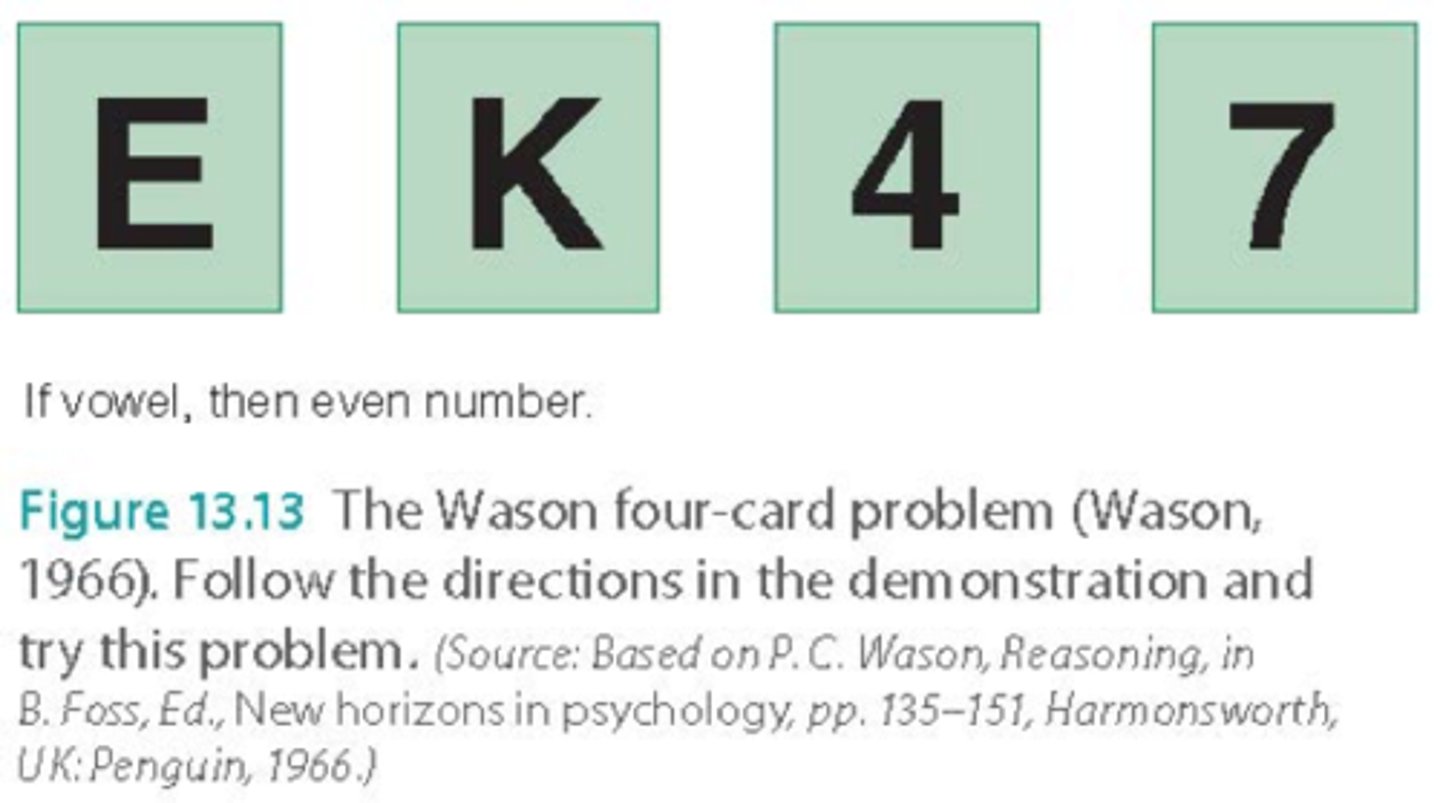
Falsification Principle
To test a rule, it is necessary to look for situations that would falsify the rule
Decision Making Process
Process of choosing between alternatives
Expected utility theory
The idea that people are basically rational, so if they have all of the relevant information, they will make a decision that maximizes gains and minimizes losses
Framing Effects
The way you frame a problem affects decision making
Tvesky and Kahneman (1981)
EXPERIMENT:
Participants had to choose between:
A. 200 people die
B. 1/3 change that 600 people will be saved
Result:
72% chooses A, risk averse option
-------------------------------------------------
Part 2:
C. 400 dies
D. 1/3 no one dies, 2/3 chance that everybody dies
Results:
78% chooses D, risk taking strategy
WHAT CHANGED?
All 4 options are mathematically equivalent
Difference between first 2 options and the last 2 options: Language use (framing effect)
Option A and B --> Framed in terms of gains
Options C and D --> Framed in terms of losses
When problems are framed in terms of gains --> We are averse to risk
When problems are framed in terms of losses --> We are most prone to take risks (because it means that there is some chance of minimizing the loss)
Expected utility theory doesn't explain those results --> Once all are the same, we should just choose at random, but that's not the case
Choice presentation effect
The way you present choices affects decisions
Status Quo Bias
People have a tendency to do nothing when faced with a decision
When a choice involves either having to do something or not having to do anything, you will likely choose the option in which you don't have to do anything
Ex: Organ donors --> Default is that you're not an organ donor, if you want to become one, you just need to tick a box, very simple, but yet people don't do it
Opt in is default (U.S) --> Low rates of organ donation
Opt out is default (France and Belgium) --> High rates of organ donation
Opt In .vs. Opt Out Procedures
Case of organ donations (representative of other cases too):
Opt in is default (U.S):
- Means that if you want to become an organ donor, you need to opt in
- Low rates of organ donation
Opt out is default (France and Belgium) :
- Means that being an organ donor is a default and if you don't want to be an organ donor, you need to opt out
- High rates of organ donation
 Note
Note  Flashcards (24)