VertZoo-Exam4
 Studied by 0 people
 Call Kai
 Learn
Learn Practice Test
 Spaced Repetition
 Match
Match Flashcards
 Knowt Play
1/194

Earn XP
Description and Tags
Ch.18-24
Name | Mastery | Learn | Test | Matching | Spaced | Call with Kai |
|---|
No analytics yet
Send a link to your students to track their progress
195 Terms
An outgroup of dinosaurs?
Pterosaurs
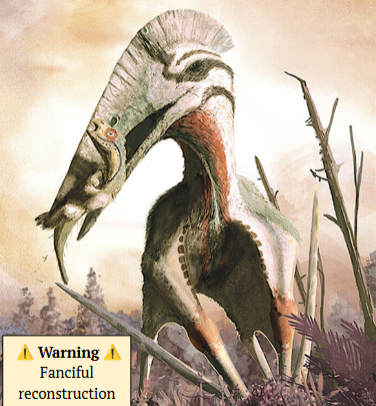
Hatzegopteryx
Apex pterosaur predator
What two groups are included in the monophyletic dinosaurs clade?
Ornithischian and Suarischian
Ornithischian
Bird-hip dinosaurs
Saurischian
Lizard-hip dinosaurs
Are birds saurischians or ornithischians?
Saurischians
Theropods
Birds
Theropod synapomorphy
Fercula
How long did Theropods exist for?
220 million years
Avetheropoda synapomorphy
Three fingers
Maniraptora synapomorphy
Pennaceous feathers
Paraves synapomorphies
Long arms/hands, asymmetrical pennaceous feathers, large claw on second digit of foot, pubis directed posteroventrally
Avialae synapomorphies
Extra long arms, reduced number of caudal vertebrae, powered flight
When did non-avian dinosaurs and pterosaurs go extinct?
66mya, around the Cretaceous period/K-T boundary
Pterosaur synapomorphies?
Hairlike pycnofibers covered bodies for insulation, evolved flight 80my before avian dinos, walked quadrupedally, and leapt into the air using all four limbs.
Convergent similarities between pterosaurs and birds?
Reduced/absent teeth, no tail, thin-walled bones (pneumatization), unidirectional airflow in lungs, large eyes and brain, small olfactory
Morphology of wing/pelvic in pterosaurs
A patagium supported by forelimb, elongated 4th digit and digits 1-3 are free
Azhdarchids
Largest pterosaurs, wingspan 11m, and apex predators
Synapomorphies of dinosauria?
Perforated acetabulum (hip joint) is a hole where the three bones of the pelvis meet.
Skeletal pneumatization
Air pockets in bones, widespread to reduce weight without lossof strength
Which bones were not pneumatized in terrestrial species because of enormous weight?
Limb bones
What were the earliest dino feathers made of and called?
Keratinaceous filaments/dino fuzzies
What colors did dino feathers tend to be?
White, brown, red, orange, and black
What are the colors of the dinosaur feathers based on?
melanosome morphology
Who is included in Ornithschian?
Stegasaurs, ankylosaurus, ceratopsians, and duck-billed dinosaurs
What evolved in Ornithschians?
Quadrupedality, herbivory, horny beaks, and complex tooth batteries.
Stegosaurs
Have large bony plates that may have been used for defense, heat exchange, and sexual selection
Ankylosaurs
Had dorsal armor and club tails which may have been used to defend themselves.
Hadrosaurs
Had batteries of teeth for chewing plants that replaced ventrally
Ceratopsians
Had tooth batteries, used horns in male-male combat
What was herding like in Ornithischians?
Formed in all life stages, social behaviors, and used vegetation for nesting and had parentel care
Perforated acetabulum
A hole where the three bones of the pelvis meet
How do Ornthiischians and Saurischians differ?
The orientation of their perforated acetabulum. O:parallel S:perpendicular
Sauropodomorph (Diplodocoid)
Elongated necks, 25%, Tail, 60%, and Trunk, 15%.
Who is included in Therapods?
Birds, tyrannosaurus, velociraptors, spinosaurus, and Archaeopteryx
Who made it past the K-T boundary?
Sauropods and Therapods—lived 220 my
Synapomorphies of therapods?
Fercula (wishbone), large hands for grasping, and gastralia (belly ribs)
What were therapod skulls like?
Light, knifelike teeth for a powerful bite, and teeth replaced throughout life
Tyrannosauriods
Enlarged in late cretaceous, deep skulls, powerful bites, and gastralia
Tyrannosaurus bites
Force of 3,000 lbs, crush bones
Tyrannosaurus speed
3mph
Megalosauroids
Giant, extinct, aquatic spinosaurus, 15m
Allosauroids
13m, large hands to grasp, replaced in Cretaceous period by tyrannosaurs
Abelisaurs
Allosauroids ecological analog
Pennaceous feathers
Evolved in smaller therapods, eventually lead to flight. Central shaft and two vanes
Ornithomimosaurs
Long necks, small heads, toothless beaks, feathers, grasping forelimbs, and pennaceous feathers
Ornithomimosaurs analogs
Ostrich
Manoraptorans
Birds evolved from them. Large forelimbs, a bird like pelvic girdle, herbivores/insectivores, and flexible wrists, pennaceous feathers
Deinonychus and Velociraptor
Hypercarnivores, knifelike teeth, enlarged claws to pin prey, and many species covered in feathers.
Archaeopteryx
Important link between dinosaurs and birds and had asymmetrical pennaceous feathers
Archaeopteryx pennaceous wing style?
asymmetrical
Avialan diversity when and how?
Diversified in cretaceous period and evolved feathers like modern birds (pygostyle)
How did relatives of birds lay eggs?
Layed eggs in pairs with their two functional ovaries; like crocs
What indicates that brooding evolved in outgroups to modern birds?
Oviraptors and Deininychus incubating eggs
What are the theories for birds evolving flight?
Ground up/wing assisted incline running or trees down
Polytomies
A node on a phylogenetic tree where a single lineage splits into three or more lineages
What is the largest groups of extant birds?
Songbirds, ~4,000
Moas
Giant birds in New Zealand that were hunted to extinction within 100 years of humans arriving. Only known wingless
Beta-keratin
main component of feathers, a protein, and a synapomorphy of sauropods
Pennaceous contour feathers
protection and generate lift, barbules holding the vanes together
Plumulaceous down
insulation
Filoplumes
Sense forces, contour feather positioning
Eyelash like bristles
protect eyes and nostrils
What do melanins produce?
ranges of brown colors and iridescent ones
What does carotenoid produce?
yellow and red
Skeletal features of birds?
Keeled sternum for flight muscle attachment, stiffened trunk, humerus are pneumatized, fused bones in wings, legs, and girdles
What are bird feet like?
Foot bones are fused into a tarsometatarsus and foot posture is digitigraded. Ankle joint is elevated and knee joint is hidden
How are muscles in the birds hindlimbs concentrated?
proximally, closer to the body, enhancing manueverability
What muscles and bones contribute to flight in birds?
Supracoracoideus, pectoralis muscles and the fercula bone (spring)
What do the supracoracoideus and pectoralis muscle do?
S: up and P: down
Is lift always perpendicular to airflow?
Yes
How do primary feathers work?
Attached to the hand and have asymmetrical vanes and act as propellers to generate thrust
How do secondary feathers work?
Attached to the forearm forming an airfoil for lift
How does the alula work?
Leading edge of the wing is supported by a patagium and has a small winglet, increases lift at low speeds
What are thrust and lift used for?
T:manuevering L:keeps the bird in the air
What is wing shape correlated to?
flight style
What are perching birds feet like?
3 toes facing forward and 1 in the back
What kind of feet do woodpeckers, owls, osprey, and parrots have?
Zygodactylous, 2 front/2 back
What kind of webbing do duck, swans, gulls, and other paddlers have?
Palmate webbing—3 toes
What kind of webbing do cormorants and boobies have? (divers)
totipalmate—webbing over 4 toes
What kind of webbing do grebes and coots (divers) have?
Lobate webbing, toes not connected
Describe tongues in hummingbirds and woodpeckers
Hyoid supports the tongue, is elongated, and wraps around the skull under skin
How do humingbirds tongues act?
A fluid trap, not a straw
What are keratinized bills used for?
Grasping, stabbing, filter, probing, and gleaning
What allows birds to raise and lower their upper jaws?
A joint in the palate and craniofacial hinge
What does the cranial kinesis do?
enlarge the gape and enhances the manipularitory ability of jaws
What is the crop used for?
Storing food for processing later, ferment vegetation, and producing milk
What does the proventriculus do?
Glandular stomach, performs chemical digestion
What does the gizzard do?
muscular stomach, used to grind food
Are owls ears asymmetrical or symmetrical? why?
Asymmetrical, to change arrival time of sound between ears to gauge where its coming from
What kind of eyes do non-predator species have?
laterally directed eyes
What kind of eyes do predator bird species have?
Binocular vision for depth and perception
what kind of vision do birds have? (color)
four-color vision
What produces sound in birds?
Syrinx, junction of bronchi and trachea
Eupelycosauria synapomorphy
Lower temporal fenestra
Cynodontia synapomorphies
Complete bony secondary palate, double occipital condyles, and differentiated lumbar regions
Mammaliaformes synapomorphies
Dentart-squamosal jaw articulation and Atlas/axis complex
Theria synapomorphies
Viviparity and nipples
Eupelycosaurs
Synapid outgroup of mammals, carnivorous, sprawled limbs, and large doral sails
Are pelycosaurs more closely related to humans or dinosaurs?
Humans
 Note
Note  Flashcards (34)