Chapter 7: Introduction to the Endocrine System単語カード | Quizlet
 Studied by 0 people
 Call Kai
 Learn
Learn Practice Test
 Spaced Repetition
 Match
Match Flashcards
 Knowt Play
1/76

There's no tags or description
Looks like no tags are added yet.
Name | Mastery | Learn | Test | Matching | Spaced | Call with Kai |
|---|
No analytics yet
Send a link to your students to track their progress
77 Terms
What are hormones?
chemical messengers secreted into the blood by specialized epithelial cells
responsible for "long-term and ongoing" functions
What is the definition of a hormone?
a chemical secreted by a cell or group of cells into the blood for transport to a distant target, where it exerts its effect at very low concentrations.
What are some body functions that fall mostly under hormonal control?
metabolism
regulation of the internal environment (temperature, water balance, ions), and reproduction, growth, and development
How do hormones act on their target cells?
1. by controlling the rates of enzymatic reactions
2. by controlling the transport of ions or molecules across cell membranes
3. by controlling gene expression and the synthesis of proteins
What are classic hormones?
hormones of the pancreas, thyroid, adrenal glands, pituitary, gonads and all discrete endocrine glands that could be easily identified and surgically removed.
What is the traditional endocrine system?
Hormones secreted by endocrine glands, i.e. thyroid gland, pancreas, etc.
What is the diffuse endocrine system?
Hormones secreted by endocrine cells
i.e. G cells in the stomach
What secretes neurohormones?
neurons
Neuron secretion is linked to the hypothalamus
Hormones can also be secreted by cells of the immune system called what?
cytokines
What are ectohormones?
signal molecules secreted into the external environment
What are pheromones?
specialized ectohormones that act on other organisms of the same species to elicit a physiological or behavioral response.
can also be used to attract members of the opposite sex for mating.
humans may/may not have pheromones
-
What are molecules that are suspected of being hormones but not fully accepted as such called?
candidate hormones
usually called a _____ factor
i.e. releasing factors or inhibiting factors.
What are growth factors?
influence cell growth and division - don't know if they are hormones yet
they are very hormone like
but they are more locally active (paracrine, autocrine) and not widely distributed in the blood
At what concentration range do most hormones act at?
nanomolar to picomolar (10^-9 - 10^-12)
What are cytokines?
very hormone like
all nucleated cells can produce some type of cytokine
some are more locally active, others used for long distance communication
BIGGEST DIFFERENCE is
cytokines are made ON DEMAND rather than stored and released.
How do hormones act?
they bind to target cell receptors and initiate biochemical responses (cellular mechanism of action of the hormone)
one hormone can act on multiple tissues and the effects may vary in different tissues or at different stages of development
it may also have no effect at all in a particular cell
What is an example of a hormone with varied effects?
insulin
alters glucose transport proteins and enzymes for glucose metabolism in muscle and adipose tissues but
in liver, it modulates enzyme activity but has no direct effect on glucose transport proteins
in the brain and certain other tissues, glucose metabolism is totally independent of insulin
Describe hormone action
chemical signals activate physiological responses at low concentration
requires target cell to have receptors
requires specific signal transduction pathway
- the signal is converted to action
- this generally involves amplification which allows large responses with low hormone concentration
Why must hormone activity be terminated?
hormone activity has longer term effect than nervous system, so it must be terminated so that the body will maintain homeostasis
How are hormone actions terminated for hormones in the bloodstream?
hormones in the bloodstream are degraded into inactive metabolites by enzymes found in the liver and kidneys
- the metabolites are then excreted in bile or urine.
How are hormone actions terminated for hormones bound to target membrane receptors?
in several ways:
enzymes that are always present in the plasma can degrade peptide hormones bound to cell membrane receptors.
in some cases, the receptor-hormone complex is brought into the cell by endocytosis, and the hormone is then digested in lysosomes.
intracellular enzymes metabolize hormones that enter cells
How are hormone actions terminated for lipophilic hormones?
intracellular enzymes metabolize (degrade) hormones that enter cells
What are the three types of hormones?
Protein or peptide hormones (most types)
Steroid hormones
Amine hormones
What are peptide hormones?
composed of linked amino acids
larger polypeptide chains
produced by protein synthesis (made in advance) and stored in secretory vesicles
- signal sequence is attached
- modified and stored until released
released from the parent cell by exocytosis
transported in the blood by dissolving in the plasma (water soluble)
have a short half-life (seconds to minutes)
receptors are located in the cell membrane
- hydrophilic/lipophobic
response to receptor-ligand binding is activation of second messenger systems; may activate genes
General target response is modification of existing proteins and induction of new protein synthesis
examples: insulin, PTH
* the initial peptide that comes off the ribosome is a large inactive protein called a preprohormone*
What is a preprohormone?
the initial peptide that comes off the ribosome is a large inactive protein
contain one or more copies of a peptide hormone, a signal sequence that directs the protein into the lumen of the RER and other peptide sequences that may or may not have biological activity
What is a prohormone?
as the inactive preprohormone moves through the ER, the signal sequence is removed, creating the prohormone which is packaged into secretory vesicles along with proteolytic enzymes to chop the prohormone to an active hormone IN THE GOLGI
this process is post tranlational modification
What are steroid hormones?
all derived from cholesterol
synthesized on demand from precursors
- produced in a few endocrine glands: adrenal cortex of adrenal gland, testes & ovaries, placenta in pregnancy
release from parent cell is simple diffusion
transported in blood: bound to carrier proteins
- plasma proteins
-- must release to enter cell
half-life is longer (hours)
receptors are in cytoplasm or nucleus
- hydrophobic/lipophilic
- intracellular receptors
SOME may have cell membrane receptors
- signal transduction pathways - non genomic responses
response to receptor-ligand binding: activation of genes for transcription and translation; may also have non genomic effects
general target response: induction of new protein synthesis
examples: estrogen, androgens, cortisol
What are amine hormones?
modifications of single amino acids, either tryptophan or tyrosine
amino acid derivatives
tryptophan: melatonin
Tyrosine:
catecholamines
- dopamine
- norepinephrine (NE)
- Epinephrine
Thyroid hormone
- T4 & T3
Explain the pathway of the amine hormones (tyrosine derivatives): catecholamines
Synthesis and storage: made in advance; stored in secretory vesicles
Release from parent cell: exocytosis
Transport in blood:dissolved in plasma
Half-life: short
Location of receptor: cell membrane
Response to Receptor-Ligand binding: activation of second messenger systems
General target response: modification of existing proteins
Examples: epinephrine
norepinephrine
Explain the pathway of the amine hormones (tyrosine derivatives): Thyroid hormones
Synthesis and storage: made in advance; precursor stored in secretory vesicles
Release from parent cell: transport protein
Transport in blood: bound to carrier proteins
Half-life: long
Location of receptor: nucleus
Response to Receptor-Ligand binding: activation of genes for transcription and translation
General target response: induction of new protein synthesis
Examples: thyroxine (T4) and T3
What are the components of reflex pathways?
stimulus
sensor
input signal
integration
output signal
one or more targets
response
in endocrine and neuroendocrine the output signal is a hormone or neurohormone
Simple reflex pathway
the endocrine cell (the sensor) directly senses a stimulus and responds by secreting its hormone
the endocrine cell acts as both the sensory and integrating center
hormone is output signal
response usually serves as a negative feedback signal that turns off the refle
What are examples of the simple endocrine reflex pathways?
PTH
insulin
Parathyroid hormone (PTH) reflex pathway
controls calcium homeostasis
secreted by 4 small parathyroid glands in the neck
parathyroid endocrine cells monitor plasma Ca++ concentration with the aid of GPC Ca++ receptors on their cell membranes
When a certain number of receptors are bound to Ca++, PTH secretion is inhibited
if plasma Ca++ concentration falls below a certain level and fewer Ca++ receptors are bound, inhibition ceases and the parathyroid cells secrete PTH
PTH travels through the blood to act on bone, kidney, and intestine initiating responses that increase the concentration of Ca++ in the plasma
the increase in plasma Ca++ is a negative feedback signal that turns off the reflex, ending the release of PTH
Insulin & glucagon
pancreatic endocrine cells are sensors that monitor blood [glucose]
if blood [glucose] increases, pancreatic beta cells secrete insulin
insulin travels through the blood to target tissues, which increase their glucose uptake and metabolism
glucose moving into cells decreases blood conc. which acts as a negative feedback signal that turns off the reflex, ending release of insulin.
GI tract stretch
- CNS: Neurotransmitter
GI tract increases [glucose concentration]
- duodenal endocrine cells secrete GIP and glucagon like peptide-1
Hormones can be controlled by the nervous system, how?
complex neuroendocrine reflex
neurohormone reflex
Complex neuroendocrine reflex
Neuron stimulation of endocrine gland
insulin: parasympathetic stimulation
What are neurohormones?
chemical signals released into the blood by a neuron
What are the major groups of neurohormones?
1. catecholamines made by modified neurons in the adrenal medulla
2. hypothalamic neurohormones secreted from the posterior pituitary
- secreted into the hypothalamic-hypohyseal or hypothalamo-pituitary portal vessel
3. hypothalamic neurohormones that control hormone release from the anterior pituitary.
What is the pituitary gland?
lima bean sized that extends downward from the brain, connected to it by a thin stalk and cradled in a protective pocket of bone
contains the anterior and posterior that are two different types of tissue
Anterior pituitary
true endocrine gland of epithelial origin
also called the adenohypophysis and its hormones are adenohypophyseal secretions
Posterior pituitary
neurohypophysis
an extension of neural tissue of the brain
secretes neurohormones made in the hypothalamus (region of brain that controls many homeostatic functions)
What is the infundibulum?
connecting stalk
hypothalamic - hypophyseal or hypothalamo-pituitary portal vessel
- axons of hormone secreting cells of hypothalamus
What is the hypothalamus?
posterior pituitary hormones are made here and they are released through the post. pit.
the neurons producing oxytocin and vasopressin are clustered together in areas of the hypothalamus known as the paraventricular and supraoptic nuclei (a cluster of nerve cell bodies in the CNS is called a nucleus)
produces vasopressin (ADH)
- target organ: kidney
- function: water reabsorption
- diuretics make you pee
produces oxytocin:
- target organs: uterus, mammary glands
Once neurohormones are packaged into secretory vesicles, the vesicles are transported to the post. pit. through what?
axons...after vesicles reach the axon terminals, they are stored there, waiting for the release signal.
Vasopressin
made by hypothalamus
released by post. pit.
ADH: antidiuretic hormone
acts on the kidneys to regulate water balance in the body. (water reabsorption)
Oxytocin
made by the hypothalamus
secreted by post. pit.
controls the ejection of milk during breast-feeding and contractions of the uterus during labor and delivery
(targets uterus, mammary glands)
oxytocin is also released from neurons as a neurotransmitter onto neurons in other parts of the brain - plays important role in social, sexual, and maternal behaviors
What are hypothalamic hormones that have effect on the anterior pituitary?
releasing hormones into capillary bed
then the anterior pituitary will release their own hormones in response to the releasing hormone
What is prolactin?
What are trophic hormones?
stimulate another endocrine gland
What are the six hormones that are secreted from the anterior pituitary?
1. Prolactin (PRL)
2. Thyrotropin (TSH)
3.Adrenocorticotropin (ACTH)
4. Growth hormone (GH)
5. Follicle-Stimulating hormone (FSH)
6. Luteinizing hormone (LH)
What is secretion of anterior pituitary hormones controlled by?
hypothalamic neurohormones (aka releasing hormones or inhibiting hormones)
Prolactin (PRL)
mammary glands and milk production, no second trophic hormone
dopamine from hypothalamus inhibits the secretion of PRL
Growth Hormone (GH)
direct tissue metabolism stimulation, no second trophic hormone (directly stimulates tissue to grow)
causes liver secretion of insulin-like growth factors (IGFs) --> cell growth and metabolism
Gonadotropins (FSH and LH)
stimulates ovaries and testes to secrete --> estrogen and testosterone (and cell development)
Thyroid Stimulating Hormone (TSH)
thyroid gland --> thyroid hormone (has an actual impact on tissues)
Adrenocorticotropic hormone (ACTH)
adrenal cortex--> cortisol
Hormones of the Hypothalamic-Anterior Pituitary Pathway: Hypothalamic hormones--> ant. pit. hormones-->endocrine targets and hormones they secrete --> non-endocrine targets: Dopamine
Dopamine (hypothalamic) --> Prolactin (anterior pituitary) --> Breast (non-endocrine)
Hormones of the Hypothalamic-Anterior Pituitary Pathway: Hypothalamic hormones--> ant. pit. hormones-->endocrine targets and hormones they secrete --> non-endocrine targets: TRH
Hypothalamic: TRH
Ant. Pit: TSH
Endocrine target(s) + their hormones: Thyroid Gland --> thyroid hormones (T4 and T3)
Non-endocrine targets: many tissues
Hormones of the Hypothalamic-Anterior Pituitary Pathway: Hypothalamic hormones--> ant. pit. hormones-->endocrine targets and hormones they secrete --> non-endocrine targets: CRH
Hypothalamic: CRH
Ant. Pit: ACTH
Endocrine target(s) + their hormones: Adrenal cortex --> cortisol
Non-endocrine targets: many tissues
Hormones of the Hypothalamic-Anterior Pituitary Pathway: Hypothalamic hormones--> ant. pit. hormones-->endocrine targets and hormones they secrete --> non-endocrine targets: GHRH, Somatostatin
Hypothalamic: GHRH or somatostatin
Ant. Pit: GH
Endocrine target(s) + their hormones: Liver --> insulin-like growth factors (IGFs)
Non-endocrine targets: many tissues
Hormones of the Hypothalamic-Anterior Pituitary Pathway: Hypothalamic hormones--> ant. pit. hormones-->endocrine targets and hormones they secrete --> non-endocrine targets:GnRH
Hypothalamic: GnRH
Ant. Pit: FSH or LH
Endocrine target(s) + their hormones: endocrine cells of the gonads --> androgens (male) and estrogen/progesterone (female)
Non-endocrine targets: many tissues and germ cells of the gonads
what is another name of somatostatin?
GHIH
growth hormone inhibiting hormone
Hypothalamic-pituitary feedback loops: complex endocrine pathway
3 hormone systems = 3 integration centers
Hypothalamus → ant. pituitary → target endocrine gland → target cells
You have
3⁰ gland & hormone→ 2⁰ gland & hormone→1⁰ gland & hormone→effect
most utilize negative feed back, but the ovaries use negative and positive (at the time of ovulation)
Hypothalamic -pituitary feedback loops: long-loop feedback
1⁰ hormone
dominant form
hormone secreted by the peripheral endocrine gland feeds back to suppress secretion of its anterior pituitary and hypothalamic hormones.
exceptions to this are the ovarian hormones estrogen and progesterone which alternate between positive and negative feedback
Hypothalamic -pituitary feedback loops: short-loop feedback
2⁰ hormone
a pituitary hormone feeds back to decrease hormone secretion by the hypothalamus
like prolactin and ACTH for short loop negative
What is synergism?
1+1>2
when two or more hormones interact at their target so that the combination yields a results that is greater than additive.
different hormones have the same effect on the body, but can accomplish that effect through different cellular mechanisms
Examples of synergism?
glucagon, epinephrine, and cortisol all act to elevate blood glucose
impact of all three together is much greater than them individually
What system is activated when you release epinephrine, cortisol, glucagon?
symapthetic
What is permissiveness?
one hormone present for the other hormone to work
one hormone requires a second hormone to fully function (2+0>2)
example: reproductive hormones require thyroid hormone for reproductive system to mature
thyroid hormone alone = no development of reproductive system
reproductive hormones alone = delayed development of reproductive system
reproductive hormones with adequate thyroid hormone = normal development of reproductive system
antagonistic:
competitive inhibitors: block receptor binding site
-- estrogen blockers (tamoxifen)
Functional antagonists:
- insulin (stores glucose) & glucagon (secretes glucose into blood)
GH and PTH for reproductive
can be competing for same receptors or one may act in a different place, reducing the amount of receptors available for the other hormone to bind.
What is hyposecretion?
too little hormone produced/secreted
- may be a gland malfunction
- may be lack of nutrients (need iodine for PTH)
What is hypersecretion?
hormone is present in excessive amount, the normal effects of the hormone are exaggerated.
can be caused by benign tumors (adenomas) and cancerous tumors of the endocrine glands.
Too little hormone effect?
reduced receptor or 2nd messenger responsiveness
- down regulation: excess hormone can cause cells to remove receptors to reduce response (example: hyperinsulemia - sustained high levels of insulin in the blood cause target cells to remove insulin receptors from the cell membrane)
- genetic abnormalities: mutations
- receptor or 2nd messenger proteins don't function properly
Endocrine Pathologies: Examples & Practice
1⁰, 2⁰ (& 3⁰) pathology: hypersecretion or hyposecretion
3⁰ gland & hormone → 2⁰ gland & hormone → 1⁰ gland & hormone
Hypothal. (TRH) → ant. pituitary (TSH) → thyroid gland (thyroxine)
1. Graves disease: a hyperthyroidism
2. Hypothyroidism
Graves disease: a hyperthyroidism
- 1⁰ hypersecretion→ too much of which hormone(s)?
- - - Thyroid gland is at fault, thyroxine
- 2⁰ hypersecretion → too much of which hormone(s)?
- - - Ant. Pit (TSH)
- 3⁰ hypersecretion → too much of which hormone(s)?
- - - Hypothalamus (TRH)
Hypothyroidism
- 1⁰ hyposecretion→ too little of which hormone(s)?
- - - thyroid (thyroxine)
- 2⁰ hyposecretion → too little of which hormone(s)?
- - - Ant. Pit (TSH)
- 3⁰ hyposecretion → too little of which hormone(s)?
- - - Hypothalamus (TRH)
Hypothal. & CRH → ant. pit. & ACTH → a. cortex & cortisol
How is pathology diagnosed?
feedback loop
Primary, secondary, tertiary hypersecretion
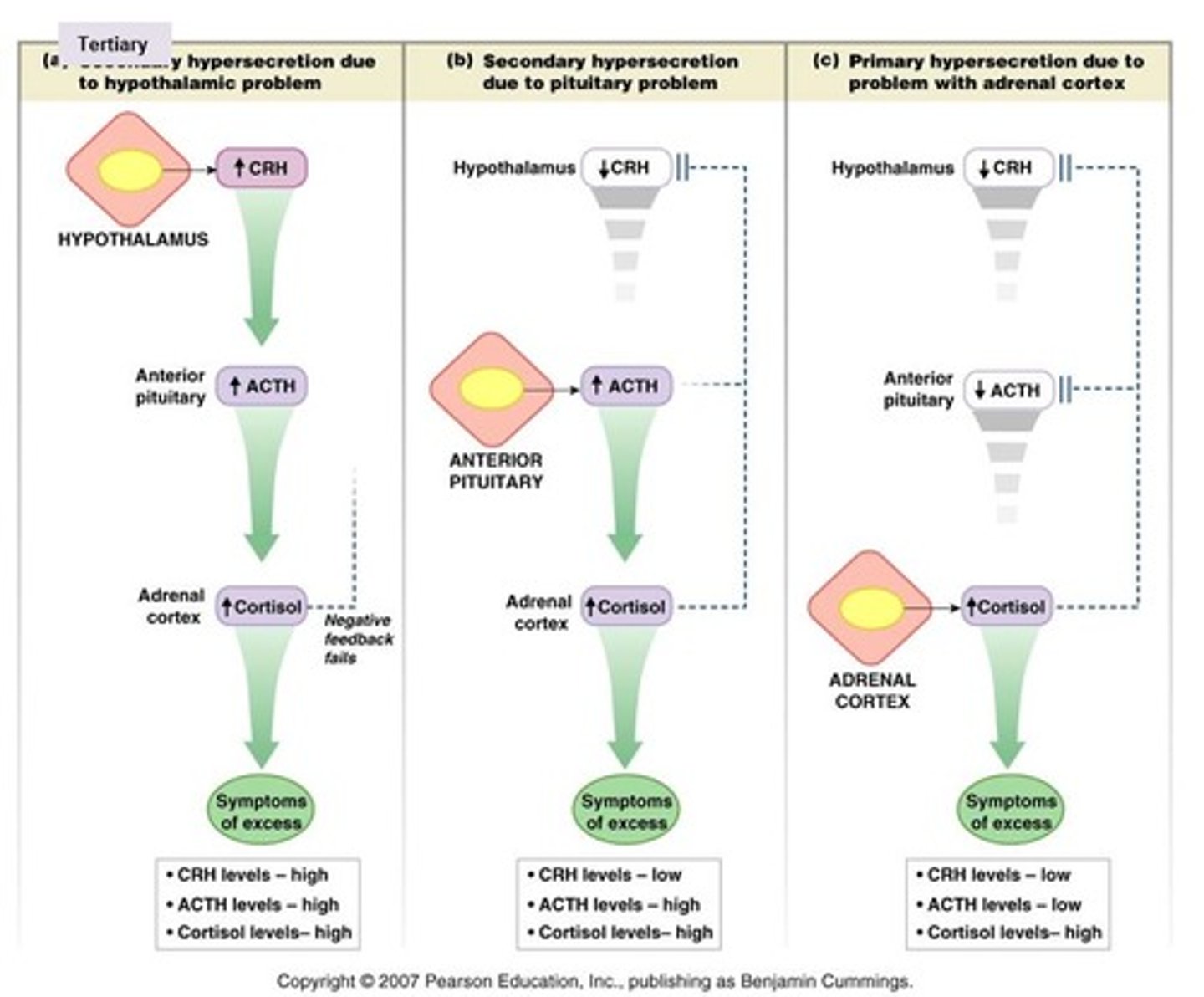
 Note
Note  Flashcards (115)