1.2.3 Price, Income and Cross Elasticities of Demand (Micro)
 Call Kai
 Learn
Learn Practice Test
 Spaced Repetition
 Match
Match Flashcards
 Knowt Play
1/10

There's no tags or description
Looks like no tags are added yet.
Name | Mastery | Learn | Test | Matching | Spaced | Call with Kai |
|---|
No analytics yet
Send a link to your students to track their progress
11 Terms
WHAT IS PRICE ELASTICITY OF DEMAND
Price elasticity of demand measures the responsiveness of the quantity demanded of goods and services to changes in price. In simpler terms, it helps us understand how sensitive consumer demand is to changes in price.
Price Elasticity of Demand (PED) = % Change in Quantity Demanded for X / %Change in Price of X
ELASTIC
Customers are very responsive to changes in price, if the price of a product increases, consumers may stop or reduce the purchase of the good or switch to another alternative available in the market.
Elastic demand occurs when PED is greater than 1
INELASTIC
Demand for a goods and services remain unresponsive to price changes. Inelastic products fall under necessities and don’t have acceptable alternatives, hence, they individuals continue buying these products in spite of price rises
Numbers range 0<|PED|<1
NORMAL GOODS (coefficient of income elasticity)
They have a positive income elasticity +1 < . As income goes up, you are going to buy more of it.
1You can’t ever just have a normal good, it has to be a Normal Luxury Good or a Normal Necessity:
Luxury goods – where the income elasticity +1 < (number above 1). High- and positive-income elasticity
Necessities – here the income elasticity > 0 and <+1. Low but positive income elasticity
INFERIOR GOODS (coefficient of income elasticity)
These have negative income elasticity 0 >.
If, following an increase in real income, less of the good is purchased, then the good is an inferior good.
INCOME ELASTICITY OF DEMAND
Measures the responsiveness of quantity demanded to a change in income.
Income elasticity of demand (YED) = % Change in Quantity Demanded / % Change in Income
XED CROSS ELASTICITY OF DEMAND (coefficient of income elasticity)
Cross-price elasticity of demand measures the responsiveness of the quantity demanded of one good to a change in the price of another related good. Useful in analysing the relationships between substitute and complementary goods.
Cross-Price Elasticity of Demand (A to B) = (% Change in Quantity Demanded of A) / (% Change in Price of B)
CROSS PRICE ELASTICITY OF DEMAND FOR SUBSTITUTES
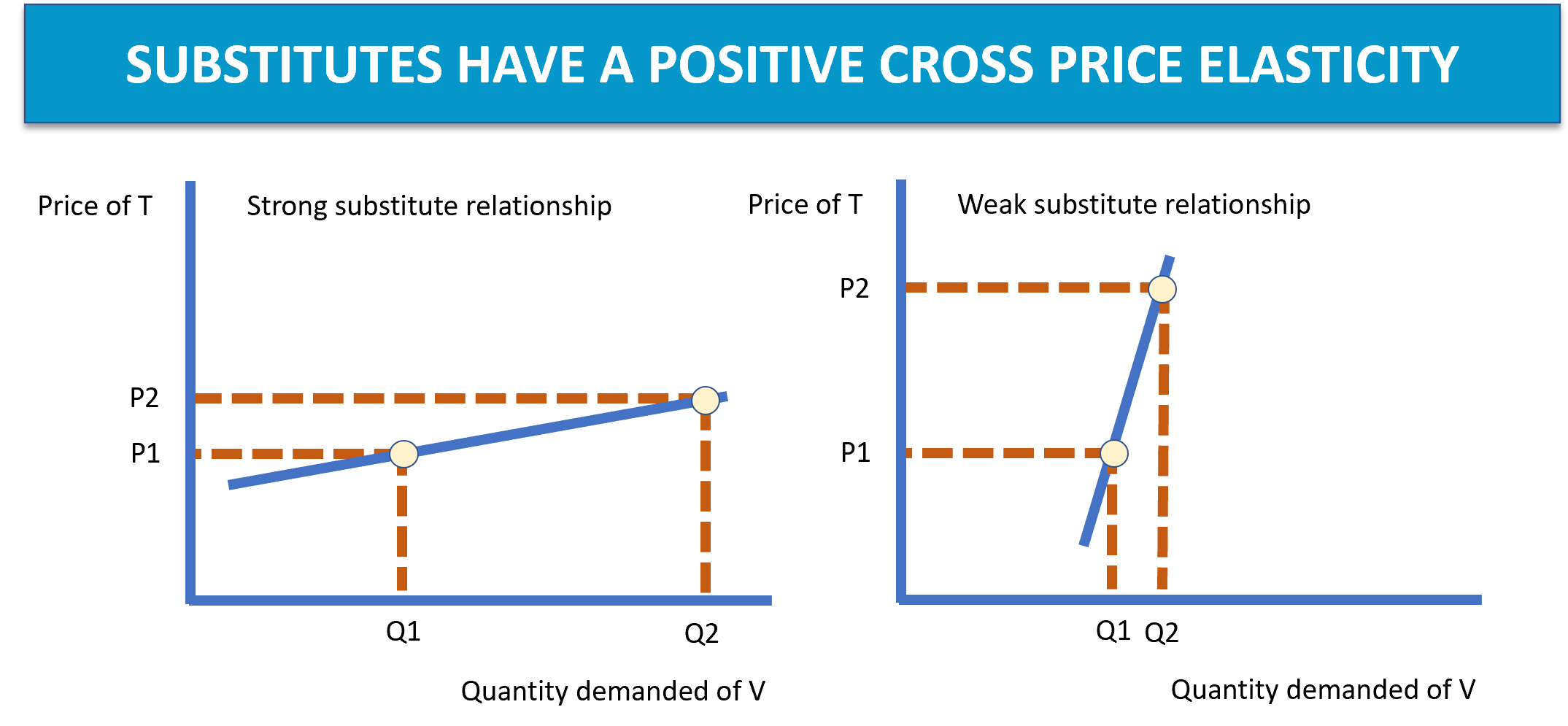
Substitutes have a positive cross price elasticity of demand.
If they are close substitutes, they are very similar to each other, an increase in the price of one product will lead to a rise in demand for its substitute. Consumers are more likely to switch between competing products when there is a change in relative prices.
The higher the value of the coefficient the closer the two products are as substitutes.
CROSS PRICE ELASTICITY OF DEMAND FOR COMPLEMENTS
If cross-price elasticity is negative, then two goods are complements.
An increase in the price of good B results in a decrease in the quantity demanded of good A, and vice versa.
If two goods are equal to 0, it means they have no effect on each other.

