Molecular bio 2.2 definitions
 Call Kai
 Learn
Learn Practice Test
 Spaced Repetition
 Match
Match Flashcards
 Knowt Play
1/23

There's no tags or description
Looks like no tags are added yet.
Name | Mastery | Learn | Test | Matching | Spaced | Call with Kai |
|---|
No analytics yet
Send a link to your students to track their progress
24 Terms
Constitutive gene expression
When a gene is transcribed at a relatively constant level under all conditions and cell types
Regulated gene expression
When a gene is transcribed only under certain cellular or environmental conditions, or in certain cell types
“Housekeeping genes” or essential genes compared to other genes
The expression of the essential genes are constitutive because they are needed by all cells. E.g. Beta-tubulin.
Other genes are needed in certain cell types and are important for the function/ behaviour of those cells. The expression of these genes is regulated.
What do transcriptional activators vs repressors do?
Is there a difference between prokaryotes and eukaryotes?
No difference.
In both prokaryotes and eukaryotes transcriptional activators and repressors bind to DNA sequences around the gene where they can influence the transcription machinery.
Activators in prokaryotes vs eukaryotes
In prokaryotes, activators bind near the promoter and help recruit RNA pol.
In eukaryotes, activators can bind to enhancer sites a long way from the promoter. DNA can loop over and bring them into contact with the initiation complex.
Cis-acting elements
DNA sequences in the vicinity of the structural portion of a gene that are required for gene expression
Trans-acting factors
Usually proteins, that bind to the cis-acting sequences to control gene expression
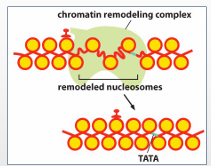
How does transcription factors affect chromatin state in eukaryotes?
In eukaryotes, activators and repressors can recruit proteins/complexes that modify histones and remodel the chromatin structure.
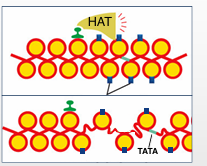
What do activators recruit and what does this help accomplish?
Transcription factors slide
This activator has recruited a Histone Acetylase (HAT), which loosens the bond between histones and DNA making the TATA box more accessible.
What do repressors recruit and what does this accomplish?
This repressor has recruited a chromatin remodelling complex which creates a condensed chromatin state, making the TATA box inaccessible.
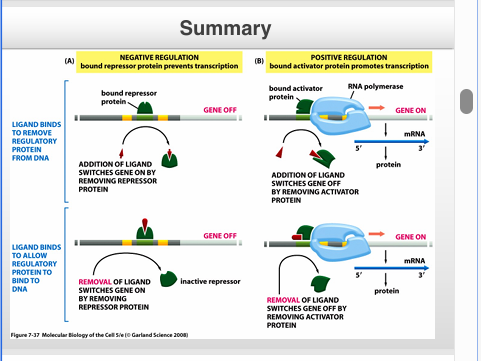
What are the four combinations you can have for positive and negative regulation?
Ligand binding subtopic
Negative regulation: bound repressor protein prevents transcription
Ligand binds to remove regulatory protein from DNA
Ligand binds to allow regulatory protein to bind to DNA
Positive regulation: bound activator protein promotes transcription
Addition of ligand switches gene off by removing activator protein
Removal of ligand switches gene off by removing activator protein.
Why are -35 and -10 regions important?
These are the two binding sites for the sigma factor.
These regions are therefore conserved.
Operons
A group of contiguous genes that are transcribed as a single mRNA molecule, which encodes several different polypeptides
Cistron
A section of DNA encoding a single polypeptide which functions as a hereditary unit. In effect, another word for a gene. Commonly used to describe the individual “gene” units in a prokaryotic operon.
Polycistron
mRNA that encodes several different polypeptides- common in bacteria, very rare in eukaryotes.
Operator
In prokaryotes, it is a DNA region that control the transcription of an adjacent gene. It is a binding site for a repressor.
How is the lac operon transcribed and what does it do?
The lac operon is transcribed as a single polycistronic RNA molecule.
It encodes three genes/cistrons, which are translated into 3 proteins: lac Z gene, lac Y gene and lacA gene.
What does lacZ, lac Y and lac A encode? (in that order: they have separate things they encode)
lacZ encodes a Beta-galactosidase enzyme
lacY encodes a lactose transporter (permease)
lacA encodes a thiogalactoside transacetylase (thought to remove toxic thiogalactosides that also get transported in by LacY).
What does lacI encode? What does this accomplish?
Is the lac I part of the lac operon?
LacI encodes the lac repressor protein (LacI).
LacI which binds to operator (O) and blocks RNA polymerase, therefore repressing transcription.
Lac I is adjacent to the lac operon but is not a part of it—> so it doesn’t need to be next to it and can be anywhere in the genome.
When does the lac operator function and how is the transcription allowed for (
The logic of the lac operator: only time to transcribe is when we don’t have glucose and we do have lactose.
In the presence of allolactose, the Lac I repressor dissociates from the operator and RNA polymerase can transcribe the operon.
The CAP helps the RNApol to bind the promoter and is needed for the expression of the lac operon.
cAMP (i.e. cyclic adenosine monophosphate) is a ligand for CAP. i.e. CAP can only bind DNA when cAMP is present.
How do we regulate operon transcription with glucose?
Glucose levels and cAMP levels are inversely related.
Reason:

