Audiology Exam 2
 Call Kai
 Learn
Learn Practice Test
 Spaced Repetition
 Match
Match Flashcards
 Knowt Play
1/23

There's no tags or description
Looks like no tags are added yet.
Name | Mastery | Learn | Test | Matching | Spaced | Call with Kai |
|---|
No analytics yet
Send a link to your students to track their progress
24 Terms
What is an example of a behavioral measure?
Audiogram; because the patient must respond
What is an example of an objective measure and why?
OAEs, tympanogram, ABR; because there is no response needed from the patient
Why do we conduct objective measures?
to target specific anatomical features, useful for individuals who are unable to perform behavioral stats
What part of the ear anatomy does tympanometry assess?
middle ear
What visual tool do we use to represent the results of tympanometry?
tympanogram
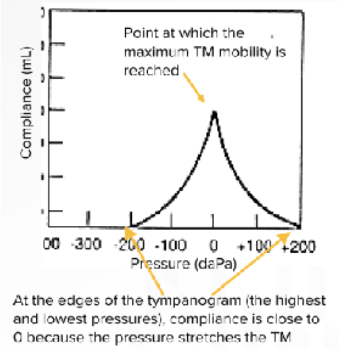
What tympanogram would you see with an individual with normal ME pressure?
Type A
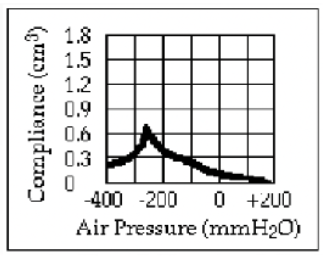
What tympanogram would you see with an individual with an obstructed Eustachian tube?
Type C
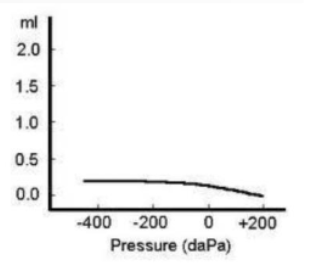
What tympanogram would you see with an individual with fluid in the ME?
Type B
What is one possible cause of an abnormally large ECV?
TM perforation
Otoacoustic emissions measures the movement of what?
Outer hair cells
OAEs are generated by the movement of what?
fluid in the cochlea
What do OAEs create?
a traveling wave that traves back through the ME and ear canal
A patient with what kind of hearing loss will have absent OAEs (no response)?
conductive, sensorineural, or hearing loss GREATER than moderate
What range do we measure OAE’s?
1000 Hz - 4000 Hz
What does the Auditory Brainstem Response measure?
the path of electrical potentials from the cochlea to the cortex, like an EEG
How long should a normal latency for a wave V on an ABR be?
~ 5 ms
What would a patient have if they have present OAEs but absent ABR?
acoustic neuroma
What are two tests that are conducted in newborn hearing screenings?
OAEs and ABRs
What do hearing aids do?
amplify sounds at a specific increments at specific frequencies
list 3 different hearing aid styles
behind-the-ear (BTE)
in-the-ear (ITE)
completely-in-canal (CIC)
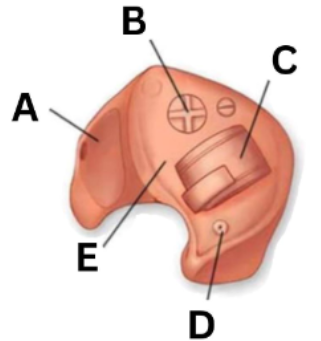
Label the parts of the hearing aids and list their functions:
a. speaker (receiver) - send sound to ear
b. volume control
c. battery - powers hearing aid
d. microphone - picks up sound
e. amplifier - amplifies sound signals
Describe the process of sound transmission in a hearing aid:
sound enters microphone → sound amplified by amplifier → sent to receiver → sounds delivered to ear
Describe what a hearing aid fitting/verification looks like:
enter patient’s audiogram onto the hearing aid software → program HA settings/programs → conducts real ear measurements (REM) to verify amplification → adjust based on patient feedback
Measuring the output of a hearing aid while the patient is wearing it is referred to as what?
Real Ear Measuements (REM)

