Physics: Unit 10 Light
 Call Kai
 Learn
Learn Practice Test
 Spaced Repetition
 Match
Match Flashcards
 Knowt Play
1/14

There's no tags or description
Looks like no tags are added yet.
Name | Mastery | Learn | Test | Matching | Spaced | Call with Kai |
|---|
No analytics yet
Send a link to your students to track their progress
15 Terms
What is refraction?
When light changes speed depending on the material that it is travelling through.
Which direction is light refracted to the normal, depending on the speed?
When light slows down, it is refracted towards the normal, and the angle decreases. When light speeds up, it refracts away from the normal, and the angle increases.
Describe the method to ploy the path of a ray through different glass prisms.
Set up the apparatus as shown using a rectangular block.
Shine the light ray through the glass block.
Use crosses to mark the path of ray.
Join up crosses with a ruler.
Draw on a normal where the ray enters the glass block.
Measure the angle of incidence and angle of refraction.
What is the refractive index?
How much a material slows the light.
Bigger value = slower light as material is denser.
How do you calculate the refractive index?
n = sin i / sin r
What is the critical angle?
Angle of incidence which causes a 90 degree angle of refraction
The smallest possible angle of incidence at which light rays are totally internally reflected.
When does the critical angle only happen?
ONLY when light speeds up (from high → low refractive index
When are light rays totally internally reflected (TIR)?
When the angle of incidence is greater than the critical angle.
What is the equation connecting the critical angle and refractive index
n = 1 / sin c
Refractive index = 1 / sin (critical angle)
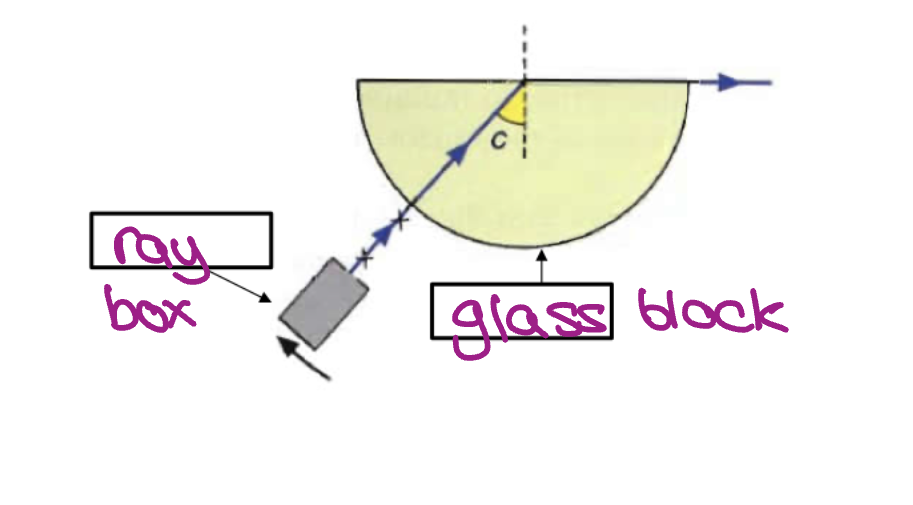
What is the method to determine the refractive index using the critical angle?
Set up apparatus as shown in diagram using a semicircular block.
Shine the light ray through the glass block such that you cause a refraction at 90 degrees.
Use crosses to mark path of ray.
Draw a normal where the ray hits the boundary.
Measure the critical angle.
Calculate the refractive index.
How does light travel?
In a straight line.
What happens when light enters along the normal (perpendicular to the surface?
It will not refract. Still changes spped, but angle is unchanged.
What are optical fibres?
Center of fibre is made of glass with very high refractive index.
Outside of fibre is made of different type of glass with lower refractive index.
As refractive index increases, the critical angle decrease (inversely proportional)
What happens to the ray of light as it travels through an optical fibre?
Uses Total internal reflection to send information, as the optical fibre core is made from glass with higher refractive index than air and because the fibre is narrow, the angle of incidence of light hitting boundary is greater than the critical angle.
What happens for reflection to occur?
when the angle of incidence is higher than the critical angle

