L12:Oxidation of hydrocarbons, lipids and the glyoxylate cycle
 Studied by 0 people
 Call Kai
 Learn
Learn Practice Test
 Spaced Repetition
 Match
Match Flashcards
 Knowt Play
1/9

There's no tags or description
Looks like no tags are added yet.
Name | Mastery | Learn | Test | Matching | Spaced | Call with Kai |
|---|
No analytics yet
Send a link to your students to track their progress
10 Terms
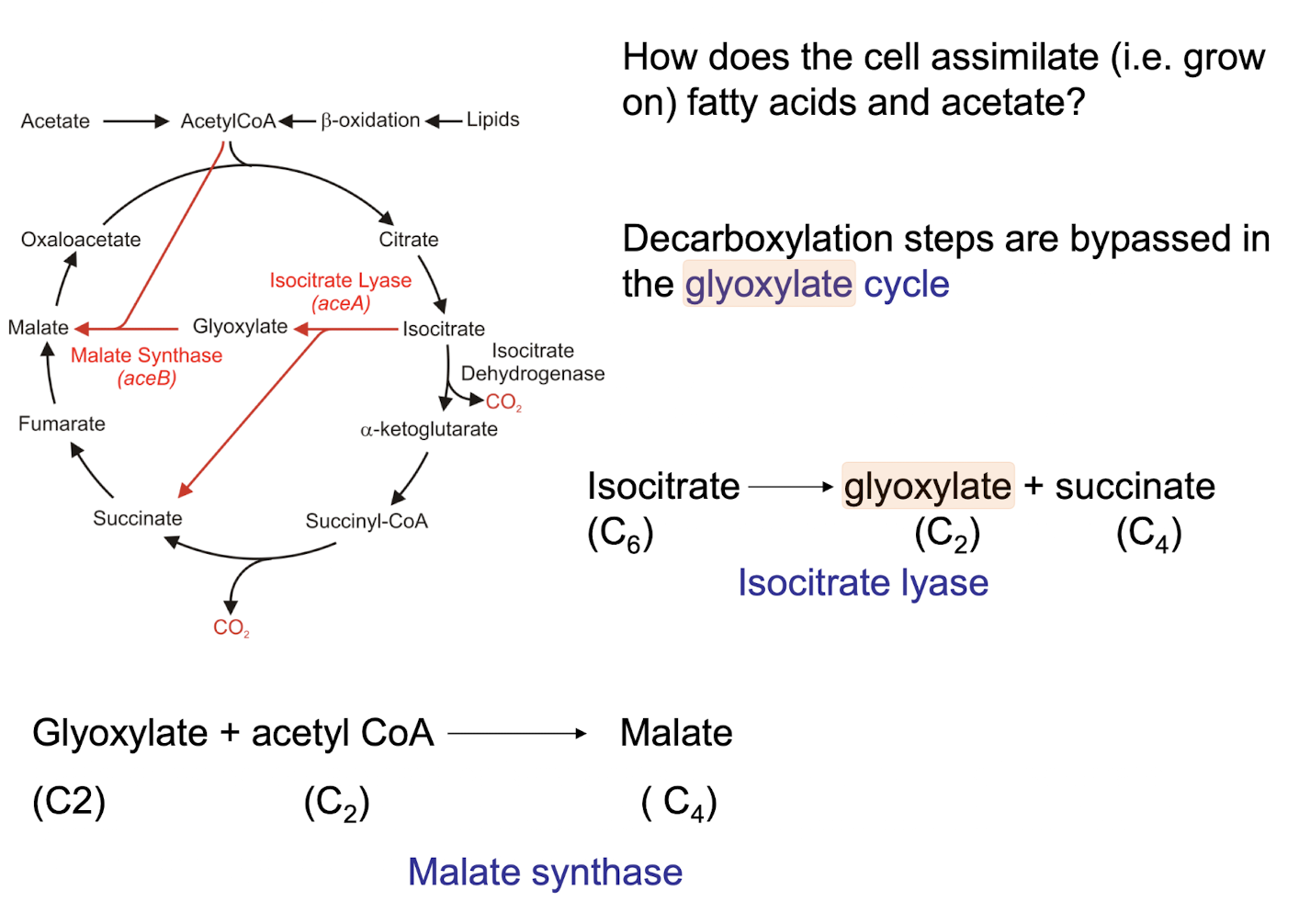
What is the glyoxylate cycle and its metabolic purpose?
A CAC bypass that preserves carbon skeletons by producing malate from isocitrate via isocitrate lyase, bypassing 2 decarboxylation steps that release CO2
replenishing CAC intermediates for biosynthesis and allowing for growth on fatty acids instead of carbohydrates.
enables organisms to convert FAs into carbohydrates, facilitating energy generation and growth in certain microorganisms and plants.
What is involved in β-oxidation?
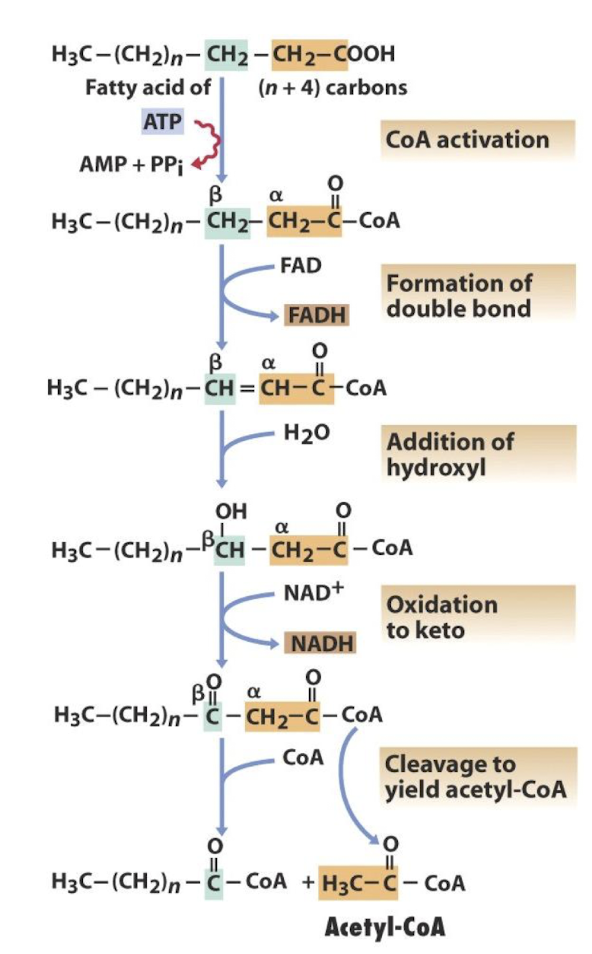
The process involves the enzymatic breakdown of fatty acids into acetyl-CoA units, accompanied by the production of NADH and FADH2 for ATP generation.
Main steps in β-oxidation
Co-enzyme A is used to ‘activate’ the fatty acid
Oxidation of the carbon-carbon bond between alpha and beta carbon atoms
FADH formed
Makes the beta-carbon atom vulnerable to ‘attack’ by water resulting in its oxidation → NADH produced
Acetyl CoA is split off and the cycle starts again
Beta-oxidation: oxidation of the beta carbon atom of the fatty acid
How does the glyoxylate bypass replace finite CAC intermediates?
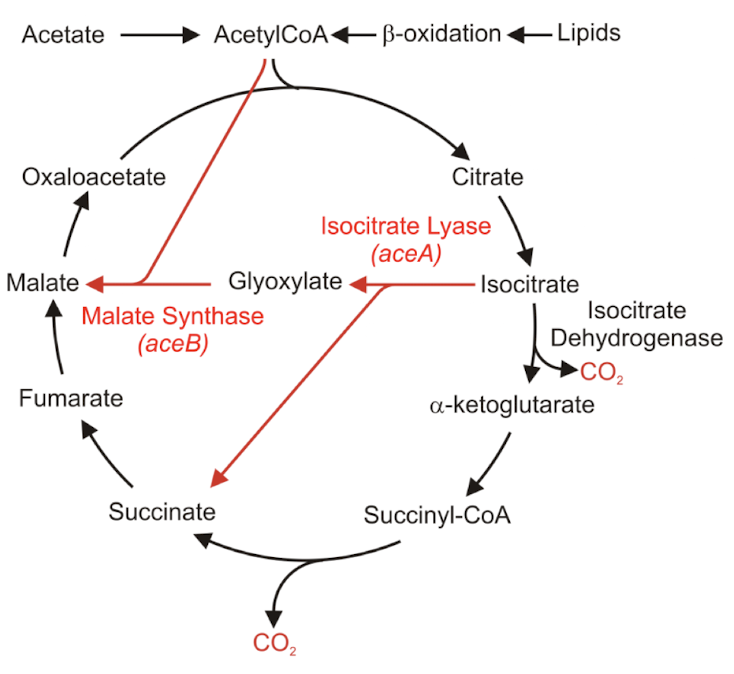
Isocitrate lyase cleaves isocitrate → succinate and glyoxylate
Glyoxylate condenses with acetyl CoA to form malate.
Contributes a new CAC intermediate molecule
Instead of being oxidised to 2 CO2 molecules, the 2-C glyoxylate fragment condenses with another acetyl CoA to form the 4-C compound malate.
Increases levels of all CAC intermediates, because malate can be oxidised to oxaloacetate that condenses with yet another acetyl CoA to form citrate, and so on.
What steps of the CAC are bypassed by the glyoxylate cycle?
The glyoxylate cycle bypasses the decarboxylation steps involving isocitrate DH and alpha-ketoglutarate DH, which release CO2
What enzymes are induced / inhibited by cells growing on acetate / FAs?
Cells growing on acetate or fatty acids induce synthesis of isocitrate lyase (aceA) AND inhibit activity of isocitrate dehydrogenase to force flow of carbon through the glyoxylate bypass
This allows assimilation via gluconeogenesis of fatty acids and acetate
What is gluconeogenesis?
the process of making glucose from non-carbohydrate sources i.e. CAC intermediates, amino acids, acetate to support energy needs and biosynthesis when sugars are scarce.
Why is the glyoxylate cycle is essential for growth on fatty acids?
Fatty acids yield only acetyl-CoA
β-oxidation produces acetyl-CoA, but acetyl-CoA cannot be converted into glucose through the standard TCA cycle because:
In the TCA cycle, the two carbons from acetyl-CoA are lost as CO₂
There is no net carbon gain for biosynthes
How is the glyoxylate cycle important for C skeleton preservation?
The glyoxylate cycle conserves carbon
The glyoxylate cycle bypasses the CO₂-producing steps (isocitrate dehydrogenase and α-ketoglutarate dehydrogenase). This allows:
Net conversion of acetyl-CoA carbon into succinate and malate
Preservation of carbon skeletons needed for anabolism i.e. AA biosynthesis
What is a pathogen that uses the glyoxylate cycle for virulence?
Rhodococcus equi causes pneumonia in horses and grows inside host cells
grows well on both fatty acids and acetate AND induces Isocitrate lyase when growing inside host cells
 Note
Note  Flashcards (105)