Multimodal Linguistics III
 Call Kai
 Learn
Learn Practice Test
 Spaced Repetition
 Match
Match Flashcards
 Knowt Play
1/73

There's no tags or description
Looks like no tags are added yet.
Name | Mastery | Learn | Test | Matching | Spaced | Call with Kai |
|---|
No analytics yet
Send a link to your students to track their progress
74 Terms
What is multimodal discourse analysis?
An approach that examines multiple modes of communication (text, colour, images) and analyzes not just how individual modes communicate, but how they interact with one another to create semiotic meaning
Name the five different approaches to multimodal text analysis mentioned in the lecture.
Mediated Discourse Analysis (MDA)
Systemic Functional Multimodal Discourse Analysis,
Social Semiotics
Multimodal (Inter)action Analysis
Multimodal Conversation Analysis
Which three multimodal analysis approaches focus on image-centric texts?
Mediated Discourse Analysis, Systemic Functional Multimodal Discourse Analysis and Social Semiotics (visual communication)
Which two multimodal analysis approaches focus on interaction and speech?
Multimodal (Inter)action Analysis and Multimodal Conversation Analysis (gesture, behaviour and speech)
What are the three main challenges that multimodal discourse analysis needs to overcome?
What are the boundaries for a multimodal text?
What are the different semiotic modes operating in a multimodal text?
How should these different semiotic modes be broken down for analysis?
What are the four stages for analyzing multimodal texts?
Stage 1 - Notice communicative situation (function/purpose/goals)
Stage 2 - Recognize visual 'gestalts' and form signs (genre conventions)
Stage 3 - Work out text content (what is depicted in which context)
Stage 4 - Integrate different semiotic modes (how they relate to each other)
What fundamental assumption does multimodal discourse analysis make about semiotic artefacts?
Every semiotic artefact operates on three levels called 'meta-functions', which are adapted from Michael Halliday's functional grammar to accommodate multimodal discourse
What is the claim of visual grammar?
There are formal configurations/patterns in images, which come equipped with certain, more or less stable social meanings
What are the three original metafunctions from Halliday's functional grammar?
Ideational function (semiotic systems represent aspects of the outside world, e.g. statements)
Interpersonal function (semiotic system construes a social relationship between producer viewer and objects represented, e.g. speech acts)
Textual function (semiotic systems form text)
What are the three image-based metafunctions for the multimodal text (communicative artefacts), corresponding to Halliday's original metafunctions?
Representation (what is depicted)
Interaction (relationship between image and viewer)
Composition (how elements are arranged)
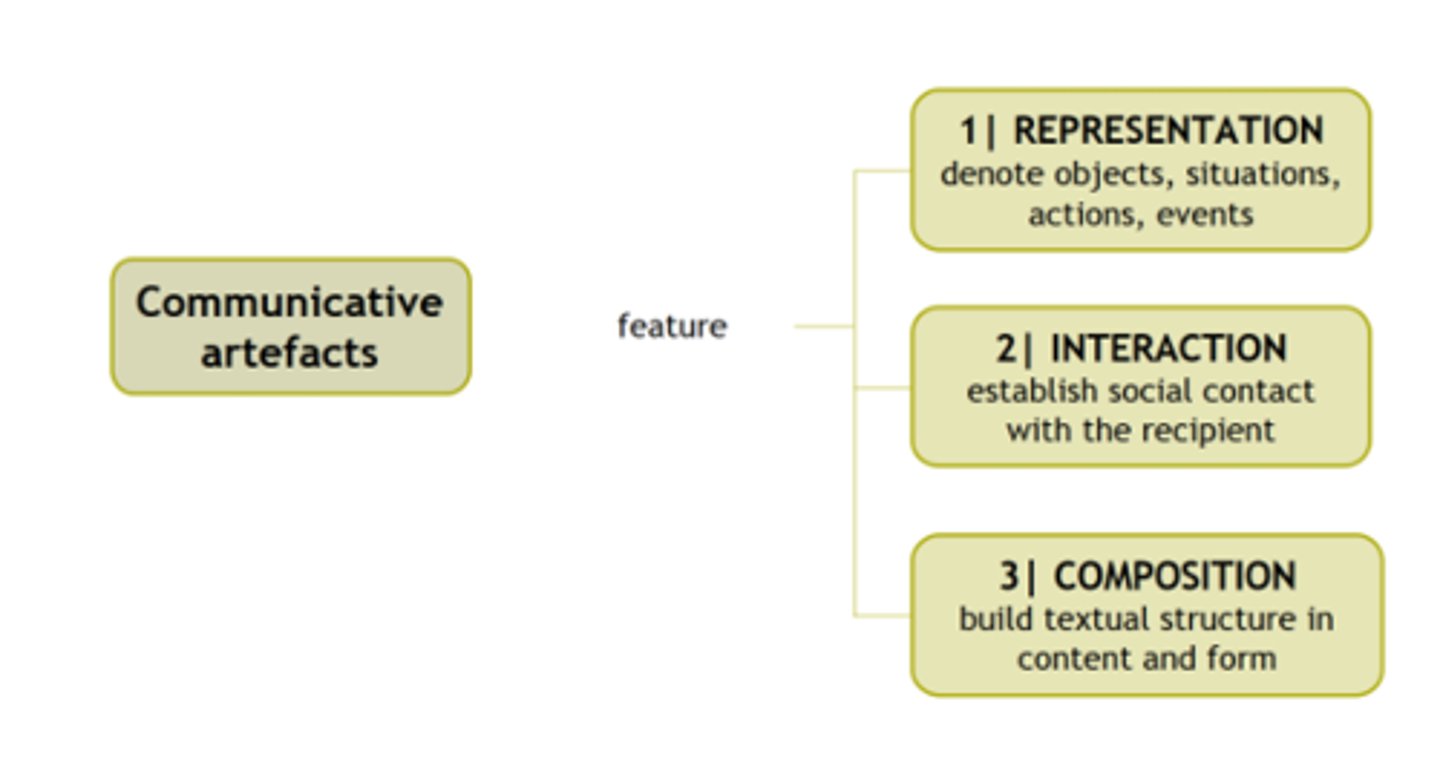
What are the four elements that contribute to REPRESENTATION?
Narrative or Conceptual --> Setting and Look of Participants
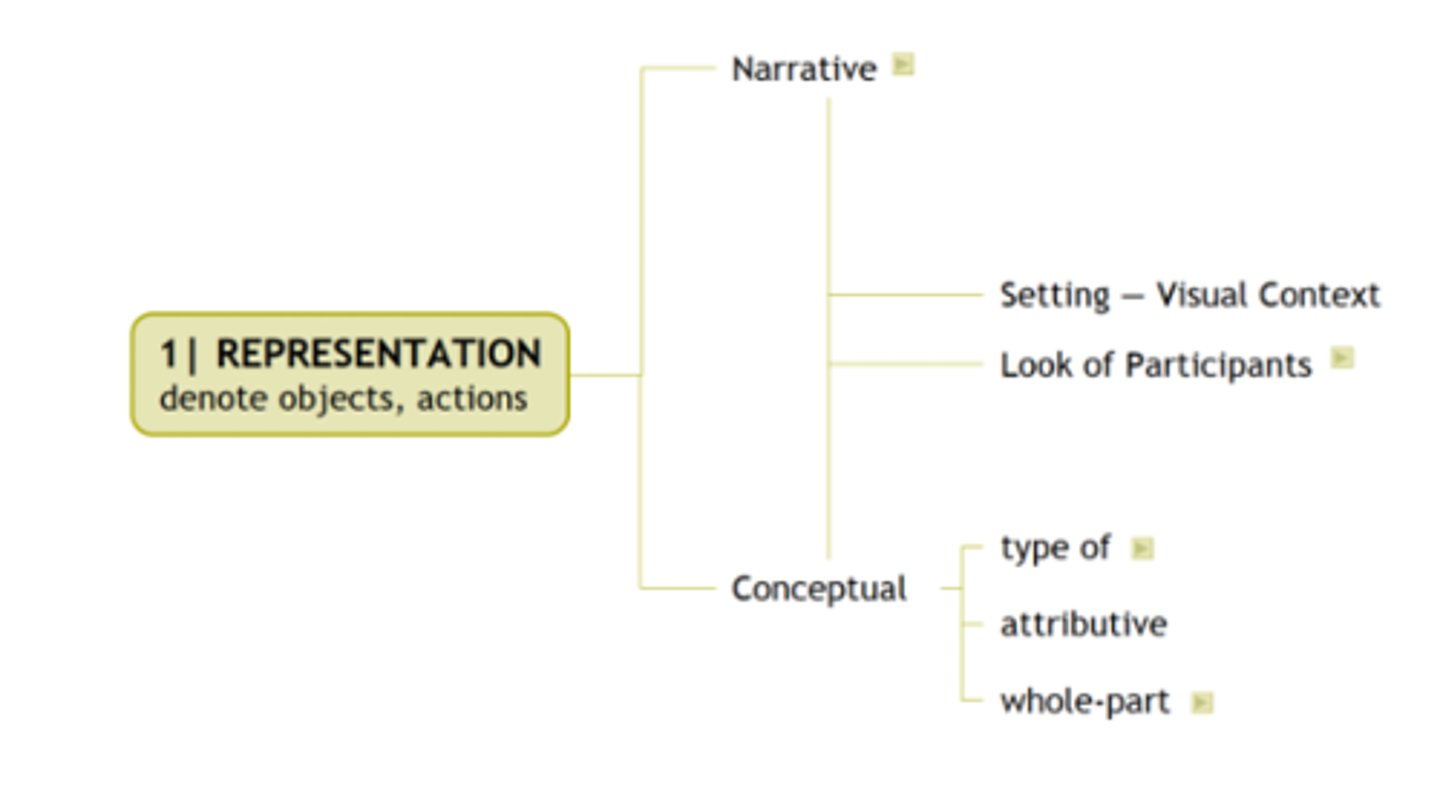
When is a image narrative?
If it depicts actions, processes or events
What does conceptual structures do and what does they not contain?
They represent participants (visual elements) in their class, structure, properties and meaning
Do not contain vectors --> they show objects
Name the three subcategories of conceptual.
Type of - attributive - whole-part
In terms of 'setting', pictorial meaning does not only emerge from the represented participants and their relations, but also from ...
... the circumstances of the action or object representation (context/situation)
What does the element 'Look of participants' mean?
Any optical detail of the main visual elements (participants) colours in the visual meaning expressed by the configuration of actors/participants (e.g. clothes, appearance)
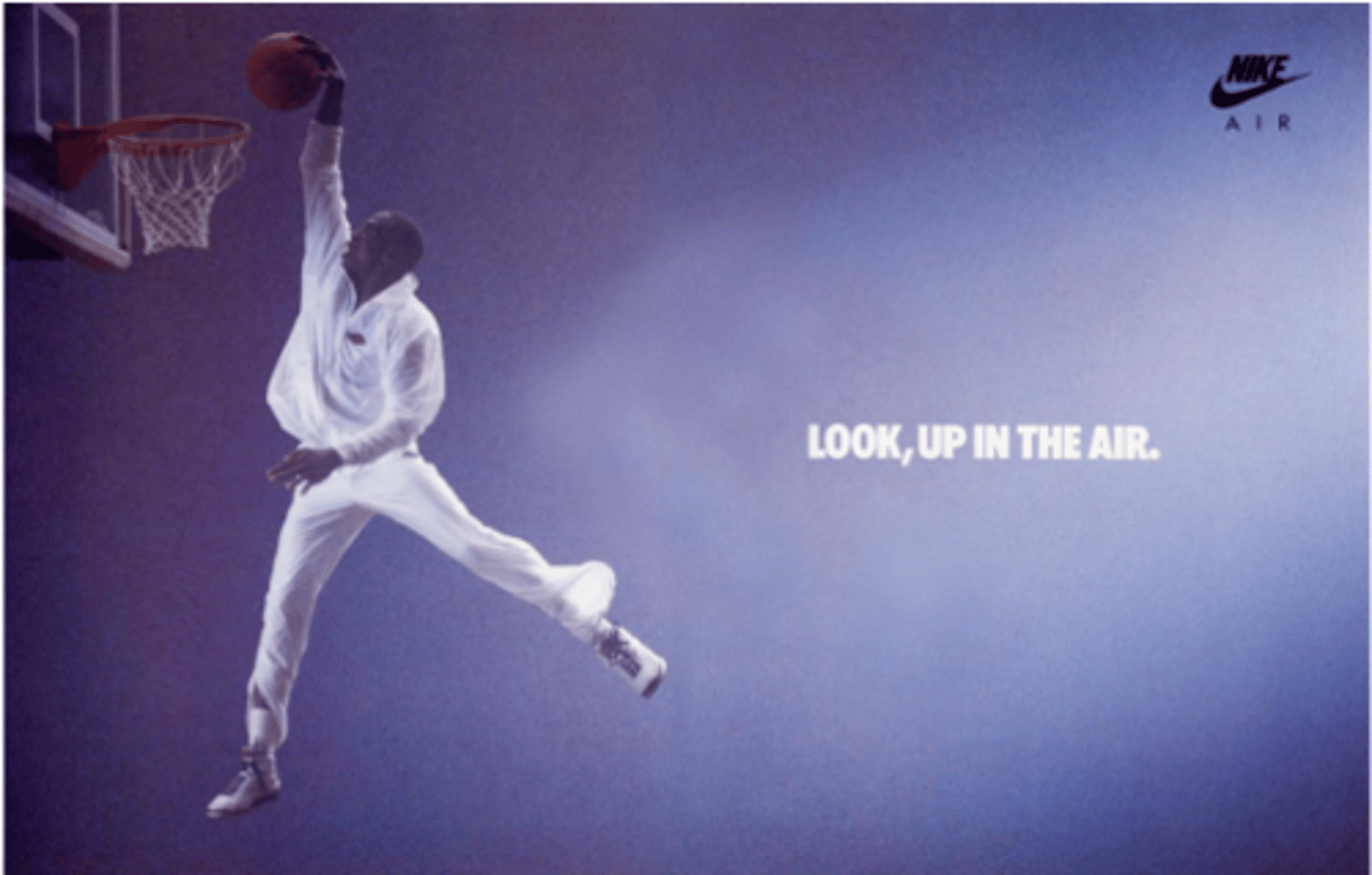
What is a transactional narrative image?
A unidirectional transaction where a person performs an action directed at an object
Example: an athlete shooting hoops - the vector connects the athlete/basketball to the basket
Name the five types of narrative representations in images.
Non-transactional (intransitive actions)
Reactional (formed by eye-lines or gaze)
Conversion (circular action)
Speech process (participants speaking)
Mental process (thinking/reflecting)
Type one of conceptual pictures, 'type of', has three major types of structures, name them.
Classificational structures, Analytical structures and Symbolical structures
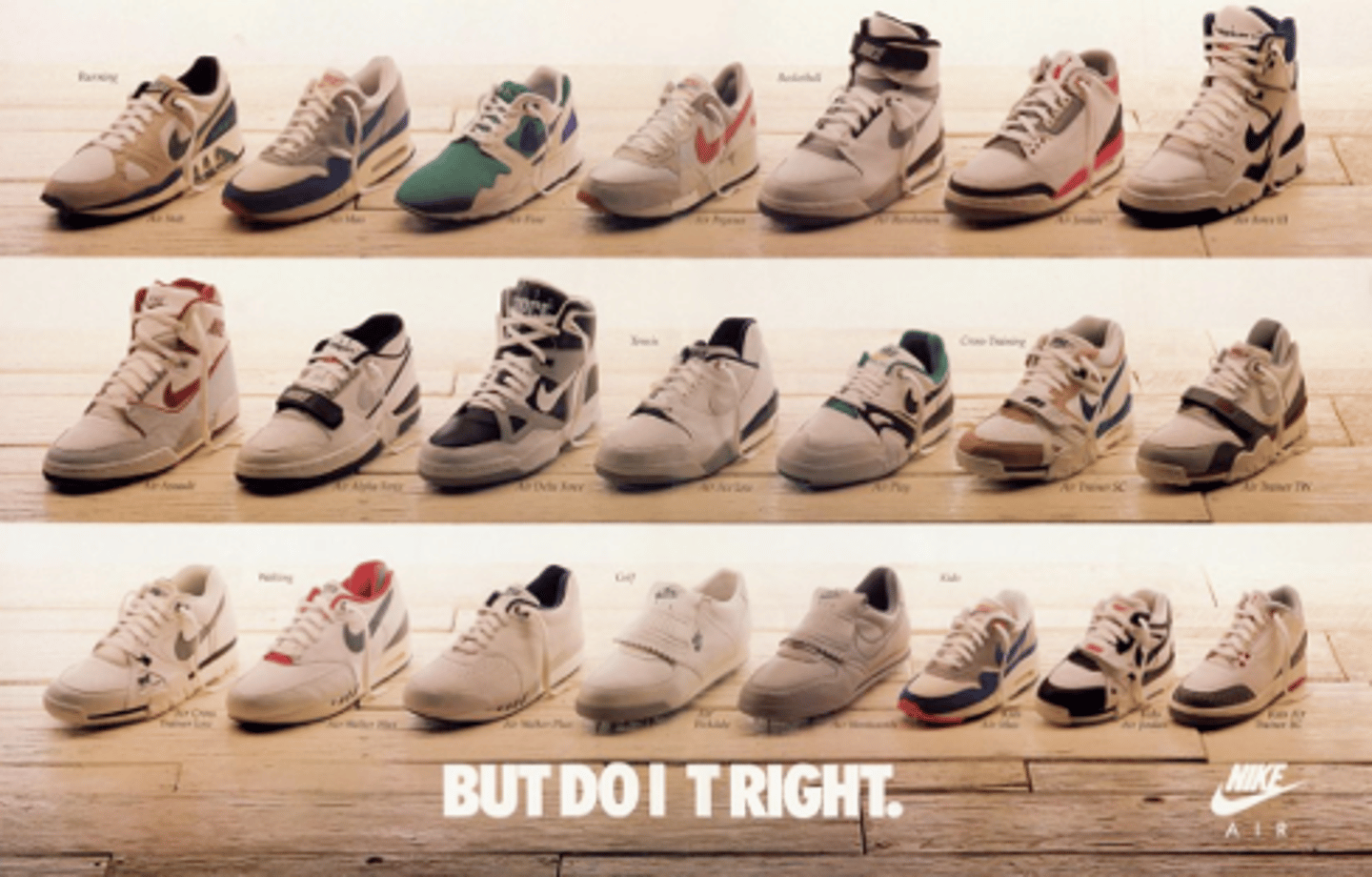
Descripe a sample for type two of conceptual pictures, 'whole-part'.
A shoe (whole) is shown as consisting of various component parts ('exhaustive analytical process')

What are 'circumstances' in visual meaning and what two categories/elements do they fall into?
Circumstances are secondary represented participants that are not directly part of the narrative or conceptual structure but provide additional detail
Elements of the setting and Look of the participants
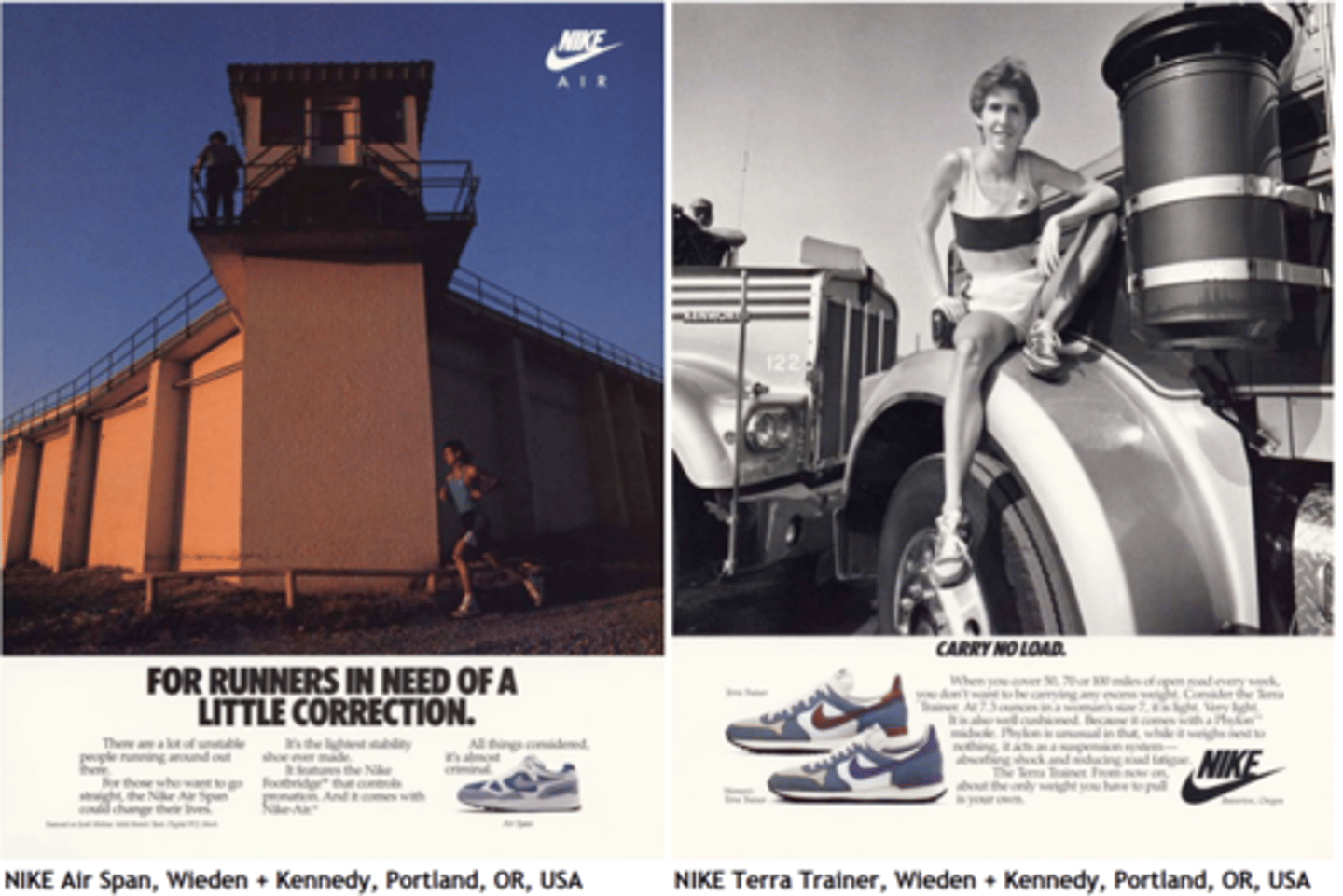
What is INTERACTION about?
Interaction is all about how viewers are (socially) positioned to pictorial content
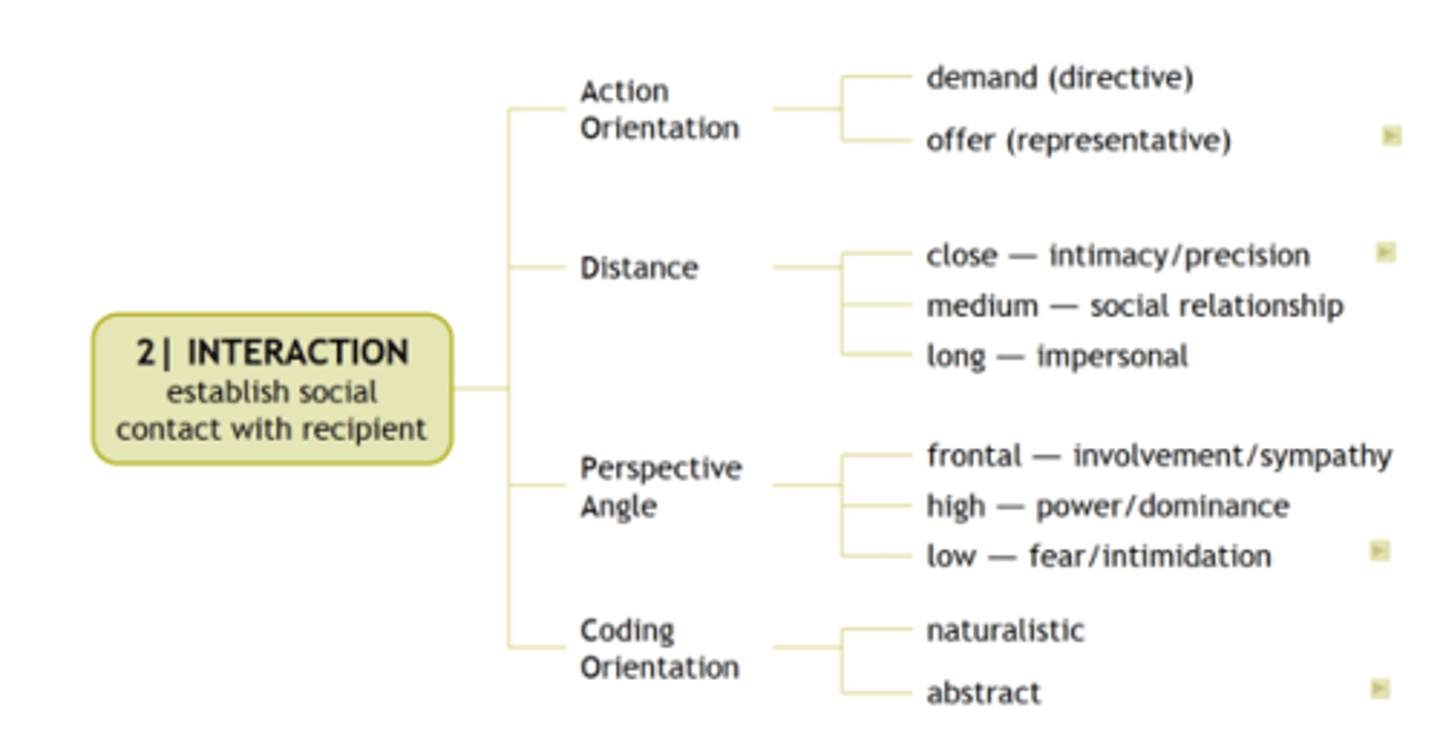
What are the four elements that contribute to INTERACTION?
Action Orientation (Image Act/Gaze) - Distance - Perspective Angle - Coding Orientation
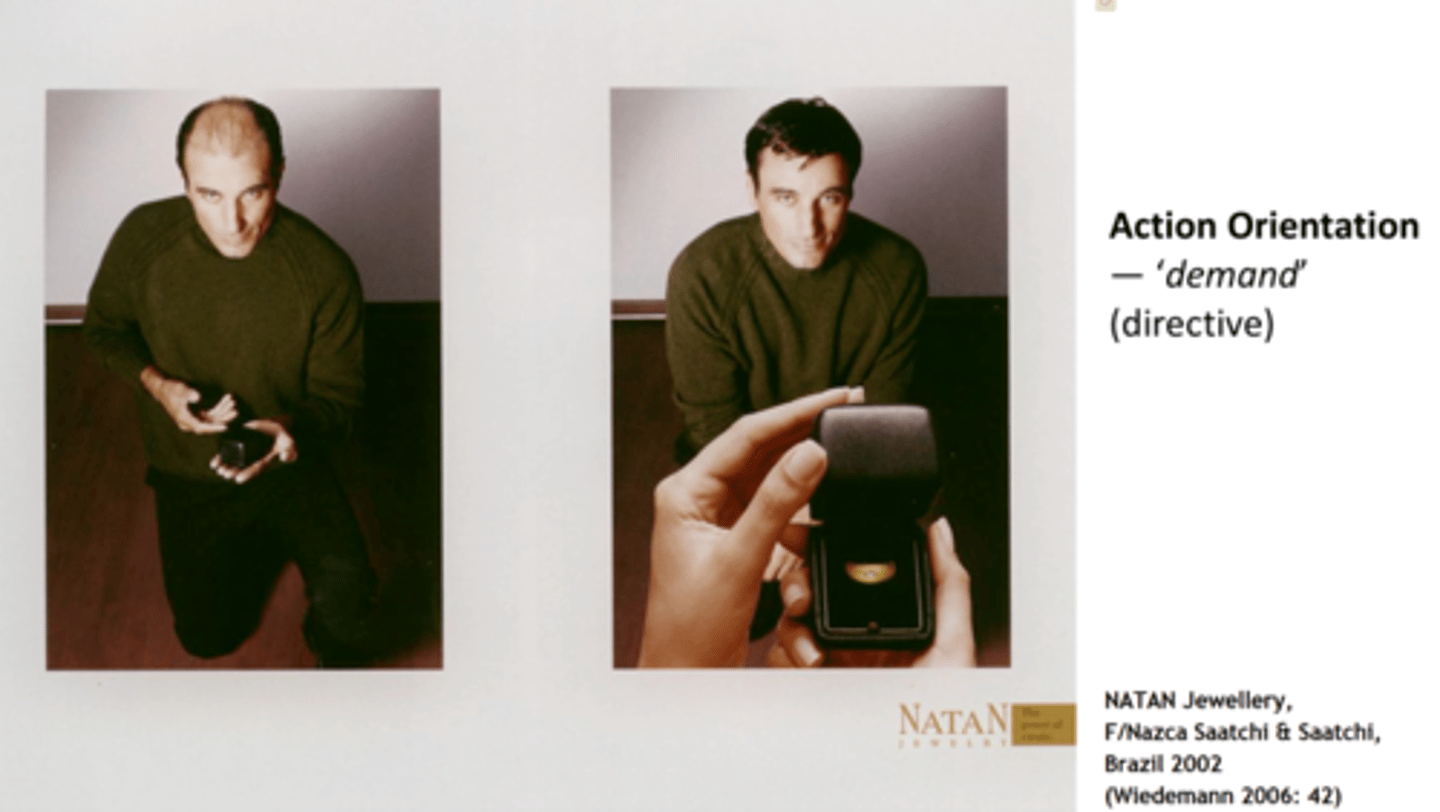
What is action orientation (image act/gaze) about and what are the two subcategories?
Pictures can offer information or demand action
Demand (directive - Kontakt zwischen dargestellten Teilnehmern und Betrachter besteht) and offer (representative - Kontakt besteht nicht)
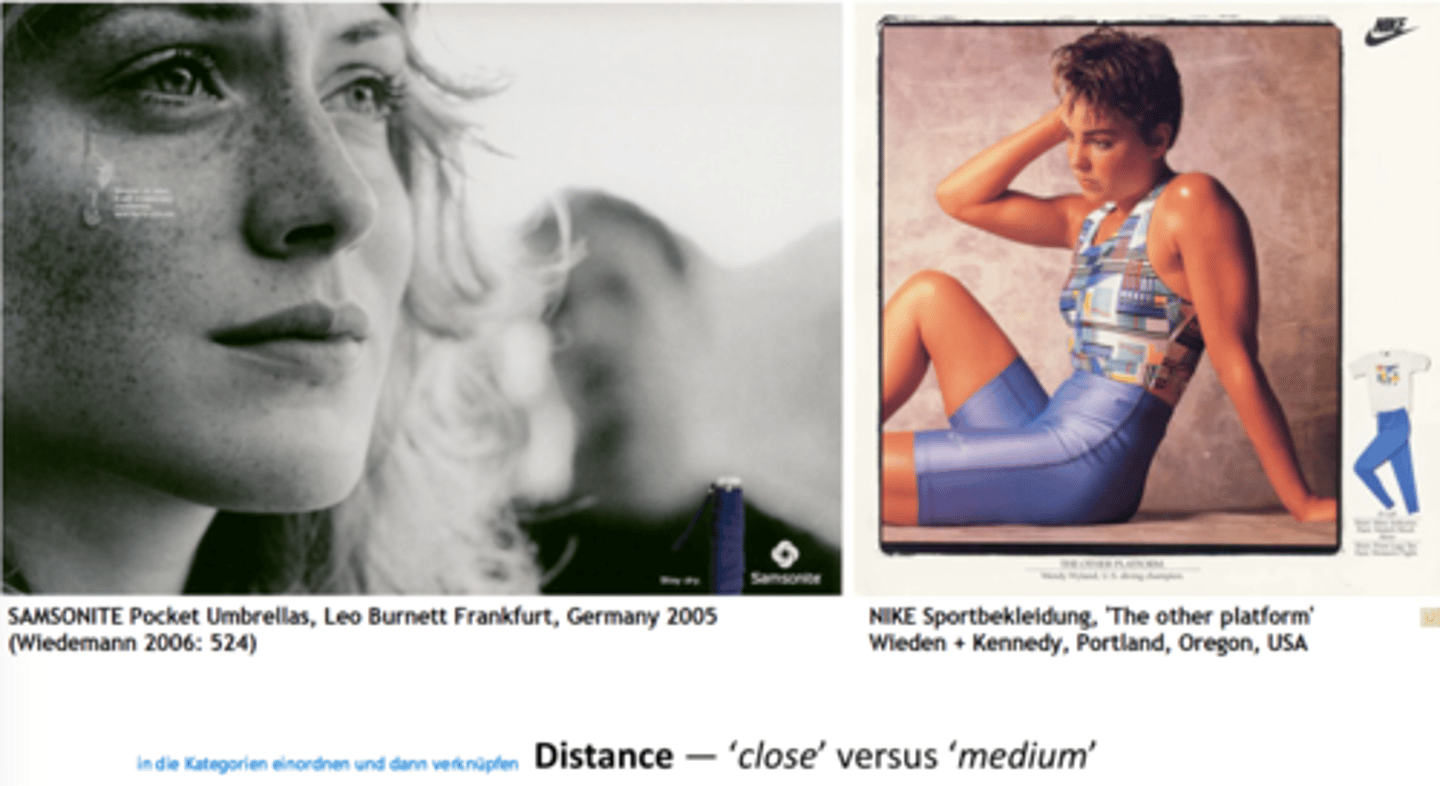
What is distance about and what are the three subcategories?
Relationships between represented and viewer - how far is it physically away and/or how far is the social distance?
Close - intimacy/precision, medium - social relationship, long - impersonal
What is perspective about and what are the three subcategories?
How are viewing it and from which perspective?
Frontal (involvement/sympathy), high (power/dominance) and low (fear/intimidation)
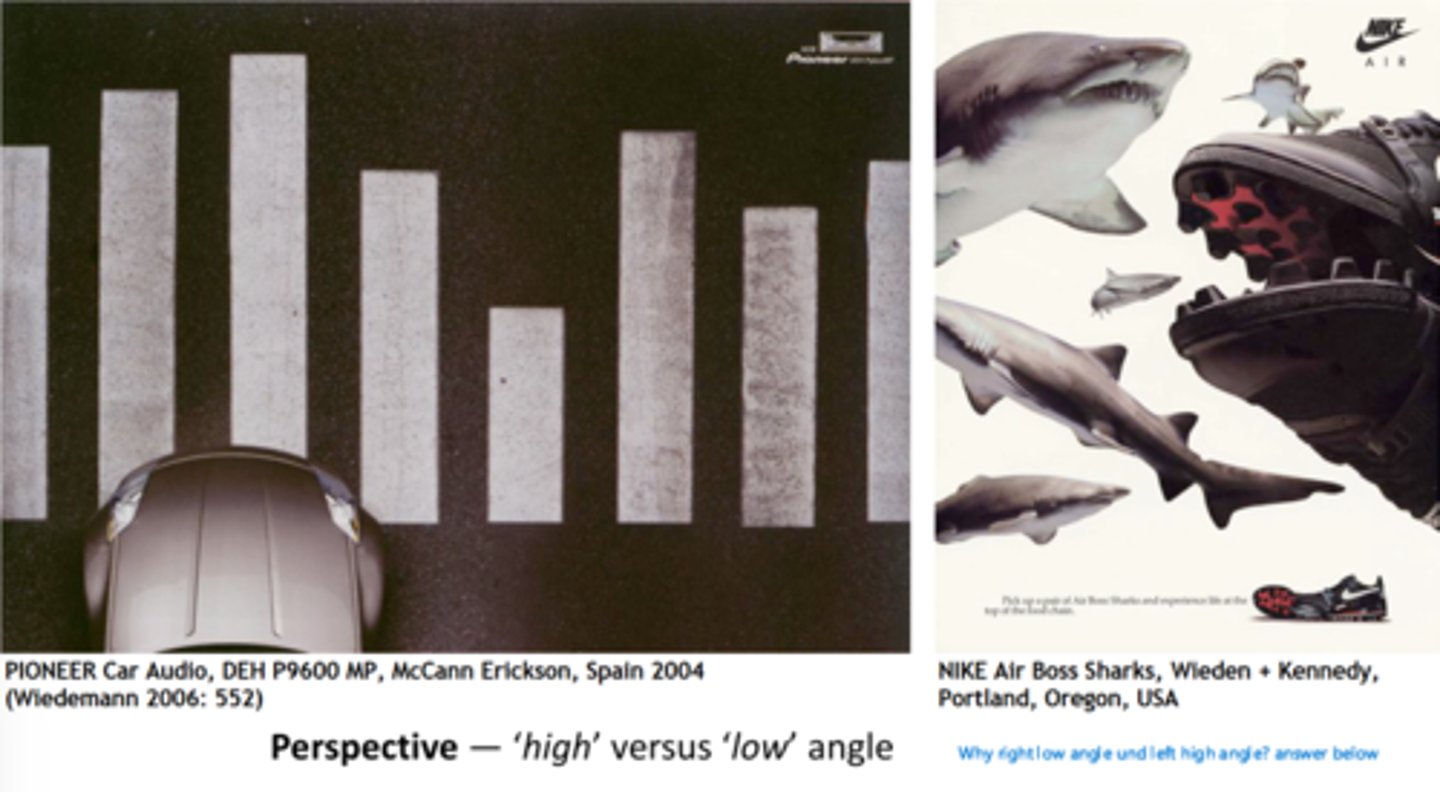
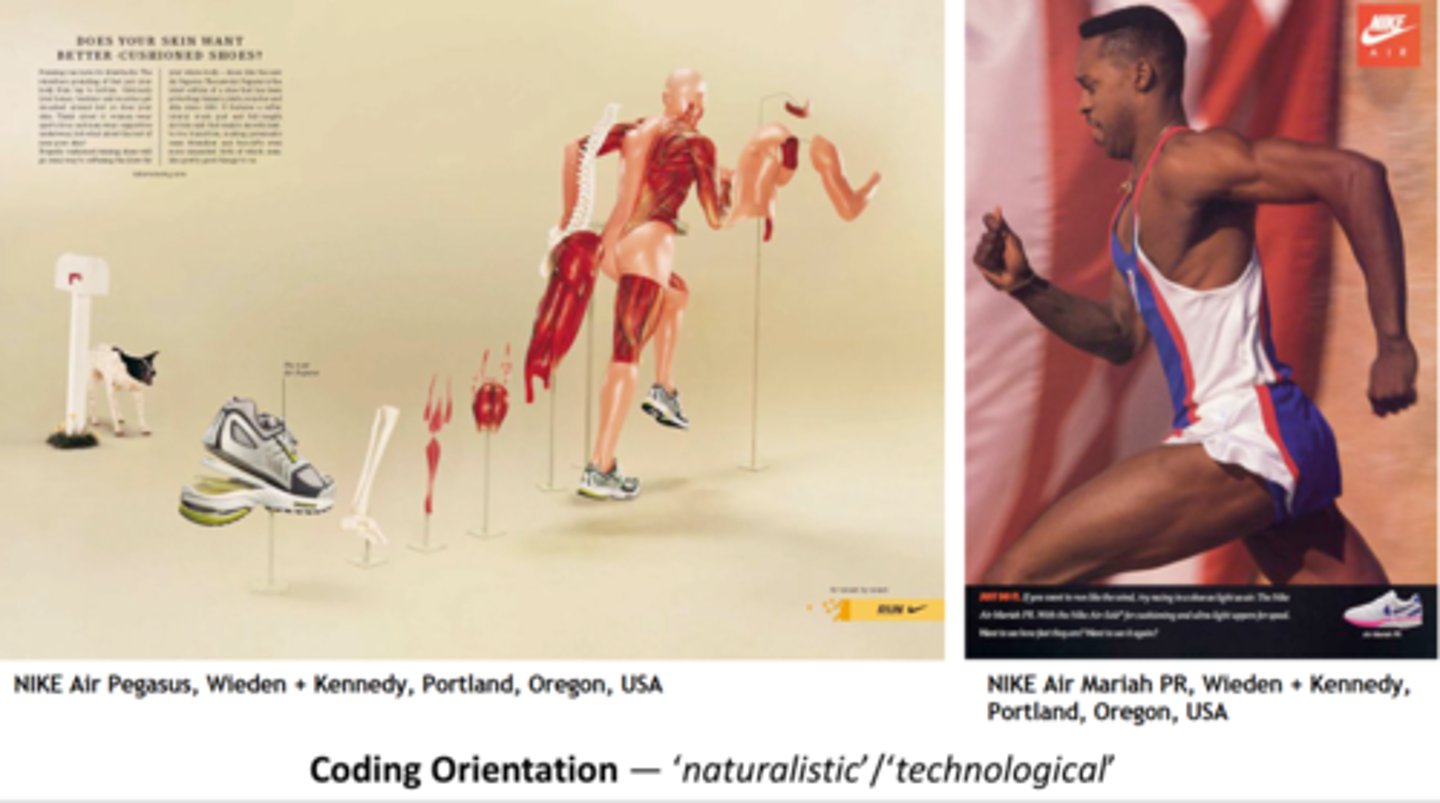
What is coding orientation about and what are the four subcategories?
The relationship between content and reality
Sensory (hyperrealistische Darstellung), technological (Röntgenbilder, Modelle), naturalistic (Fotografie) and abstract (Skizze, Karte, Diagramm)
What is COMPOSITION about?
Organises and guides the attention of the viewer during visual understanding
Relates the representational and interactive meaning of the picture to each other through interrelated systems
What are the three elements that contribute to COMPOSITION?
Information value, framing and salience
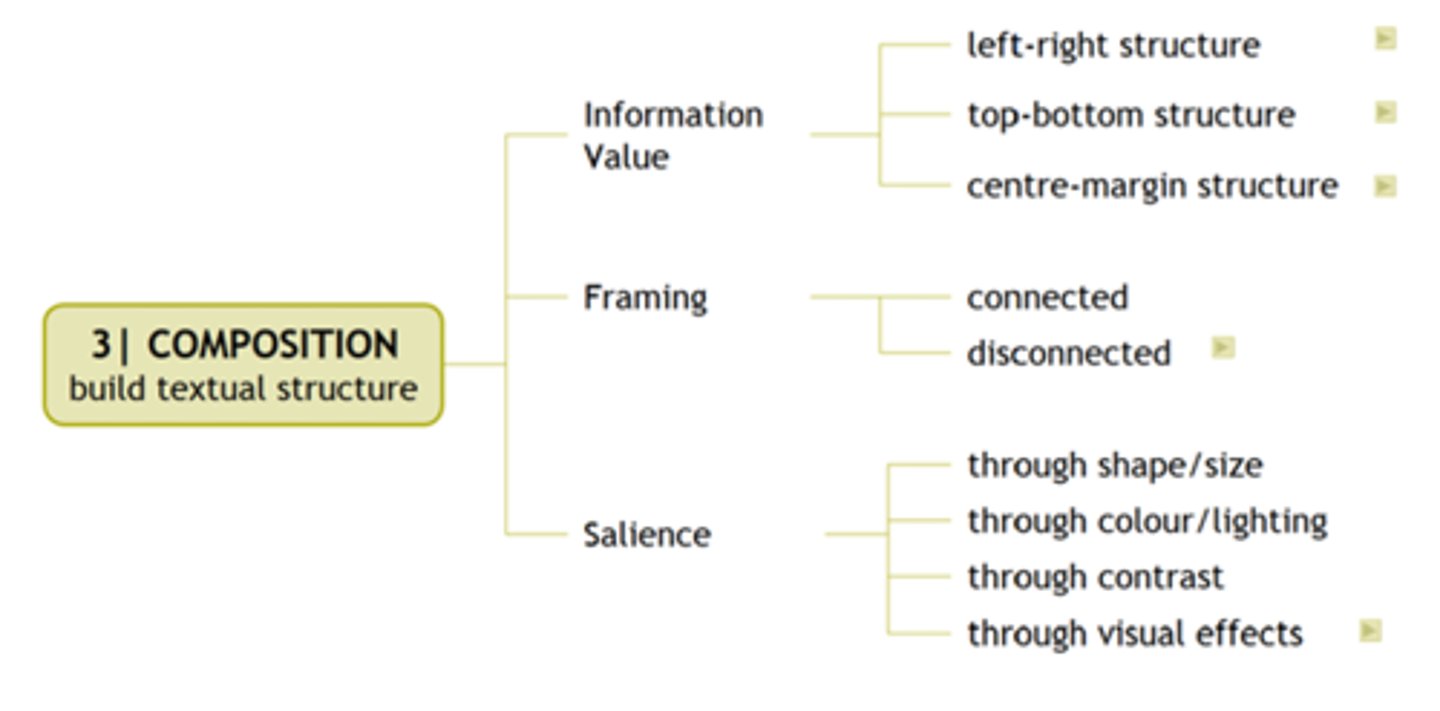
What is information value about and what are the three subcategories? (examples for subcategories - week 10 page 22, 24 and 26)
The placement of elements and how they transport the specific informations through their position
Left-right structure, top-bottom structure and centre-margin strucutre
Semiotic modes ... in contexts to form multimodal texts.
co-operate
Is there a mono-modal text?
No (all multimodal)
What are the two subcategories of framing?
Connected and disconnected
Through what four subcategories can salience be expressed?
Shape/size, colour/lighting, contrast and visual effects
We experience events - what does these events do? (3)
Units demarcate what happens (Grenzen Geschehen ein), inform our actions and reactions and help us react correctly to the things happening in the world
What do we subjectively experience rather than raw sensory data?
Events
(These event units demarcate what happens, help us encode and retrieve information in memory, support inferences about what will happen next, inform our actions and reactions, and fit our understanding of causal origins and outcomes - Grenzen das Geschehen ab und helfen uns es einzuordnen, zu verarbeiten und richtig darauf zu reagieren)
What are the two types of processes involved in event representation?
Bottom-up (low-level) processes:
Reacting to prominence markers such as edge detection, contrast, boundaries, or thresholds
Top-down (higher-order) processes:
Prior experience, learning, goals, values, and information about causality
What is the difference between temporally bounded and unbounded events and which endpoints are more salient?
Bounded events have a natural, inherent endpoint and are temporally bounded
Unbounded events are unspecified about when they end and are temporally unbounded
Research shows that endpoints of bounded events are more salient than those of unbounded events
Why are event boundaries important for cognition?
Event boundaries serve as anchors for comprehending, learning, and describing events
Sharply defined boundaries carry richer information and make it easier to individuate events, compare them to other events, generalize from them, and remember them
What is the bi-directional relationship between events, boundaries, and attention?
Events are connected to both boundaries and attention
Both boundaries and attention can shape and influence whether we experience something as a cohesive unit or as a fragmentary and disconnected stream of sensory data - the relationship works in both directions
What are the three central concepts that distinguish how we process information and how do they differ?
Prominence (standing out):
Not all things that stand out get our attention or matter
Salience (attention):
Not all things that get our attention stand out or matter
Importance (mattering):
Not all things that matter necessarily stand out or get immediate attention
These three concepts are related but distinct aspects of information processing
Name two tools for the multimodal annotation of interactional data.
Elan and NOVA
How are multimodal texts formed?
Semiotic modes co-operate in contexts
What is the "division of communicative labour" in multimodal texts?
In multimodal texts, every mode has a specific function to fulfill
Different modes are assigned different communicative tasks in order to optimally achieve the text's aim in context
Each mode contributes what it does best
What are affordances and constraints of semiotic modes and what do they do?
Affordances are what a mode can do well or makes possible (its strengths and capabilities)
Constraints are what a mode cannot do well or limits (its restrictions)
These affordances and constraints determine what each mode is useful for in a text
What does it mean that mode-combination is "strategic and patterned"?
The integration of the semiotic modes can be described and analysed
How do modes create cohesive and coherent wholes?
Modes interlock on various levels to form unified texts - the integration happens at multiple levels simultaneously, and it takes different analytical approaches to fully describe what is happening in this integration process - the modes work together to create both cohesion (structural unity) and coherence (meaningful unity)
What are the three ways that language can be mediated by technology according to the lecture?
Mediating ourselves to do new things (e.g., glasses, hearing aids, bio-hacking)
Mediating the environment to support different things (e.g., social media, presentations, film/TV)
Mediating the code to do different things (e.g., manipulating, recording, editing sound, image, movement)
How do typography and sound differ as second-order semiotic systems?
Typography is inherently attached to written language (you don't get typography without typeface)
Sound is not inherently connected to speech
Technology has changed what's possible with typography and who can access it, while sound has been mediated to shift from ephemeral (vergänglich) and situated to stable and digital
Why has typography moved from the periphery to the centre of the 'semiosphere'? (2)
Technology has enhanced typographic options and made them available to everyone, not just specialists like type-setters
Our sensitivity to the social meanings of typographic design has increased with exposure
What does the text-graphic design of a piece of communication include? (4)
Font design/type-faces used
Copy-setting on the page
Layout of page and document
Choice of material and printing technique
Why is typography described as a "secondary system of meaning-making"?
Because it clings to a primary one (written language)
We don't pay much attention to type as we focus on the meaning of words, but typography cannot be avoided - just as you cannot speak without intonation, voice, and stress
According to van Leeuwen (2005), what are the two levels of meaning in printed words?
The 'word image' - the idea represented by the word itself, constructed from letters
The 'typographic image' - the holistic visual impression created by the typography
What are the four kinds of typography?
Microtypography
Mesotypography
Macrotypography
Paratypography
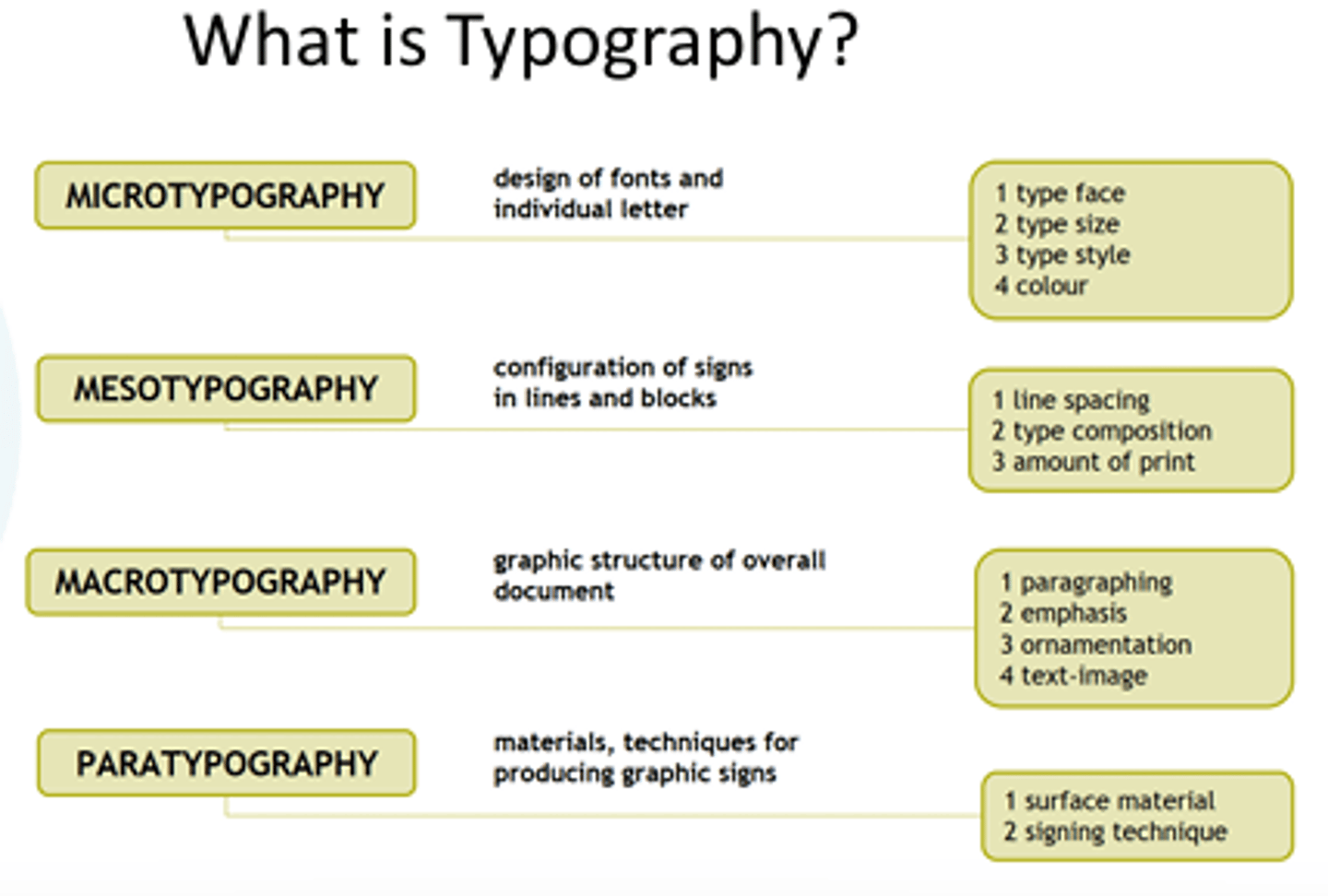
Describe Microtypography and what four aspects does it include?
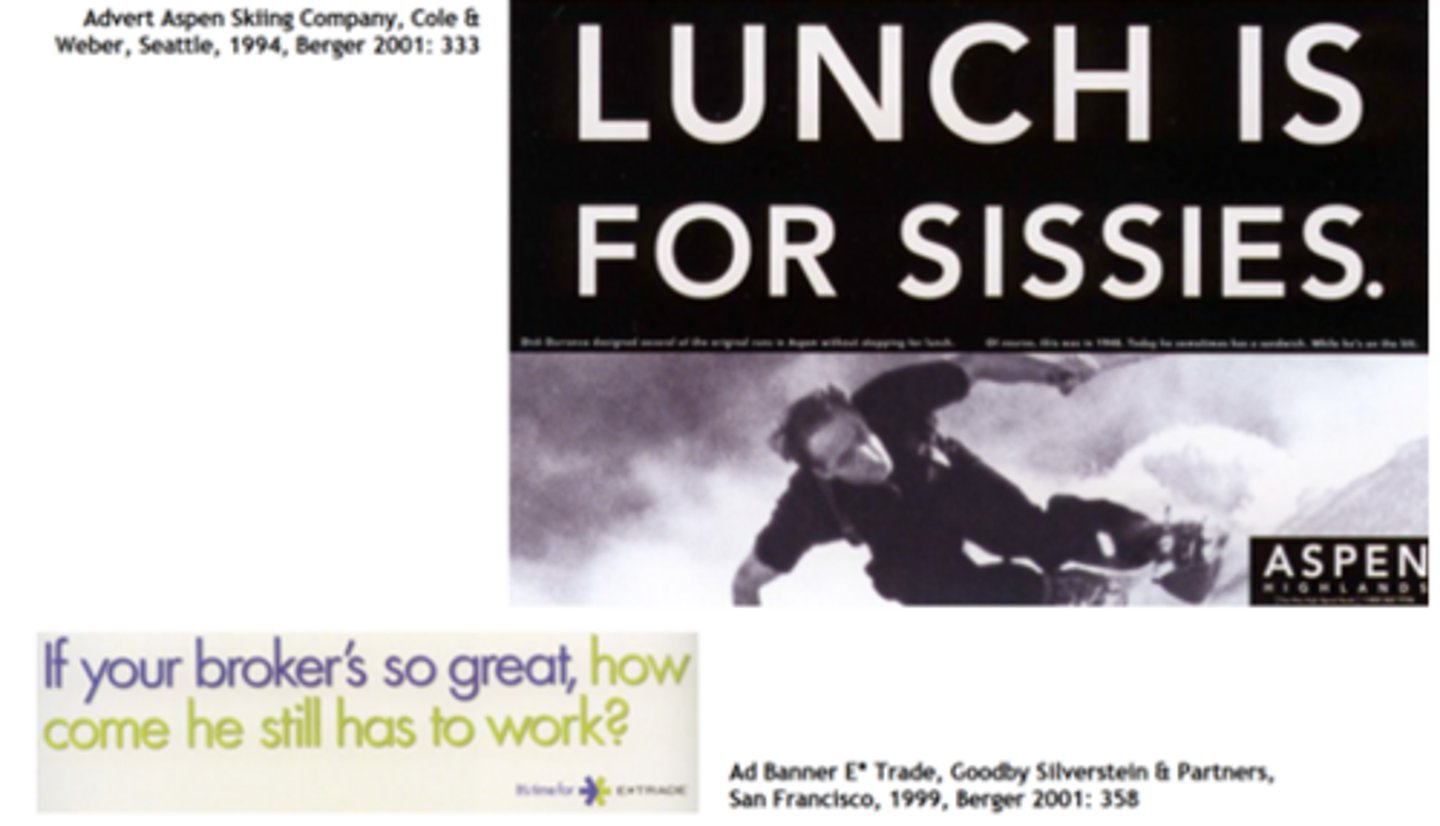
Design of fonts and individual letter
Type face, type size, type stile and colour
Describe Mesotypography and what three aspects does it include?
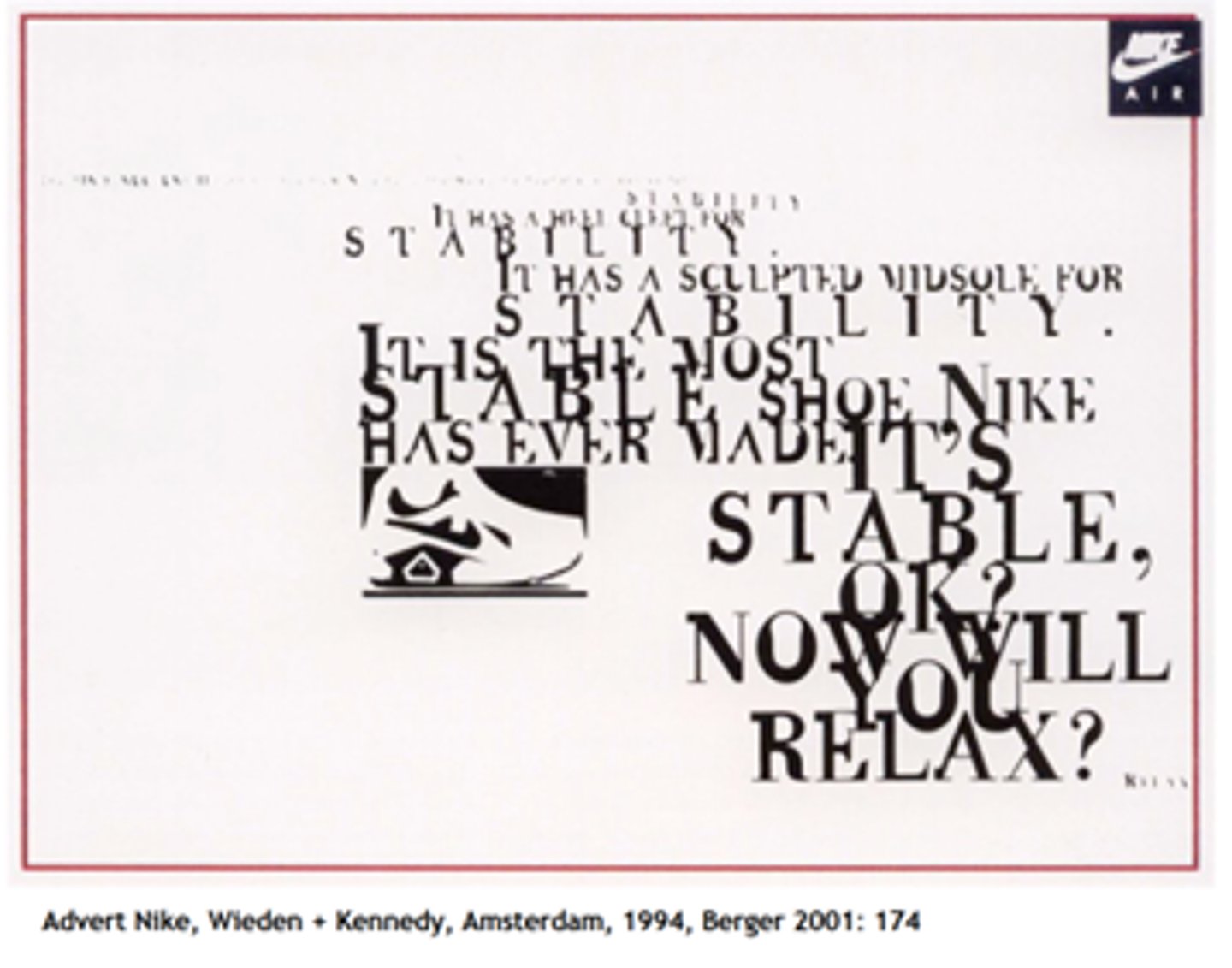
Configuration of signs in lines and blocks
Line spacing, type composition and amount of print
Describe Macrotypography and what four aspects does it include?
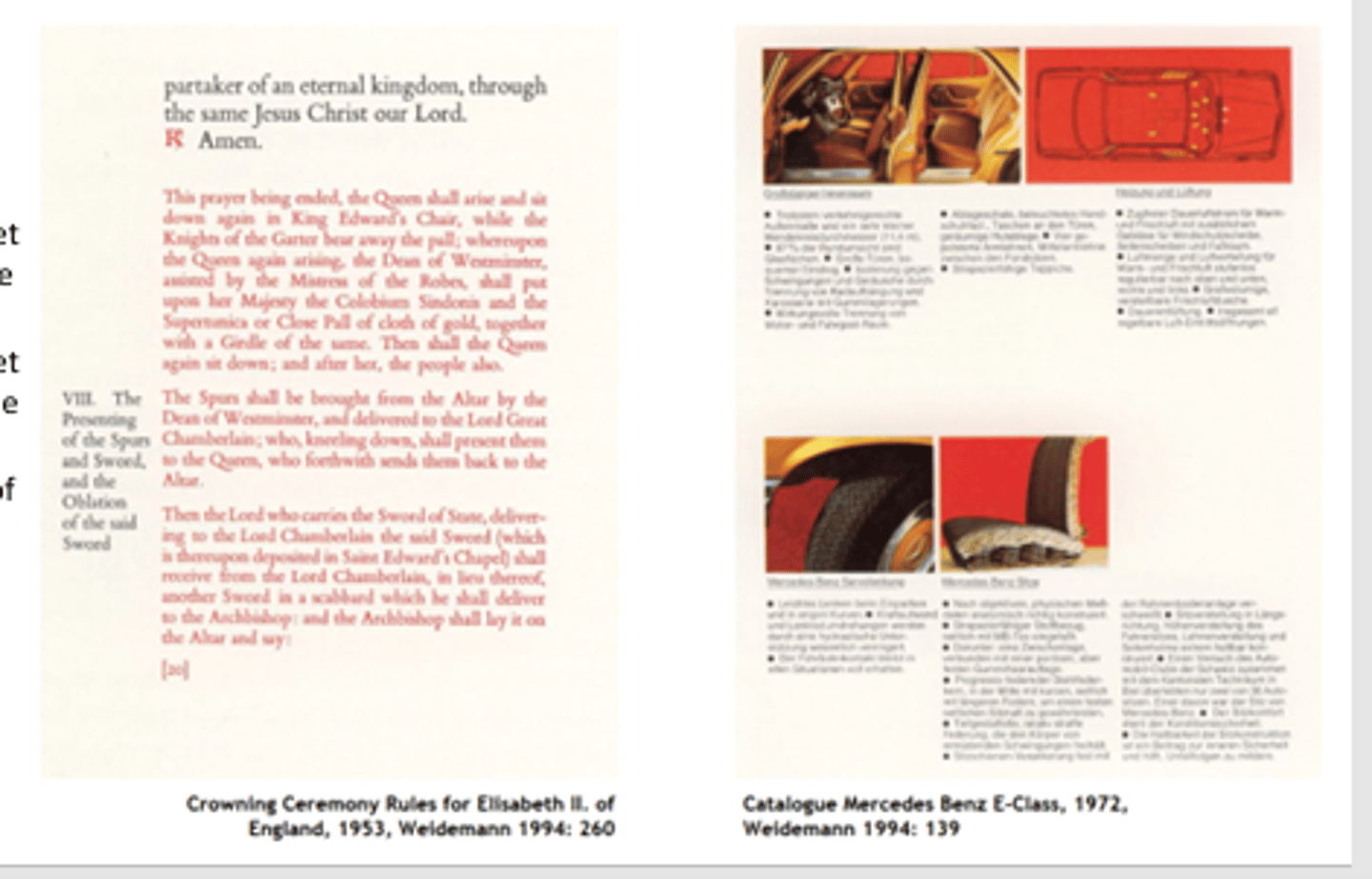
Graphic structure of overall document
Paragraphing, emphasis, ornamentation and text-image
Describe Paratypography and what two aspects does it include?
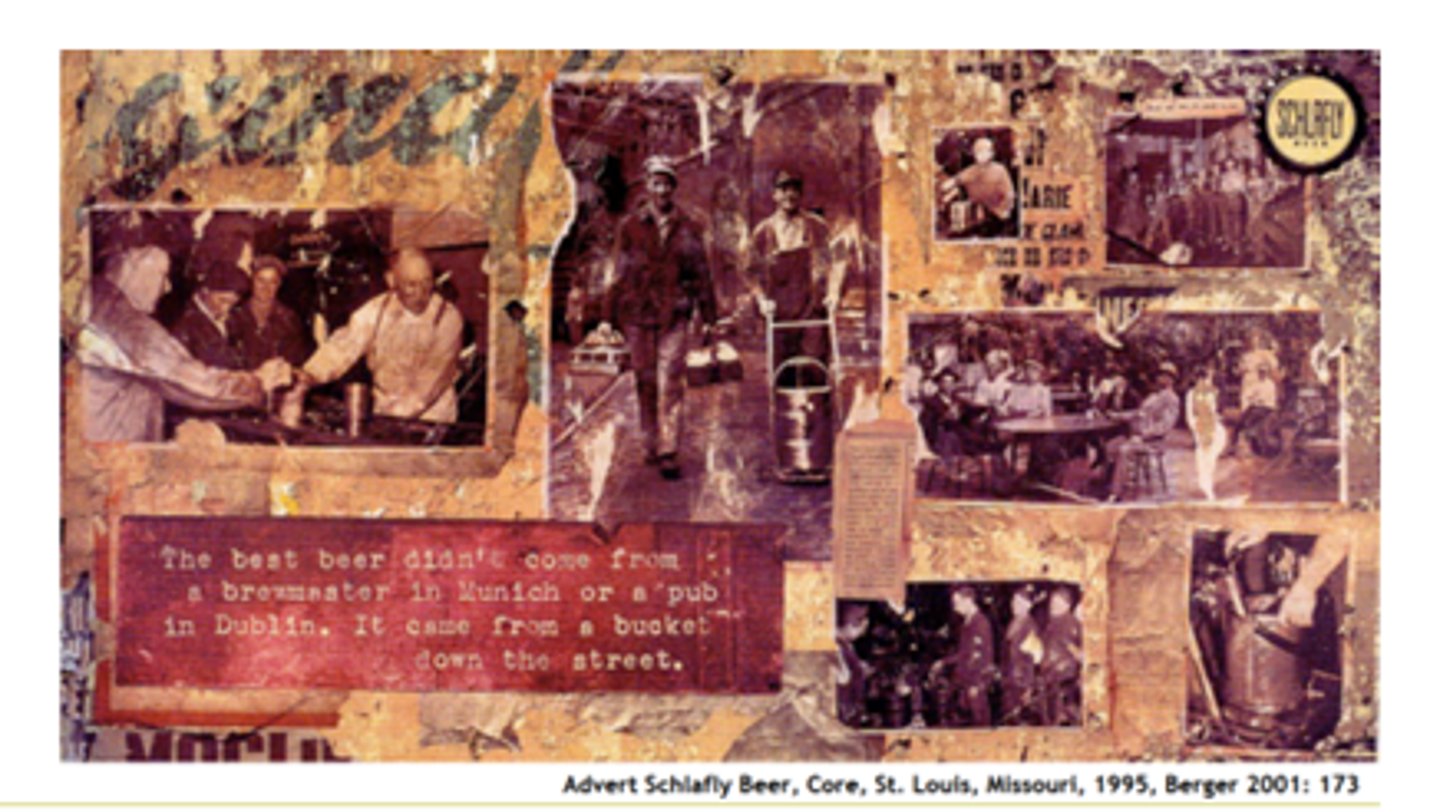
Materials and techniques for producing graphic signs
Surface material and signing technique
Name four levels or aspects on which typography can be designed and adjusted to fit situation and communicative task.
Individual letters and lines of print must be designed using fonts
Letters must be arranged on the page
Pages from documents
All typographic decisions depend on printability
Is there a Grammar of Typography? Explain the six elements ideational, interpersonal, textual, semantics, pragmatics and syntax in this context.
Ideational: typography supports meaning expressed in language
Interpersonal: typography socially addresses the reader
Textual: typography gives texture and shape to the documents
Semantics: typography makes connotative and pictorial meanings available
Pragmatics: typography aims at aptness and decorum
Syntax: typographic elements configure to form conventional patterns
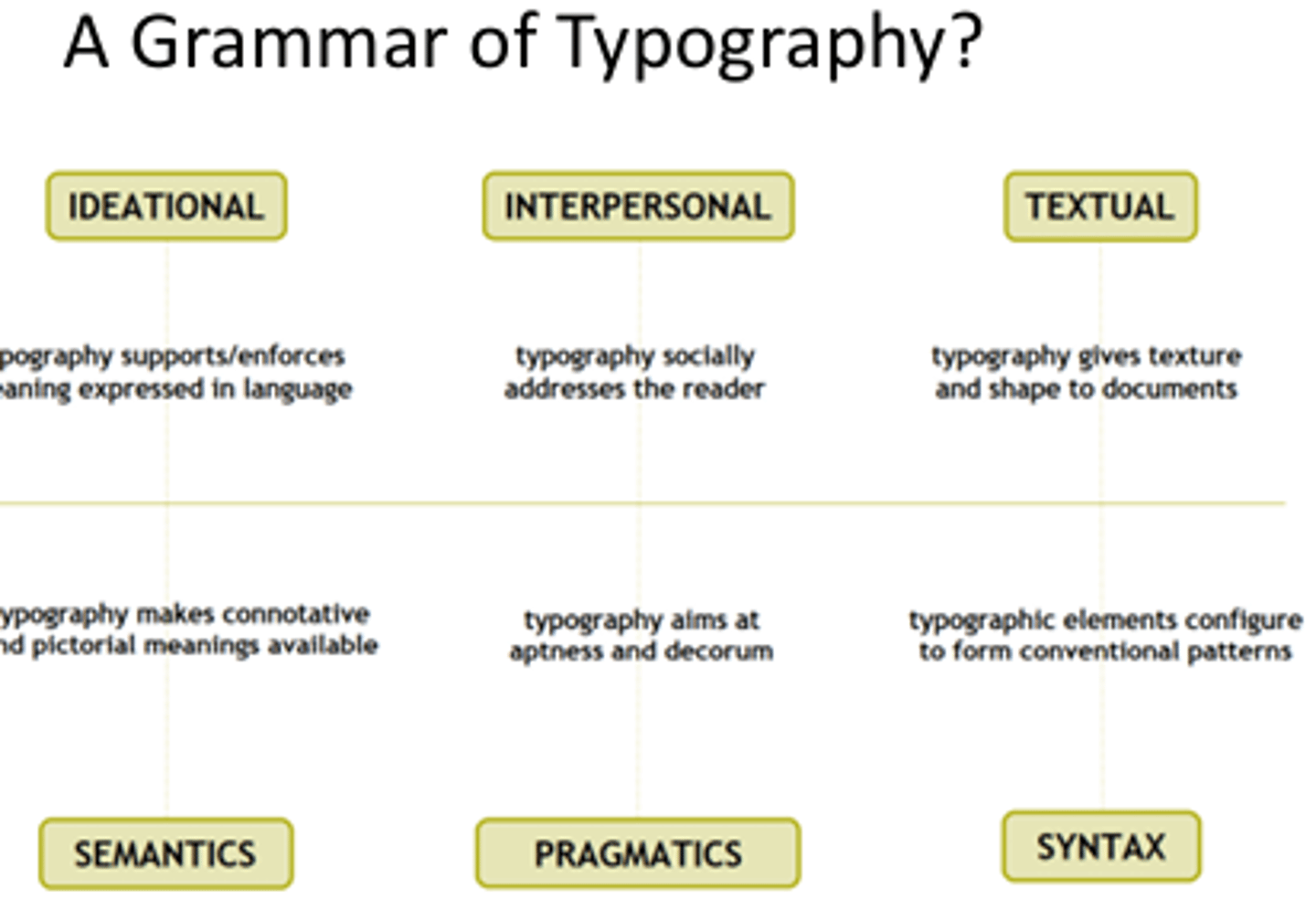
What can typography be compared to in terms of these aspects?
A sign system (semiotic mode)
Name three criteria that make typography and semiotic modes comparable.
Typographic signs can make meaning
They both have pragmatic rules
Typical graphic designs for a certain text type
In which three major ways is typographic meaning made?
Through connotation and metaphor
Through pictoriality
Through spatial division and emphasis
What are the five functions of Typography?
Optical division of space (lends the text visual structure and semantic order)
Pictoriality (converts wiriting into picture)
Semantic emphasis (emphazises content and speech act functions of text)
Connotative indexing (conveys additional meanings)
Inter-semiotic harmony (adapts to all other modes in form and function)
In which three components can sound be devided?
Music
Noise
Speech Sound
Name two reasons why the communicative potential of sound is limited.
Music can't depict or represent
Noise can only indexically point to places, actions and states
Sound as a semiotic resource can be divided into three aspects, name them and give one example.
Levels of design - tune
Choices/distinctions - rising/descending pitch
semiotic value - activating or soothing
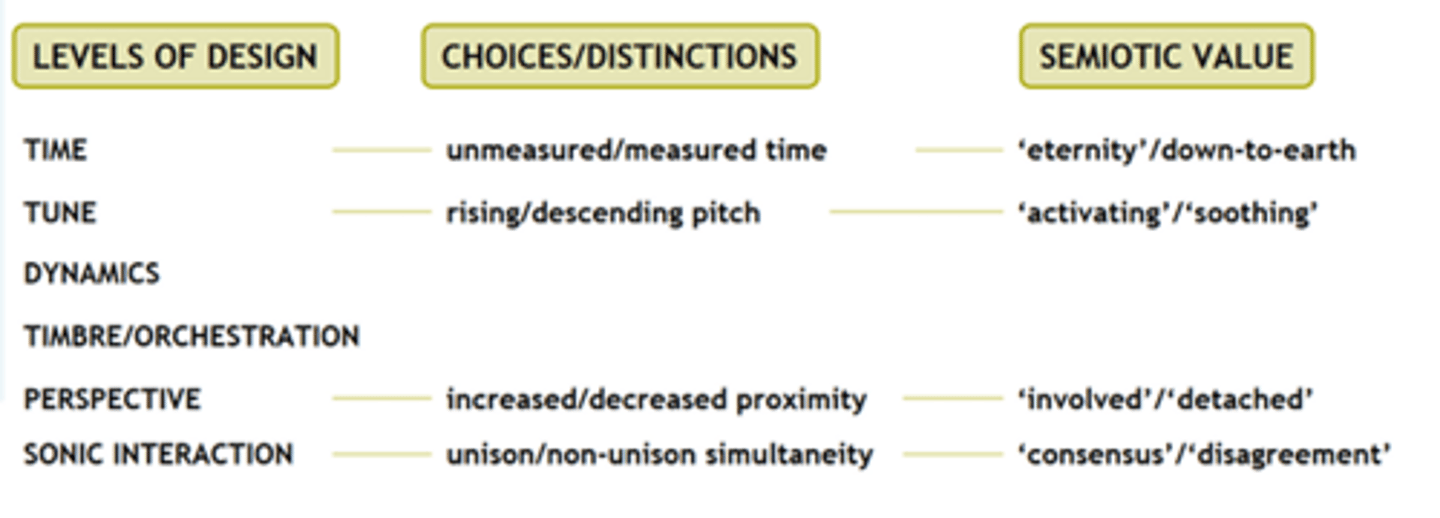
How can music become functionally communicative? (5)
Musical genre (genres allude to times and carry prestige)
Knowledge of music (knowledge helps to contextualise and give it meaning)
General character (effects emotions)
Iconic/indexical (imitate environmental phenomena)
Foreground one aspect (one feature is foregrounded)
Name the seven Submodes of music.
Tune, Harmony, Tempo, Dynamics, Timbre, Sonic interaction and perspective
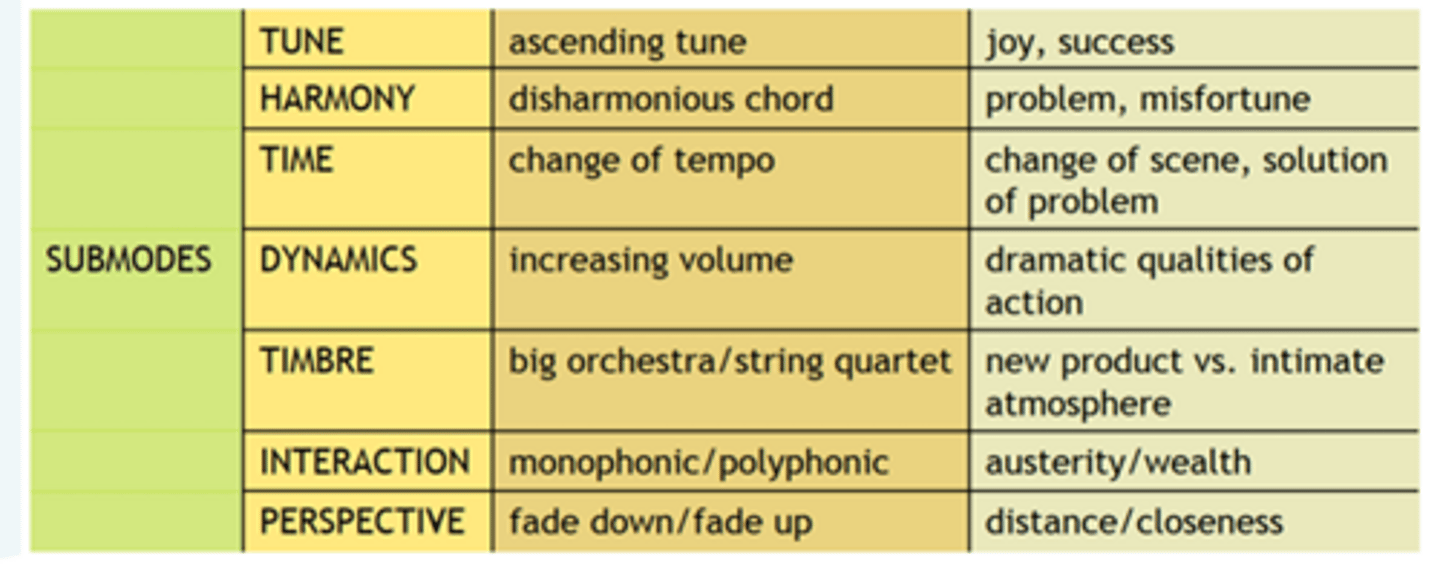
Name three reasons why music is a semiotic resource.
Tunes can ascend and descend
Volume can increase and decrease
Sounds may come from near or far
How are music and noise both utilized as semiotic resources?
Both music and noise function as semiotic resources that can create meaning in multimodal texts
In addition noise can serve functions including cohesion in multimodal compositions
Name and shortly explain the two general semiotic principles according to which music can be made sense of.
Provenance
Music carries connotations, which may be imported into new contexts
Experimental meaning potential
Some quality of the music metaphorically stands for some abstract quality
There are three principal ways in which noises can become meaningful in audio texts, name them.
Indexical (noises make meaning by communicating)
Metaphorical (noises generate sense)
Intertextual (noises make meaning by becoming stereotypical)
What creates new opportunities for creating multimodal texts?
New media

