Ch. 23: Mirrors and Lenses

0.0(0)
Studied by 0 people
call kaiCall Kai
learnLearn
examPractice Test
spaced repetitionSpaced Repetition
heart puzzleMatch
flashcardsFlashcards
GameKnowt Play
Card Sorting

1/27

encourage image

There's no tags or description

Looks like no tags are added yet.

Last updated 11:23 PM on 3/27/26
Name
Mastery
Learn
Test
Matching
Spaced
Call with Kai

No analytics yet

Send a link to your students to track their progress

28 Terms

1
New cards

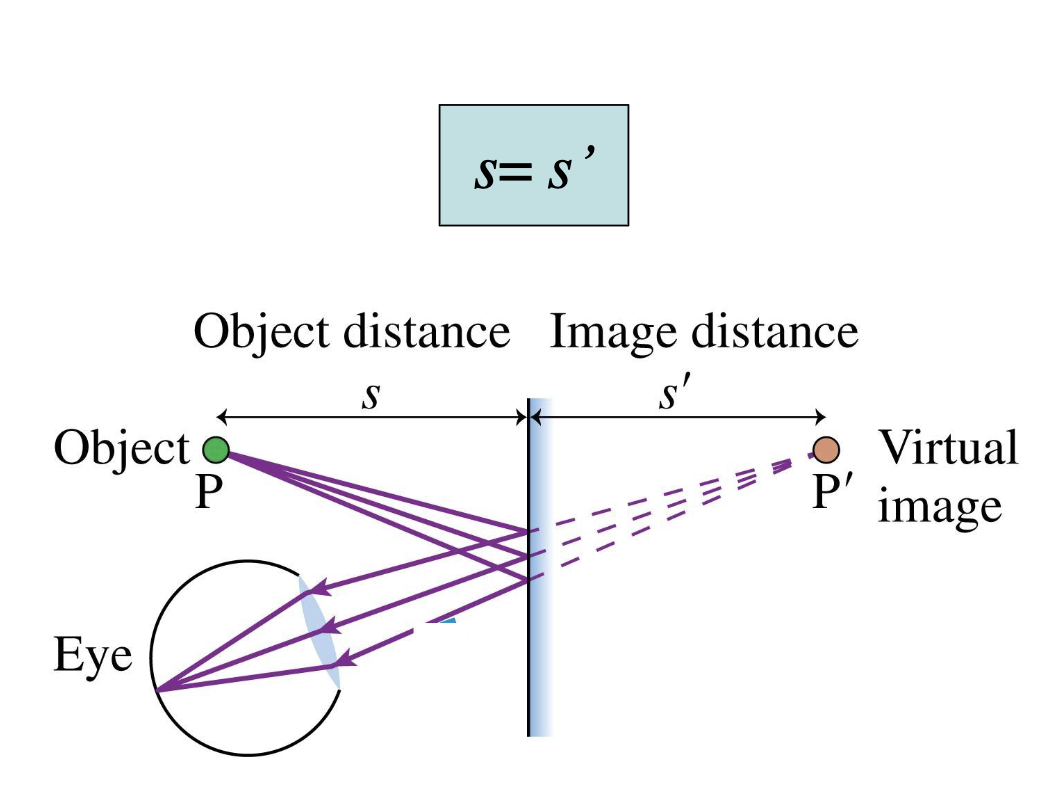
the plane mirror

s=s’

-s=object distance (do)

-s’=image distance (di)

^same so no distortion

-treat objects as sources of light (light from room bounces off object and goes to your eye); light doesn’t converge at virtual image
<p>s=s’</p><p>-s=object distance (do)</p><p>-s’=image distance (di)</p><p>^same so no distortion</p><p>-treat objects as sources of light (light from room bounces off object and goes to your eye); light doesn’t converge at virtual image</p>
2
New cards

concave vs convex mirror

-concave: curves away from object

-Convex: curves towards object; always creates a virtual image

3
New cards

real vs virtual image

-real image: where light converges, can put on a screen

-virtual image: were light could theoretically cross, can’t get an image on the screen

4
New cards

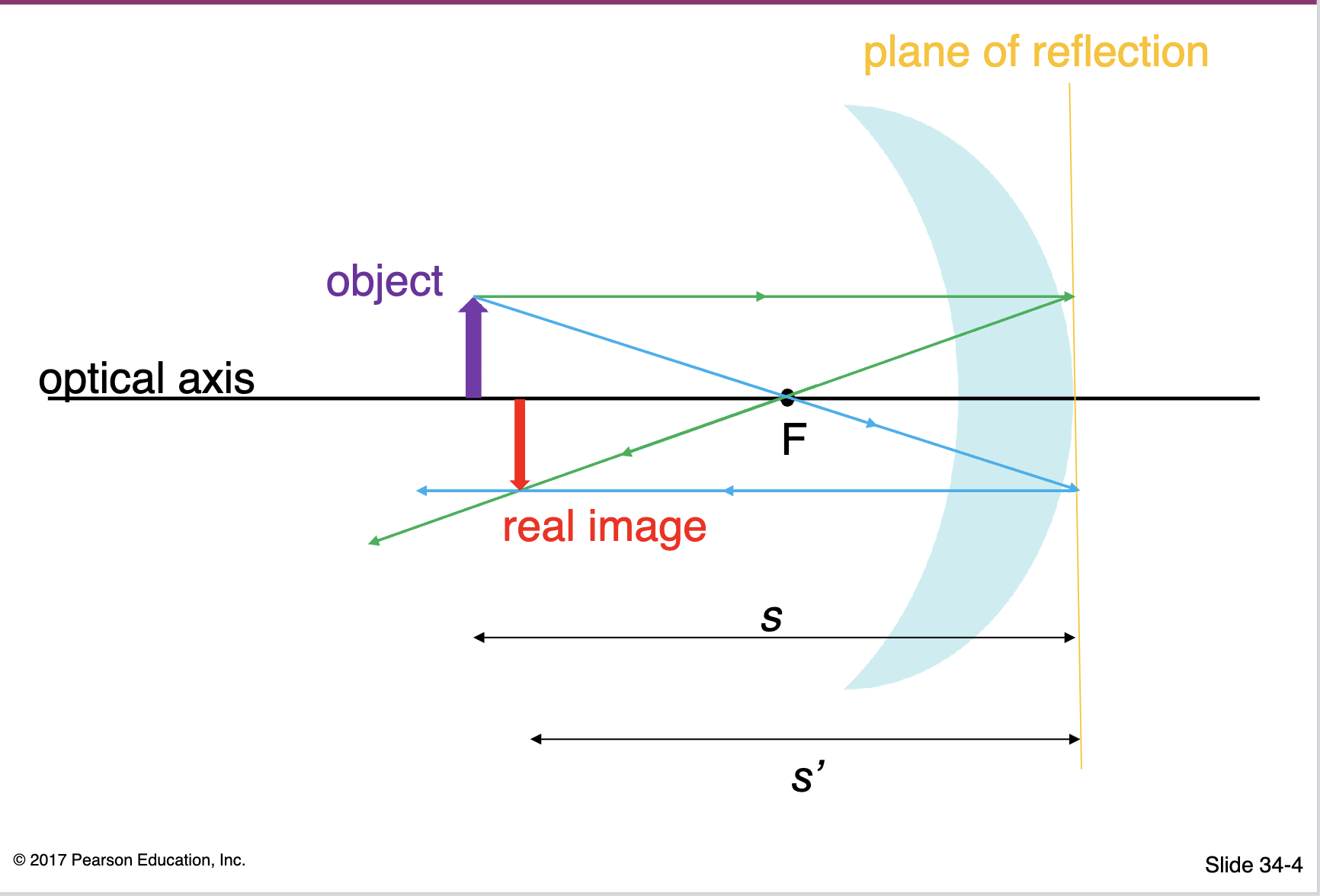
2 special rays for a concave mirror

-green line parallel of optical axis: reflects and goes through the focal point

-blue line through focal point: reflects and becomes parallel to the optical axis (reverse of green)

-optical axis: horizontal line center of mirror; plane of reflection: vertical line back of mirror

-real image: both rays converge
<p>-green line parallel of optical axis: reflects and goes through the focal point</p><p>-blue line through focal point: reflects and becomes parallel to the optical axis (reverse of green)</p><p>-optical axis: horizontal line center of mirror; plane of reflection: vertical line back of mirror</p><p>-real image: both rays converge</p>
5
New cards

what happens if an object is inside the focal point of a concave mirror?

will be blurry/can’t read it anymore, NOT a real image anymore

6
New cards

take all measurements from the

plane of reflection

7
New cards

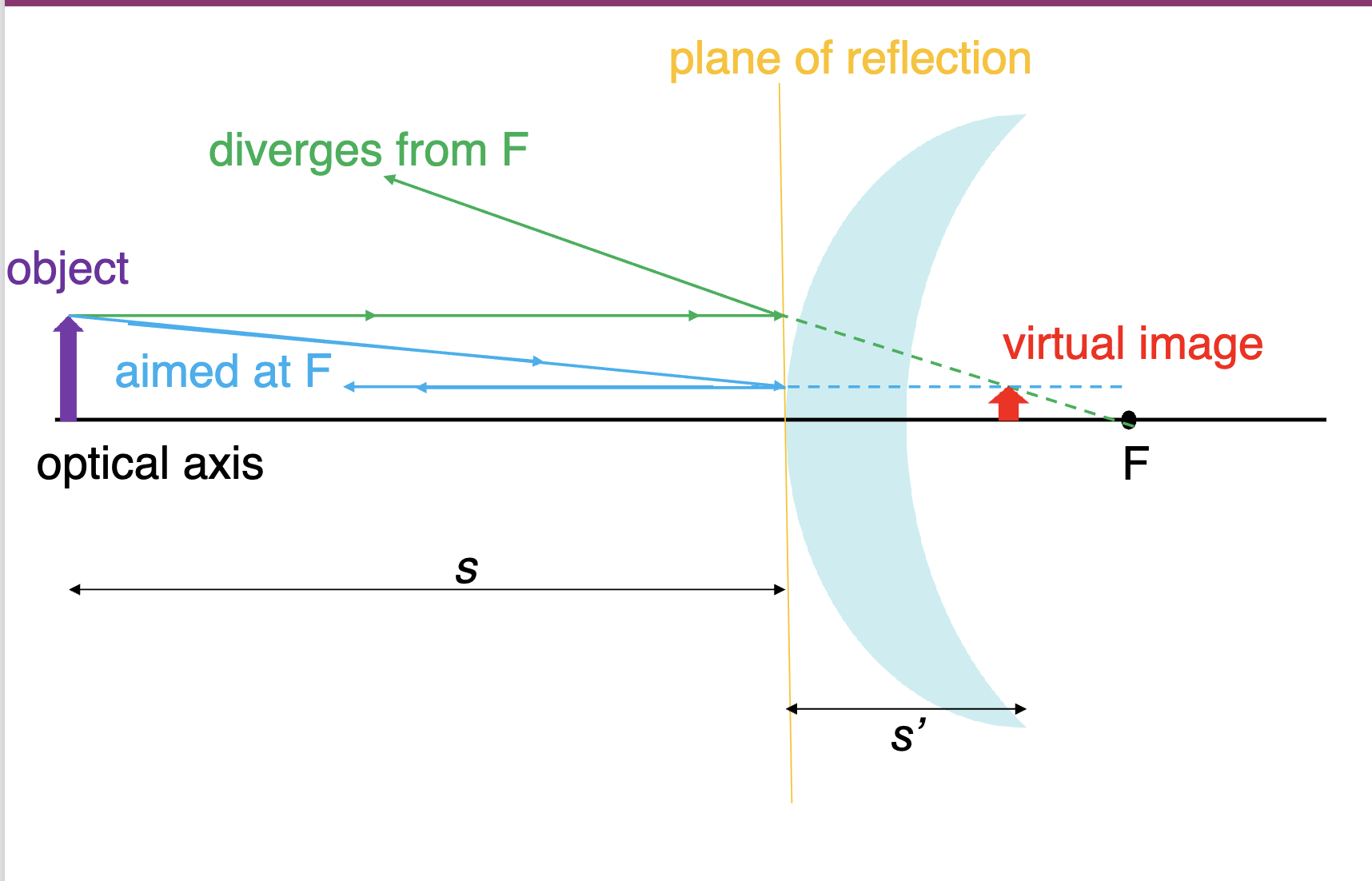
2 special rays for a convex mirror

-green parallel to optical axis: diverges from focal point

-blue aimed at focal point: parallel to optical axis

*rays never cross so no real image; virtual image smaller and right side up, same side as radius of curvature

-optical axis: horizontal line center of mirror; plane of reflection: vertical line back of mirror

*ex=car side or rearview mirror; safety mirrors at stores
<p></p><p>-green parallel to optical axis: diverges from focal point</p><p>-blue aimed at focal point: parallel to optical axis</p><p>*rays never cross so no real image; virtual image smaller and right side up, same side as radius of curvature</p><p>-optical axis: horizontal line center of mirror; plane of reflection: vertical line back of mirror</p><p>*ex=car side or rearview mirror; safety mirrors at stores</p>
8
New cards

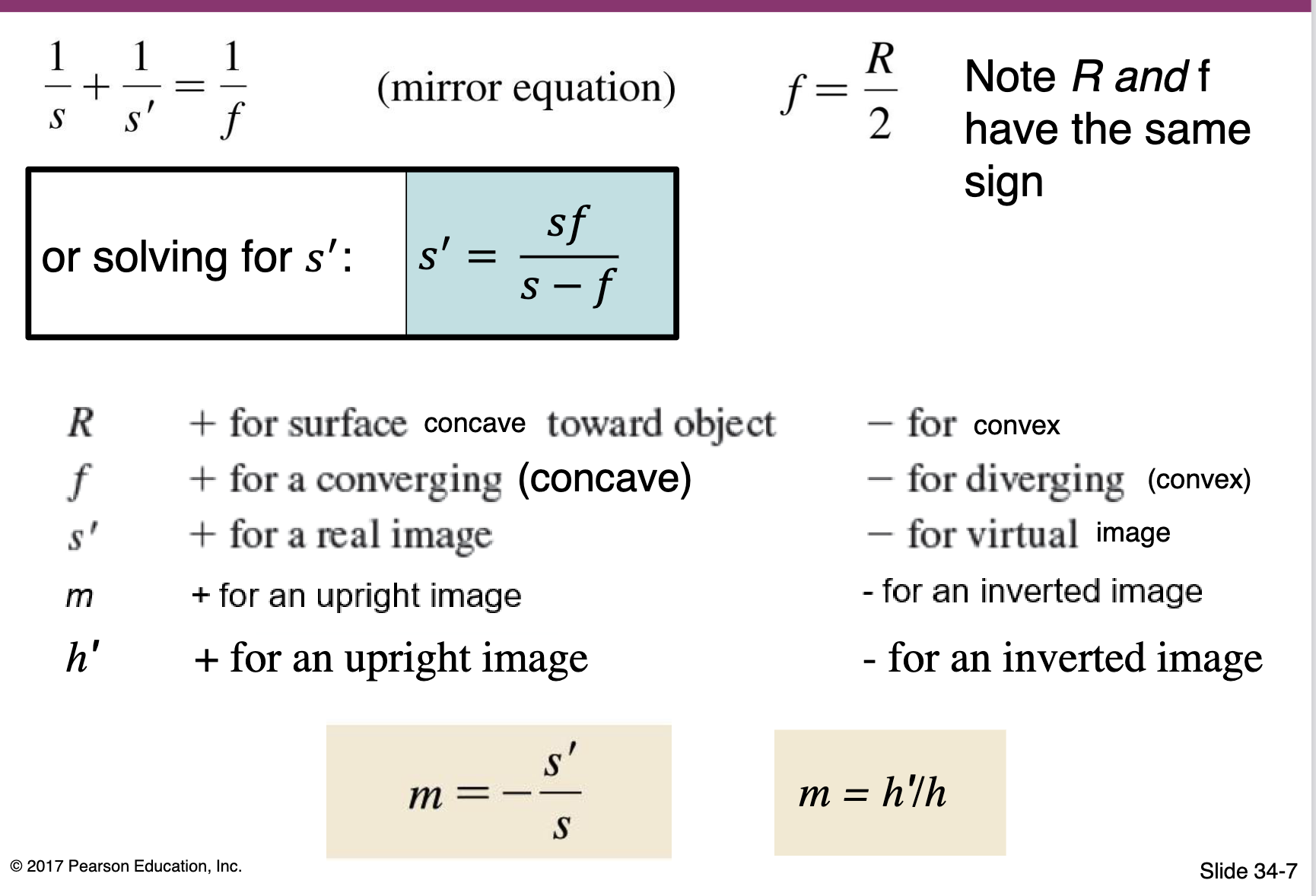
mirror and lens equations

<p></p>
9
New cards

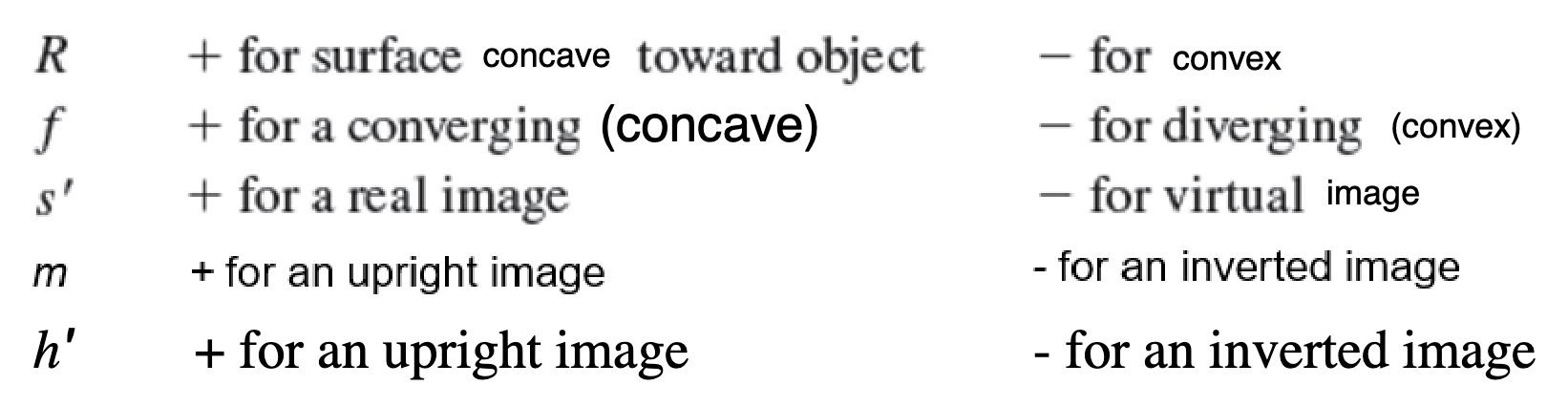
mirror and lens sign conventions

knowt flashcard image
10
New cards

true or false: m and h’ always have the same sign? R of the curvature is always positive?

true! true!

11
New cards

converging vs diverging lenses

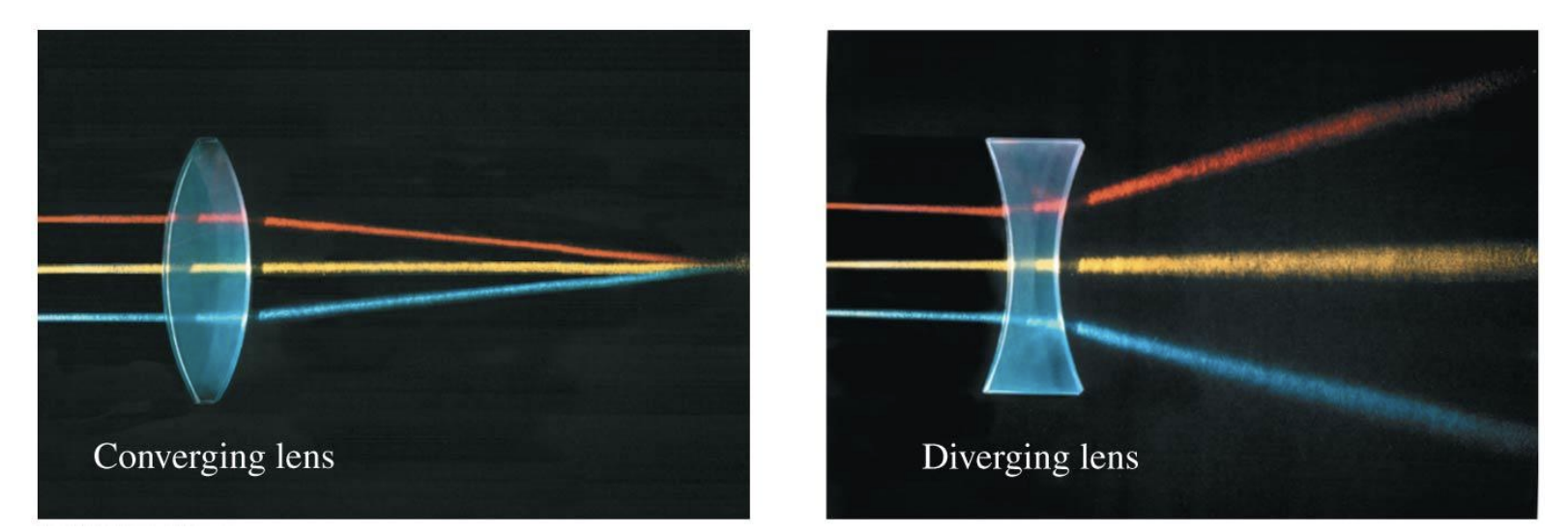
-The left lens, called a converging lens, causes parallel rays to refract toward the optical axis. Focal Length > 0 (*f>0, R>0; only produce real image)

-The right lens, called a diverging lens, refracts parallel rays away from the optical axis. Focal Length < 0 (*f<0, R<0; only produce virtual image)

*for both: 2 curved sides=focal point on each side, and focal points same distance left and right from plane of refraction
<p>-The left lens, called a <strong>converging lens</strong>, causes parallel rays to refract toward the optical axis. Focal Length &gt; 0 (*f&gt;0, R&gt;0; only produce real image)</p><p>-The right lens, called a <strong>diverging lens,</strong> refracts parallel rays away from the optical axis. Focal Length &lt; 0 (*f&lt;0, R&lt;0; only produce virtual image)</p><p>*for both: 2 curved sides=focal point on each side, and focal points same distance left and right from plane of refraction</p>
12
New cards

-converging lens=

-diverging lens=

-converging lens=double convex lens (*careful! bc converging mirror=concave)

-diverging lens=double concave lens (*careful! bc diverging mirror=convex)

13
New cards

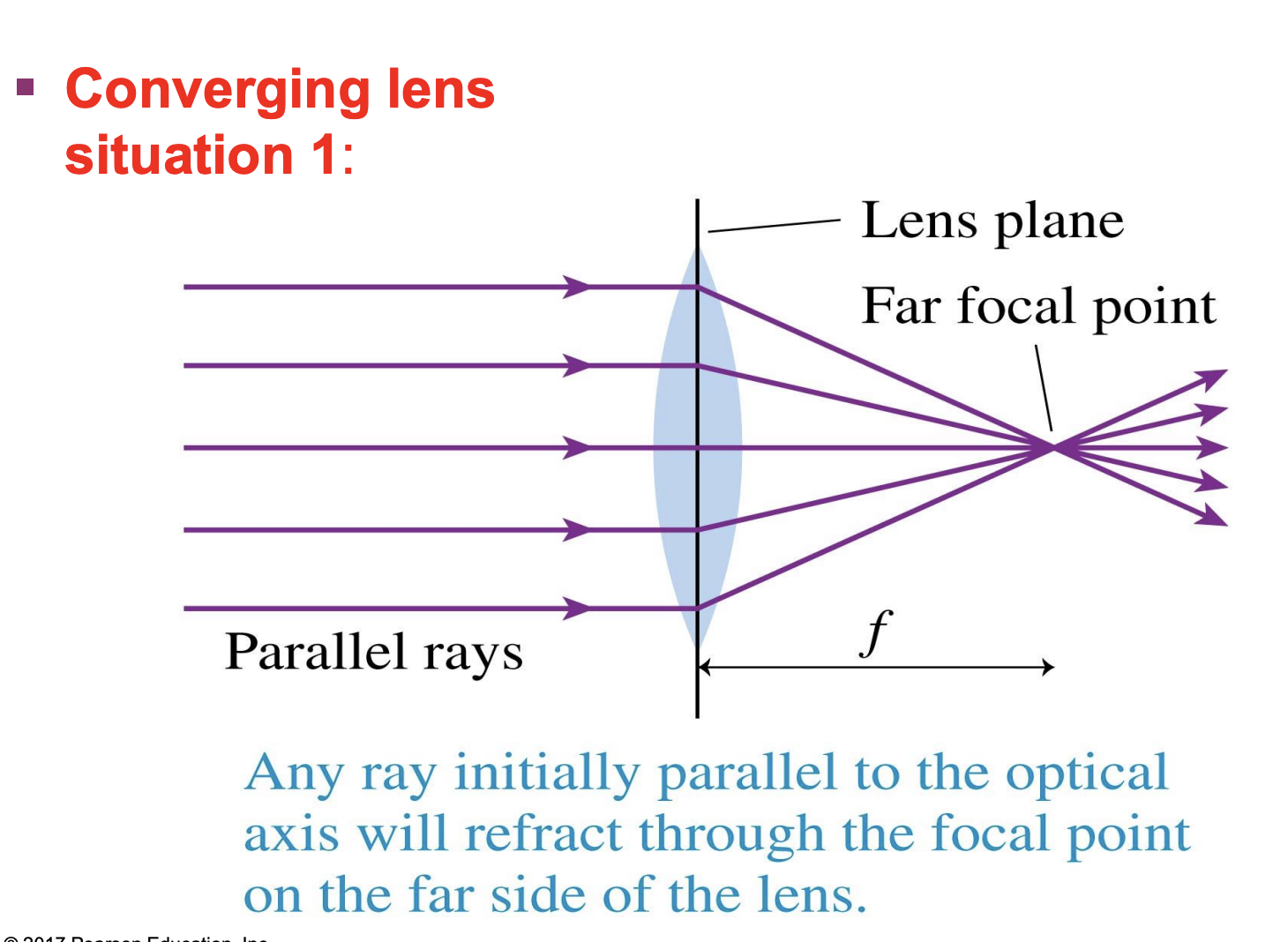
converging lens situation 1

<p></p>
14
New cards

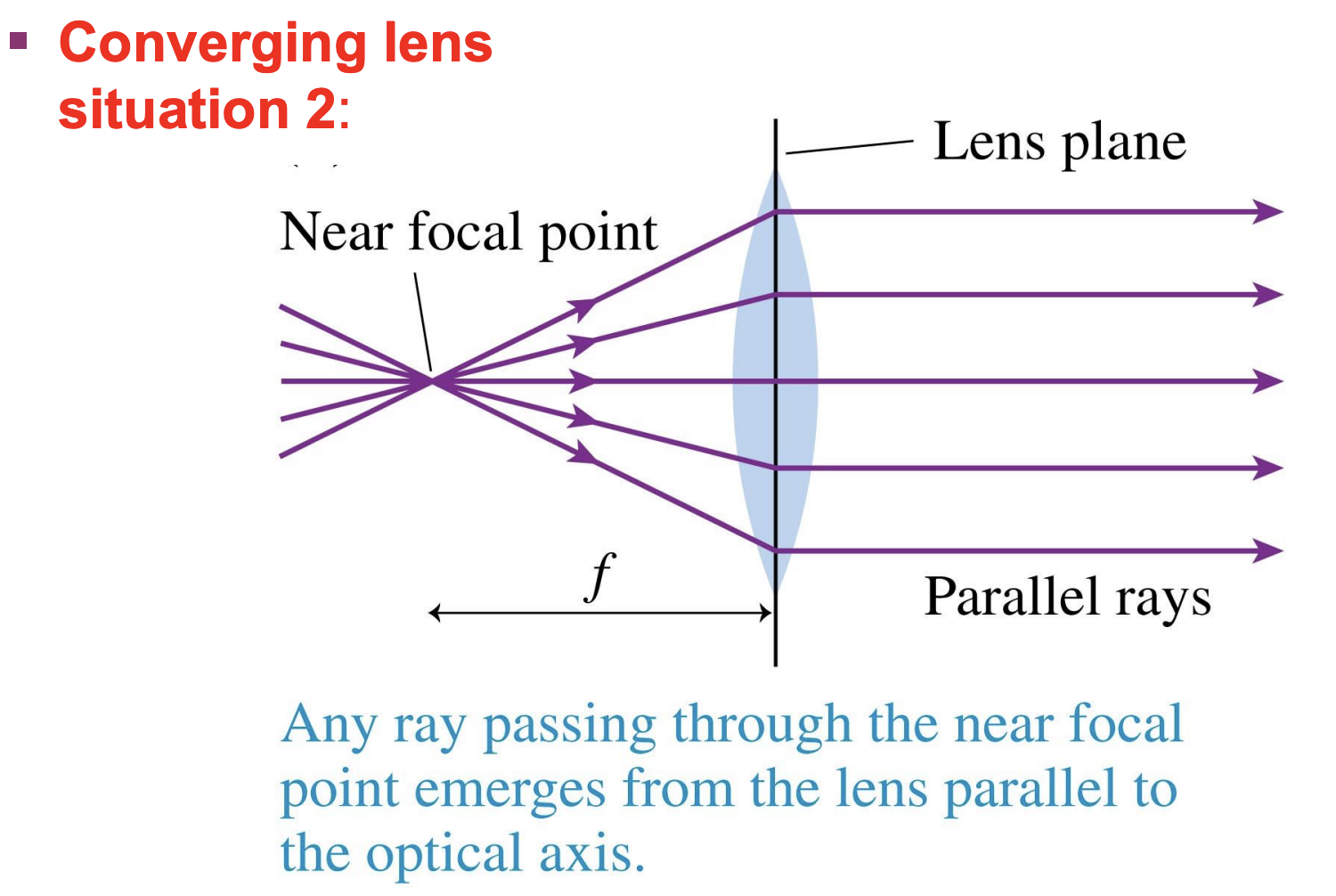
converging lens situation 2

knowt flashcard image
15
New cards

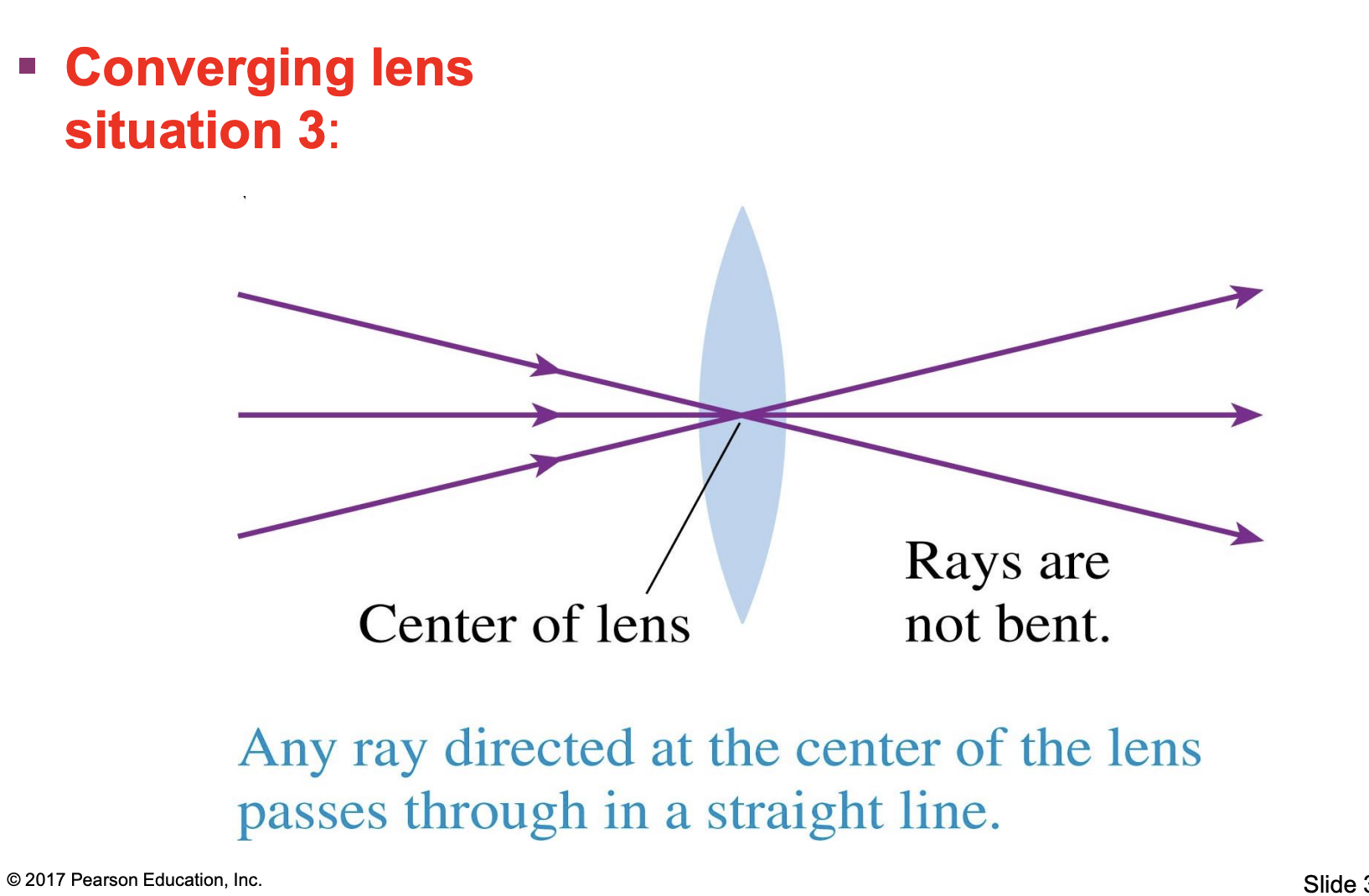
converging lens situation 3

knowt flashcard image
16
New cards

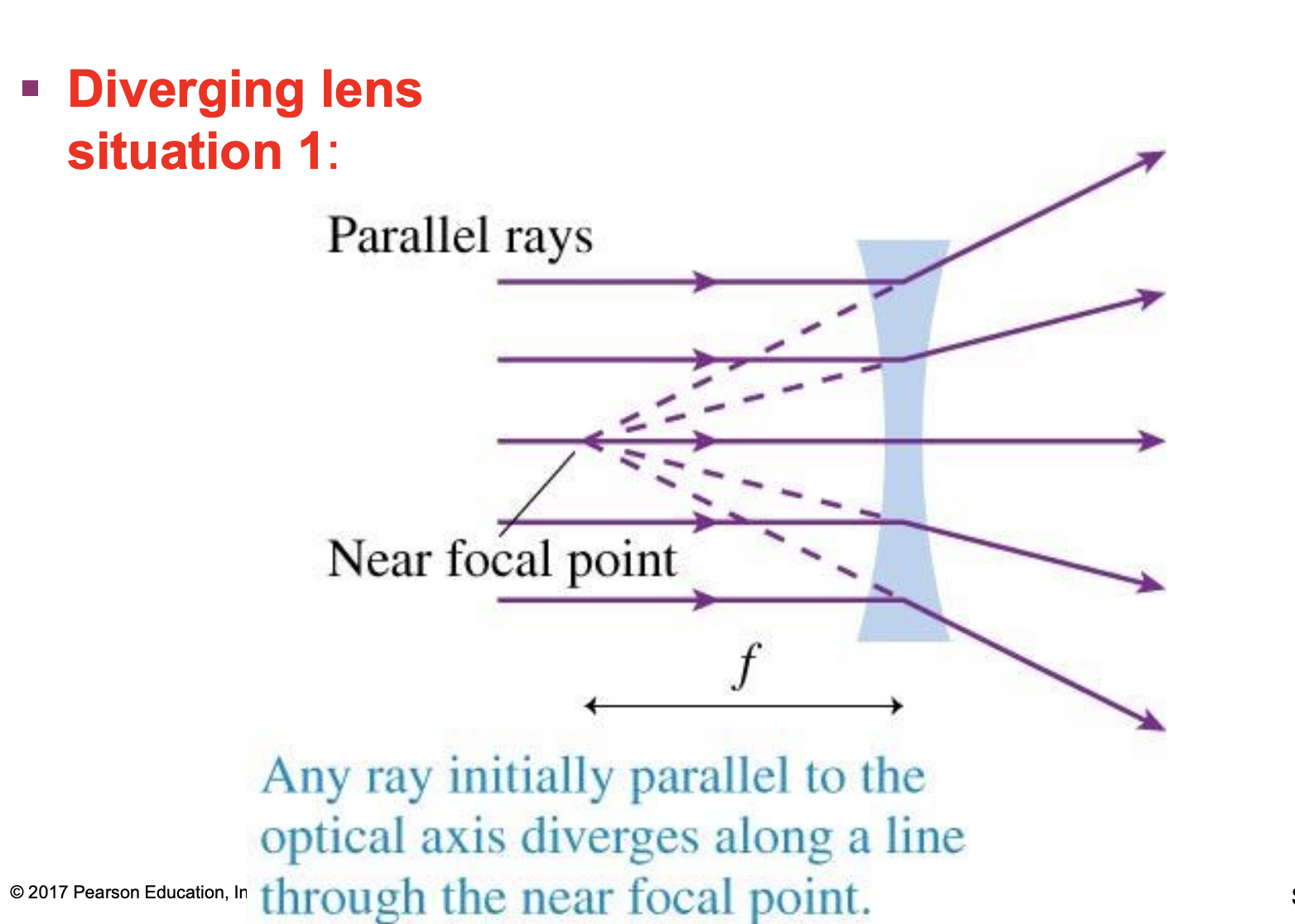
diverging lens situation 1

knowt flashcard image
17
New cards

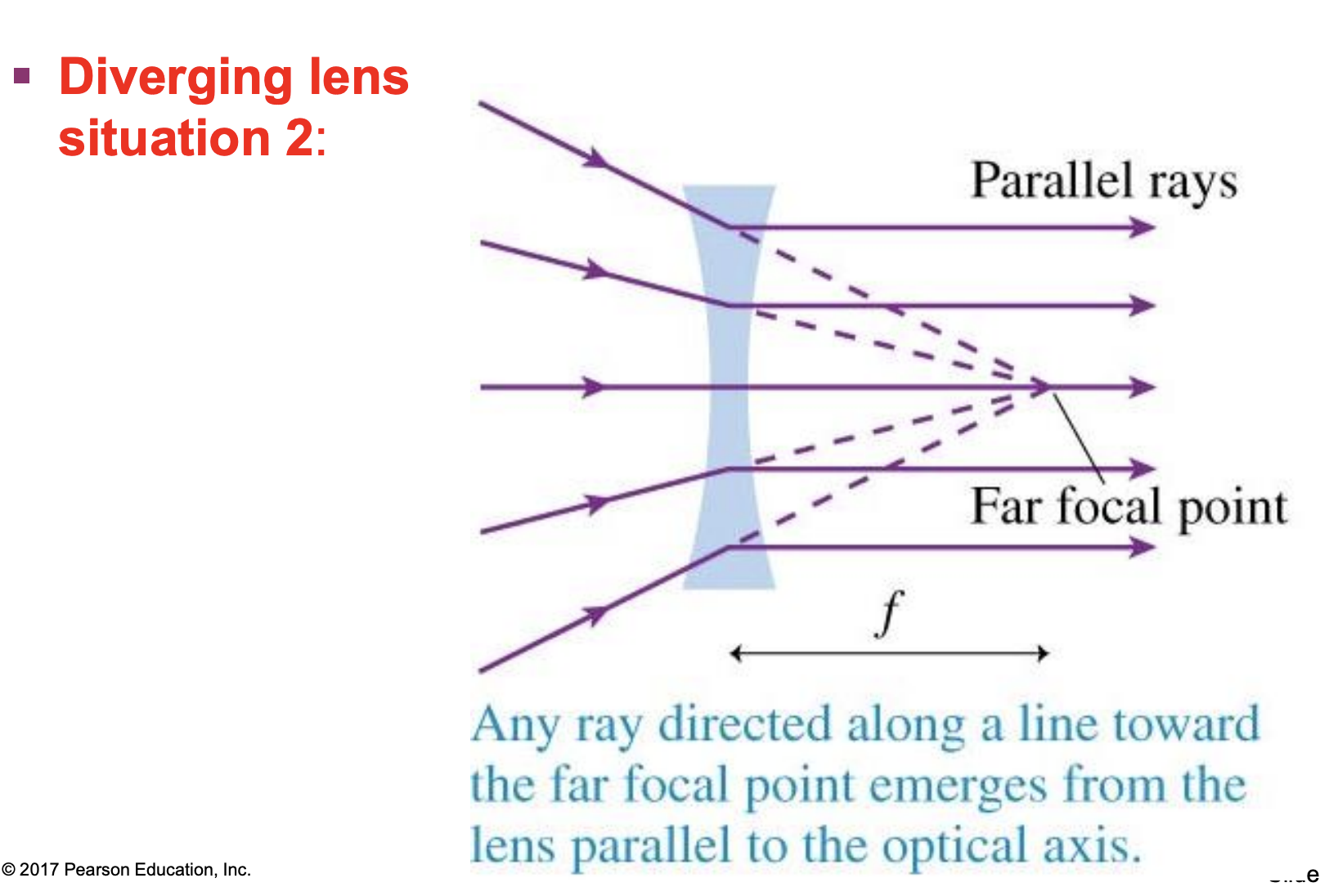
diverging lens situation 2

knowt flashcard image
18
New cards

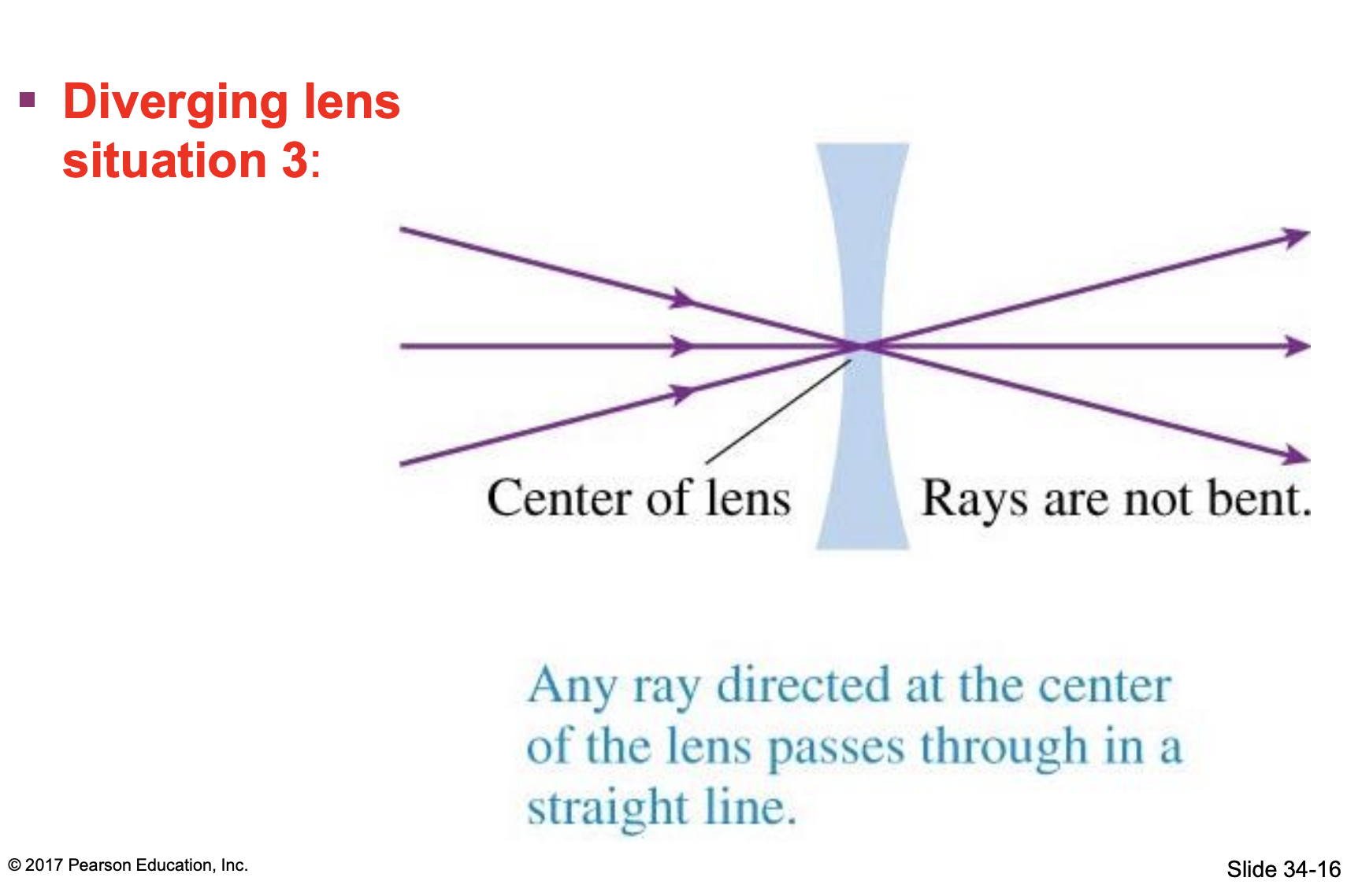
diverging lens situation 3

knowt flashcard image
19
New cards

how would you create a graph for the mirror equation variables?

-1/s’ on y-axis; 1/s on x-axis; y-intercept=1/f

-relating to y=mx+b: y=1/s’, m=-1, x=1/s, and b=1/f

20
New cards

far point

-The farthest distance at which a relaxed eye (with perfect vision) can focus is called the eye’s far point (FP)

-The far point of a normal eye is very large/; that is, the eye can focus on objects extremely far away. We will approximate this distance to be infinity for simplicity.

*ex=eye chart across the room

*ciliary muscles change focal length of lens; most refraction from lens; focus light on retina, humor fluid does little refraction
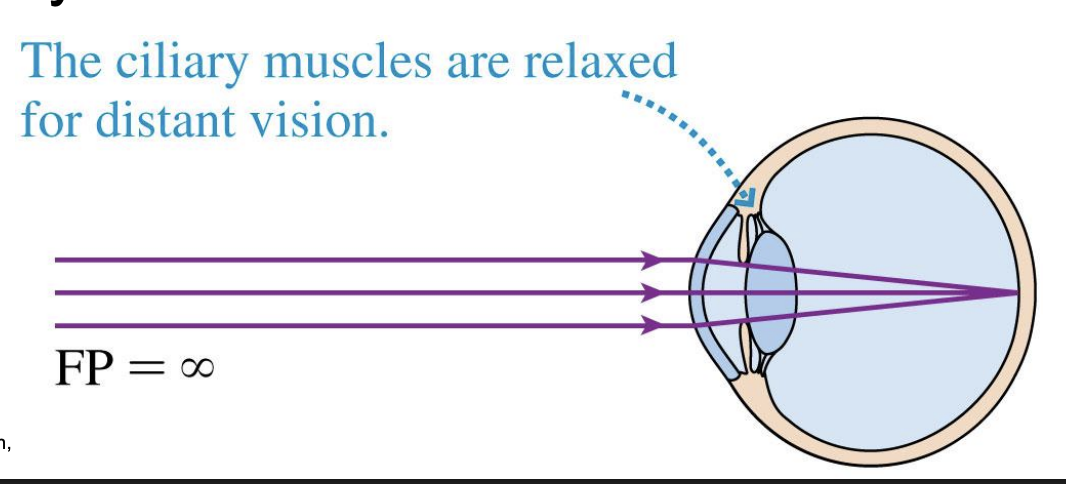
<p>-The farthest distance at which a relaxed eye (with perfect vision) can focus is called the eye’s far point (FP)</p><p>-The far point of a normal eye is very large/; that is, the eye can focus on objects extremely far away. We will approximate this distance to be <strong>infinity</strong> for simplicity.</p><p>*ex=eye chart across the room</p><p>*ciliary muscles change focal length of lens; most refraction from lens; focus light on retina, humor fluid does little refraction</p>
21
New cards

near point

-The closest distance (on average) at which a perfect eye can focus, using maximum accommodation, is the eye’s near point (NP) = 25 cm.

*normal near point (NP)=infinity, far away object:s=infinity, 1/s=1/infinity=0

*closest can focus on something; ex=bring phone to phase
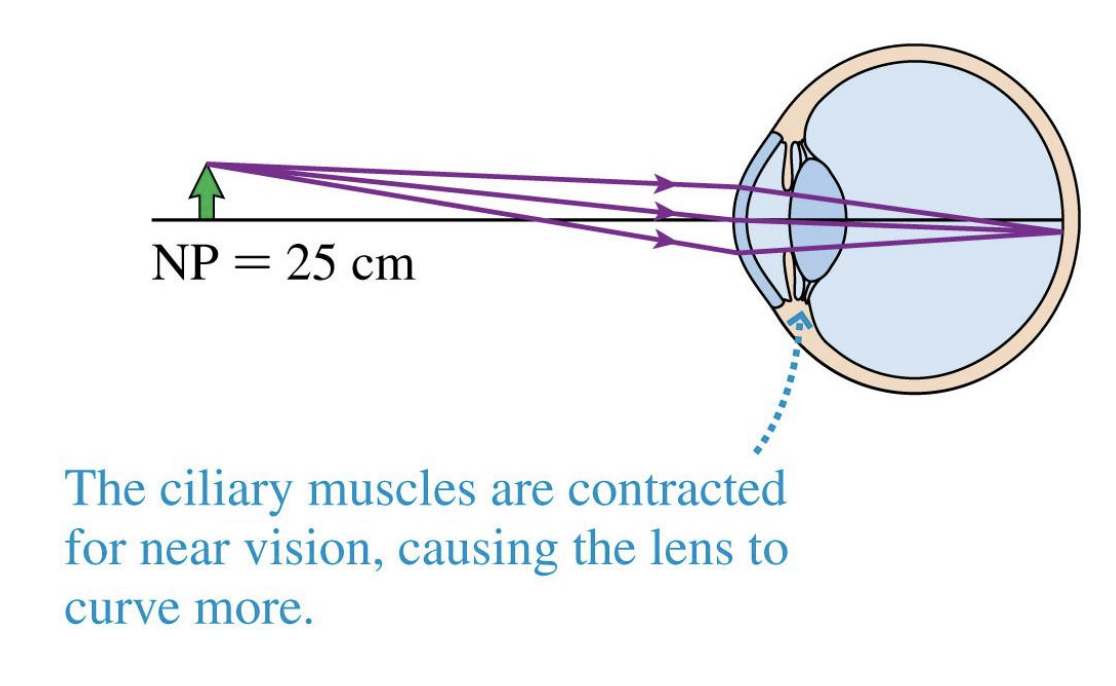
<p>-The closest distance (on average) at which a perfect eye can focus, using maximum accommodation, is the eye’s near point (NP) <mark data-color="green" style="background-color: green; color: inherit;">= 25 cm.</mark></p><p>*normal near point (NP)=infinity, far away object:s=infinity, 1/s=1/infinity=0</p><p>*closest can focus on something; ex=bring phone to phase</p>
22
New cards

corrective lenses

-Corrective lenses are prescribed not by their focal length but by their refractive power

-The power of a lens is the inverse of its focal length in meters: P=1/f

-The SI unit of lens power is the diopter, abbreviated D, defined as 1 D = 1 m−1

  • Thus, a lens with f = 50 cm = 0.50 m has power P = 2.0 D

*+=converging lens, -=diverging lens
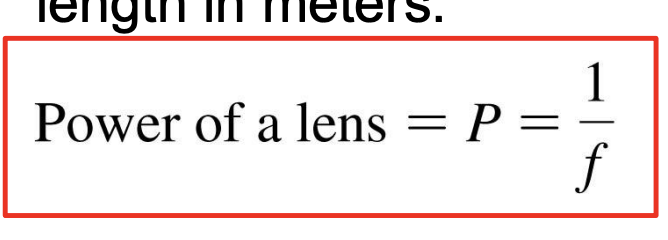
<p>-Corrective lenses are prescribed not by their focal length but by their refractive <strong>power</strong></p><p>-The power of a lens is the inverse of its focal length in meters: P=1/f</p><p>-The SI unit of lens power is the <strong>diopter</strong>, abbreviated D, defined as <mark data-color="green" style="background-color: green; color: inherit;">1 D = 1 m−1</mark></p><ul><li><p>Thus, a lens with f = 50 cm = 0.50 m has power P = 2.0 D</p></li></ul><p>*+=converging lens, -=diverging lens</p>
23
New cards

hyperopia

-A person who is farsighted can see faraway objects clearly, but their near point is larger than 25 cm, often much larger, so they cannot focus on nearby objects.

*eye stretched long way so light not focused on retina
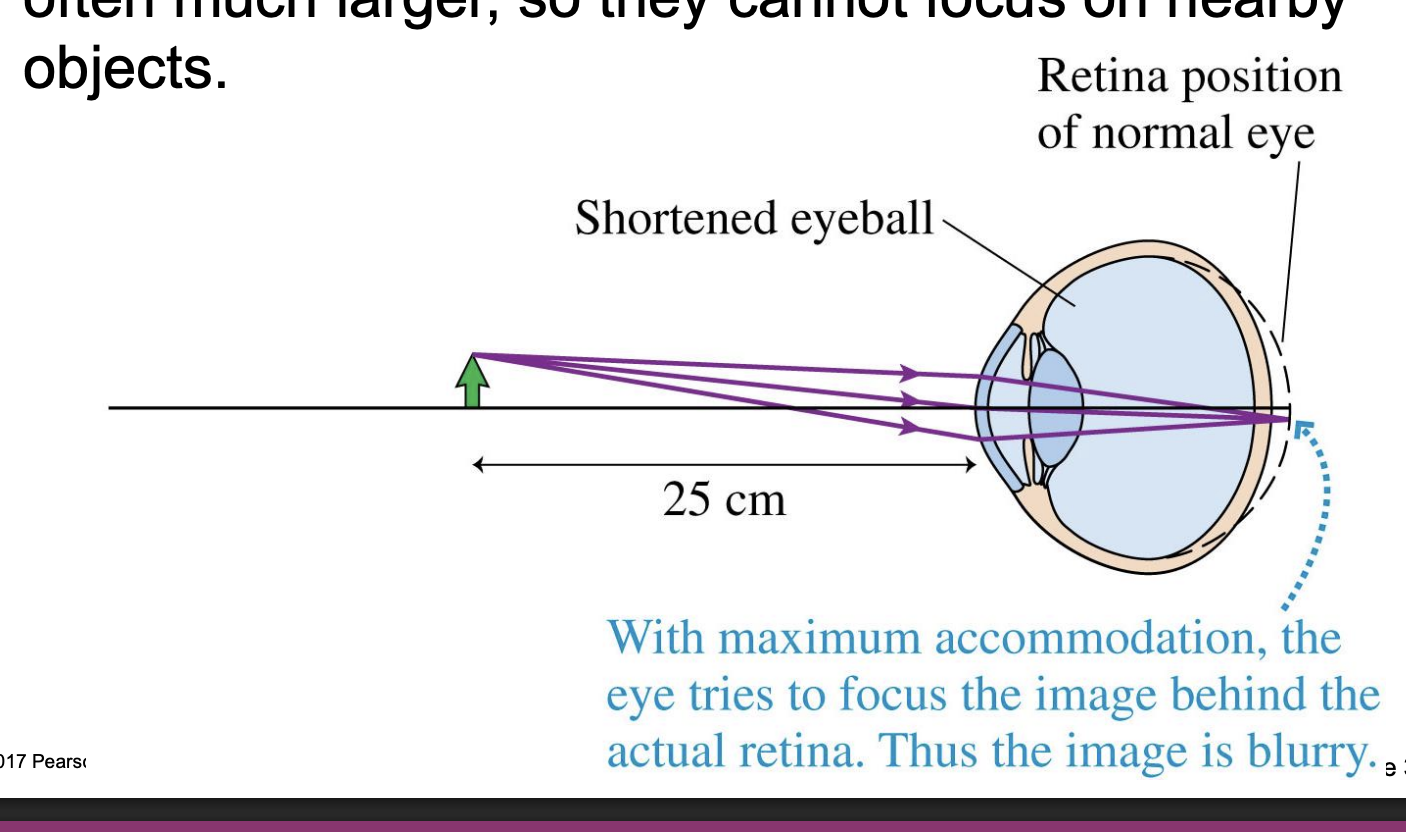
<p>-A person who is <strong>farsighted </strong>can see faraway objects clearly, but their near point is larger than 25 cm, often much larger, so they cannot focus on nearby objects.</p><p>*eye stretched long way so light not focused on retina</p>
24
New cards

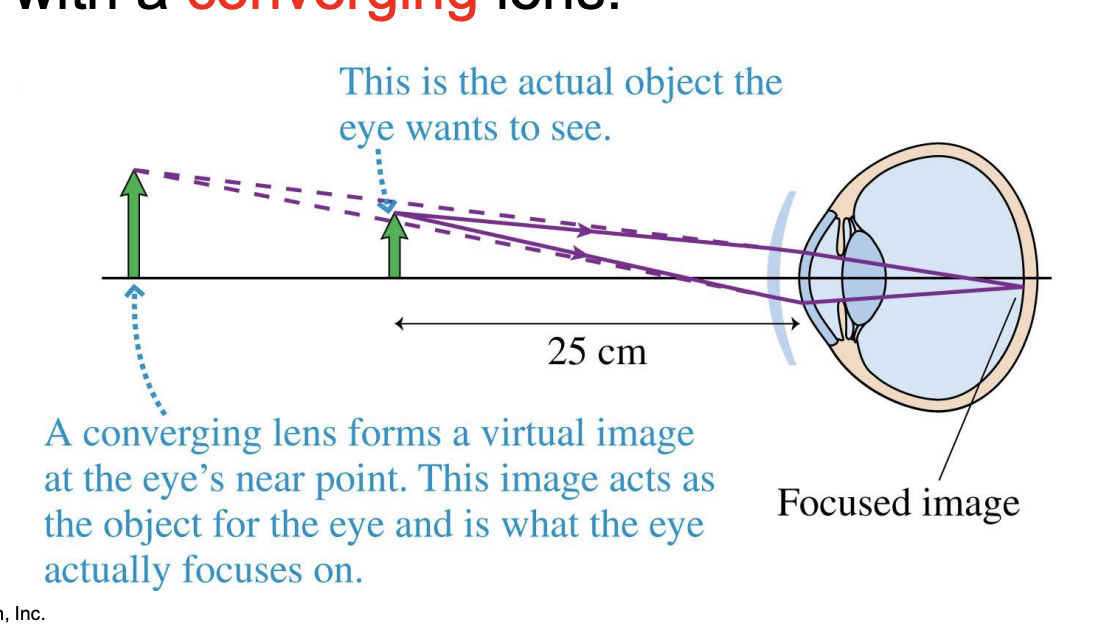
hyperopia correction

-With hyperopia, the eye needs assistance to focus the rays from a near object onto the closer than normal retina.

-This assistance is obtained by adding refractive power with a converging lens.

  • f>0; P>0

-virtual image made at person’s personal NP >25cm

*so rays pulled down and cross over earlier; makes virtual image at place where can see with out lens
<p>-With hyperopia, the eye needs assistance to focus the rays from a near object onto the closer than normal retina.</p><p>-This assistance is obtained by adding refractive power with a converging lens.</p><ul><li><p>f&gt;0; P&gt;0</p></li></ul><p>-virtual image made at person’s personal NP &gt;25cm</p><p>*so rays pulled down and cross over earlier; makes virtual image at place where can see with out lens</p>
25
New cards

any corrective lens makes a….

virtual image

-so s’ is always negative!

26
New cards

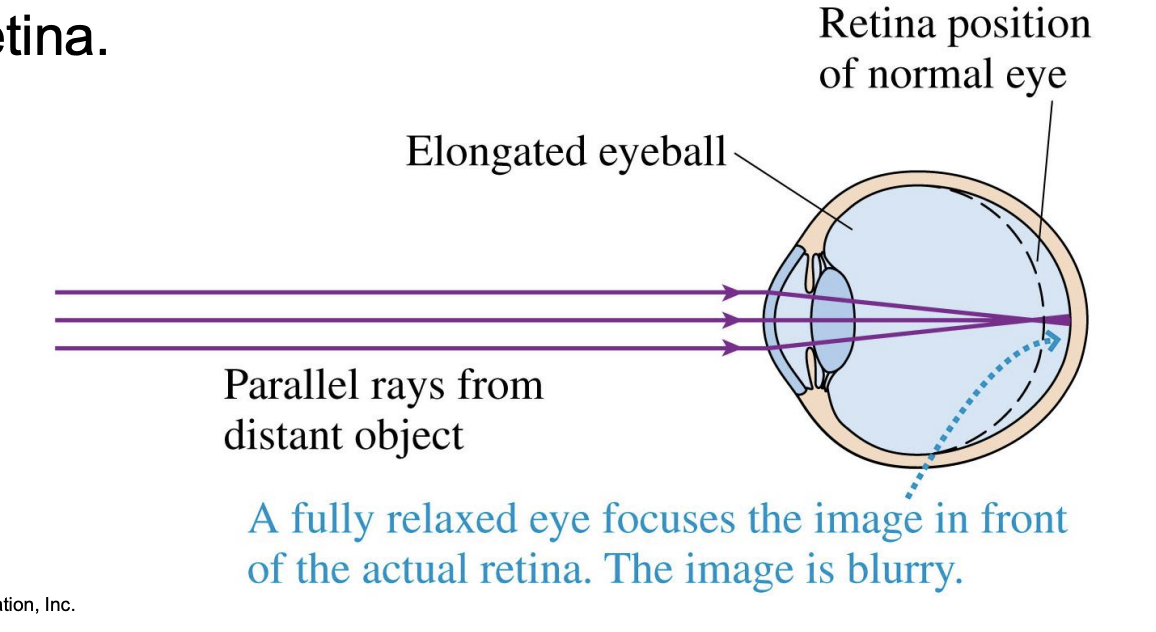
myopia

-A person who is nearsighted can clearly see nearby objects, but no amount of relaxation allows them to see distant objects

-Nearsightedness is caused by an eyeball that is too long

-Rays from a distant object come to a focus in front of the retina and have begun to diverge by the time they reach the retina.

*more common; converges before retina then spreads out
<p>-A person who is <strong>nearsighted </strong>can clearly see nearby objects, but no amount of relaxation allows them to see distant objects</p><p>-Nearsightedness is caused by an eyeball that is too long</p><p>-Rays from a distant object come to a focus in front of the retina and have begun to diverge by the time they reach the retina.</p><p>*more common; converges before retina then spreads out</p>
27
New cards

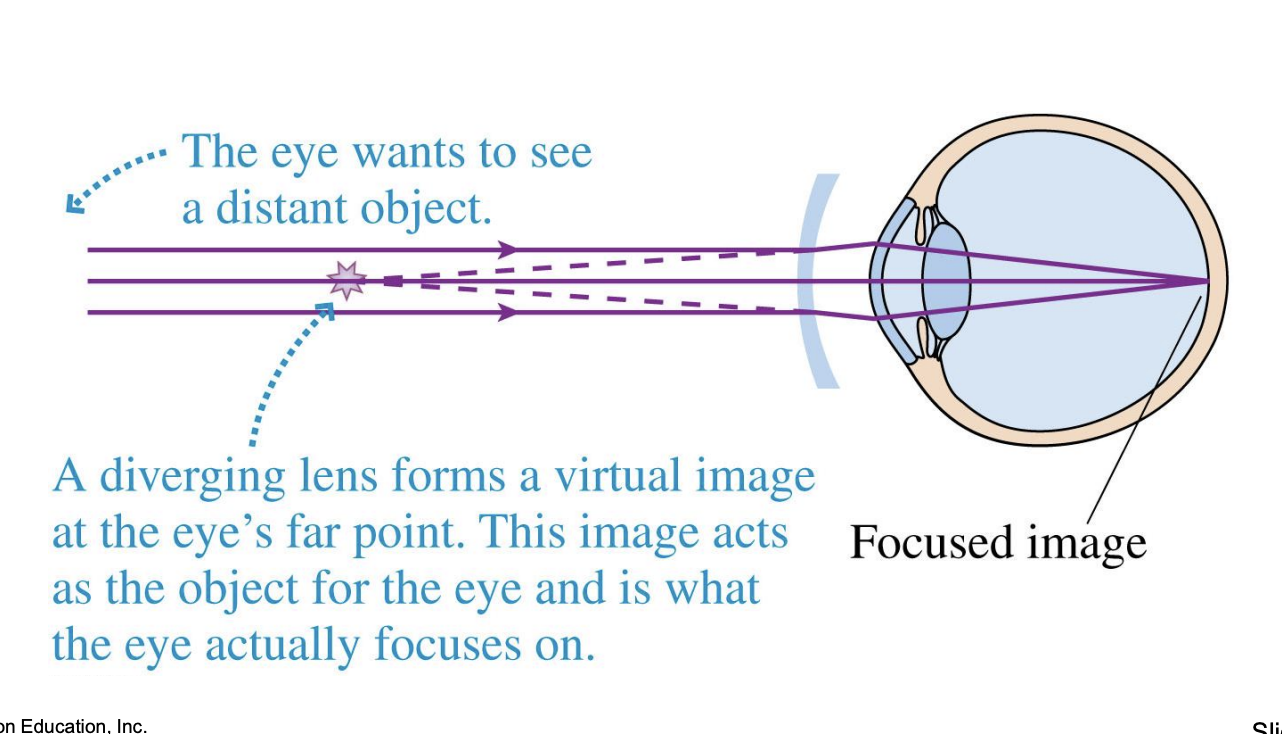
myopia correction

-To correct myopia, we needed a diverging lens to slightly defocus the rays and move the image point back to the retina

  • f<0, P<0

*spread rays out so converge on retina
<p>-To correct myopia, we needed a diverging lens to slightly defocus the rays and move the image point back to the retina</p><ul><li><p>f&lt;0, P&lt;0</p></li></ul><p>*spread rays out so converge on retina</p>
28
New cards

summary hyperopia vs myopia

-hyperopia=farsigthed, need converging corrective lens (f>0,P>0), virtual image made at person’s personal NP >25cm

-myopia=nearsigthed, need diverging corrective lens (f<0,P<0)

Explore top notes

note
Nervous System
Updated 1292d ago
0.0(0)
note
Chapter Eleven: Eating Disorders
Updated 1073d ago
0.0(0)
note
Français 2
Updated 1175d ago
0.0(0)
note
Aller Test
Updated 722d ago
0.0(0)
note
Verbal Forms
Updated 668d ago
0.0(0)
note
science
Updated 1263d ago
0.0(0)
note
Nervous System
Updated 1292d ago
0.0(0)
note
Chapter Eleven: Eating Disorders
Updated 1073d ago
0.0(0)
note
Français 2
Updated 1175d ago
0.0(0)
note
Aller Test
Updated 722d ago
0.0(0)
note
Verbal Forms
Updated 668d ago
0.0(0)
note
science
Updated 1263d ago
0.0(0)

Explore top flashcards

flashcards
370 CANCER PREVENTION
89
Updated 1093d ago
0.0(0)
flashcards
AP Psych Unit 2
48
Updated 900d ago
0.0(0)
flashcards
Science - Unit 2 Quiz
28
Updated 1214d ago
0.0(0)
flashcards
PD E2- General symptoms
58
Updated 367d ago
0.0(0)
flashcards
Ar Verbs
56
Updated 1162d ago
0.0(0)
flashcards
Fisiologia Cardiovascular
21
Updated 347d ago
0.0(0)
flashcards
370 CANCER PREVENTION
89
Updated 1093d ago
0.0(0)
flashcards
AP Psych Unit 2
48
Updated 900d ago
0.0(0)
flashcards
Science - Unit 2 Quiz
28
Updated 1214d ago
0.0(0)
flashcards
PD E2- General symptoms
58
Updated 367d ago
0.0(0)
flashcards
Ar Verbs
56
Updated 1162d ago
0.0(0)
flashcards
Fisiologia Cardiovascular
21
Updated 347d ago
0.0(0)