Marine Zoology and Ecosystems: Primary Production
 Studied by 0 people
 Call Kai
 Learn
Learn Practice Test
 Spaced Repetition
 Match
Match Flashcards
 Knowt Play
1/29

There's no tags or description
Looks like no tags are added yet.
Name | Mastery | Learn | Test | Matching | Spaced | Call with Kai |
|---|
No study sessions yet.
30 Terms
Primary production definition
base of marine food web- photosynthesis, rate of organic carbon formation
Sunlight -> producers -> consumers
Marine primary producers
phytoplankton & macroalgae/marine angiosperms
Gross Primary Production (GPP)
total rate of CO2 fixation via photosynthesis
Autotropic Respiration (Ra)
carbon used by producers for metabolic maintenance
Net Primary Production (NPP)
GPP-Ra (what is left for growth, export, higher trophic levels)
New/Export production
portion of NPP that is exported out of the euphotic zones, not respired on surface
Net Ecosystem Production (NEP)
if including respiration by heterotrophs
Seaweed: Marine macroalgae
large, multicellular protists
not true plants
Seaweed: main groups
Green, Brown & red
Green seaweed
Chlorophyta: chlorophyll a & b
shallow waters
Brown seaweed
Phaeophyta: fucoxanthin pigment
cooler waters, kelps
Red seaweed
Rhodophyta: phycoerythrin pigment
deeper waters
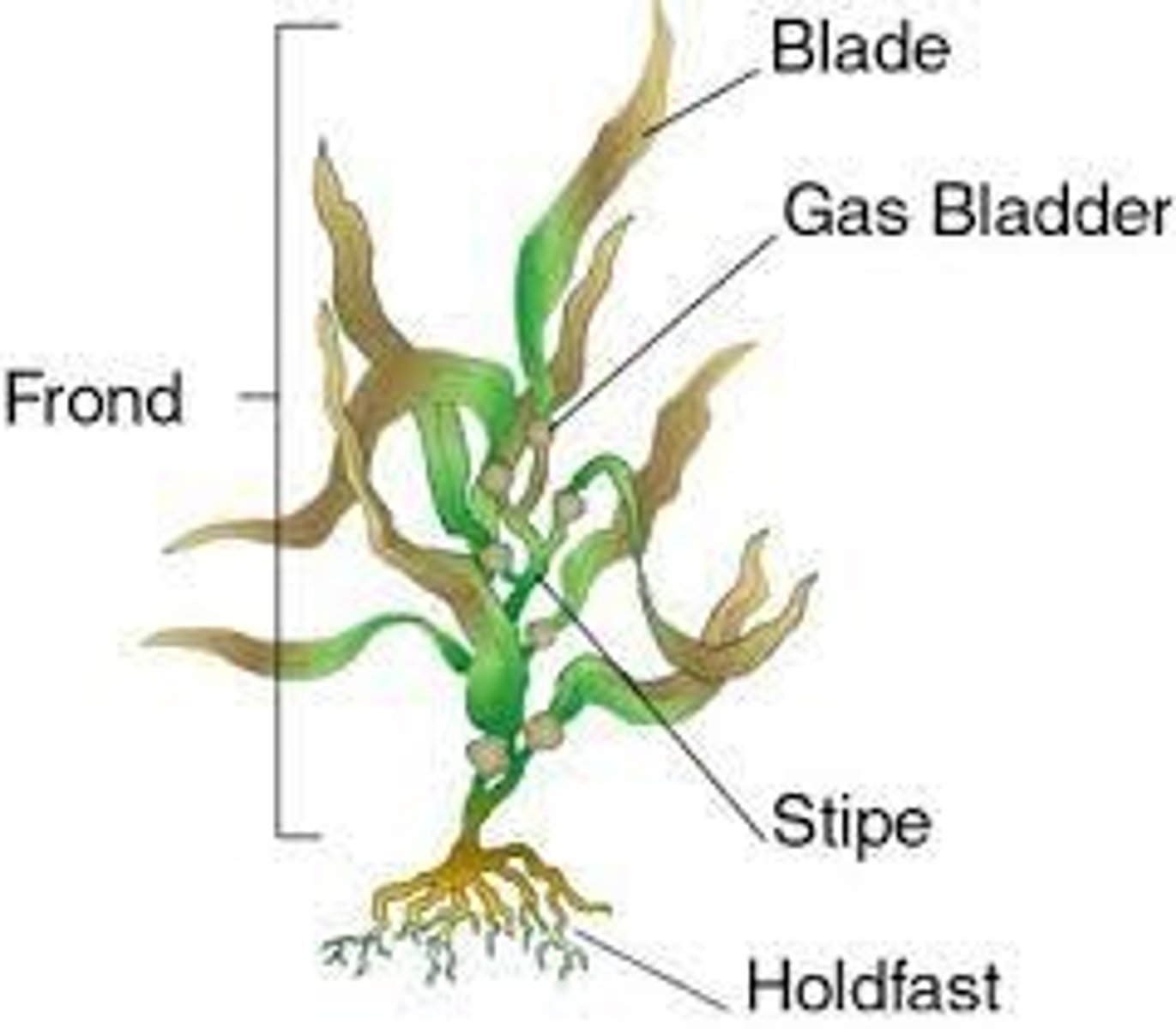
Seaweed: Form & Function
blades- analogous function to leaves
pneumatocyst- buoyancy
stipe- flexible to reduce breakage
holdfast- anchors, no roots, no nutrients
Seaweed: Ecology & Zonation
temp defines global distribution patterns
competition and herbivory structure the community
light, wave action, desiccation gradients
Seaweed Productivity
kelp forest 200-1700g C m-2 yr-1
does not get stored long-term
enters food webs as: detritus, dissolved organic matter, consumed by grazers
Seagrass
angiosperms- adapted to full marine life
~60 spp
Seagrass: adaptations
flexible leaves, thin cuticle
hydrophilic pollen- travels in water to different locations
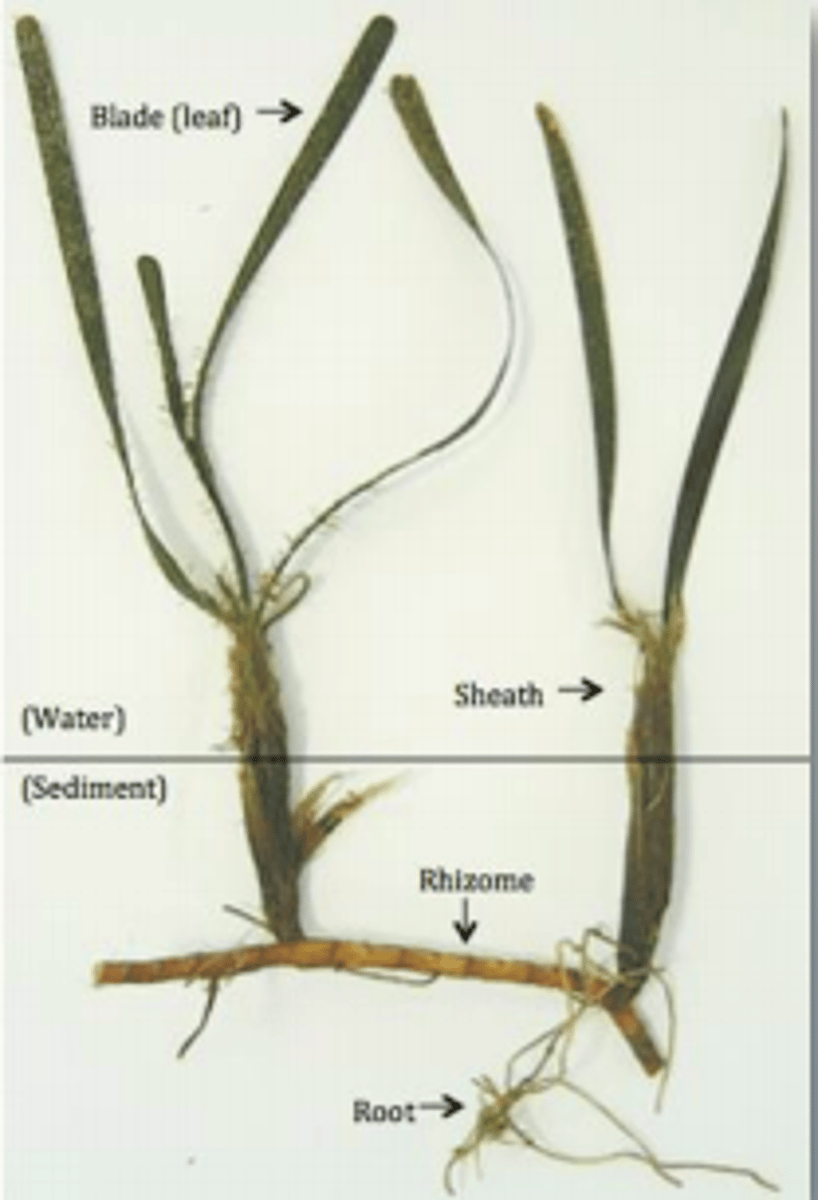
root/rhizome system in sediments
low-light adapted- usually require clear water so they can have light, but usually live with lots of turbidity
seagrass anatomy
Seagrass: Productivity
538g C m-2 yr-1
high carbon burial in anoxic sediments → blue carbon sink
traps sediments= improves clarity
crucial nurseries for fish/invertebrates
Mangroves
flowering trees/shrubs in intertidal tropics
adapted to salinity & anoxia
Mangroves: salinity adaptation
salt excretion- (avicennia), salt exclusion (Rhizophora)
Mangroves: anoxia adaptation
aerial roots (prop roots, pneumatophores)
Mangroves: ecology and ecosystem functions
detrital export supports estuarine & coastal food webs
coastal protection
provide nursery grounds for juvenile fish/shrimp
major long-term carbon sinks (anoxic sediments)
most productive forest in the world
Comparing Coastal producers: Type
Seaweeds- protists
seagrasses- flowering plants
mangroves- trees/shrubs
Comparing Coastal producers: Substrate
seaweeds- hard rocks
seagrass- soft sediments
mangroves- intertidal mud
Comparing Coastal producers: productivity
seaweed & mangroves- high
seagrass- moderate
Comparing Coastal producers: Carbon storage
Seaweed- low
seagrass- medium
mangroves- high
Human impacts: losses
seagrass: 110km2 per year ~7% per year since 1990
mangroves: 0.21% to 0/04%
seaweeds: ~1.8% per year, Kelp 90% loss on hotspots
Human impacts: threats
development, eutrophication, trawling, climate change
Human impacts: conservation
Marine protected areas (MPA), water quality regulation, restoration, blue-carbon credits
 Note
Note  Flashcards (26)