ANAT 3001 reproductive system (internal pelvic anatomy)

0.0(0)
studied byStudied by 0 people
0.0(0)
full-widthCall Kai
learnLearn
examPractice Test
spaced repetitionSpaced Repetition
heart puzzleMatch
flashcardsFlashcards
GameKnowt Play
Card Sorting

1/34

encourage image

There's no tags or description

Looks like no tags are added yet.

Study Analytics
Name
Mastery
Learn
Test
Matching
Spaced

No study sessions yet.

35 Terms

1
New cards

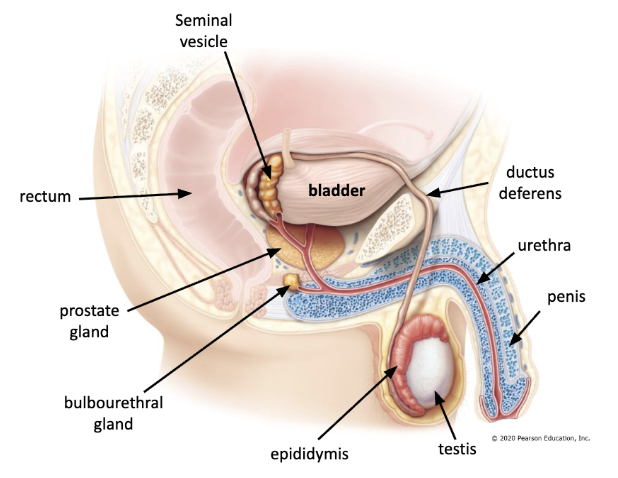
male pelvic structures

knowt flashcard image
2
New cards

ductus deferens and seminal vesicle

  • ductus (vas) deferens enters pelvic cavity through inguinal canal

  • ductus deferens joined by seminal vesicle to create ejaculatory duct within prostate gland

  • seminal vesicles release into semen

    • fructose - energy supply for sperm cells

    • prostaglandins - promote dilation of cervical canal and contraction of uterus

clotting proteins - coagulates semen after ejaculation
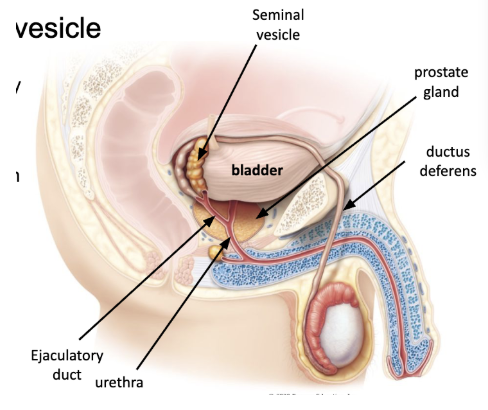
<ul><li><p><span style="background-color: transparent;"><span>ductus (vas) deferens enters pelvic cavity through inguinal canal</span></span></p></li><li><p><span style="background-color: transparent;"><u><span>ductus deferens</span></u><span> joined by </span><u><span>seminal vesicle</span></u><span> to create </span><u><span>ejaculatory duct</span></u><span> within </span><u><span>prostate gland</span></u></span></p></li><li><p><span style="background-color: transparent;"><span>seminal vesicles release into semen</span></span></p><ul><li><p><span style="background-color: transparent;"><u><span>fructose</span></u><span> - energy supply for sperm cells</span></span></p></li><li><p><span style="background-color: transparent;"><u><span>prostaglandins</span></u><span> - promote dilation of cervical canal and contraction of uterus</span></span></p></li></ul></li></ul><p><span style="background-color: transparent;"><u><span>clotting proteins</span></u><span> - coagulates semen after ejaculation</span></span></p>
3
New cards

prostate gland

  • prostate gland located inferior to bladder

  • ejaculatory duct joins the urethra within the prostate gland

    • seminalplasmin - antibiotic to combat urinary tract infections

    • prostate specific antigen (PSA) - liquefies semen after ejaculation

4
New cards

urethra

  • carries urine and semen to exit the penis

  • has specific regions

    • prostatic urethra - through prostate, joined by ejaculatory ducts

    • penile (spongy) urethra - through penis
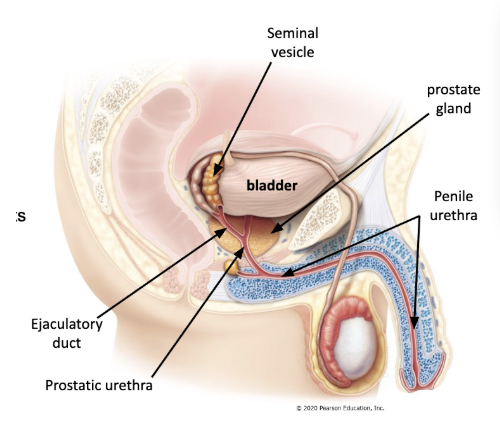
<ul><li><p><span style="background-color: transparent;"><span>carries urine and semen to exit the penis</span></span></p></li><li><p><span style="background-color: transparent;"><span>has specific regions</span></span></p><ul><li><p><span style="background-color: transparent;"><u><span>prostatic urethra</span></u><span> - through prostate, joined by ejaculatory ducts</span></span></p></li><li><p><span style="background-color: transparent;"><u><span>penile (spongy) urethra</span></u><span> - through penis</span></span></p></li></ul></li></ul><p></p>
5
New cards

bulbourethral gland

  • produces mucus like substance that conditions penile urethra before ejaculation

    • neutralizes acidic urine and lubricates urethra
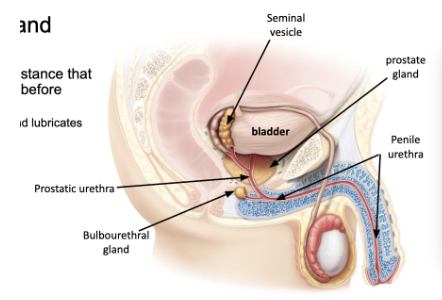
<ul><li><p><span style="background-color: transparent;"><span>produces mucus like substance that conditions penile urethra before ejaculation</span></span></p><ul><li><p><span style="background-color: transparent;"><span>neutralizes acidic urine and lubricates urethra</span></span></p></li></ul></li></ul><p></p>
6
New cards

female pelvic structures

  • bladder sits behind pubic bone

  • vagina and uterus between bladder and rectum

  • uterus arches anteriorly 

  • uterine (fallopian) tube located anterior to ovary
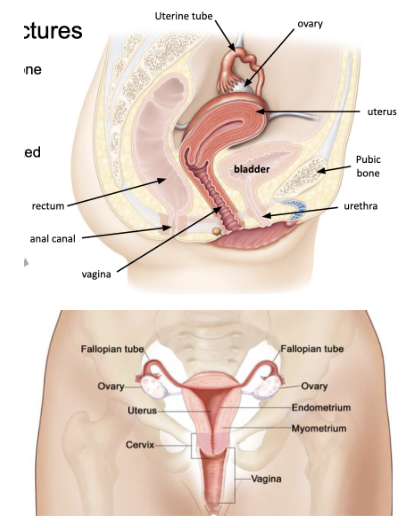
<ul><li><p><span style="background-color: transparent;"><span>bladder sits behind pubic bone</span></span></p></li><li><p><span style="background-color: transparent;"><span>vagina and uterus between bladder and rectum</span></span></p></li><li><p><span style="background-color: transparent;"><span>uterus arches anteriorly&nbsp;</span></span></p></li><li><p><span style="background-color: transparent;"><span>uterine (fallopian) tube located anterior to ovary</span></span></p></li></ul><p></p>
7
New cards

pouches in the pelvis

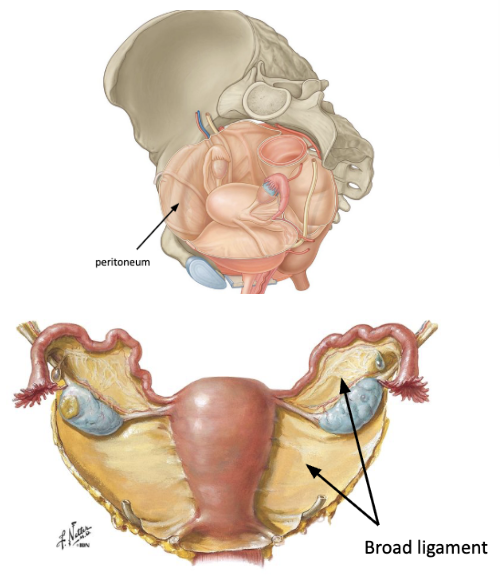
peritoneum drapes over pelvic structures to form pouches
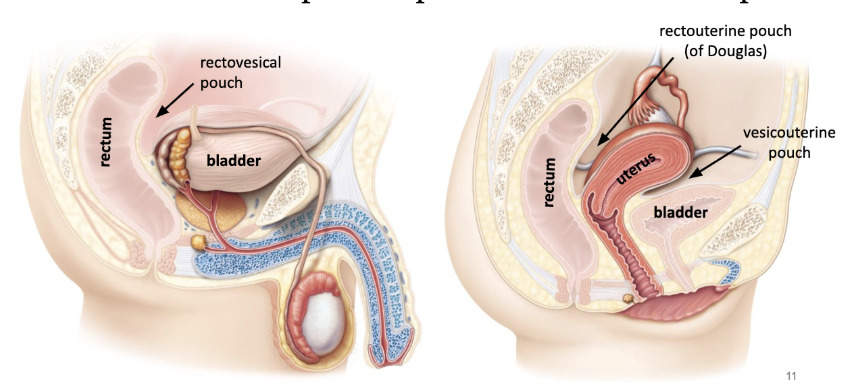
<p>peritoneum drapes over pelvic structures to form pouches</p>
8
New cards

vagina and uterus

  • vagina - muscular canal

    • stratified squamous epithelium

    • fornix - circular area surrounding the cervix

  • uterus - hollow organ where embryo/fetus develops

    • cervix - inferior “donut shaped” projection into vaginal canal
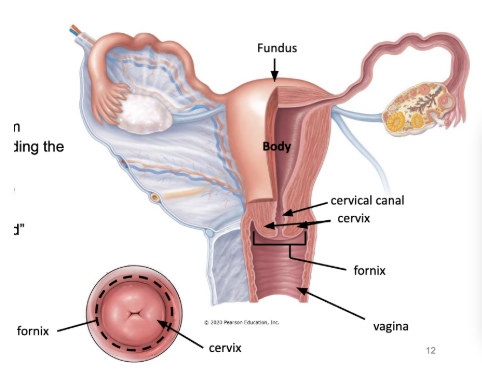
<ul><li><p><span style="background-color: transparent;"><u><span>vagina</span></u><span> - muscular canal</span></span></p><ul><li><p><span style="background-color: transparent;"><span>stratified squamous epithelium</span></span></p></li><li><p><span style="background-color: transparent;"><u><span>fornix</span></u><span> - circular area surrounding the cervix</span></span></p></li></ul></li><li><p><span style="background-color: transparent;"><u><span>uterus</span></u><span> - hollow organ where embryo/fetus develops</span></span></p><ul><li><p><span style="background-color: transparent;"><u><span>cervix</span></u><span> - inferior “donut shaped” projection into vaginal canal</span></span></p></li></ul></li></ul><p></p>
9
New cards

uterine wall - 3 layers

  • perimetrium

    • outer serous membrane (peritoneum)

  • myometrium 

    • thick muscular layer

    • produces contractions during childbirth

  • endometrium 

    • mucosal lining of uterine cavity, simple columnar epithelium with connective tissue

    • highly vascularized

    • functional layer - thick inner layer, shed during menstruation 

    • basal layer - thinner, not shed, forms new functional layer
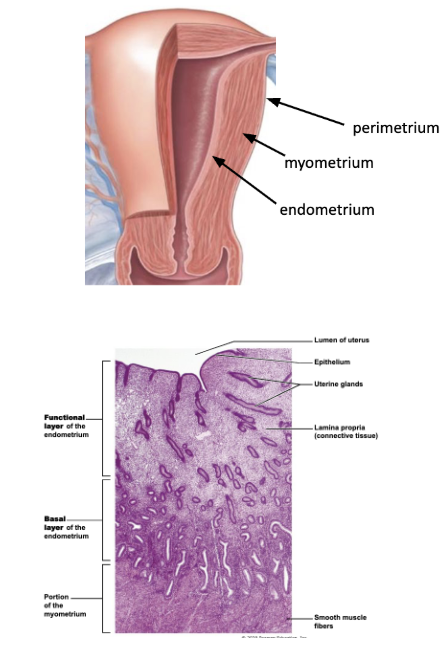
<ul><li><p><span style="background-color: transparent;"><u><span>perimetrium</span></u></span></p><ul><li><p><span style="background-color: transparent;"><span>outer serous membrane (peritoneum)</span></span></p></li></ul></li></ul><ul><li><p><span style="background-color: transparent;"><u><span>myometrium&nbsp;</span></u></span></p><ul><li><p><span style="background-color: transparent;"><span>thick muscular layer</span></span></p></li><li><p><span style="background-color: transparent;"><span>produces contractions during childbirth</span></span></p></li></ul></li><li><p><span style="background-color: transparent;"><u><span>endometrium&nbsp;</span></u></span></p><ul><li><p><span style="background-color: transparent;"><span>mucosal lining of uterine cavity, simple columnar epithelium with connective tissue</span></span></p></li><li><p><span style="background-color: transparent;"><span>highly vascularized</span></span></p></li><li><p><span style="background-color: transparent;"><u><span>functional layer</span></u><span> - thick inner layer, shed during menstruation&nbsp;</span></span></p></li><li><p><span style="background-color: transparent;"><u><span>basal layer</span></u><span> - thinner, not shed, forms new functional layer</span></span></p></li></ul></li></ul><p></p>
10
New cards

uterus and adnexa

adnexa - 3 structures that hand from the uterus

  1. uterine (fallopian tube

    1. transports oocytes from ovaries to uterine cavity 

    2. fimbriae - finger like projections that draw oocyte

  2. ovary and ovarian ligament

    1. ovaries - gonads, produce gametes (oocytes)

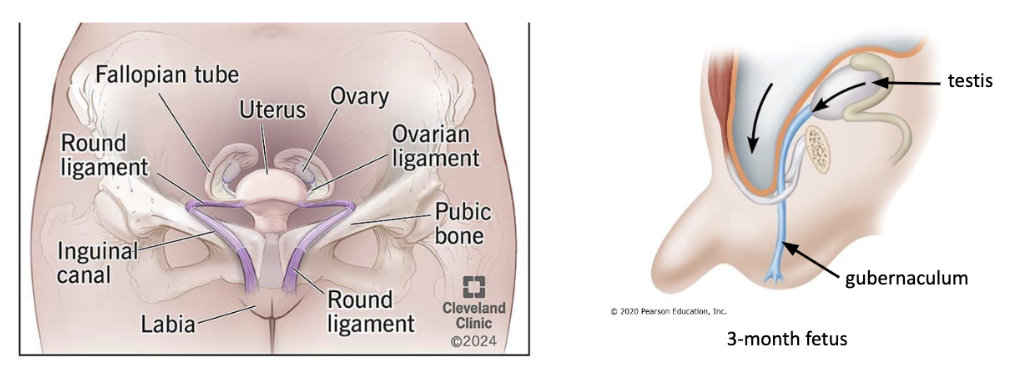
  3. round ligament

    1. travels anteriorly through inguinal canal on each side and attach to labia majori 

    2. positional support and anchor for uterus
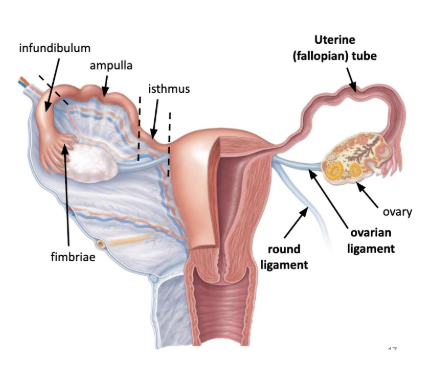
<p><span style="background-color: transparent;"><u><span>adnexa</span></u><span> - 3 structures that hand from the uterus</span></span></p><ol><li><p><span style="background-color: transparent;"><u><span>uterine (fallopian tube</span></u></span></p><ol><li><p><span style="background-color: transparent;"><span>transports oocytes from ovaries to uterine cavity&nbsp;</span></span></p></li><li><p><span style="background-color: transparent;"><u><span>fimbriae</span></u><span> - finger like projections that draw oocyte</span></span></p></li></ol></li><li><p><span style="background-color: transparent;"><u><span>ovary and ovarian ligament</span></u></span></p><ol><li><p><span style="background-color: transparent;"><span>ovaries - gonads, produce gametes (oocytes)</span></span></p></li></ol></li><li><p><span style="background-color: transparent;"><u><span>round ligament</span></u></span></p><ol><li><p><span style="background-color: transparent;"><span>travels anteriorly through inguinal canal on each side and attach to labia majori&nbsp;</span></span></p></li><li><p><span style="background-color: transparent;"><span>positional support and anchor for uterus</span></span></p></li></ol></li></ol><p></p>
11
New cards

homologous to the gubernaculum…

knowt flashcard image
12
New cards

broad ligament

  • draping of peritoneum over the uterus and adnexa 

  • has three parts

    • mesometrium

    • mesosalpinx

    • mesovarium

<ul><li><p><span style="background-color: transparent;"><span>draping of peritoneum over the uterus and adnexa&nbsp;</span></span></p></li><li><p><span style="background-color: transparent;"><span>has three parts</span></span></p><ul><li><p><span style="background-color: transparent;"><u><span>mesometrium</span></u><span> </span></span></p></li><li><p><span style="background-color: transparent;"><u><span>mesosalpinx</span></u><span> </span></span></p></li><li><p><span style="background-color: transparent;"><u><span>mesovarium</span></u></span></p></li></ul></li></ul><p></p>
13
New cards

3 parts of broad ligament

  • mesometrium - covers uterus

  • mesosalpinx - covers uterine tube

  • mesovarium - covers ovarian ligament and ovaries 
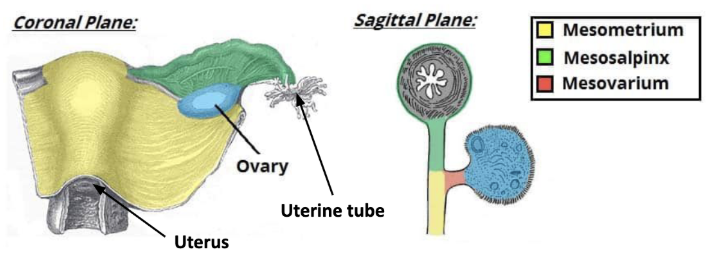
<ul><li><p><span style="background-color: transparent;"><u><span>mesometrium</span></u><span> - covers uterus</span></span></p></li><li><p><span style="background-color: transparent;"><u><span>mesosalpinx</span></u><span> - covers uterine tube</span></span></p></li><li><p><span style="background-color: transparent;"><u><span>mesovarium</span></u><span> - covers ovarian ligament and ovaries&nbsp;</span></span></p></li></ul><p></p>
14
New cards

blood supply to pelvic structures

  • internal iliac artery gives off many branches to supply blood to pelvic structures 

    • vesical artery - to bladder (and prostates)

    • uterine artery - to uterus

    • vaginal artery - to vagina

    • middle rectal artery - to rectum

  • each has corresponding veins that drain into the IVC

  • ovarian (gonadal) artery - from abdominal aorta, supply ovaries

  • ovarian (gonadal) vein 

    • left joins left renal vein

    • right joins IVC

  • similar pattern to testicular arteries and veins but stay inside pelvis

  • when ovarian arteries and veins covered in peritoneum, called suspensory ligament
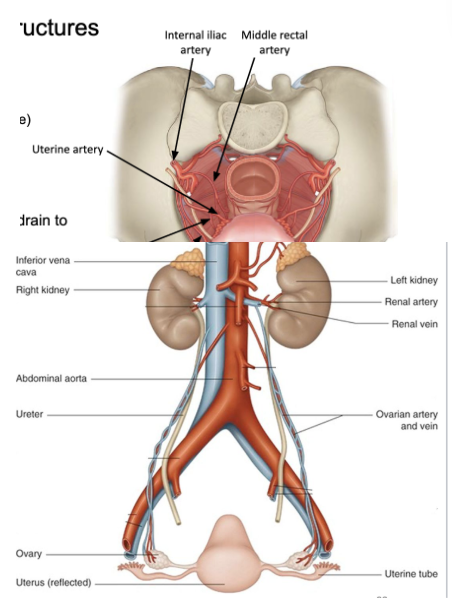
<ul><li><p><span style="background-color: transparent;"><u><span>internal iliac artery</span></u><span> gives off many branches to supply blood to pelvic structures&nbsp;</span></span></p><ul><li><p><span style="background-color: transparent;"><u><span>vesical artery</span></u><span> - to bladder (and prostates)</span></span></p></li><li><p><span style="background-color: transparent;"><u><span>uterine artery</span></u><span> - to uterus</span></span></p></li><li><p><span style="background-color: transparent;"><u><span>vaginal artery</span></u><span> - to vagina</span></span></p></li><li><p><span style="background-color: transparent;"><u><span>middle rectal artery</span></u><span> - to rectum</span></span></p></li></ul></li><li><p><span style="background-color: transparent;"><span>each has corresponding veins that drain into the IVC</span></span></p></li></ul><ul><li><p><span style="background-color: transparent;"><u><span>ovarian (gonadal) artery</span></u><span> - from abdominal aorta, supply ovaries</span></span></p></li><li><p><span style="background-color: transparent;"><u><span>ovarian (gonadal) vein</span></u><span>&nbsp;</span></span></p><ul><li><p><span style="background-color: transparent;"><span>left joins left renal vein</span></span></p></li><li><p><span style="background-color: transparent;"><span>right joins IVC</span></span></p></li></ul></li><li><p><span style="background-color: transparent;"><span>similar pattern to testicular arteries and veins but stay inside pelvis</span></span></p></li><li><p><span style="background-color: transparent;"><span>when ovarian arteries and veins covered in peritoneum, called </span><u><span>suspensory ligament</span></u></span></p></li></ul><p></p>
15
New cards

blood supply to external genitalia

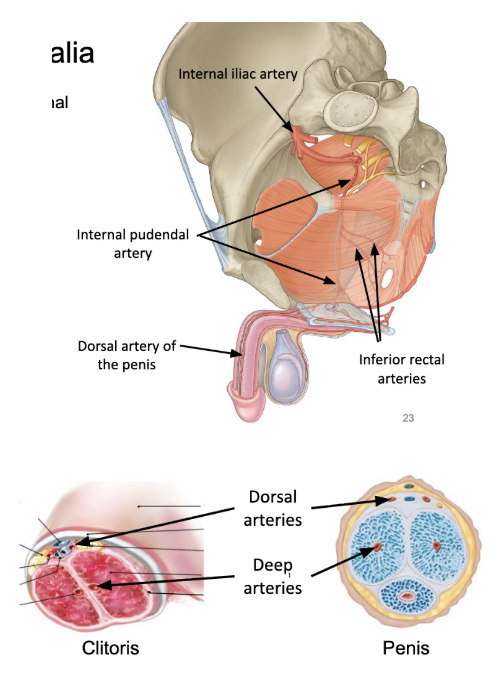
  • internal pudendal artery - branch from internal iliac artery

    • main artery of perineum and external genitalia, also rectum

    • inferior rectal arteries

    • dorsal arteries of the penis/clitoris

    • deep arteries of the penis/clitoris

<ul><li><p><span style="background-color: transparent;"><u><span>internal pudendal artery</span></u><span> - branch from internal iliac artery</span></span></p><ul><li><p><span style="background-color: transparent;"><span>main artery of perineum and external genitalia, also rectum</span></span></p></li><li><p><span style="background-color: transparent;"><u><span>inferior rectal arteries</span></u></span></p></li><li><p><span style="background-color: transparent;"><u><span>dorsal arteries of the penis/clitoris</span></u></span></p></li><li><p><span style="background-color: transparent;"><u><span>deep arteries of the penis/clitoris</span></u></span></p></li></ul></li></ul><p></p>
16
New cards

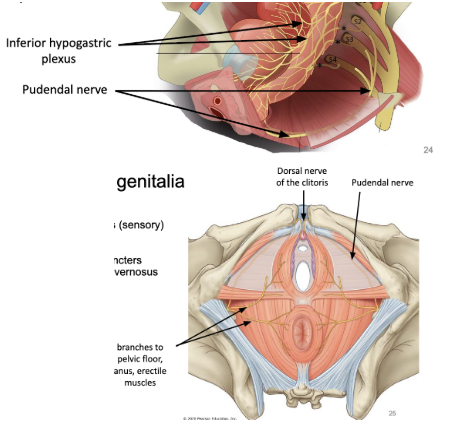
innervation to pelvic structures

  • inferior hypogastric plexus - visceral sensory and motor innervation to pelvic structures and external genitalia

    • sympathetics via sympathetic trunk

    • parasympathetics via pelvic splanchnic nerves (S2-S4)

  • pudendal nerve - from S2-S4, innervation of external genitalia 

    • dorsal nerve of clitoris/penis (sensory)

    • somatic motor branches to

      • muscles of pelvic floor

      • external anal/urethral sphincters

      • bulbospongiousis, ischiocavernosus

<ul><li><p><span style="background-color: transparent;"><u><span>inferior hypogastric plexus</span></u><span> - visceral sensory and motor innervation to pelvic structures and external genitalia</span></span></p><ul><li><p><span style="background-color: transparent;"><u><span>sympathetics</span></u><span> via sympathetic trunk</span></span></p></li><li><p><span style="background-color: transparent;"><u><span>parasympathetics</span></u><span> via pelvic splanchnic nerves (S2-S4)</span></span></p></li></ul></li><li><p><span style="background-color: transparent;"><u><span>pudendal nerve</span></u><span> - from S2-S4, innervation of external genitalia&nbsp;</span></span></p><ul><li><p><span style="background-color: transparent;"><u><span>dorsal nerve of clitoris/penis</span></u><span> (sensory)</span></span></p></li><li><p><span style="background-color: transparent;"><span>somatic motor branches to</span></span></p><ul><li><p><span style="background-color: transparent;"><span>muscles of pelvic floor</span></span></p></li><li><p><span style="background-color: transparent;"><span>external anal/urethral sphincters</span></span></p></li><li><p><span style="background-color: transparent;"><span>bulbospongiousis, ischiocavernosus</span></span></p></li></ul></li></ul></li></ul><p></p>
17
New cards

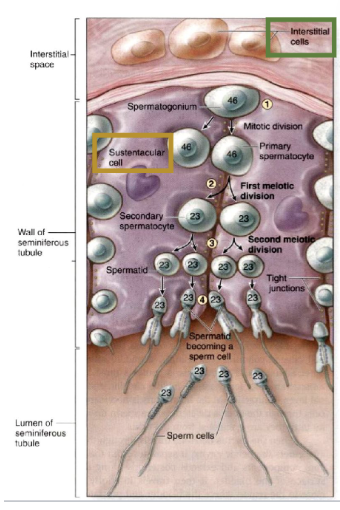
spermatogenesis

  • formation of sperm within testes

    • spermatogonia (stem cells) differentiate into sperm, takes ~75 days

  • occurs in seminiferous tubules of testes

  • produce 400 million sperm per day

  • starts at puberty and continues until death (declines with old age)

  • 3 stages

18
New cards

stage 1

 formation of spermatocytes 

  • spermatogonia (stem cells) located in outer region of seminiferous tubules

  • spermatogonia undergo continuous mitosis (cell division) that results in 2 daughter cells:

    • type A - remain in outer region to maintain germ cell line

    • type B - move toward lemur as primary spermatocyte
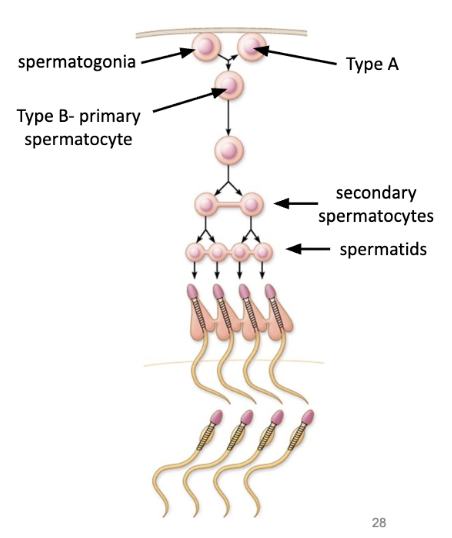
<p><span style="background-color: transparent;"><span>&nbsp;formation of spermatocytes&nbsp;</span></span></p><ul><li><p><span style="background-color: transparent;"><u><span>spermatogonia</span></u><span> (stem cells) located in outer region of seminiferous tubules</span></span></p></li><li><p><span style="background-color: transparent;"><span>spermatogonia undergo continuous mitosis (cell division) that results in 2 daughter cells:</span></span></p><ul><li><p><span style="background-color: transparent;"><u><span>type A</span></u><span> - remain in outer region to maintain germ cell line</span></span></p></li><li><p><span style="background-color: transparent;"><span>t</span><u><span>ype B</span></u><span> - move toward lemur as </span><u><span>primary spermatocyte</span></u></span></p></li></ul></li></ul><p></p>
19
New cards

stage 2

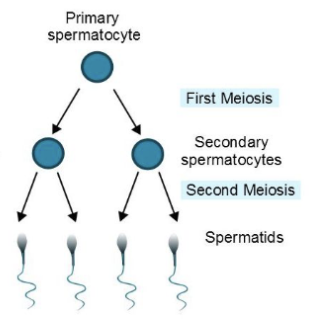
meiosis

  • spermatocytes undergo meiosis

    • a process of 2 subsequent divisions

    • 1 diploid cell → 4 haploid cells (spermatids)
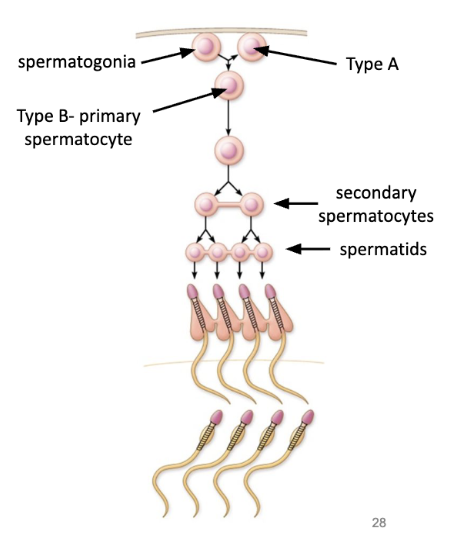
<p><span style="background-color: transparent;"><span>meiosis</span></span></p><ul><li><p><span style="background-color: transparent;"><span>spermatocytes undergo </span><u><span>meiosis</span></u></span></p><ul><li><p><span style="background-color: transparent;"><span>a process of 2 subsequent divisions</span></span></p></li><li><p><span style="background-color: transparent;"><span>1 diploid cell → 4 haploid cells (</span><u><span>spermatids</span></u><span>)</span></span></p></li></ul></li></ul><p></p>
20
New cards

stage 3

spermiogenesis 

  • spermatids differentiate into sperm

    • sperm have 3 parts

      • head - with nucleus

      • midpiece - with mitochondria to produce energy for tail

      • tail - flagellum that whips around to proper sperm

  • sperm detaches from epithelium of seminiferous tubule and enters lumen
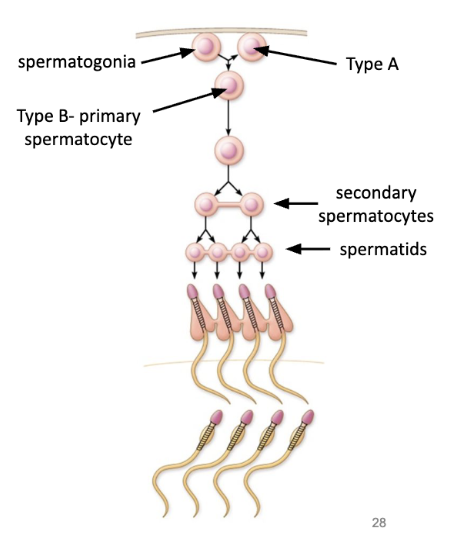
<p><span style="background-color: transparent;"><span>spermiogenesis&nbsp;</span></span></p><ul><li><p><span style="background-color: transparent;"><u><span>spermatids</span></u><span> differentiate into </span><u><span>sperm</span></u></span></p><ul><li><p><span style="background-color: transparent;"><span>sperm have 3 parts</span></span></p><ul><li><p><span style="background-color: transparent;"><u><span>head</span></u><span> - with nucleus</span></span></p></li><li><p><span style="background-color: transparent;"><u><span>midpiece</span></u><span> - with mitochondria to produce energy for tail</span></span></p></li><li><p><span style="background-color: transparent;"><u><span>tail</span></u><span> - flagellum that whips around to proper sperm</span></span></p></li></ul></li></ul></li><li><p><span style="background-color: transparent;"><u><span>sperm</span></u><span> detaches from epithelium of seminiferous tubule and enters lumen</span></span></p></li></ul><p></p>
21
New cards

supporting cells - interstitial (leydig) cells

  • located in connective tissue between seminiferous tubules 

  • produce androgens (testosterone)

<ul><li><p><span style="background-color: transparent;"><span>located in connective tissue between seminiferous tubules&nbsp;</span></span></p></li><li><p><span style="background-color: transparent;"><span>produce androgens (testosterone)</span></span></p></li></ul><p></p>
22
New cards

supporting cells - sustentacular (sertoli) cells

  • with seminiferous tubules 

  • sperm cells pass towards the lumen between sustentacular cells

  • nutritional support of sperm cells

  • produce inhibin (prevent spermatogenesis when sperm count is too high)

23
New cards

ovaries

  • produce oocytes (oogenesis) in cortex

  • produce estrogen and progesterone (sex hormones)
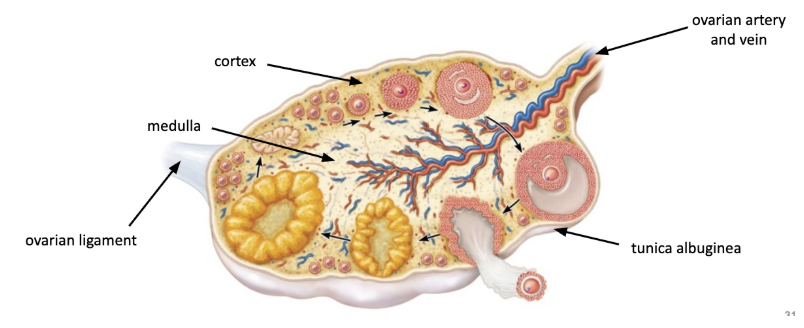
<ul><li><p>produce oocytes (oogenesis) in cortex</p></li><li><p>produce estrogen and progesterone (sex hormones)</p></li></ul><p></p>
24
New cards

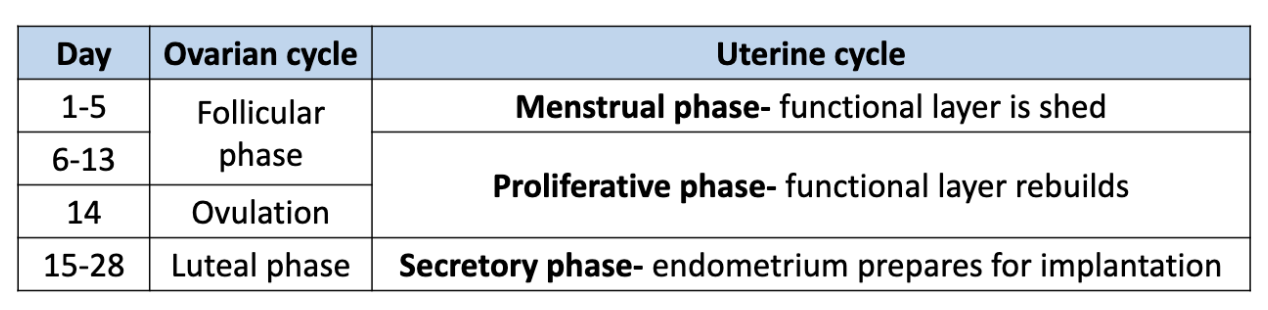
menstrual cycle

  • approximately monthly hormone induces cycling of the ovary (ovarian cycle) and uterus (uterine cycle)

  • ovarian cycle - stimulates development of ovarian follicles and the production of oocytes

  • uterine cycle - prepares the uterine wall for implantation and nourishment of a fertilized ovum

25
New cards

oogenesis

  • formation and development of oocytes

  • starts in ovary, finishes in uterine tube

  • 1 oocyte → 1 ovum + 2-3 polar bodies

    • ovum retains most of cytoplasm, polar bodies have primarily DNA and degenerate

  • takes many years to complete (many steps)
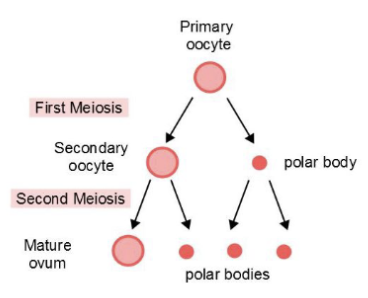
<ul><li><p><span style="background-color: transparent;"><span>formation and development of oocytes</span></span></p></li><li><p><span style="background-color: transparent;"><span>starts in ovary, finishes in uterine tube</span></span></p></li></ul><ul><li><p><span style="background-color: transparent;"><span>1 oocyte → 1 ovum + 2-3 polar bodies</span></span></p><ul><li><p><span style="background-color: transparent;"><span>ovum retains most of cytoplasm, polar bodies have primarily DNA and degenerate</span></span></p></li></ul></li><li><p><span style="background-color: transparent;"><span>takes many years to complete (many steps)</span></span></p></li></ul><p></p>
26
New cards

spermatogenesis

  • formation and development of sperm

  • starts in testes, finishes in epididymis 

  • 1 spermatocyte → 4 sperm cells

  • occurs continuously, takes ~75 days

<ul><li><p><span style="background-color: transparent;"><span>formation and development of sperm</span></span></p></li><li><p><span style="background-color: transparent;"><span>starts in testes, finishes in epididymis&nbsp;</span></span></p></li><li><p><span style="background-color: transparent;"><span>1 spermatocyte → 4 sperm cells</span></span></p></li><li><p><span style="background-color: transparent;"><span>occurs continuously, takes ~75 days</span></span></p></li></ul><p></p>
27
New cards

process of oogenesis

  • process that begins before birth and stalls until puberty 

  • in fetus 

    • oogonium (stem cell) → primary oocyte 

    • primary oocytes stalls before first division until puberty

  • after puberty during ovarian cycle

    • primary oocyte → secondary oocyte

    • secondary oocyte arrests before second division until after ovulation, and will only produce an ovum when sperm attaches to oocyte 
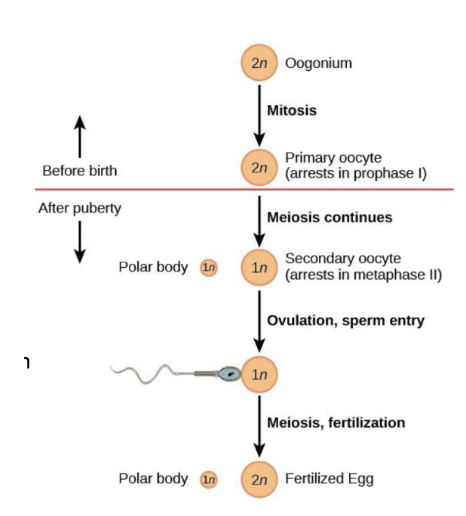
<ul><li><p><span style="background-color: transparent;"><span>process that begins before birth and stalls until puberty&nbsp;</span></span></p></li><li><p><span style="background-color: transparent;"><span>in fetus&nbsp;</span></span></p><ul><li><p><span style="background-color: transparent;"><u><span>oogonium</span></u><span> (stem cell) → </span><u><span>primary oocyte&nbsp;</span></u></span></p></li><li><p><span style="background-color: transparent;"><span>primary oocytes stalls before first division until puberty</span></span></p></li></ul></li><li><p><span style="background-color: transparent;"><span>after puberty during ovarian cycle</span></span></p><ul><li><p><span style="background-color: transparent;"><span>primary oocyte → </span><u><span>secondary oocyte</span></u></span></p></li><li><p><span style="background-color: transparent;"><span>secondary oocyte arrests before second division until after ovulation, and will only produce an </span><u><span>ovum</span></u><span> when sperm attaches to oocyte&nbsp;</span></span></p></li></ul></li></ul><p></p>
28
New cards

ovarian cycle

3 phases

  1. follicular phase (~day 1-13)

  2. ovulation (~on day 14)

  3. luteal phase (on ~day 15-28)

29
New cards
  1. follicular phase

(~day 1-13)

  • about 1.5 million primordial follicles (w/primary oocytes) present at birth, about 300-400 thousand at puberty 

  1. follicle stimulating hormone (FSH) - stimulates release of 6-12 primordial follicles 

  2. one primordial follicle continues to develop into tertiary follicle
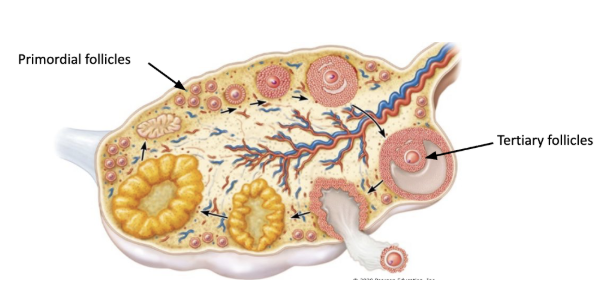
<p><span style="background-color: transparent;"><span>(~day 1-13)</span></span></p><ul><li><p><span style="background-color: transparent;"><span>about 1.5 million primordial follicles (w/primary oocytes) present at birth, about 300-400 thousand at puberty&nbsp;</span></span></p></li></ul><ol><li><p><span style="background-color: transparent;"><u><span>follicle stimulating hormone (FSH</span></u><span>) - stimulates release of 6-12 primordial follicles&nbsp;</span></span></p></li><li><p><span style="background-color: transparent;"><span>one primordial follicle continues to develop into tertiary follicle</span></span></p></li></ol><p></p>
30
New cards
  1. ovulation

(~on day 14)

  • mature follicle ruptures and releases secondary oocyte from the one of the persons two ovaries 

  • secondary oocyte is swept into the uterine tube by the fimbriae 

  • secondary oocyte does not complete secondary division unless sperm attaches
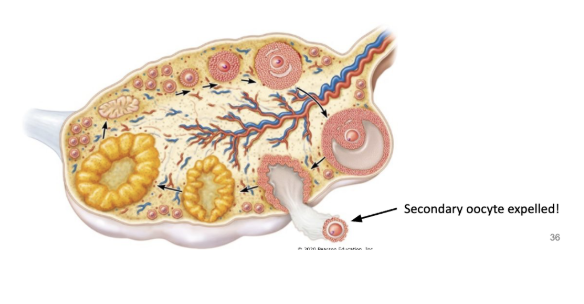
<p><span style="background-color: transparent;"><span>(~on day 14)</span></span></p><ul><li><p><span style="background-color: transparent;"><span>mature follicle ruptures and releases secondary oocyte from the one of the persons two ovaries&nbsp;</span></span></p></li><li><p><span style="background-color: transparent;"><u><span>secondary oocyte</span></u><span> is swept into the uterine tube by the fimbriae&nbsp;</span></span></p></li><li><p><span style="background-color: transparent;"><u><span>secondary oocyte does not complete secondary division unless sperm attaches</span></u></span></p></li></ul><p></p>
31
New cards
  1. luteal phase

(on ~day 15-28)

  • after ovulation, remaining part of the follicle collapses, called corpus luteum

  • corpus luteum persists as an endocrine gland, secretes estrogen and progesterone

    • stimulate build up of endometrium in preparation for pregnancy

  • if there is no implantation, corpus luteum dies after 2 weeks and becomes scar like tissue (corpus albicans)
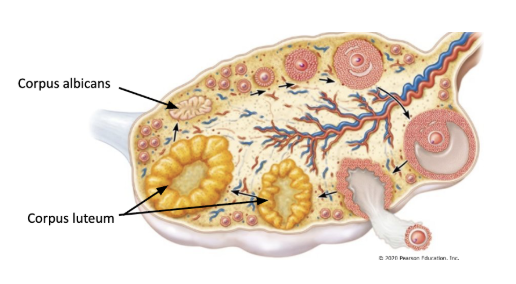
<p><span style="background-color: transparent;"><span>(on ~day 15-28)</span></span></p><ul><li><p><span style="background-color: transparent;"><span>after ovulation, remaining part of the follicle collapses, called </span><u><span>corpus luteum</span></u></span></p></li><li><p><span style="background-color: transparent;"><u><span>corpus luteum</span></u><span> persists as an endocrine gland, secretes </span><u><span>estrogen</span></u><span> and </span><u><span>progesterone</span></u></span></p><ul><li><p><span style="background-color: transparent;"><span>stimulate build up of endometrium in preparation for pregnancy</span></span></p></li></ul></li><li><p><span style="background-color: transparent;"><span>if there is no implantation, corpus luteum dies after 2 weeks and becomes scar like tissue (</span><u><span>corpus albicans</span></u><span>)</span></span></p></li></ul><p></p>
32
New cards

menstrual cycle (review)

  • uterine phases are closely coordinated with phases of ovarian cycle

  • at puberty, pituitary gland releases follicle stimulating hormone (FSH) and luteinizing hormone (LH) to initiate ovarian cycle

  • FSH and LH initiate changes in the ovaries during oogenesis

  • FSH stimulates growth of primordial follicles

  • cells in follicles release estrogen to rebuild functional layer of endometrium

  • LH increases fluid and pressure in tertiary follicle until rupture (ovulation)

  • corpus luteum releases estrogen and progesterone to prepare endometrium for implantation
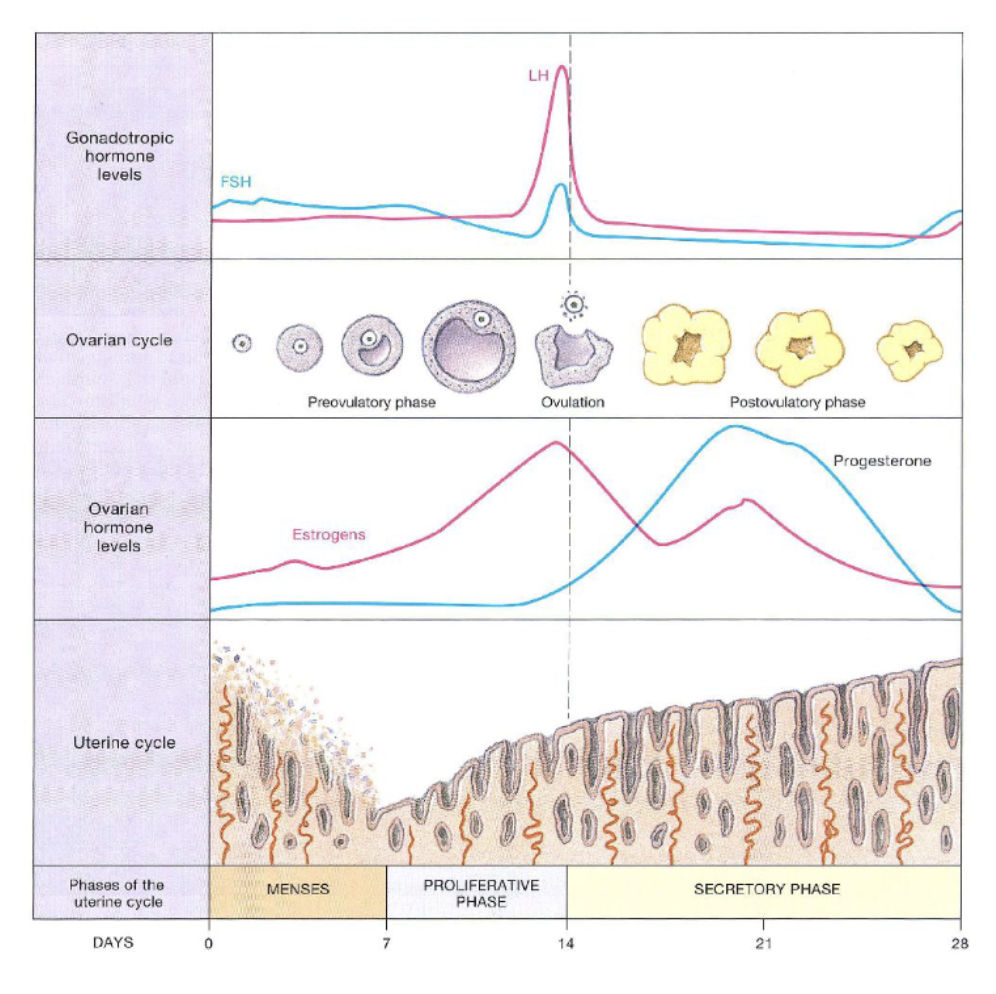
<ul><li><p><span style="background-color: transparent;"><span>uterine phases are closely coordinated with phases of ovarian cycle</span></span></p></li><li><p><span style="background-color: transparent;"><span>at puberty, pituitary gland releases follicle stimulating hormone (FSH) and luteinizing hormone (LH) to initiate ovarian cycle</span></span></p></li><li><p><span style="background-color: transparent;"><span>FSH and LH initiate changes in the ovaries during oogenesis</span></span></p></li><li><p><span style="background-color: transparent;"><span>FSH stimulates growth of primordial follicles</span></span></p></li><li><p><span style="background-color: transparent;"><span>cells in follicles release estrogen to rebuild functional layer of endometrium</span></span></p></li><li><p><span style="background-color: transparent;"><span>LH increases fluid and pressure in tertiary follicle until rupture (ovulation)</span></span></p></li><li><p><span style="background-color: transparent;"><span>corpus luteum releases estrogen and progesterone to prepare endometrium for implantation</span></span></p></li></ul><p></p>
33
New cards

uterine cycle coordination

<p></p>
34
New cards

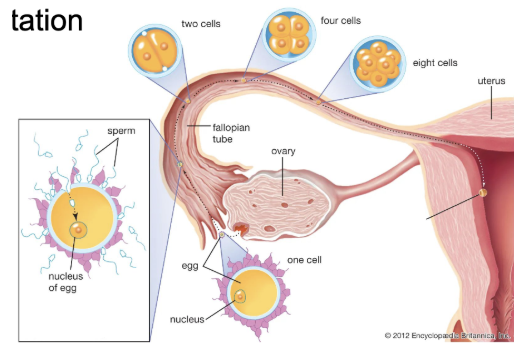
fertilization

  • secondary oocyte swept into uterine tube by fimbriae 

  • sperm cells deposited at the cervix travel through uterus to uterine tube

  • oocyte can remain in reproductive tract for 24 hours, sperm for 4 days

  • fertilization - one sperm cell fuses with oocyte to form new diploid cell

    • occurs in ampulla typically

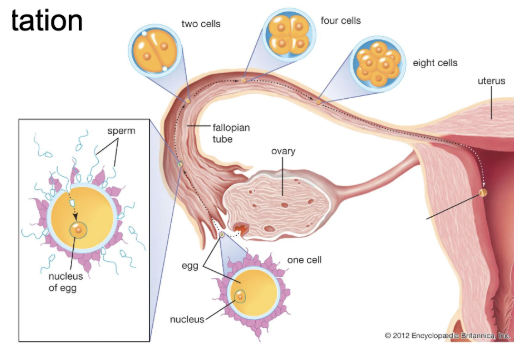
  • fertilized ovum (zygote) moves toward uterine cavity and divides
<ul><li><p><span style="background-color: transparent;"><span>secondary oocyte swept into uterine tube by fimbriae&nbsp;</span></span></p></li><li><p><span style="background-color: transparent;"><span>sperm cells deposited at the cervix travel through uterus to uterine tube</span></span></p></li><li><p><span style="background-color: transparent;"><span>oocyte can remain in reproductive tract for 24 hours, sperm for 4 days</span></span></p></li><li><p><span style="background-color: transparent;"><u><span>fertilization</span></u><span> - one sperm cell fuses with oocyte to form new diploid cell</span></span></p><ul><li><p><span style="background-color: transparent;"><span>occurs in ampulla typically</span></span></p></li></ul></li></ul><ul><li><p><span style="background-color: transparent;"><span>fertilized ovum (zygote) moves toward uterine cavity and divides</span></span></p></li></ul><p></p>
35
New cards

implantation

  • after 6 days, zygote implants in uterine wall (pregnancy)

    • corpus luteum keeps producing progesterone to stabilize uterine lining (placenta at 3 months)

  • if no implantation, menstruation occurs

    • corpus luteum regresses, stops producing progesterone and estrogen
<ul><li><p><span style="background-color: transparent;"><span>after 6 days, zygote implants in uterine wall (pregnancy)</span></span></p><ul><li><p><span style="background-color: transparent;"><span>corpus luteum keeps producing progesterone to stabilize uterine lining (placenta at 3 months)</span></span></p></li></ul></li><li><p><span style="background-color: transparent;"><span>if no implantation, menstruation occurs</span></span></p><ul><li><p><span style="background-color: transparent;"><span>corpus luteum regresses, stops producing progesterone and estrogen</span></span></p></li></ul></li></ul><p></p>

Explore top flashcards