CISC 324 Quiz 2
 Studied by 0 people
 Call Kai
 Learn
Learn Practice Test
 Spaced Repetition
 Match
Match Flashcards
 Knowt Play
1/242

There's no tags or description
Looks like no tags are added yet.
Name | Mastery | Learn | Test | Matching | Spaced |
|---|
No study sessions yet.
243 Terms
bytes, address, primary, slowest, clock cycles
Memory:
Massive array of circuitry (e.g. transistors)
Organized in _______, each having its own unique ___________
Part of __________ storage:
Direct contact with the CPU
Program’s instructions and data must move to memory before execution
Memory is the ________ primary storage element
Accessing instructions/data in the main memory can take many _____________ (stalls CPU)
clock cycle
A __________ is the time period during which a single pulse or cycle of the CPU’s clock is completed
Each pulse or cycle of the clock allows the CPU to perform a basic operation
Ex. a CPU with a speed of 2.5 GHz can execute up to 2.5 billion basic operations in a single second, assuming one operation per cycle.
memory, memory parts, user processes, user processes, hardware
In memory management, the responsibilities of the OS are:
Managing programs’ instruction/data movement in and out of _________
Allocating and deallocating memory space as needed
Keeping track of ___________ being used by each program
Ensures processes operate within their allocated memory spaces for protection
Protect the operating system from access by ____________
Protect ____________ from one another
Protection via ___________
legal addresses, base registers, limit registers, kernel
Separate memory space for process:
Range of _______________ that the process may access
Implemented using ____________ and ____________
Loaded by the OS in _______ mode
base register
Type of register used to implement process memory space:
Holds the smallest legal physical memory address
limit register
Type of register used to implement process memory space:
Specifies the size of the range
operating system, process, process, process, base and limit, base
A base and limit register define a logical address space
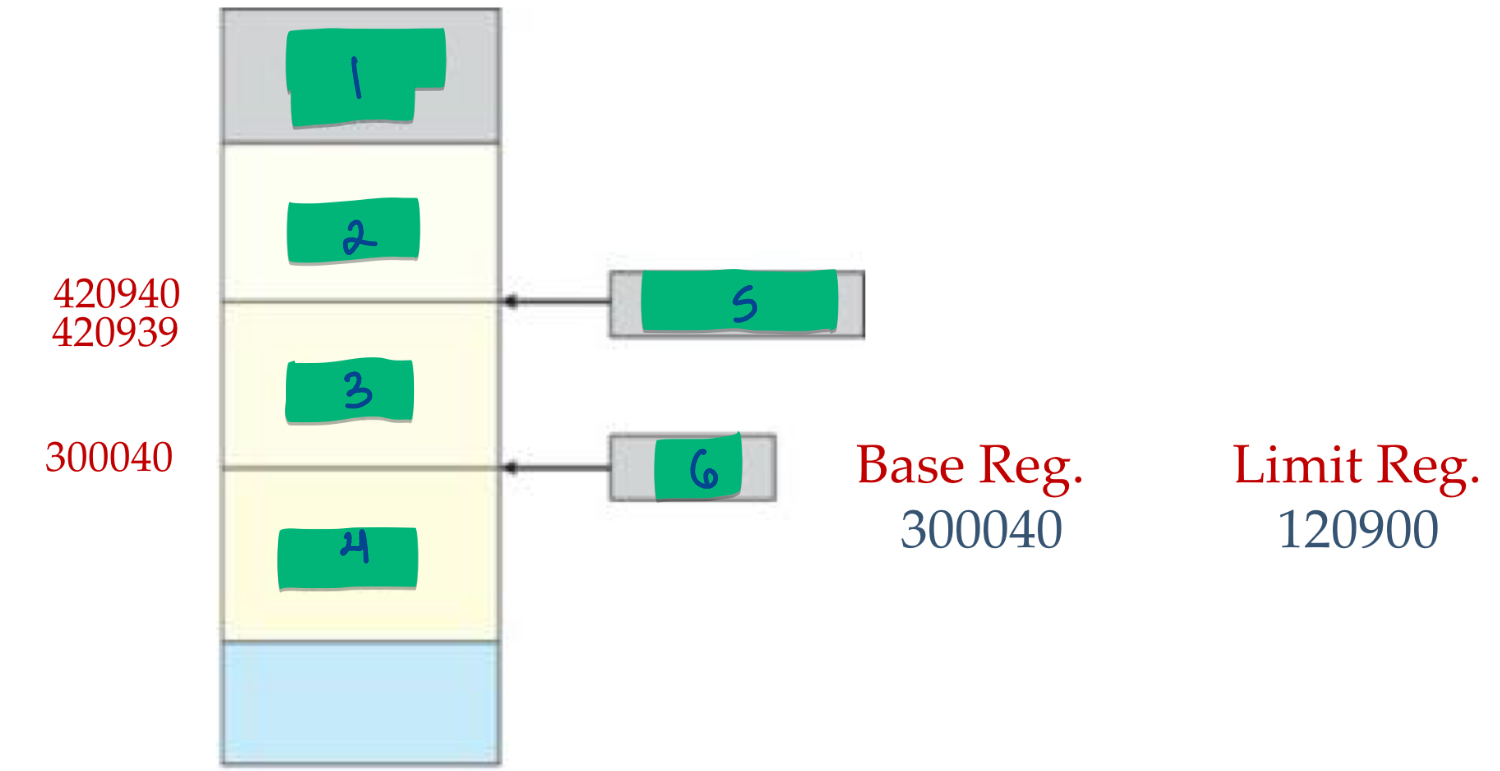
CPU, address, base, base and limit, memory
Hardware address protection with base and limit registers

logical, physical, symbolic, relocatable
The four types of addresses are…
logical address, virtual
Type of address ________________:
Aka _______ address
Addresses used by CPU, software, and the operating system
Used to point to instructions, variables, and data
E.g. Mov Ax, [0xF23E]
logical address space, virtual address space
_______________ is the set of all logical addresses generated by a program during its execution, also referred to as _________________
memory management unit
The mapping from logical to physical address space is done by a unit called __________________ or MMU
physical address, RAM
Type of address _______________:
Actual location on ______
It is a unique identifier for a memory cell or a group of cells where program/data is stored physically
Where processes physically reside when brought from disk
physical address space
_________________ is a range of unique memory addresses that correspond to the physical locations in a computer’s RAM
logical
Analogy for __________ addresses:
The building’s management (the OS) has a directory (page table) that maps each mailing address to an apartment number
When mail (data) arrives, the building’s manager (MMU) checks the directory to find out where to deliver the mail within the building.
This system allows the residents to receive mail without knowing exactly where in the building their apartment is located, and they can even move apartments (data can move between physical memory locations) without changing their mailing address (logical address)
physical
Analogy for _________ addresses:
A large apartment building (the computer’s memory) where each apartment (memory cell) has a unique apartment number (physical address)
The residents of the apartment building use a mailing address (logical address) that includes a post box number at the building’s entrance, which in-turn refer to individual apartment numbers
process
When a __________ is loaded into memory, different parts go to different places (e.g. stack memory address, registers, etc.)
physical address
For any program, we need the ________________ to run it
symbolic address
Type of address ______________:
Address in the source program, when the programmer writes the code and assigns names to variables and functions
Ex. in age; // ‘age’ is a symbolic address or identifier
symbolic
_________ addresses are names that represent the memory location of the variable or function
symbolic
_________ addresses are not yet associated with any specific memory location
relocatable address
Type of address _________________:
Memory addresses that are relative to the start of the program or library
compiler
A ___________ typically binds the symbolic addresses to relocatable addresses (such as “14 bytes from the beginning of this module”)
source program, compiler, object file, other project files, linker, executable files, loader, dynamically linked libraries, program in memory, compile time, load time, execution time (run time)
Multistep processing of a user program
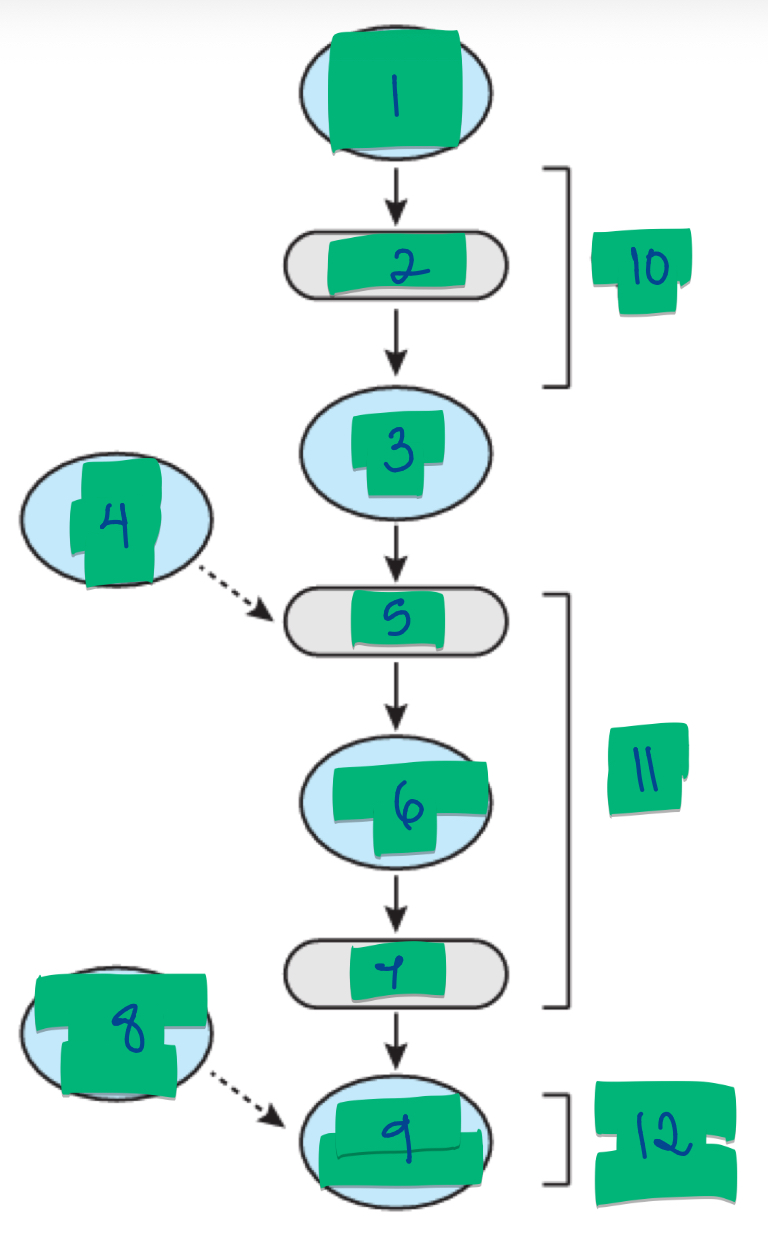
compile time, load time, execution time
Mapping between logical and physical addresses can occur at different stages: ___________, ____________, _______________
compile time
Stage where mapping between logical and physical addresses occurs _____________:
If address binding occurs at this stage, the physical addresses known → absolute binary code generated with static addresses identical to physical address
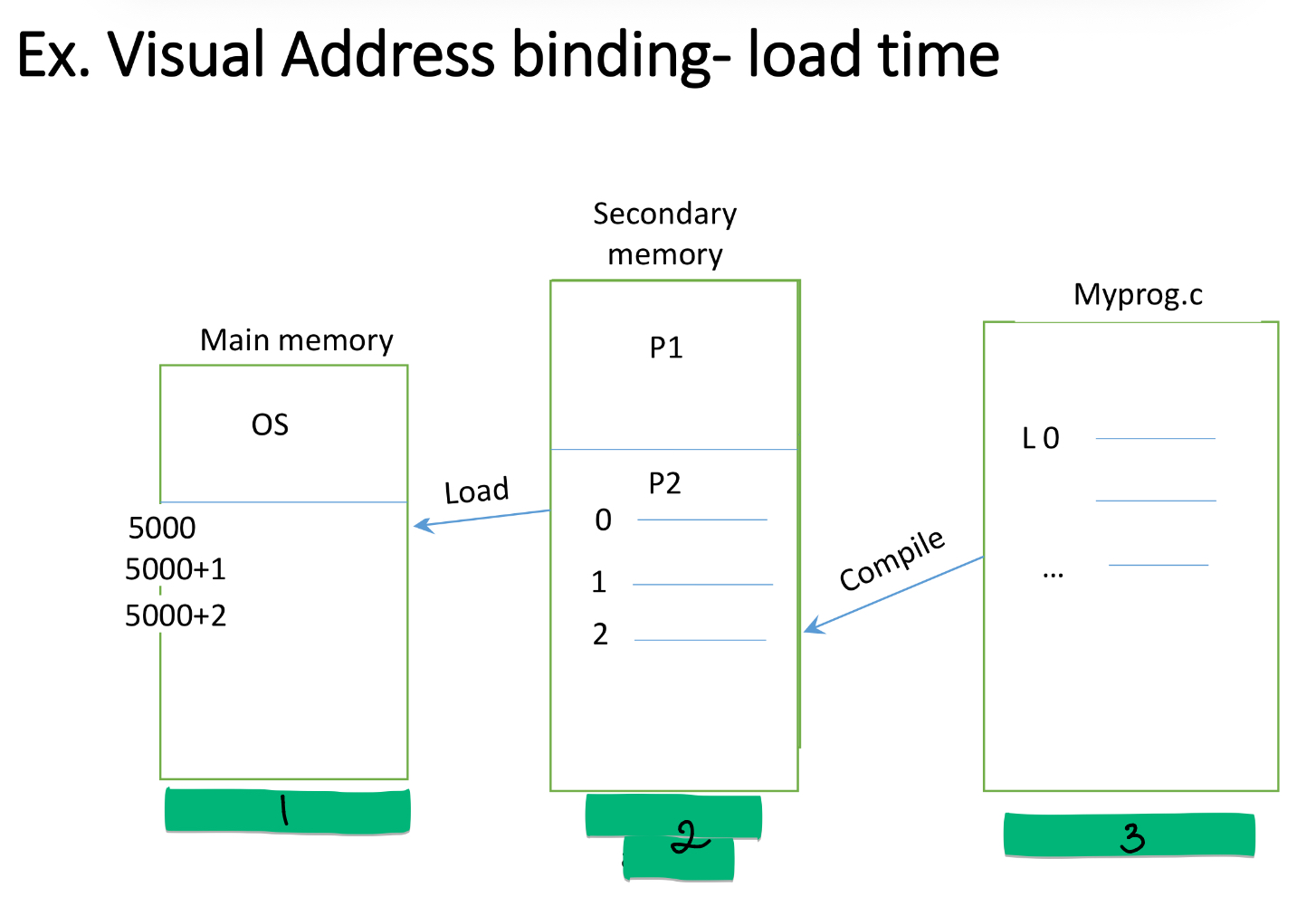
load time, relocatable address
Stage where mapping between logical and physical addresses occurs _____________:
Compiled program is loaded into memory to be executed
The operating system allocates memory for the program’s code, data, and stack segments
Compiler generates ________________ (relative to base register), the OS/loader binds these addresses to physical addresses at load time
execution time
Stage where mapping between logical and physical addresses occurs _____________:
When process can move its occupied memory space during execution
Used in most operating systems
Addresses mapped at run-time using memory management unit (MMU)
0, physical, logical, R
Simple MMU operation:
Logical addresses defined as offsets from address ___
Logical address space: from 0 to max_addr (for each process)
Physical address translation:
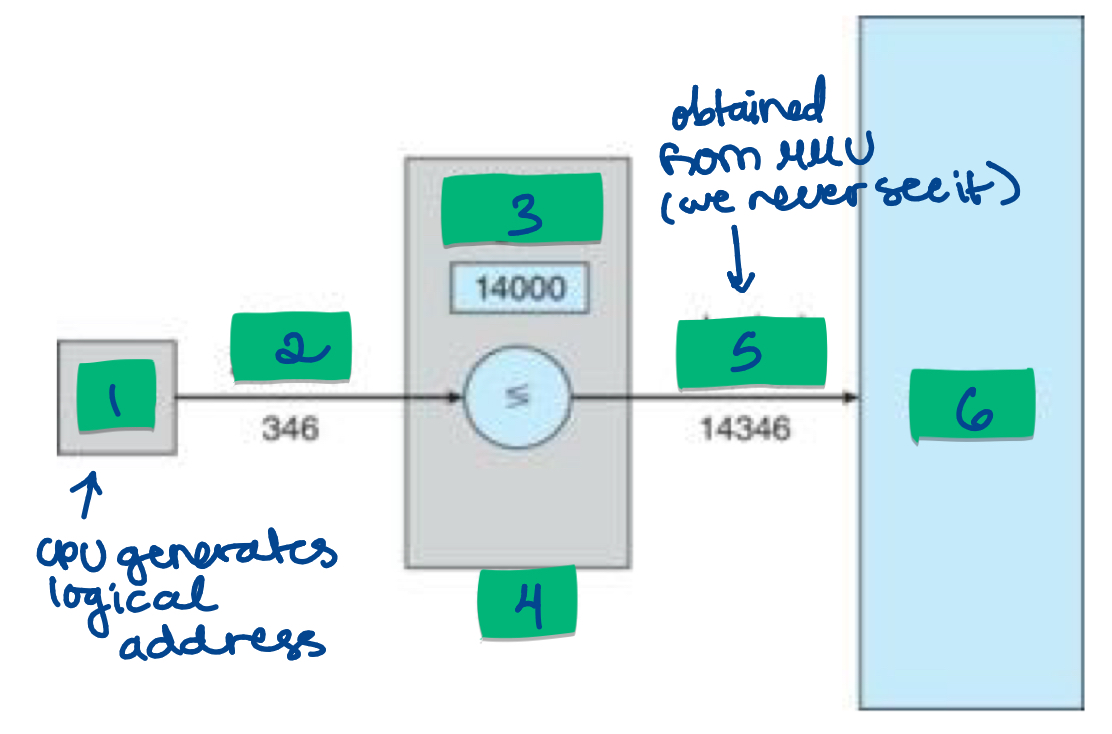
_________ address = _________ address + Value ____ in relocation register
base address
______________ (value in relocation register): is the starting physical memory address where a program segment resides in RAM (separate base addresses for each process)
CPU, logical address, relocation register, MMU, physical address, memory
Dynamic relocation using a relocation register
dynamic loading
________________:
For better memory-space utilization, only main program loaded at start
Other routines (libraries, binaries, Java classes, plugins) kept on disk
Loaded only when called by loader, which also updates address space
dynamic linking
____________________:
When linking is postponed until execution
Linker does not include the library code in the program executable, but instead creates a reference to the library’s code
At runtime, when the program is loaded into memory, the OS’s dynamic linker resolves these references by locating the necessary library functions and linking them to the program
Allows multiple programs to share a single copy of a library in memory
MMU protection
_________________ is preventing a process from accessing memory of other processes
relocation register, limit register, logical address
MMU protection:
When a process is dispatched by scheduler:
_______________ = Starting (smallest) physical address
______________ = max_addr (for individual process) + 1
Check made by comparing _____________ to limit register
If check not passed = Trap
If passed = address is translated by adding the value in the relocation register
CPU, logical address, limit register, relocation register, trap: addressing error, physical address, memory
MMU protection process

dynamic, routines/functions
Concern: Guaranteeing instructions and data needed by CPU in memory
Solution: _____________ allocation/deallocation in memory to __________________
hardware
Concern: Protection of memory spaces of OS and processes from illegal access
Solution: Mainly the role of the ___________; OS supports this role by maintaining and loading process address information in base and limit registers
address space
Two processes can have same or different logical address, since each process has a unique _______________
absolute address, relocatable address, symbolic address
main memory, contiguous, non-contiguous, hybrid (e.g. virtual memory), fixed partitioning, variable/dynamic partitioning, paging, segmentation
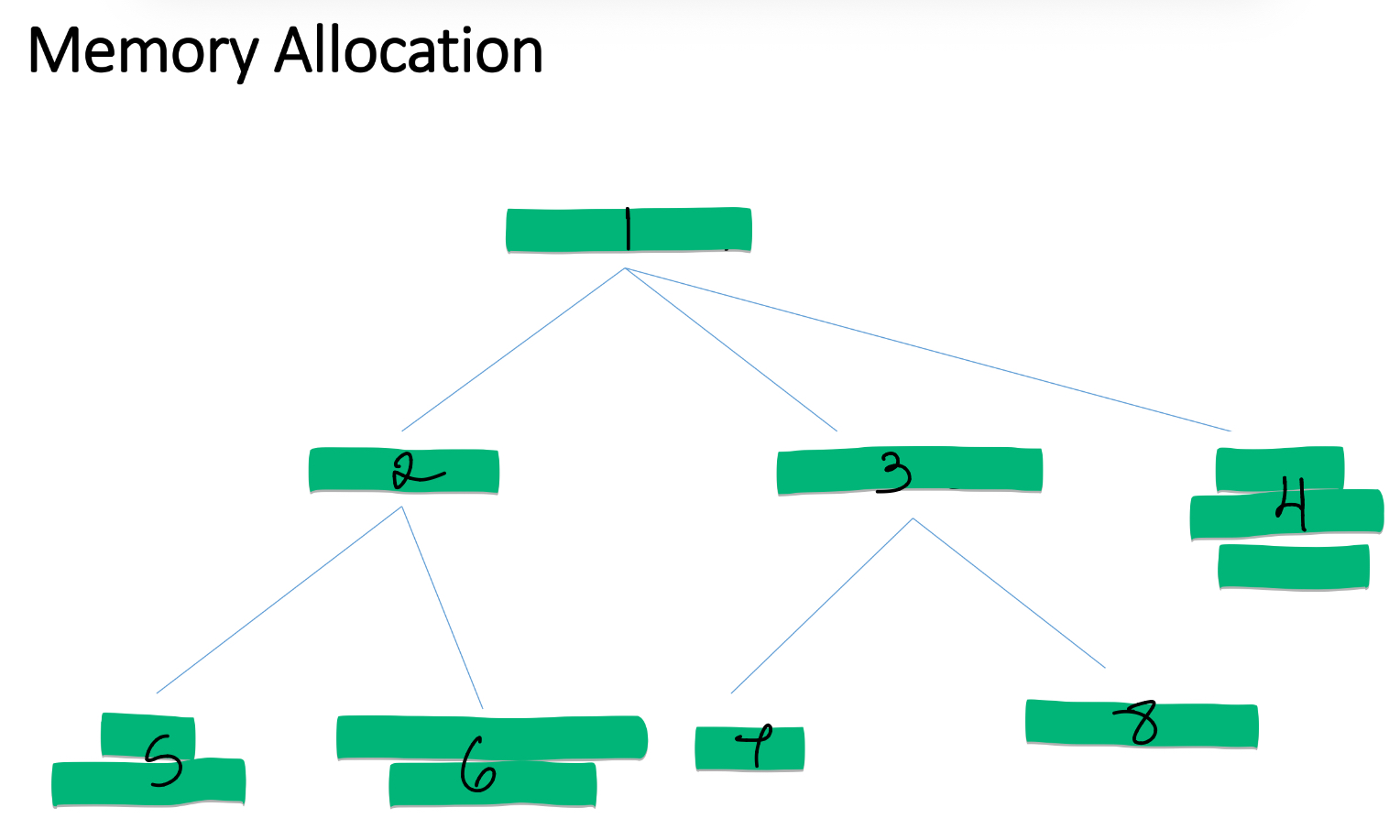
degree of multiprogramming
The _______________________ is the number of programs that can be loaded into memory at once
number of partitions
The ____________________ is the number of processes that can be loaded into memory
contiguous memory allocation, non-contiguous memory allocation
The two types of memory allocation are…
contiguous memory allocation
Type of memory allocation:
OS assigns on partition in the memory for each process
Most OSs usually assigned the higher range in the memory
Each process is contained in a single common section of memory
We can’t split the memory for a process
Keep a table of available and occupied partitions
Process not finding enough space either rejected or wait
fixed partitioning, dynamic/variable partitioning
The two types of contiguous memory allocation are…
fixed partitioning, degree of multiprogramming
Type of contiguous memory allocation ___________________:
Memory is divided into fixed-size partitions
______________________ is bound by the number of partitions
internal fragmentation
With fixed partitioning, we have the problem of __________________
dynamic/variable partitioning
Type of contiguous memory allocation:
Memory is allocated based on the size of the process (dynamic)
non-contiguous memory allocation
Type of memory allocation:
Different parts of a program are allocated into non-adjacent memory locations
Pages/segments loaded into different physical spaces in the memory
We can split the process in the memory
internal fragmentation
Problem in fixed partitioning:
Let’s assume the number of partitions is 5, each 5MB
The degree of multiprogramming is 5
Even though we have remaining memory, we can’t allocate other process in the free space

dynamic/variable partitioning
__________________ is a more efficient type of contiguous memory allocation because it is sized to a given process’s needs
external fragmentation, holes
Problem with dynamic/variable partitioning _____________________:
All memory is initially available as one block then gradually occupied
Releases and unequal allocations create _______ (blocks of available memory various small-size free slots scattered throughout memory)
When a process arrives, it is allocated memory from a hole large enough to accommodate it
Process exiting frees its partition
Gradually creates holes
first-fit, best-fit, worst-fit
In dynamic/variable partitioning, the three solutions to the problem of selecting a hole for a process of size n are…
first-fit
A solution to selecting a hole for a process of size n in dynamic/variable partitioning:
Search from beginning or from last for the first appropriate hole
best-fit
A solution to selecting a hole for a process of size n in dynamic/variable partitioning:
Must search entire list, unless ordered by size
Results in the smallest leftover holes
worst-fit
A solution to selecting a hole for a process of size n in dynamic/variable partitioning:
Full list must be searched
Consumes largest holes first
first-fit, best-fit, first-fit
Comparison of the solutions for selecting a hole for a process of size n in dynamic/variable partitioning:
_______ and ________ are better than worse-fit
First-fit and best-fit perform similarly, but ________ is faster
external fragmentation
Type of fragmentation in contiguous allocation:
Subset or all holes satisfy process by are not contiguous
If N blocks are allocated, 0.5 N wasted → 50-percent rule
internal fragmentation
Type of fragmentation in contiguous allocation:
If memory is divided into fixed-size partitions
Only one process per partition
Unused memory internal to partition
compaction, non-contiguous memory allocation
The two types of solutions to fragmentation in contiguous memory allocation are…
compaction, execution time, opposite
A solution to fragmentation in contiguous memory allocation ______________:
Relocate processes in memory to group fragments into larger blocks
Not possible for static address relocations done at compile or load times
Only possible in dynamic relocation done at ________________
Move program and data
Change base/relocation register
Simplest version of this solution can be expensive (e.g. when moving all assigned blocks and holes in __________ directions)
paging
___________ is a non-contiguous allocation approach
Allows a part of the program to load in non-adjacent locations in memory
paging
_________ resolves external fragmentation by allows program parts to fill varying-sized memory holes (fragments)
pages
________ are fixed and equal-sized blocks of logical address space
Size typically in powers of 2; e.g. 4 KB (2^10 bytes) to 4 MB (2^22) per page
In Linux: type getconf PAGESIZE
frames
_________ are fixed-sized blocks of the physical memory
paging
Steps of _________:
Loads pages of programs into any available frames in the memory
Program of size N pages are loaded in N free frames
Page size is equal to frame size
contiguous
Logical address division is always _______________
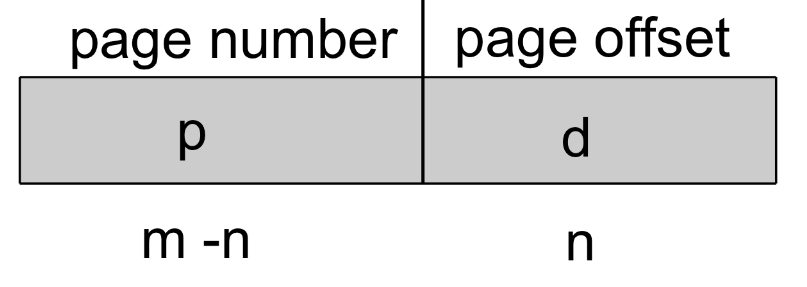
logical, page number, offset
___________ address division:
2^m addresses (total) divided into pages of size 2^n
Number of pages → 2^m / 2^n
m-n is the most significant bits of any address, also called ______________ (p)
n is the least significant bits of any address, also called ________ (d) inside this page
page number
______________ or p is the pages in logical address space represented by the number of bits
page offset
_____________ or d is the number of bits to refer to a word within a page
logical address space, page size, number of pages, page number bits, m, n
Page number and offset example:
________________ = 64kB = 2^6 × 2^10 = 2^16
__________ = 1 kB = 2^10
__________________ = 2^16/2^10 = 2^(16-10) = 2^6 = 64 pages (pages 0 to 63)
_________________ = 16-10 = 6
___ = 16 (bits required for logical address space), ___ = 10 (to address within each page)
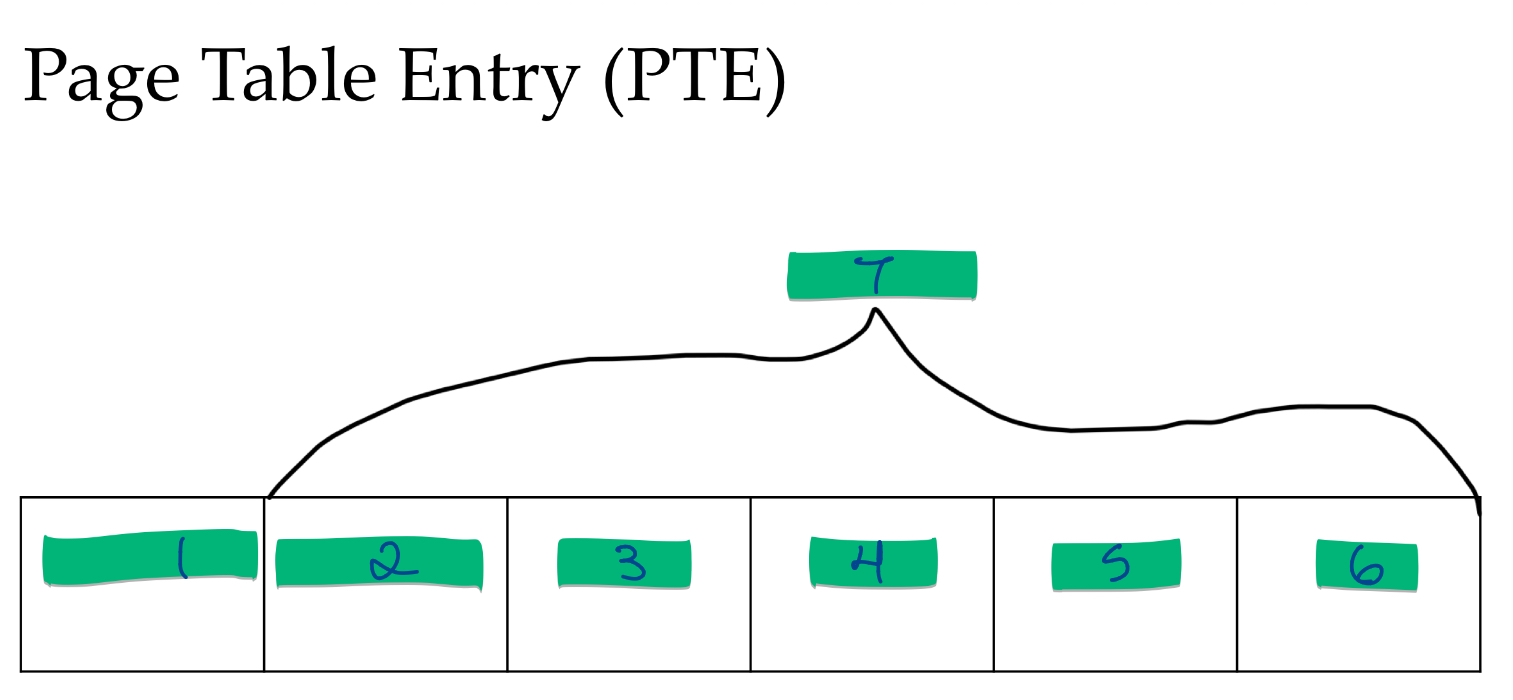
page tables
_____________ map virtual addresses as seen by the CPU into physical address
process, RAM, process creation
One page table per _________, stored into _____, filled at ______________
page table base register, context switch
A ______________________ or PTBR stores the starting address of the page table for the currently running process
On ____________, PTBR is updated with the newly loaded process
MMU
The _______ uses a process’s page table for address translation
offset, base
In a page table, the ________ of the logical points to the physical address in the frame starting from the _____ address

frame number, present/absent, protection, reference, caching, dirty, optional
CPU, logical address, p, d, physical address, f, d, p, f, page table, physical memory, f
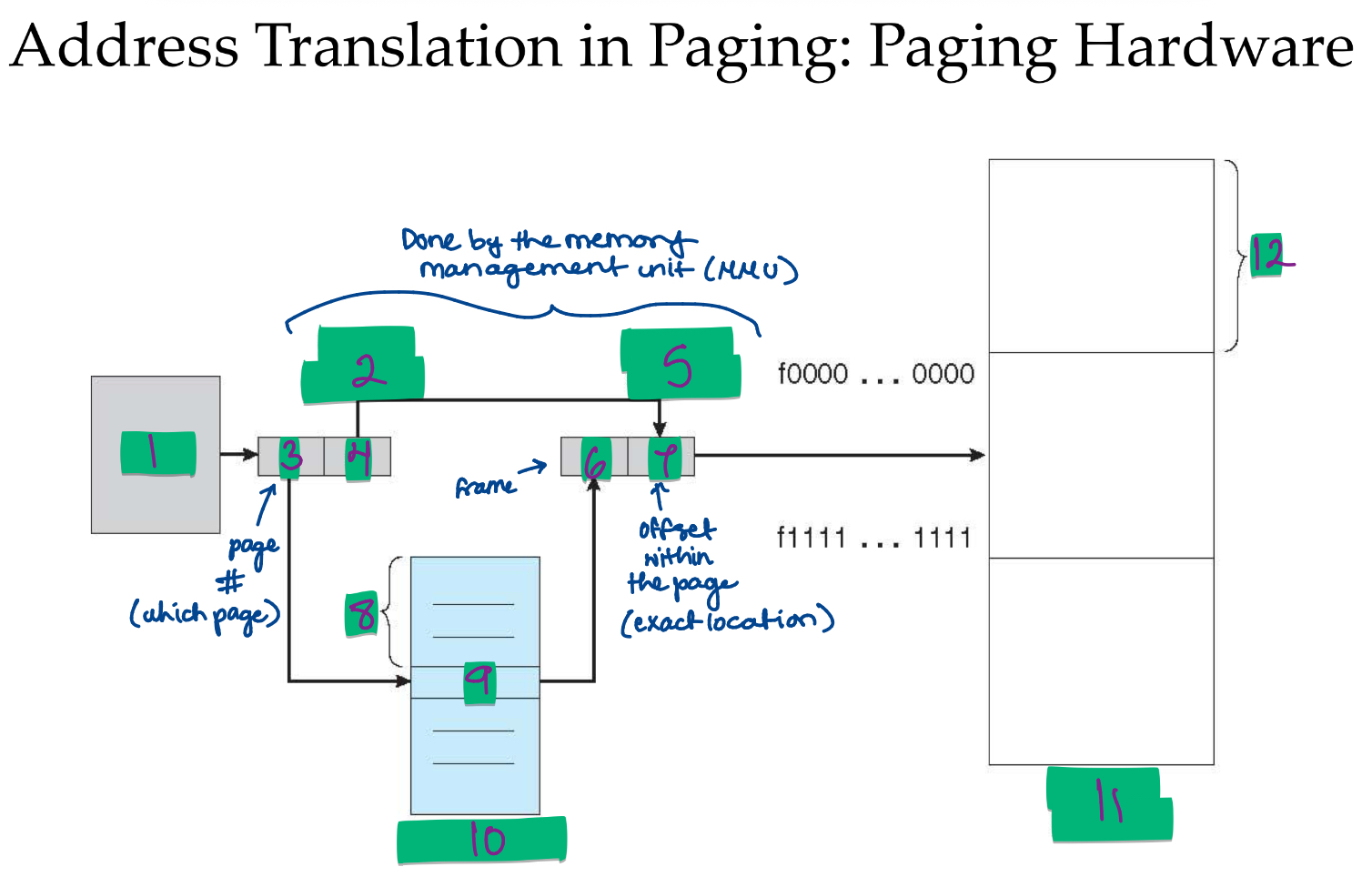
address translation
______________ in paging steps:
Extract p and d
Get p’s frame base address (f) from table
Append/add d to f to obtain address in memory
logical memory, page table, frame number, physical memory
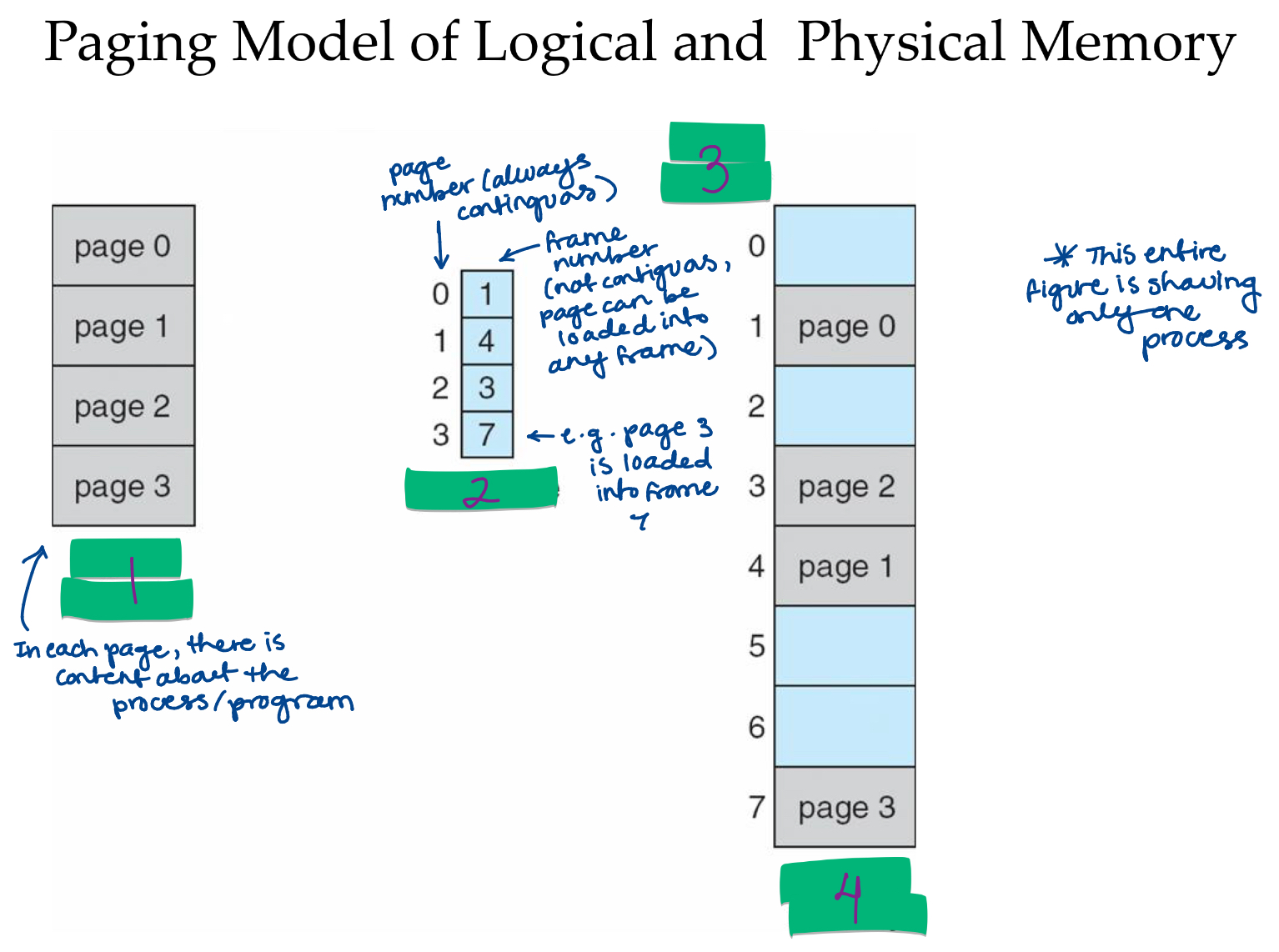
logical memory, page table, physical memory
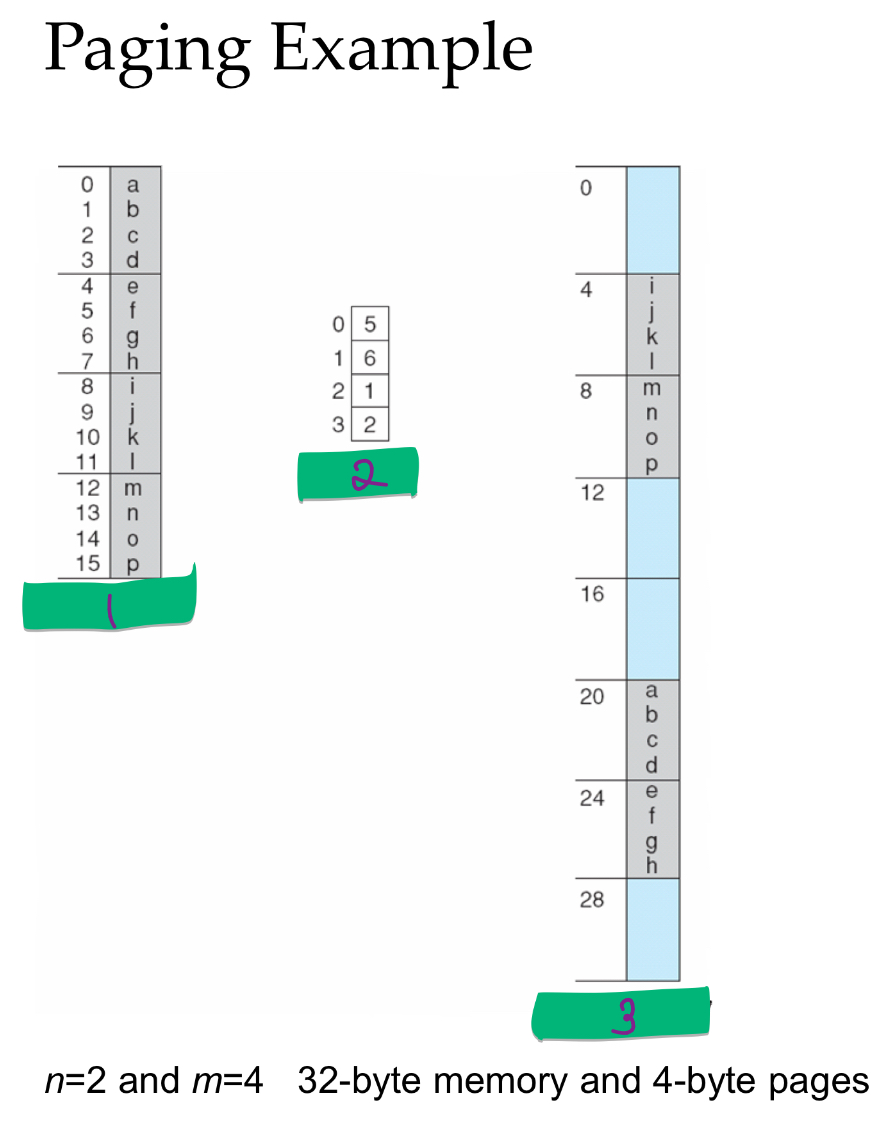
paging
There is no external fragmentation in _________, but internal fragmentation may still occur (last frame not filled with information in last page of program)
Example:
Page/frame size = 2048 bytes
Process size = 72766 bytes
72766/2048 = 35 pages + 1086 bytes
Internal fragmentation of 2048 - 1086 = 962 bytes
Allocation: 36 frames - one having 962 unused bytes
n+1, 1/2, smaller
With internal fragmentation in paging:
Worst case: process that is split into n pages plus 1 byte would be allocated _____ frames
Average case: ____ page/frame size
Solution: ________ page/frame sizes
Larger overhead in keeping and searching larger page tables
high-speed registers, address translation, context switching, 2^8
Implementation of page table via dedicated ________________:
Each register storing one entry in the page table
Pro: Very fast in __________________
Con: Very slow ________________ (content of each register must be exchanged by the page table entry of the next process)
Fact: Satisfactory for small page tables up to ____ entries
memory, larger, PCB, page-table base register, context switching time, memory access time, page table, physical address
Implementation of page table via ___________:
Suitable for _______ (most common) tables (e.g. 2^20 entries)
Pointer to page table base address (where page table is located) in memory is stored in ______
The pointer is loaded from PCB into a ___________________ or PTBR at context switching
Pro: Much faster _____________________ (changing processes requires only a change in this register)
Con: Slower __________________ (two memory accesses to reach physical address: one to locate the __________ and the other to access the identified ________________)
translation look-aside buffer
A solution to the 2-step memory access problem in the page table implementation via memory is a special fast-lookup hardware cache called the __________________ or TLB
translation look-aside buffer
The ____________________ or TLB stores the recently used virtual-to-physical address translations to speed up the memory access process
instructions, data, MMU, hit, miss
TLB used in page search:
TLB stores a few page-table entries between 32 and 1024
Sometimes two TLBs are used, one for ______________ and one for ______
The _____ checks if the page number is in the TLB:
If so: _____ - Base address is extracted and used to access memory
If not: ______ - 2-step memory access (get the address from the page table)
LRU, RR, random
Replacement in TLB:
Add recently called address in TLB instead of an existing one
Replacement policies: _____ (least recently used), ____, _________
CPU, logical address, p, d, page number, frame number, TLB, TLB hit, f, d, physical address, physical memory
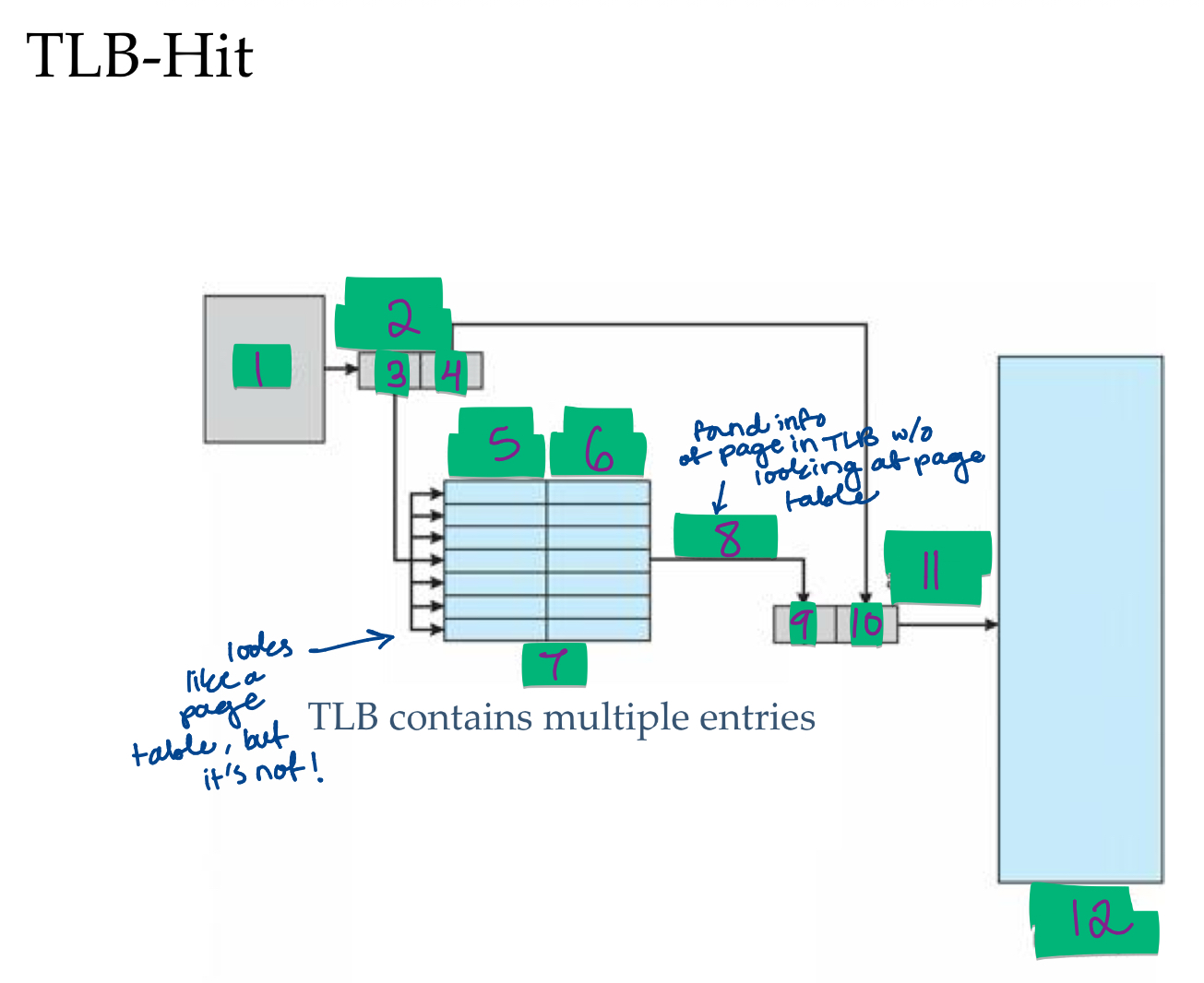
CPU, logical address, p, d, page number, frame number, TLB, TLB miss, p, f, page table, f, d, physical address, physical memory

effective access time
Access time differs between TLB hit and miss cases
________________ or EAT defines the overall performance of the system
hit ratio
___________ is the proportion of time a page is found in TLB
miss ratio
__________ is the proportion of time a page is not found in TLB (1- hit ratio)
access time
__________ is the time needed to access the memory once
hit ratio, access time, miss ratio, 2, access time
The formula for EAT is _________ x __________ + _________ x ___ x _____________
memory protection
_________________ is implemented by associating a protection bit with each frame to indicate if read-only or read-write access is allowed
Can also add more bits to indicate page execute-only, and so on
valid-invalid bit, valid, invalid, page table length register, trap
A ________________ is attached to each entry in a page table:
_______ indicates that the associated page is in the process’s logical address space, and is thus a legal page
_________ indicates that the page is not in the process’s logical address space
Or use a __________________ or PTLR
Any violations result in a ______ to the kernel.
virtual address, frame number, valid-invalid bit, page table, physical address
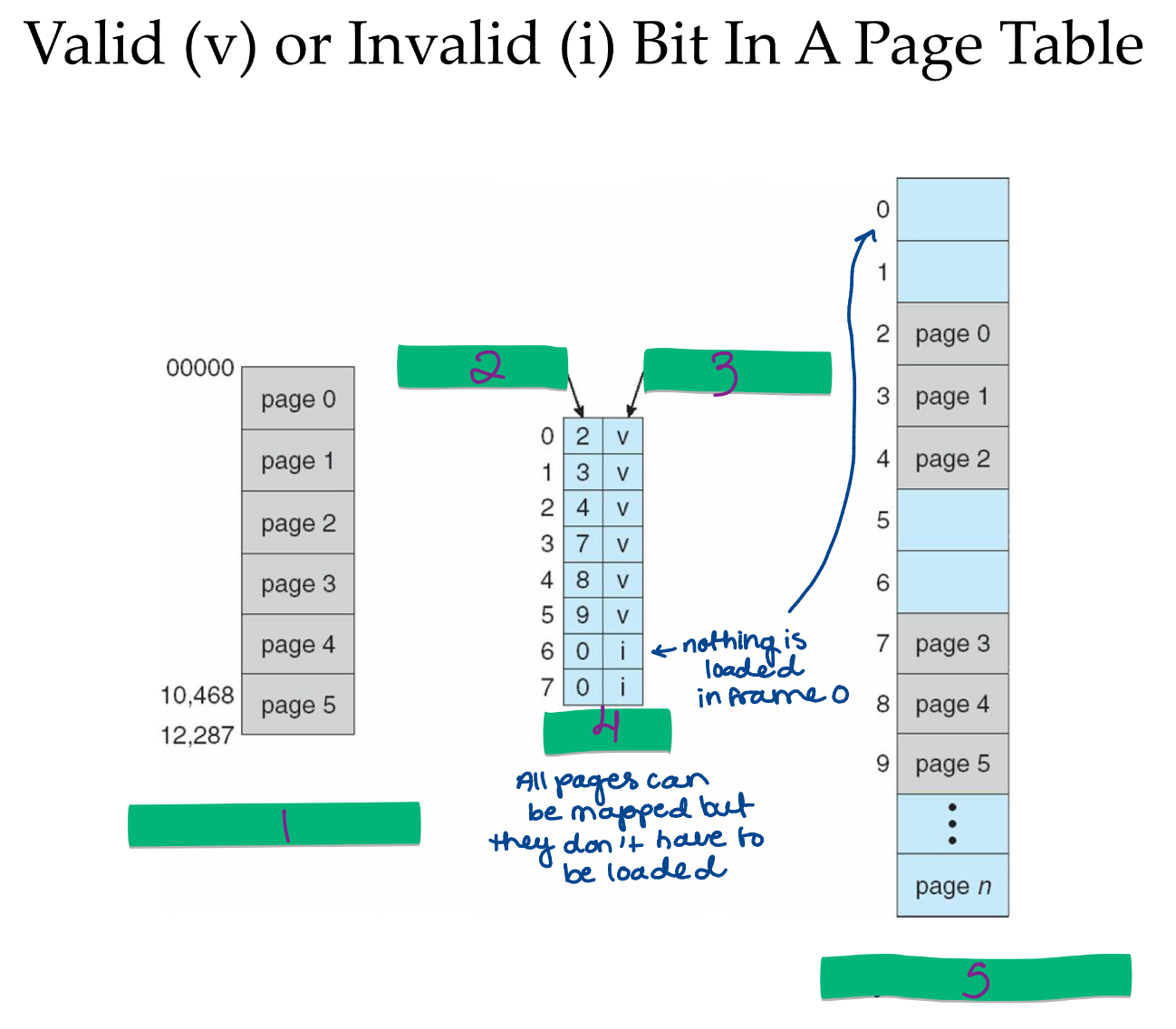
 Note
Note  Flashcards (141)