Audiology (131) Unit 2 Exam
 Call Kai
 Learn
Learn Practice Test
 Spaced Repetition
 Match
Match Flashcards
 Knowt Play
1/53

There's no tags or description
Looks like no tags are added yet.
Name | Mastery | Learn | Test | Matching | Spaced | Call with Kai |
|---|
No analytics yet
Send a link to your students to track their progress
54 Terms
Otoscopy definition
examination of ear canal and tympanic membrane
Ostocopy clinical relevance
Diagnostic tool for various ear conditions
Ostocope standard components (4)
Handle, light source, speculum, magnifying lens
Otoscope step-by-step procedure (4)
external inspection
straighten ear canal
insert speculum
systematic examination
How to straighten the ear canal for adults? children?
adults: pull up and back
children: pull down and back
Otoscopy - Normal Findings of the external canal
Skin-lined, small amounts of cerumen
Otoscopy - Normal Findings of the tympanic membrane
pearly gray, slightly concave, with visible handle of malleus and cone of light
Otis Externa Characteristics - Otoscopy Abnormal findings
redness, swelling, discharge, pain
cause: bacterial or fungal infection
Otis Media Characteristics - Otoscopy Abnormal findings
red/bulging TM, effusion
known complications: tympanosclerosis and cholesteatoma
Earwax impaction Characteristics - Otoscopy Abnormal findings
hearing loss, earache, tinnitus
removed via irrigation or manual extraction
Foreign bodies Characteristics - Otoscopy Abnormal findings
common objects (insects, beads, cotton swabs
require safe removal
Acoustic immittance includes… (3)
impedance, admittance, compliance
Impedance (z)
opposition to energy flow
determined by resistance, mass, and stiffness
Admittance (y)
ease of energy flow
the reciprocal of impedance
Compliance
how well the TM moves in response to pressure changes
low = stiff
high = hypermobile
Acoustic immittance testing equipment (4)
loudspeaker, microphone, air pump, probe assembly
good for difficult-to test pop
non-invasive, no behavioral response required
probe tone adults = 226Hz
infants = 1000Hz
Tympanometry - Type A
(shape/peak & What it suggests)
Normal peak near 0 daPa
normal middle ear function
Tympanometry - Type As
(shape/peak & What it suggests)
shallow peak
stiffness (eg. otosclerosis)
Tympanometry - Type Ad
(shape/peak & What it suggests)
very high/tall peak
flaccid TM or ossicular discontinuity
Tympanometry - Type B
(shape/peak & What it suggests)
Flat, no peak
TM perforation or fluid in middle ear
Tympanometry - Type C
(shape/peak & What it suggests)
Peak shifted to negative pressure
Eustachian tube dysfunction
ipsilateral vs contralateral reflexes
ipsilateral = same ear
contralateral = opp ear, crossing at the superior olivary complex
ART (Acoustic Reflex Threshold) definition
lowest intensity that triggers a measurable contraction
acoustic reflex definition
contraction of the stapedius muscle in response to loud sound
ART outcomes and their meaning
present at normal level
absent
present at low intensity
present at elevated level
present at normal level = typical funciton
absent = conductive HL or severe SN HL
present at low intensity = mild cochlear HL
present at elevated level = retrocochlear pathology
Acoustic reflex decay is a measure of …
how long the stapedius can sustain contraction
tone presented 10dB above ART
Absent acoustic reflex means…
conductive loss
abnormal decay (acoustic reflex) means…
retrocochlear issue (eg. auditory nerve tumor)
Webber test (con and SN)
fork on midline of forehead
test laterlization
conductive loss = laterizes to the ear
SN = away from the ear
Rinne test
AC vs BC
conductive hl = negative, BC > AC
Normal or SN = positive, AC > BC
Air conduction
Tests full auditory pathway (outer, mid, inner)
shows DEGREE of HL but not type
bon conduction
stimulates cochlea
determines TYPE of HL
Audiogram symbols
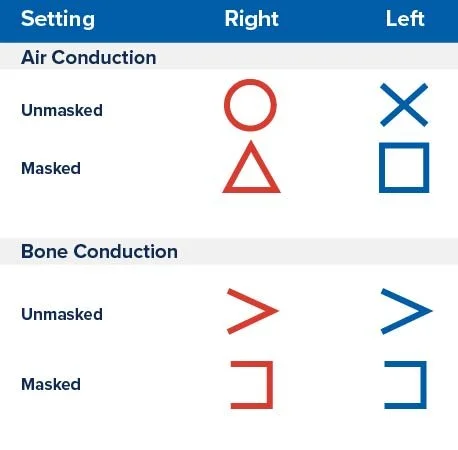
Degrees of hearing loss
normal
slight
mild
moderate
mod-severe
severe
profound
normal = -10 to 15
slight = 15 - 25
mild = 25 - 40
moderate = 40 to 55
mod-severe = 55 to 70
severe = 70 to 90
profound = 90+
Patient responses, false positive
RESPONDS when NO sound was presented
Patient responses, false negative
FAILS to respond to a sound they DID hear
Can air conduction alnoe tell you the type of hearing loss?
no, BC needed
What range of HL does 60dB fall under?
moderatley-severe (55-70dB)
cross-hearing
stimuli reaches non-tested ear
solved by masking
Interaural Attenuation (IA)
reduction in signal strength as sound travels from one ear to the other
Shadow audiogram
audiogram that actually represents the non-tested ear’s hearing
due to cross hearing and IA
Types of masking noise
narrowband noise = used for pure-tone audiometry
speech noise = used for speech audiometry
Plateau method
gold standard for clinical masking
increase masking in non-test ear until plateau is reached
masking problems (3)
udermasking
overmasking - crosses back to the test ear
occlusion effect - covering the ear boosts low frequ BC thresholds
must account for this during BC masking
Bone conductioni IA is essentially __ dB
0
meaning masking is almsot ALWAYS needed for BC testing
occlusion effect impacts ____ frequencies specifically
low
SRT (speech recognition threshold)
lowest level speech is UNDERSTOOD 50% of the time
uses spondiac (two-syllable equal stress)
SDT (speech detection threshold)
lowest level at which speech is DETECTABLE - not necessarily understood
PTA is calculated from witch 3 frequencies?
500, 1000, 2000 Hz
Match behavioral tests to age range
BOA
VRA
play audiometry
Standard
(Boy vat pus stankkk)
BOA= birth - 6mo
VRA = 6mo - 2.5/3yrs
Play audiometry = 2-5yrs
Standard = 5+yrs
The gold standard for newborn hearing screening is _____
AABR - detects neural pathway integrity
Which test screens cochlear function specifically?
OAEs - quick and noninvasive
Auditory Brainstem response (ABR) - Which wave corresponds to which structure?
I
III
V
I - auditory nerve
III - SOC (superior olivary complex)
V - Lateral lemniscus/IC
most clinically SIGNIFICANT
True or false: TEOAES CAN confirm cochlear function but CANNOT rule out neural problems
True

