AA. Theme 2 - full textbook notes (b)
 Call Kai
 Learn
Learn Practice Test
 Spaced Repetition
 Match
Match Flashcards
 Knowt Play
1/142

There's no tags or description
Looks like no tags are added yet.
Name | Mastery | Learn | Test | Matching | Spaced | Call with Kai |
|---|
No analytics yet
Send a link to your students to track their progress
143 Terms
Gross Domestic Product (GDP)
GDP is the total market value of the goods and services produced in a country in a year.
It does not include earnings by its residents while outside the country.
Actual economic growth
An increase in real incomes or real gross domestic product (RGDP)
Potential ecomonic growth
An increase in the productive capacity in a country.
This could be caused by an increase in the labour supply, investment, or productivity.
What’s the difference between real and nominal values?
Real values have been adjusted to remove the effects of inflation, whereas nominal values are the current incomes that are unadjusted for changes in average prices.
What is Gross National Income (GNI)
GNI is GDP plus net income paid into the country by other countries
How is ‘net income’ calculated for GNI
profits and income earned overseas from locally owned firms minus profits and income that goes abroad from foreign-owned companies
What are Purchasing Power Parities (PPPs)
PPPs are when values are expressed in accordance with the amount that the currency will buy in the local economy
What are some limitations of using GDP to compare living standards between countries/over time?
Subsistence, barter, and the hidden economy.
If farmers consume their own output
If goods are traded without price (e.g. barter)
goods paid for without being declared for tax purposes
The informal economy
Some output is not recorded as its not bought or sold
Currency values
When comparing countries, it is difficult to know whether to use the official value of a currency (the exchange rate), or the purchasing power of that currency
Income distribution
Size of the public sector
Consumer and capital spending
Spending on investment goods might mean standard of living increases in the future, but at the expense of living standards today
What is the Easterlin paradox
The idea that happiness rises with average incomes, but only up to a point
What is the public sector
The public sector is the part of the economy controlled by the government
What is inflation
Inflation is a sustained rise in the general price level over a period of time
What is deflation
Deflation is a fall in the general price level
What is disinflation
Disinflation occurs when prices rise more slowly than they have done in the past
What is the reason for using an index such as the Consumer Prices Index (CPI)
Percentage changes can be shown easily, making effective comparisons possible
Problems with deflation
Problem for people with debts
The real payments (adjusted for lower prices) will become larger
Stops any firm from wanting to invest in a country from abroad as the value of output is likely to fall relative to the initial costs
What are limitations of using the Consumer Price Index (CPI) as a measure of inflation
Does not include housing costs such as mortgage interest repayments or rent
Average mortgage payments costing 15-20% of income
CPI measures the cost of living only for an average household
Top 4% and bottom 4% income brackets not included, and neither are pensioners
Sampling problems - in 2017, less than 50% of households responded to the survey
The list of 650 items is changed once a year, but tastes and fashions change quicker than this
Does not take into account a change in the quality of goods - buying a more expensive phone this year might not be because of inflation but because of the higher quality of the new phone
Despite these limitations, CPI is the measure used to make international comparisons of the rate of inflation
What does CPIH stand for, and what is the main difference from CPI
CPIH - Consumer Price Index including owner-occupiers’ housing costs
The main difference from CPI is that CPIH includes changes in residential rents across the UK, and includes council tax in its calculations.
What is the Retail Price Index (RPI) and the limitations
It includes housing costs
Limitations:
Unreliable for international comparison as the statistical method of basing the data is unique to the UK
It includes the cost of mortgage interest repayments. These will rise when interest rates are raised, and any interest rate rise implemented to tackle inflation will have a one-off effect of making inflation appear worse, making policy-makers look incompetent
What are the two types of inflation
Demand-pull: rightward shift in the AD curve, caused by C,I,G,(X-M)
Cost-push: leftward shift in AS, caused by increased production costs such as rise in wages or fall in the exchange rate (more expensive raw material imports)
Effects of inflation on consumers
Real value of savings falls as prices rise
Purchasing power of those on fixed incomes falls as prices rise - e.g. pensioners will have their standard of living decline when there is more inflation
Those with high levels of debt benefit from inflation, as the real value of the debt falls
Effects of inflation on firms
Good:
Increased prices might mean firms can make more profits
A little inflation means that real wage differentials can be changed without actually cutting wages in nominal terms
Bad:
Loss of international competitiveness: Exports become relatively expensive and imports relatively cheap
Increased uncertainty: If firms think costs are rising and fear increases in interest rates, they might stop Investing
Investment from abroad might decrease: Inflation erodes the value of money = noones buying into a currency thats falling in value
Effects of inflation on the government
Inflation reduces the real interest rate, so cost of borrowing falls
A little inflation provides a cushion against the perils of deflation - when prices are falling, the economy can enter a vicious cycle of underinvestment and reduced spending
Undermines government income redistribution - people on fixed incomes will find their incomes fall in real terms while those with index-linked incomes won’t miss out.
Why does inflation disproportionately affect lower income groups?
Already buying the cheapest possible version of a good, so cannot cut costs
Usually spend most of income on necessities such as food and gas which are usually the most highly hit by inflation
Lack the ability to bulk buy or wait and save, so waste money
Effects of inflation on workers
Might mean that some workers expect higher wages but firms do not feel confident paying higher costs
Trade-off between wage inflation and unemployment: if there is high wage inflation, it is easier for people to find work because firms are raising wages only because they cannot choose other workers at lower wages
The short-run Phillips curve
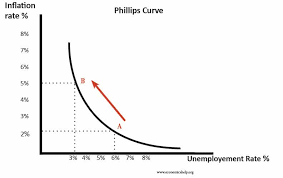
What is the short-run Phillips curve?
Phillips curve shows the inverse relationship and the trade-off between unemployment and inflation, suggesting higher inflation can lead to lower unemployment.
What is the level of employment
The number of people in work
What is the employment rate
The number of people who have a job as a percentage of the working age population
What is the labour force
A measure of the people who are of working age and are willing and able to work
Define unemployment
A situation in which someone is willing and able to work, but is not currently employed
Who are the economically inactive
People without a job but who are not classed as unemployed because they have not been actively seeking work within the last 4 weeks and/or they are unable to start work within the next 2 weeks.
This includes students, early retirees, and very sick people.
How does the ILO measure unemployment
The International Labour Organisation uses the Labour Force Survey, which is now the official measure used in the UK
What is the Labour Force Survey?
A measure of unemployment calculated using surveys of those out of work in the last 4 weeks and ready to start in the next 2 weeks.
Made up of about 40,000 responding UK households and 100,000 individuals per quarter.
Yay:
The questions relate to anyone over 16 years old so is more inclusive]
Nay:
The survey data are 6 weeks out of date by the time they are published, which happens every month
What is the claimant count
A measure of unemployment using the number of claimants of JSA (Jobseeker’s Allowance)
Advantages/limitations of using the claimant count as a measure of unemployment
Yay:
Quick to obtain data
Cheap to obtain data
Useful measure of hardship - you are unlikely to claim JSA if you dont need the money between jobs
Nay:
Stigma attached to claiming benefits so some people may be eligible yet not claim
Stringent criteria: you can’t have resigned from your previous job within the last 6 months or refused 3 jobs that you have been offered
What is underemployment
A situation in which a worker is employed but wants to work more hours
What affects the rate of employment
The school or compulsory training leaving age - in the short term, people in education are not counted as economically active, but in the long term, school leavers become more employable
Number of school leavers entering higher or further education
Number of people who continue to work beyond the state requirement age
In the UK, number of people working over the age of 65 quadrupled between 2007 and 2017
Likely this will continue due to state pension being low relative to other developed economies
Level of net migration - most immigrants come to the UK to study but the second most common reason is related to work
Availability of jobs - more jobs likely to mean more employment
Level of taxes and benefits - high income taxes or high out-of-work benefits are a disincentive for people to work
What is the classical view of unemployment?
There are only unemployed people who are not able and willing to work at the going rate.
The best solution is ‘lassez faire’ - leave it to the market forces which will eventually ensure that the problem of unemployment will disappear.
If people accept lower wages, the cost of living will fall as firms do not need to charge such high prices, so workers will find the lower wages are acceptable once they start working. For this reason, it is called real wage unemployment or real wage inflexibility because wages have been forced above the market-clearing wage.
Define real wage unemployment
A measure of people who are unwilling to work at the going wage rate
What is the Keynsian view of unemployment?
That people can be unemployed even in the long run, because there is insufficient aggregate demand in the economy.
This is demand-deficient employment, in which if people spend too little and save too much, there will be less demand for goods and services which will result in fewer job opportunities
Define demand-deficient / cyclical unemployment
Caused by a lack of aggregate demand in an economy such as during a recession.
Reasons for demand-deficient unemployment:
Saving too much
A lack of business confidence
An increase in the value of a currency, making a country’s goods less internationally competitive
Slow rates of productivity growth relative to other countries
External shocks such as oil price rises for countries that are net oil-importers (oil is imported and demand is price-inelastic)
Increased consumption of imports from low wage economies
The economy is undergoing structural change and so different types of labour are required
Define structural unemployment
A measure of the workers who lose jobs in a declining industry and do not have the skills to work in other industries
The higher the level of skills in the labour force, the more flexible workers will be if there is a change in the requirements in the labour market
Define frictional unemployment
Referring to people who are unemployed between jobs or beginning the search for a job after entering the workforce
Define seasonal unemployment
Refers to people who are unemployed at certain times of the year
How can the implications of immigration for employment differ?
If immigrants come into a country to fill vacancies, employment rate rises.
If immigrants are looking for work and don’t find it or displace other people from work, employment rate may be stable or decrease
Costs of unemployment to consumers
Lower incomes mean living standards will fall
People out of work may become demoralised and their skill sets can quickly become obsolete
Effects of unemployment on firms
People spend less → lower prices → less profit
However, people may be more willing to stay in their jobs for fear of unemployment, so work harder and accept lower pay
Cost of unemployment to government
As unemployment rises, the government has to pay more in social benefits
Will recieve less in tax revenues, from income tax and expenditure taxes such as VAT
Cost of unemployment to society
Unemployed resources represent an opportunity cost
The economy could produce more without anything being given up = we could all have better standards of living
What is the balance of payments
A record of payments between one country and the rest of the world. It comprises the current, financial and capital account
What does the Current account do?
Records trade in goods, trade in services, investment income and current transfers
What is the balance of trade.
Part of the current account
The difference between the value of goods and services exported and the value of goods and services imported
What is investment income
Part of the current account
A measure of interest, profit and dividends that are rewards for capital investments in another country.
E.g.: A British company builds a factory in Poland, the investment does not appear on the current account, but any dividends appear as a positive figure on the UK current account
What are current transfers
The movement of funds for which there is no corresponding trade in goods and services
e.g. taxes paid to the EU, remittances
Define a current account surplus
Where inflows on the current account of the balance of payments are greater than outflows
What does the financial account do
It records money flows for investment purposes: Foreign Direct Investment (buying out assets and ownership of companies in other countries) and foreign portfolio investment (hot money) which is the speculative movement of money between countries as exchange rates and interest rates rise
What does the capital account do
Puts the other two accounts in balance by recording the changes in net assets in each country, as well as errors
What is the problem with a balance of payments deficit on the current account
Not a problem as long as it can be funded: can be a sign that living standards are rising
It becomes a problem when reserves of foreign currency start to run low
This may mean that the currency falls in value, which is inflationary (imports become more expensive)
Might be a sign that the country is becoming uncompetitive and costs are rising relative to trading partners, which can cause unemployment in the domestic economy
Higher taxes and cuts in government spending might solve the current account deficit but are likely to cause a slowdown in economic growth
What does international trade mean
That countries become interdependent, relying on each other both for income (through exports) and for resources and goods and services (through imports). This reliance means that economies are increasingly connected.
Define Aggregate Demand
The total planned expenditure on goods and services produced in an economy over a period of time
Define Aggregate Supply
The total planned output of goods and services in an economy over a period of time
Why is the AD curve downward-sloping?
Lower prices in an economy mean increased international competitiveness, so there are more exports and fewer imports. In other words, net exports are higher at lower prices
Total expenditure by the economy remains much the same along the AD curve
e.g. a fall in the price level → people spend the same amount but buy a larger amount of goods and services. This is called the real balance effect
At higher price levels, interest rates are likely to be raised by the monetary authorities. This means that investment - a component of AD - falls and savings increase
Define consumption
Spending by households on goods and services
What are some determinants of consumption?
The higher the income after tax (disposable income), the more people are likely to spend. However they might spend at a slower rate as they earn more
Consumer confidence, influenced by things such as job security and future income prsopects
Interest rates - higher = less spending money after mortgage payments but also less able to borrow money
The housing market: when house prices increase, home owners can extract more equity from their houses (wealth effect)
Define investment
Investment is an increase in the capital stock (the value of the total stock of capital inputs (shares in a company) in an economy)
What are the two types of investment?
Gross investment: The total amount of investment before any account is taken of depreciation of assets.
Net investment: Total investment minus the fall in value of capital assets. It is more significant for changes in the productivity of an economy and its productive potential. Capital loses value as it wears out or becomes less efficient
What factors influence investment?
Interest rates: an inverse relationship between investment and interest rates. This is because increases in the capital stock have to be financed and there is an opportunity cost to that finance
Profits of businesses - many businesses finance their investments from retained profits
Taxation - If the corp. tax rate is high, this might limit the funds which companies have available for investment
Government policy - if the gov is following a reflationary economic policy, for example by increasing government expenditure and cutting taxes, then this could stimulate investment
Low exchange rate = more competitive exports so increase in demand
Easiness of access to credit
Technological developments: firms will be more likely to invest if there is new technology that will improve productivity and reduce costs
Business confidence - e.g. economic growth - anything that determines future sales
Define animal spirits
The forces that make markets move in large booms and busts, as people buy and sell impulsively rather than calmly, using purely rational behaviour
What is the accelerator effect?
It suggests that an increase in demand or output in an economy will lead to a proportionately larger increase in investment.
E.g. if demand increases, firms have to invest in some way to increase output, and then might invest further to meet the expectations of what a future rise in demand will be
What is fiscal policy?
The deliberate manipulation of government spending and taxation in order to influence the level of AD in the economy.
What are the main influences on the net trade balance?
Changes in real incomes - if UK real incomes rise more rapidly than other countries, there is likely to be an increase in consumer expenditure and therefore imports relative to other countries
Changes in the exchange rate
Changes in the global economy - e.g. if Spain in a recession will import less from the UK
Degree of protectionism in country / country’s trade partners
Non-price factors e.g. quality of goods
Define Aggregate Supply
the total quantity of goods and services that all firms in an economy are willing and able to produce and sell at a given price level during a specific time period
What factors influence the SRAS?
Changes in costs of raw materials and energy - most developed countries import majority of raw materials
Changes in exchange rate - costs of imported goods for firms will fall if exchange rate strengthens
Changes in tax rates - higher taxes will increase costs for all firms
What is the classical view of the LRAS curve
In the long run, an economy will operate at full capacity and there will be no unemployed resources in the economy. If there are any unemployed resources, the prices of these factors will fall until the surplus dissapears.
What is the Keynsian view of the LRAS curve
That the equillibrium level of output can occur below the full employment level of output.
The assumption is that an economy can be at equlibrium when it is not at full employment - so demand deficiency may mean that unemployed resources (e.g. labour) will not find work if the economy is left to its own devices
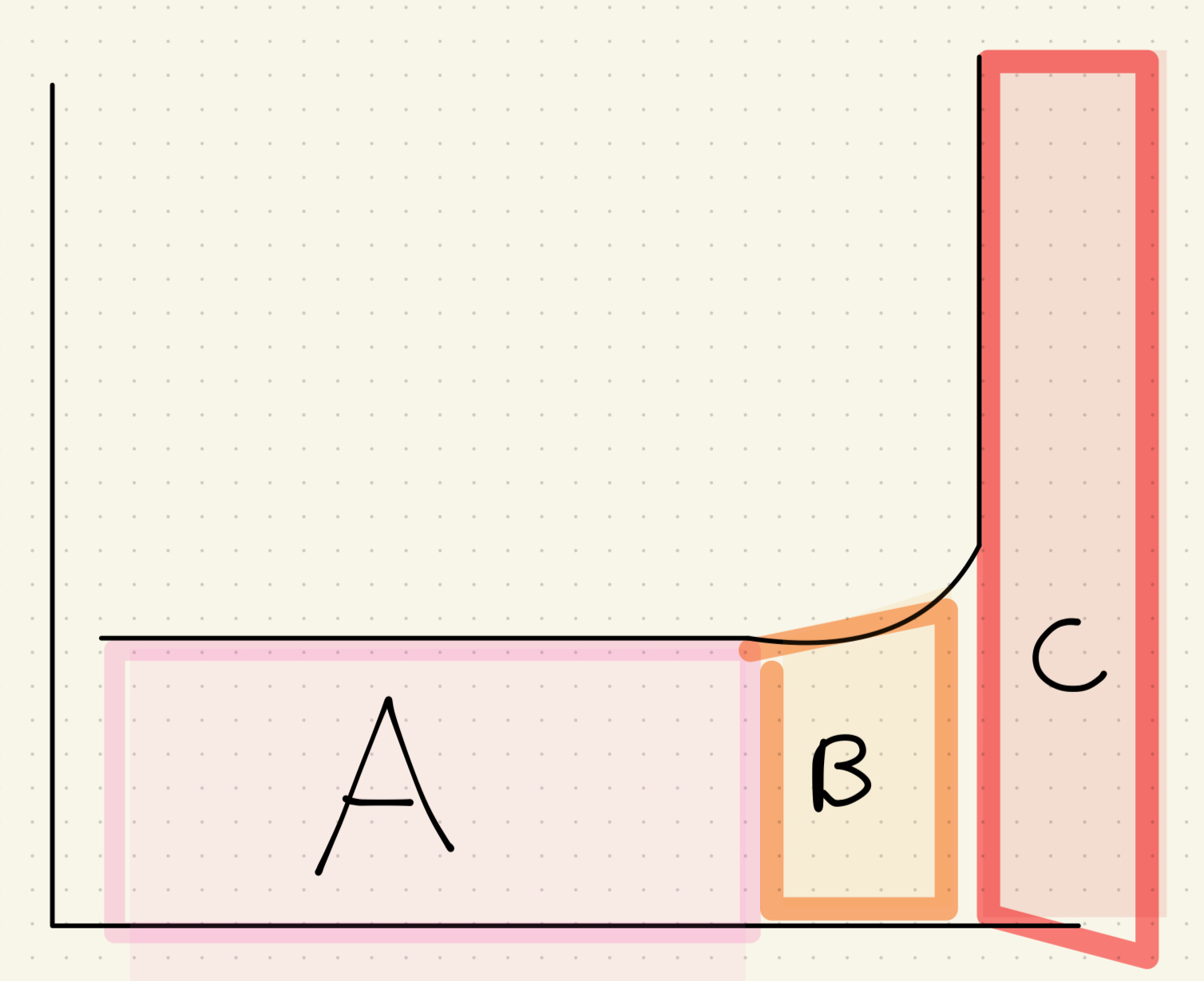
What occurs in each of the three sections of the Keynsian LRAS curve
Section A: There is spare capacity here.
The economy can increase output without any cost pressures
There are unused resources such as factories not working at full capacity
Here, AD might increase, and equilibrium real output would increase but the price level would stay the same
An example is Japan in the 1990s and 2000s, where there was much scope for increased production but unemployment persisted in the long run
Section B: The ‘bottlenecks’ section
Some constrictions in the supply chain cause cost and wage pressures to build up in some areas of the economy.
This usually involves a shortage of a particular type of labour which would cause a rise in wages
Example: The limited availability of construction workers associated with the HS2 rail link. If AD expands here, there will still be growth, but also some inflation
Section C: Full capacity
All resources are fully employed. If a firm wants to take on more workers it will have to offer higher wages to entice them away from other jobs. Here, if AD increases, there may be some extra spending in the short run, the long-term effect will be increased inflation and the same output
Define productivity
Output per unit of input
What factors influence the LRAS in the labour market?
Changes in relative productivity
Changes in education and skills - increased spending on education and training = higher value of potential output. HOWEVER not all education achieves this, e.g. BSc in Surf Science won’t have a major impact on costs of production in the UK
Demographic changes and migration - e.g. higher birth rates, life expectancy, migration = higher supply of labour
What factors influence the LRAS in the product market
Technological advances - e.g. buying a book is cheaper now with internet because fewer expensive retail outlets to maintain
Changes in government regulation - e.g. many regulations in the UK removed for postal and telecommunications service have been reduced over the past two decades to increase competition, so parcel postage and phone services (costs faced by all firms) have reduced in real terms
Competition policy and reduction in barriers to international trade - As a country opens up to more trade, competition drives down prices and inefficient domestic firms give way to overseas firms with a comparative advantage = AS shifts out
What causes shifts in the SRAS vs LRAS
Shifts in the SRAS occur because there is a change in costs of production, but the overall productive capacity remains unchanged
Changes in the quantity or quality of factors of production feed through into a shift in the LRAS curve
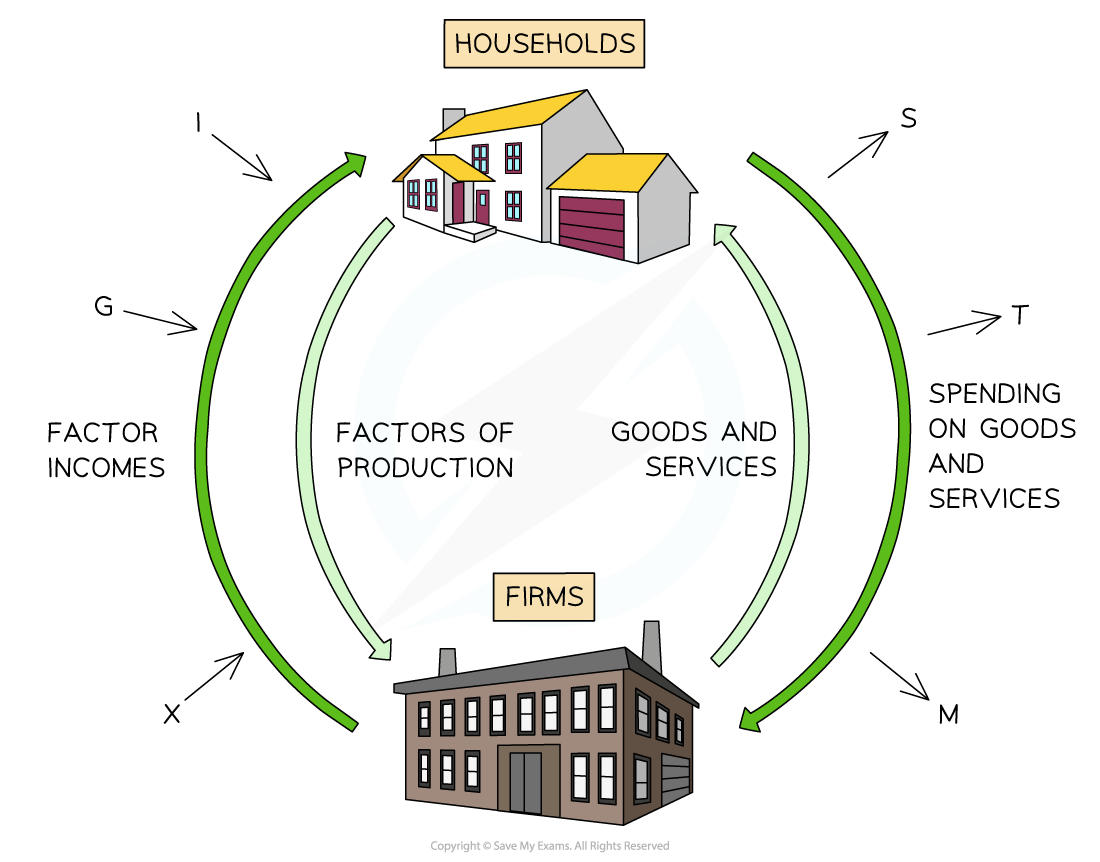
How does the circular flow of income look?
Stock v Flow concept
Stock concept - A quantity measured at a specific point in time, a ‘snapshot’
Flow concept - A variable measured over a period of time, representing activity/movement
Define wealth
The sum of all the assets in an economy. It is a stock concept.
Define income.
Refers to the amount of income earned during a period of time. It is a flow concept.
What is the wealth effect?
The effect on incomes or spending when asset values change
If you live in a property that increases in value, you might feel more confident about spending.
What are injections?
Flows into the circular flow of income, comprising: Investment, Government spending, Exports
What are withdrawals?
Flows out of the circular flow of income, comprising: Savings, Tax, Imports
What is an equlibrium point?
A balancing point where there is no tendency for the price level or real output to change
What is the multiplier ratio?
The ratio of a change in equilibrium real income (GDP) to the autonomous change (the injection) that brought it about.
It is the number of times a change in GDP exceeds the change in net injections that caused it
E.g. a multiplier of 3 means a $10 million injection into the economy will cause a $30 million increase in incomes in total
What is the most important factor in determing the size of the multiplier, and how is the multiplier calculated?
The size of the withdrawals from the circular flow: what proportion of the additional income is saved by households, which proportion is spent on imported goods, and what proportion is paid to the government in taxes.
So, the multiplier is inversely proportional to the marginal propensity to withdraw:
1
—-
MPW (MPS + MPT + MPM)
OR
1
——————
(1 - MPC)
What is MPW AND MPC
MPW: A measure of how much of any extra pound earned is saved, taxed, or spent on imports
MPC: A measure of how much of any extra pound earned is spent within the economy
What is the distinction between actual and potential growth?
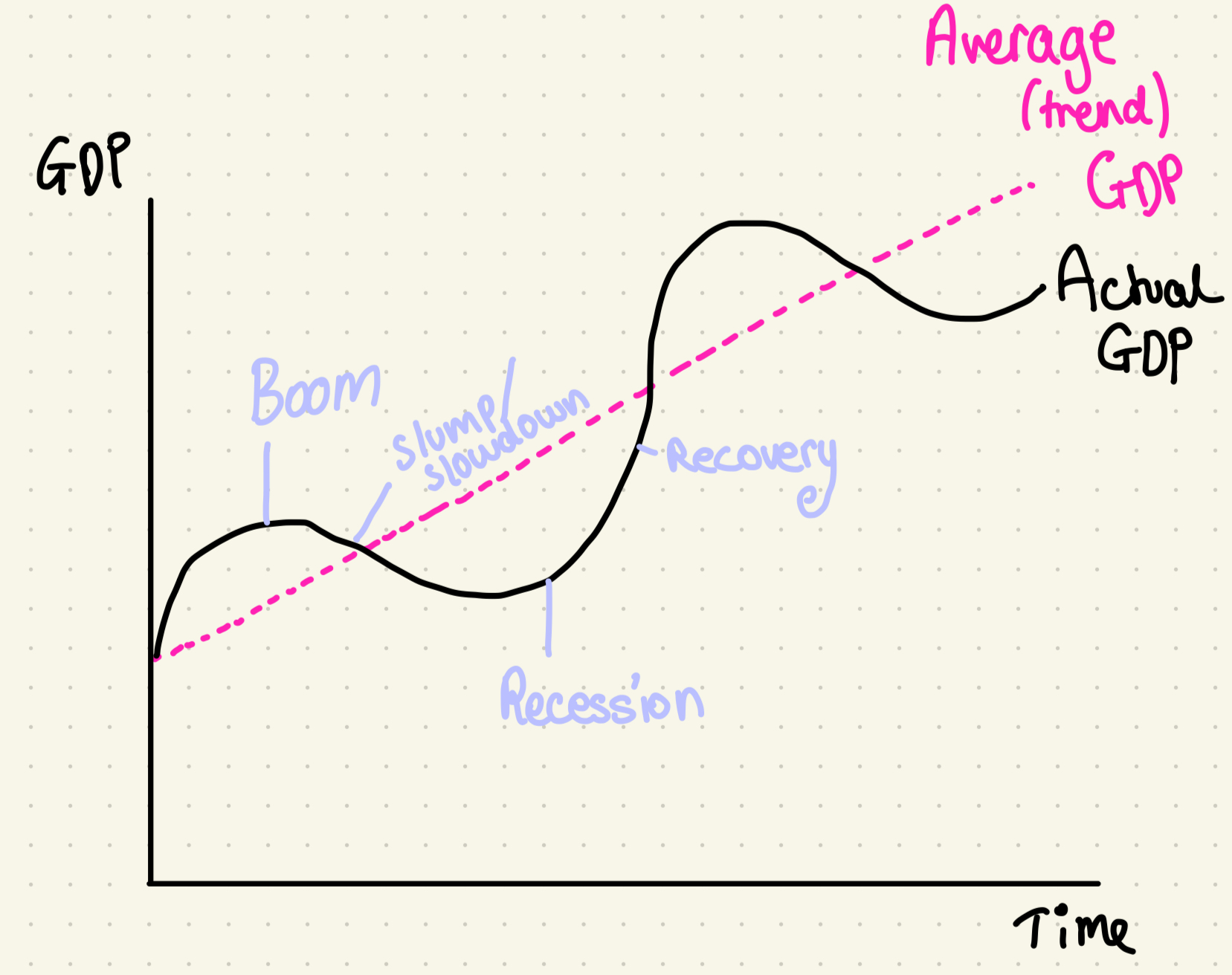
Actual economic growth: An increase in a country’s real GDP over time. Real GDP tends to fluctuate over the course of an economic cycle.
Potential economic growth: An increase in the productive capacity in the economy
What causes actual economic growth?
An increase in one of the components of AD: C, I, G, (X-M)
An increase in AS
However, on the keynsian LRAS, if AD increases on the vertical part of LRAS, no change in rGDP. If LRAS shifts out and AD is on the horizontal part, no change in rGDP.
What causes potential economic growth?
PEG only occurs when the vertical part of the AS curve shifts out
Discovery of new natural resources
Increased investment by the public or the private sector
Increased size of labour force - higher birth rates or higher immigration
Increased productivity - new technology or more highly skilled workforce
What is the problem with export-led growth?
Export-led growth is when the driver of growth is an increase in the export component in AD.
The exporters are vulnerable to changes in demand in other countries, or changes in exchange rates - both factors outside their control.
Example: China’s exports can often account for more than 50% of their AD. In the 2008 financial crisis China intervened to keep it’s currency from rising against other countries.
What are some constraints on economic growth
Labour market problems
As countries get richer, birth rates tend to fall, so long run labour supply falls.
Best way to fix this is allow a higher level of immigration
Cost of / ability to access credit
High interest rates = less consumption and investment = less growth
If banks are unwilling to lend money = subdued growth
Deficiencies in infrastructure
Poor energy, water, transport, communication networks will limit economic growth
E.g. frequently interrupted electricity will lead manufacturing output to be lower than potential output
External factors
Volatility in exchange rate markets = uncertainty
What is the output gap
The distinction between actual output and the trend/potential output.
An output gap means the counrty is not growing at the trend rate of economic growth or the potential output
Classical economists believe that output gaps do not exist in the long run, Keynsians believe a negative output gap can exist in the long run
What happens if there is a positive / negative output gap?
Positive: Pressures will grow in the economy, e.g. tight labour markets, wage pressures, and shortages of raw materials
Inflationary pressures likely to be evident
Negative: There is prob spare capacity in the economy, so there’s scope for a cut in interest rates
What can a negative output gap do to potential economic growth over time?
The non-use of resources (esp. labour) makes them less usable in the future so the productive potential of an economy tends to fall when there are high levels of long-term unemployment
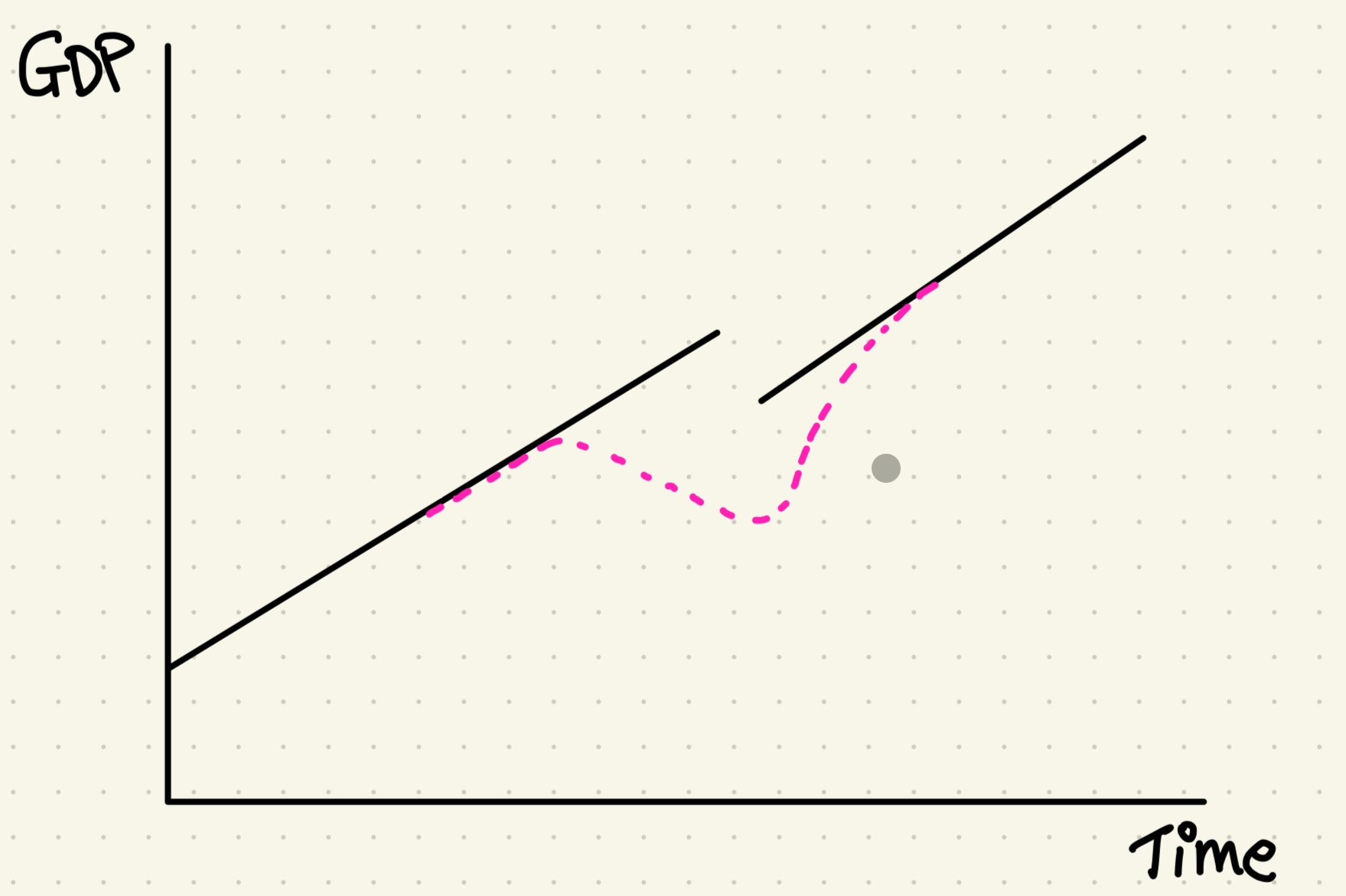
What is the trade cycle (/business cycle / economic cycle) on a diagram?