Week 11 - Southeast II and III: Woodland and Mississippian
 Studied by 0 people
 Call Kai
 Learn
Learn Practice Test
 Spaced Repetition
 Match
Match Flashcards
 Knowt Play
1/74

There's no tags or description
Looks like no tags are added yet.
Name | Mastery | Learn | Test | Matching | Spaced | Call with Kai |
|---|
No analytics yet
Send a link to your students to track their progress
75 Terms
Which of the following is an ascribed status?
Queen of England
What happens when people become sedentary and aggregate?
they develop new group identity
they develop rules to organize the group (social organization)
leaders/leadership arise to manage conflict, organize labor, etc.
The largest prehispanic structure north of Mexico is called:
Monks Mound
The highest ranking men at Moundville were buried with:
copper axes
At what Hopewell site did archaeoastronomers identify monumental alignments to the 18.6-year-long lunar cycle?
Newark Earthworks, Ohio
What exotic material is thought to have been retrieved in "one shot" from Wyoming by Ohio Hopewell travelers?
Obsidian
At what site in Western North Carolina were two small geometric earthworks recently discovered which, along with an assemblage of scrap pieces of cut mica, suggests the Appalachian peoples were involved with Hopewellian monument and crafting traditions?
Garden Creek
What although native seed crops supported Native southeastern communities until the contact period, what new crop was introduced during the Mississippian period, making possible the accumulation of surplus that is thought to have driven the emergence of inequality at that time?
Maize
The ritual themes of the Southeastern Ceremonial Complex were remarkably consistent across the entire American Southeast, and they underwent no changes throughout the Mississippian period. The central “Birdman” theme was universal from the beginning of the Mississippian period, indicating that southeastern societies all underwent an ideological shift toward individual power ca. AD 1000.
false
What was the first and largest Mississippian city, and included the famous Monks Mound and Mound 72?
Cahokia
People during the Woodland Period were wide diversity of hunter-gatherer societies in the Eastern Woodlands that are:
ultimately augmented with some cultivation, manufacturing pottery, and utilizing more elaborate ritual and trade activities
What happens as people become more sedentary and aggregated into larger groups?
these communities need:
group identity
rules to organize society (social organization)
leaders
ascribed
A position given to you by society that you don't earn or choose
achieved
A position you work for or earn through your own actions, choices, and merits.
kinship
family relationships by blood, marriage, or adoption, forming the basis of social structures
a fundamental source of power by creating social structures, determining responsibilities, and mobilizing support through bonds of blood (consanguineal), marriage (affinal), or social ties, providing stability, identity, and economic/political leverage
economic source of power
stem from controlling wealth, resources, production, and markets, leveraging factors like natural resources, labor, capital (money/technology), and entrepreneurship, and utilizing tools like trade, sanctions, and foreign aid to influence decisions, build wealth, and project strength, impacting nations, businesses, and individuals
political source of power
stems from various sources like popular consent (elections), force, resources (wealth, expertise), institutions (constitutions, parties), and ideology (religion, media), ultimately resting on the obedience or support of the people, whether granted freely or imposed from above
religious source of power
stem from divine beings (God/Allah/Brahman), spiritual forces (like the Holy Spirit in Christianity), sacred texts/traditions, charismatic leaders, and the collective faith/actions of followers, manifesting as inner strength, authority, or influence, with ultimate power often residing in the divine for creation and guidance, while human power comes through faith, anointing, or designated roles
The Archaic Period 8000 - 1000 BCE
hunter-gatherer, mobile societies
Poverty Point:
mounds and earthworks
place of aggregation on landscape
ceremonial importance
Also see the ___ utilized first in Archaic Period, and then relied heavily on by Woodland communities
Eastern Agricultural Complex
The Woodland Period date range
1000 BCE - 1000 CE
Woodland Period Life
sedentary forager-farmers
broadly egalitarian domestic communtiies of varying sizes
regular larger-scale aggregations indicative of complex social, political, and ritual relationships
Woodland Ritual Life Elements
human burial and associated activities
exotic raw materials and ritualized craft production
monumental architecture
Discovering Woodland Ritual
1. 19th-century settlement west of the Appalachians
In the 1800s, European-American settlers moved into areas west of the Appalachian Mountains (Ohio, Kentucky, Tennessee).
While building farms and towns, they noticed huge earthen mounds and earthworks.
These mounds were created by Woodland peoples, including the Adena and Hopewell cultures.
2. Early surveys of Squier & Davis
Ephraim Squier and Edwin Davis were two early American archaeologists.
In 1848, they published Ancient Monuments of the Mississippi Valley.
They created detailed maps, drawings, and descriptions of the mounds.
Their work was the first major archaeological documentation of Woodland ritual sites.
Early Woodland Adena
building large mounds
Early Woodland burials
central tomb others buried around
Adena grave goods: Where were adult men buried and with what items
buried in central tomb with ceremonial items
Adena grave goods: What were others buried with
everyday items
What were mounds
family lineage, related by common ancestor
leaders
achieved, power derives from kinsip and religious knowledge
Where was early Woodland Adena culture located and when
Ohio, 1000 BC to AD 100
Hopewell Ohio monumentality communtiies built:
Conical/Platform mounds
conical mounds → rounded burial mounds
platform mounds → flat-topped mounds possibly used for rituals, ceremonies, or structures
Large geometric earthworks
served as ceremonial centers, ritual spaces, and gathering places
Little to no associated habitation debris
people did not live in these earthworks permanently
they were not villages
Newark Earthworks, Ohio
one of the largest and most complex Hopewell ceremonial landscapes in North America
built by Hopewell culture between 100 BCE - AD 400
wray figure
a stone carved human figurine from the Adena culture
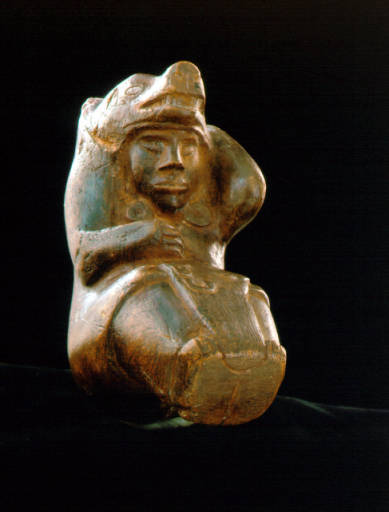
Hopewell Ritual Material culture example
Hopewell Mound Group, Ohio
exotic materials, elaborate ceremonial objects, and monumental earthworks, all used for ritual and social gatherings
The One-Shot Hypothesis
says that all of the obsidian found at Hopewell sites (like the Hopewell Mound Group) probably came from ONE single trip to Obsidian Cliff in Wyoming—not repeated long-distance journeys.
How was Obsidian procured?
direct procurement or down the line procurement from trading partners
The Pilgrimage Hypothesis
Hopewell mica probably came from repeated ritual journeys to the southern Appalachians, especially Garden Creek, and was brought back to Ohio for burial and ceremonial use.
Defining hallmarks of the Woodland Period across the Eastern Woodlands
Shared mortuary practices, similar monumental traditions, and widely circulated exotic materials
Extent of Hopewell
wasn’t just located in Ohio
it was a huge cultural and ceremonial network that stretched across the entire Eastern Woodlands
Appalachian Hopewell
southern Appalachian communities (NC & TN) that participated in the Hopewell ceremonial exchange network, especially supplying mica and sharing similar ritual and burial traditions.
Garden Creek Site, NC
a major Appalachian Hopewell ceremonial site with mounds, ritual buildings, and abundant mica, showing strong connections to Ohio Hopewell and long-distance pilgrimage networks
Snake Den Group
complex circles and squares revealed by LiDAR, showing a large, hidden Hopewell ritual landscape
Junction Group
highly complex earthworks including rare quatrefoil shapes, showing sophisticated Hopewell symbolism and planning.
Winchester Farm, Kentucky
where people from smaller surrounding communities periodically gathered to bury the dead, exchange exotic goods, and perform rituals. It was part of the broader Hopewell cultural network
Garden Creek shows the ___ of mica and quartz objects, while Ohio Hopewell sites show the ___ ritual artifacts
production; finished
Early and Middle Woodland:
Egalitarian forager-farmers in Ohio valley and across the Eastern Woodlands participate in Aden and Hopewell ceremonialism and exchange
Late Woodland Transformation subsistence
the adoption of Maize agriculture (AD 800 - 1000)
Archaeological Evidence of Maize
charred maize in houses, pits
stable isotope signatures in human bones - indicates diet high in C4 plants like maize
appearance of heavy Mill Creek chert hoes, used to prepare larger gardens
Consequences of Maize
encourage greater commitment to sedentism and larger population concentrations (fully fledged towns)
storage ability → surplus accumulation → opportunities for creating social inequality between households and communities
Maize consequences created emergence of __
Mississippian Chiefdoms (AD 1000 - 1450)
Rank society of Mississippian Chiefdoms
chiefs inherit status
Mississippian Chiefdoms hierarchial settlement patterns
towns and villages are organized with central plazas or mound complexes where elites live; commoners live around them
Mississippian Chiefdoms ideological institutions
Systems of religion, ritual, or ceremony that support hierarchical relationships.
These institutions legitimize the authority of chiefs and the social stratification of the society
Mississippian towns
located on waterways with abundant resources
mounds, plazas, and a few hundred - a thousand inhabitants in town
other settlements clustered around mound centers to balance labor demands, resource distribution, and defensive needs
The American Bottom
floodplain east of St. Louis, on the Illinois side of the Mississippi River
Environmental features:
easily cultivated soils → ideal for agriculture
marshy lakes → provided water, fish, and fertile areas for crops
Significance:
this supported intensive maize agriculture and the growth of Mississippian chiefdoms like Cahokia
rich soils and water resources made it prime area for settlement and social complexity
Cahokia
largest pre-Columbian city north of Mexico
core site area is 10 sq km, with 100+ earthen mounds
as many as 10 - 20,000 inhabitants at peak
grand plaza = 50 acres
Significance:
major center of Mississippian culture
demonstrates social complexity, hierarchy, and urban planning
reflects intensive maize agriculture in surrounding floodplains to support large pop
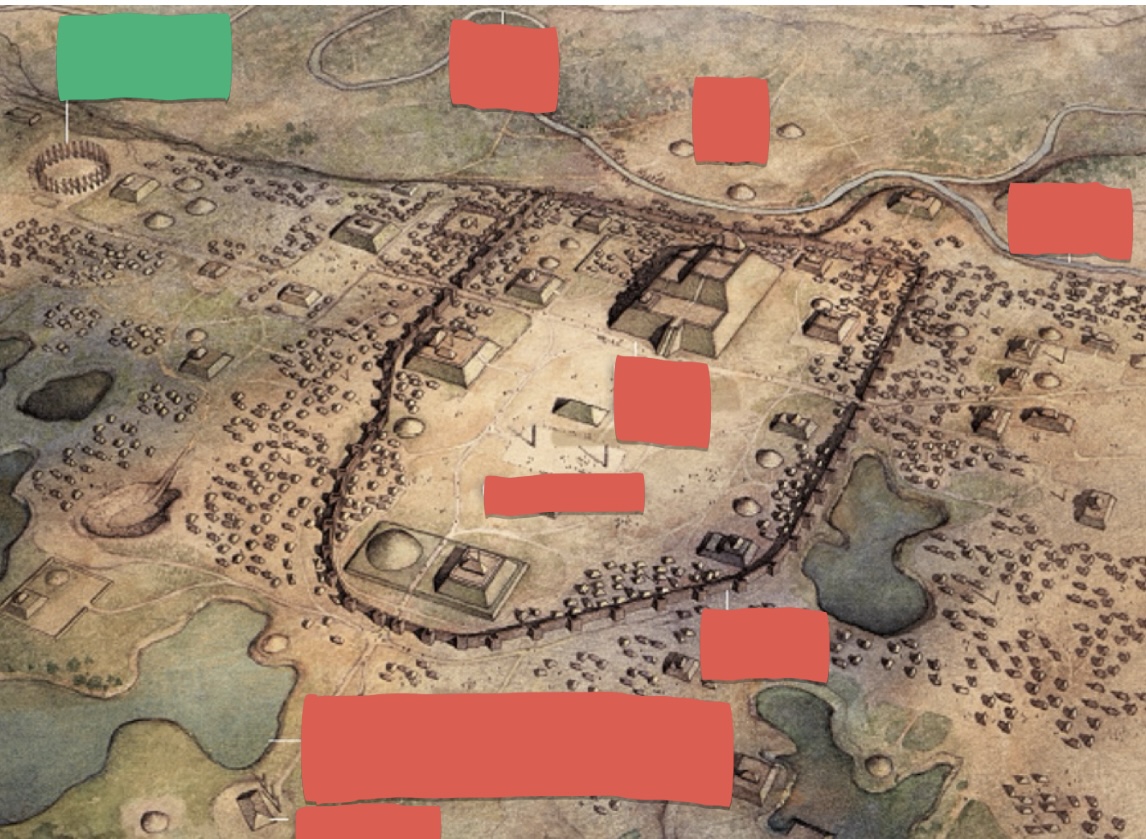
Woodhenge
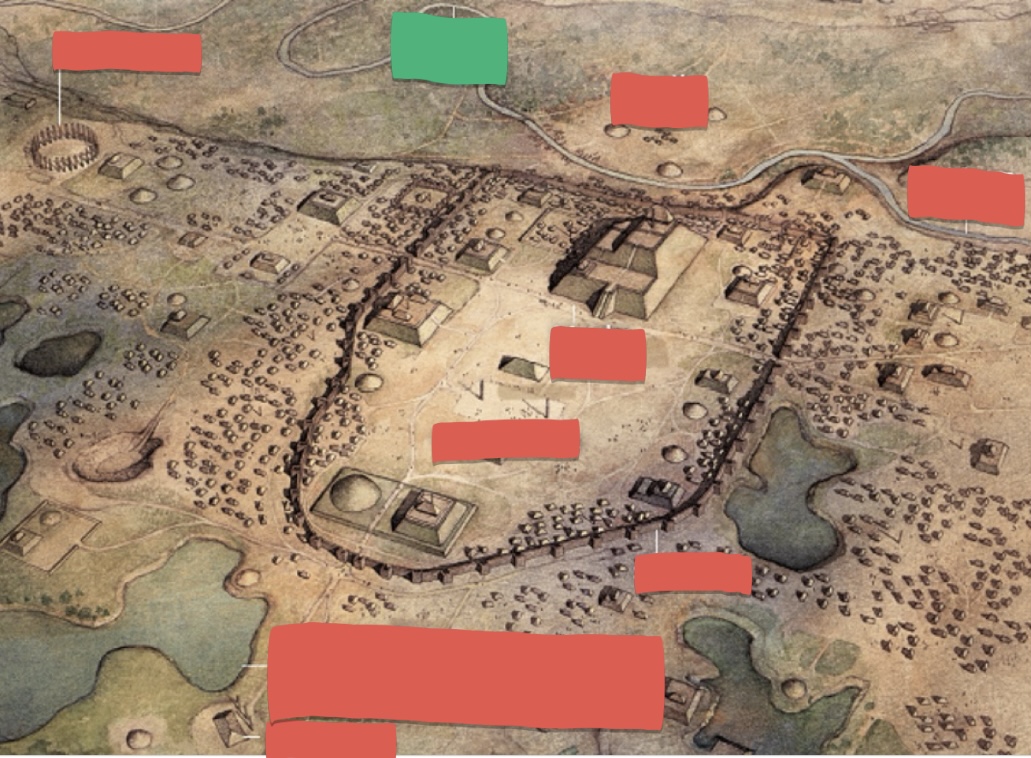
Cahokia Creek
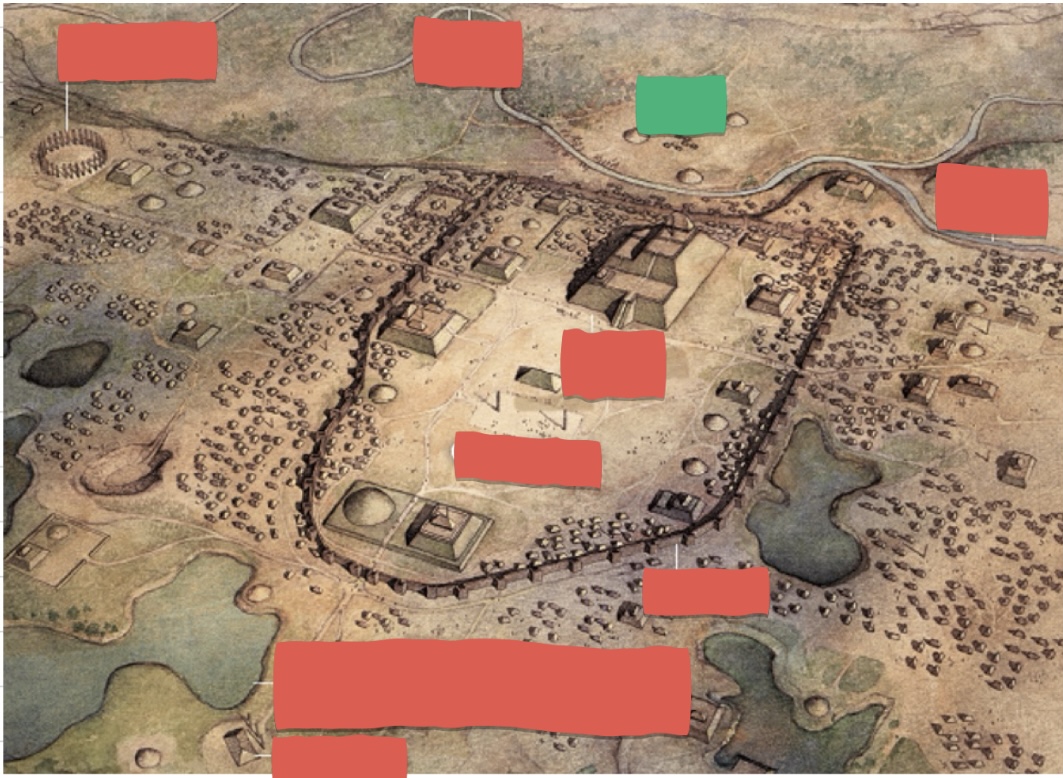
North Plaza
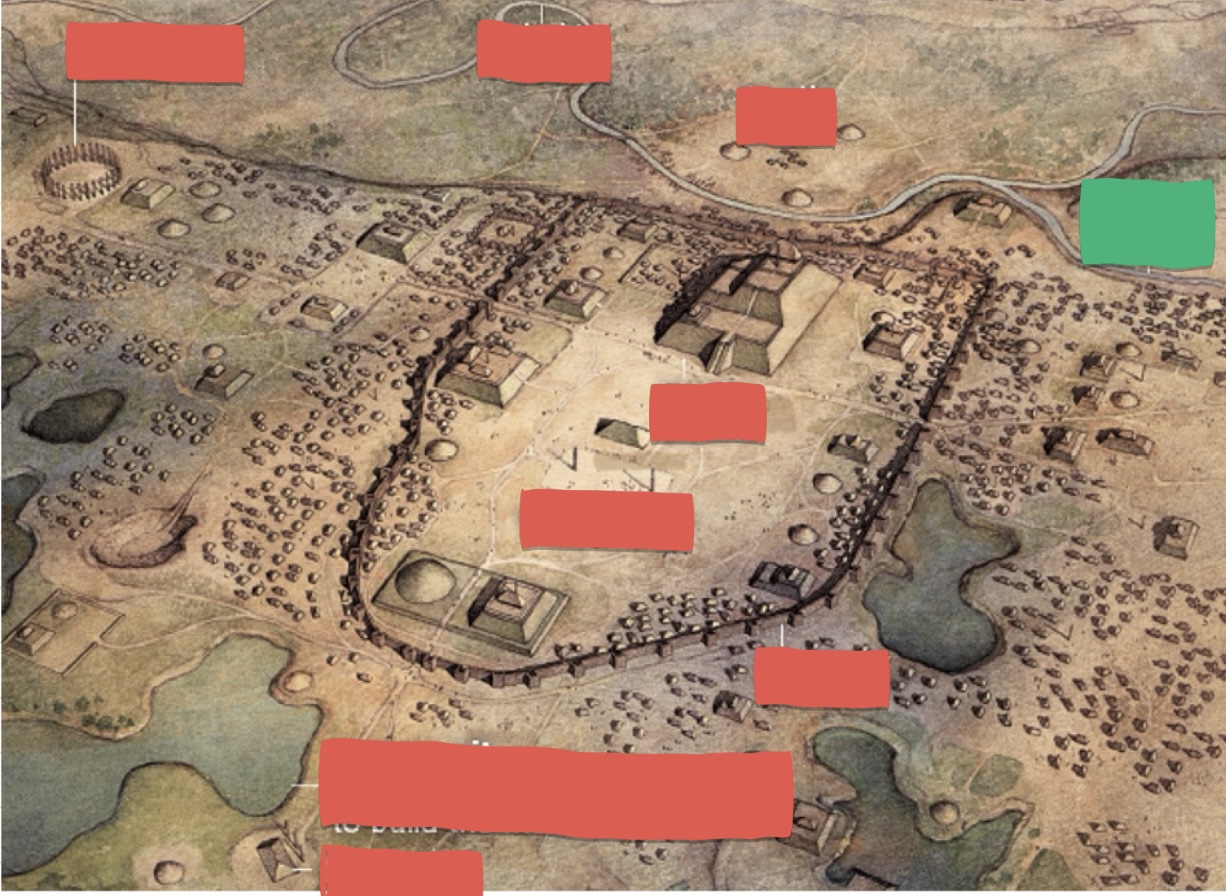
Canteen Creek

Monks Mound
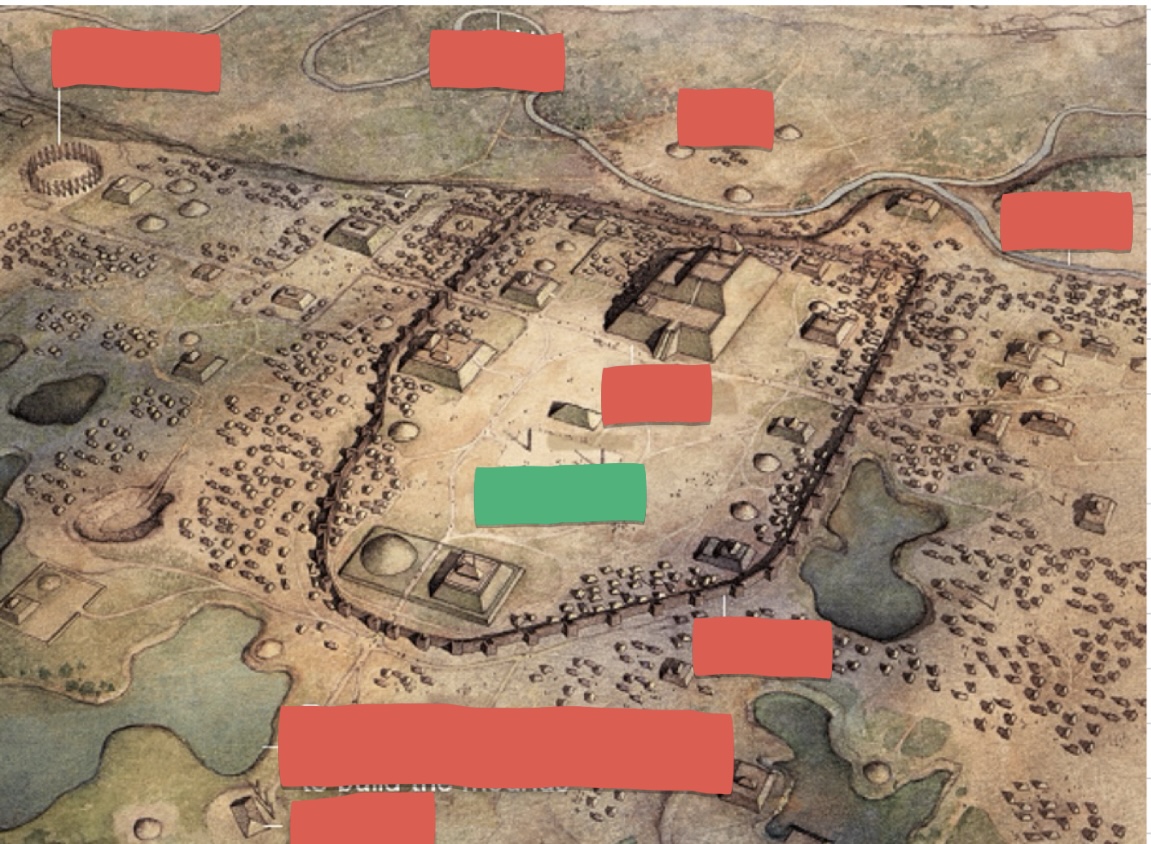
Grand Plaza
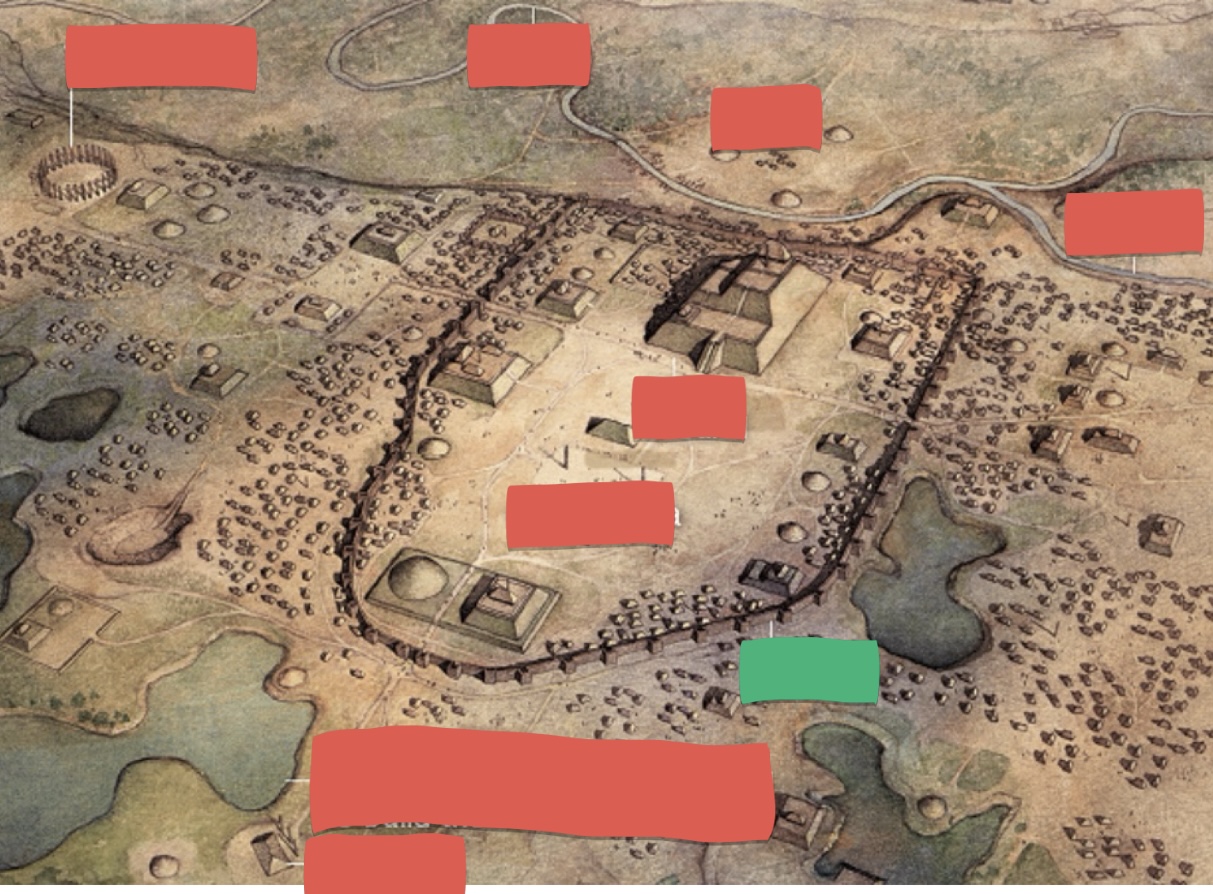
Stockade
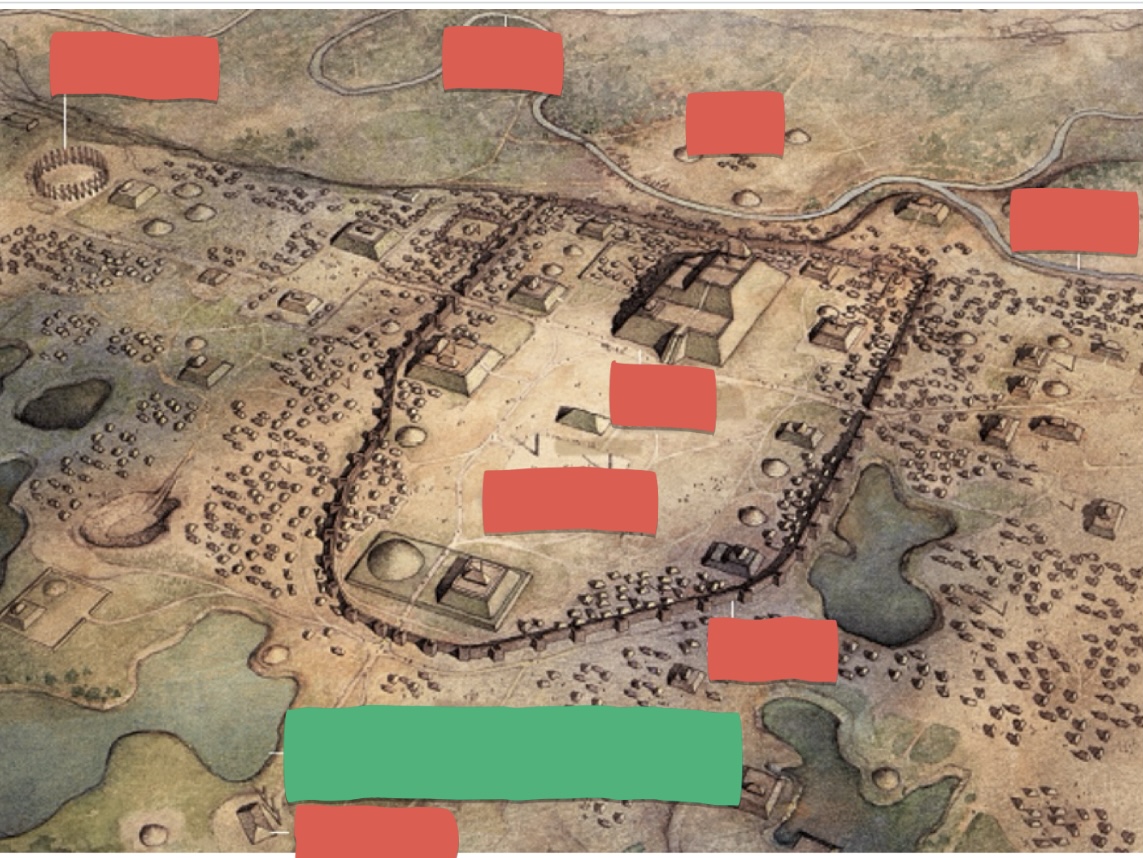
Borrow pit
area where earth was extracted to build the mounds
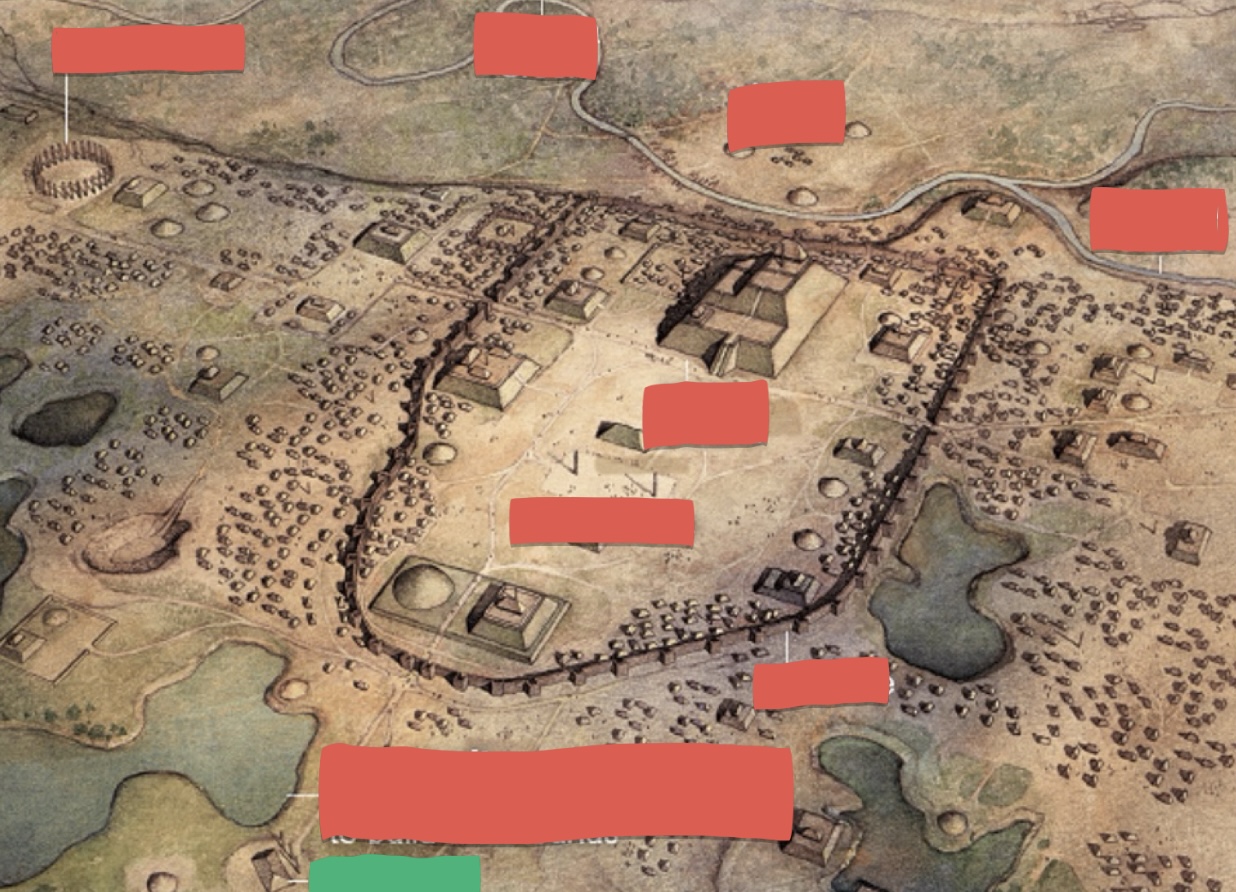
Mound 72
Burial Mound 72 at Cahokia
used multiple times → indicates repeated ceremonial or funerary significance
may represent a recreation of a creation myth
Artifacts and Features
Arrows: many types of stone, never used → likely symbolic offerings
Shell discs: arranged deliberately → ritual or status symbols
chunky stones: may been part of a game or activity
copper and mica: high status materials, show wealth or elite status
Mississippian society to understand Mound 72 context
Leadership: Paramount Chief
Connection to creator → religious and political authority intertwined.
Inherited/ascribed status → leadership passed down through family lines.
Status markers: prestige goods, elaborate clothing, and ornaments.
Responsibilities:
Sponsor feasts
Collect and redistribute tribute
Ritual Practices
Human sacrifice: conducted to honor the dead and increase the status of the family or chief.
Sacrifices and offerings reinforce social hierarchy and religious beliefs.
3. Social Implications for Mound 72
Elite burials with exotic materials (copper, mica, shell discs) reflect paramount chief status.
Symbolic artifacts (arrows, stones, arrangements) mirror ritual and cosmological beliefs.
Repeated use and elaborate burials show how religion and social structure are expressed materially
Mississippian exchange and interactions: Spread
Cultural emulation/diffusion: communities adopting Mississippian practices from neighbors.
Defensive reaction: societies adjusting practices due to pressures or threats.
Population movement: migration of peoples spreading ideas, practices, and material culture
Mississippian exchange and interactions: evidence in Material Culture
Shell-tempered pottery → indicates shared technology and style.
Wall-trench houses → common architectural form across regions.
Southeastern Ceremonial Complex (SECC):
Artifacts, iconography, ceremonies, and mythology
Reflects exchange among elites and shared ritual traditions
Mississippian exchange and interactions: Regional Variation
Common cultural elements visible, but ritual beliefs and practices varied by region.
Practices evolved over time, showing dynamic interaction networks rather than uniform culture
Mississippian exchange and interactions: Overall Significance
Mississippian society was highly interconnected through trade, migration, and ritual exchange.
Shared material culture demonstrates both social connections and local adaptations
by 1200 __ was a regional center
Moundville
Cahokia and Moundville are 2 examples of Mississippian chiefdoms rising, exerting power for a few hundred years, and then losing power - at which time power shifts to another location. Archeologists refer to this pattern as?
chiefly cycling
Northern part of Moundville sites has burials with ___
prestige items
 Note
Note  Flashcards (82)