Internal Energy, Thermal Energy transfer
 Studied by 1 person
 Call Kai
 Learn
Learn Practice Test
 Spaced Repetition
 Match
Match Flashcards
 Knowt Play
1/23

There's no tags or description
Looks like no tags are added yet.
Name | Mastery | Learn | Test | Matching | Spaced | Call with Kai |
|---|
No analytics yet
Send a link to your students to track their progress
24 Terms
What happens when an object overcomes friction (in terms of energy)?
Work is being done, as the object is overcoming friction. That means a force is being applied in an opposite direction.
What also happens when work is done?
Energy is being transferred, either to the objects velocity or its particles.
Relative Motion
The calculation of an object relative to the motion of another object.
Atoms
The smallest particle of a chemical element that can exist.
What are atoms in terms of physics?
Very small elastic balls that are elastic
What happens when elastic objects collide?
Both momentum and kinetic energy is conserved.
Element
a substance that can't be broken down by non-nuclear reactions, all atoms of a given element have the same number of protons.
What happens when elastic objects collide?
Both momentum and kinetic energy is conserved.
Compounds
Materials that contain more than one type of atom
Solids
Have a fixed shape, and molecules have a fixed position.
Three states of matter
Solid, Liquid & Gas
Density Formula
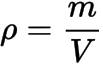 Where,
p = density (g/cm³) (kg/m³)
m = mass (g) (kg)
v = volume (mL) (L)
Solids
Have a fixed shape, and molecules have a fixed position.
What happens if you try pull the molecules of a fixed position apart?
Their intermolecular force pulls them back together. This is due to charge.
Temperature
How hot & cold something is. The energy that your body has goes to the energy of another object, thus, the object may feel colder. But, the temperature is the same. (Room temperature)
Internal Energy (only for solids and liquids)
The sum of the average kinetic energy and potential energy of all the molecules in a body.
Density of a gas, liquid and solid
The density of a gas is lower than the density of a solid or liquid. But, not all liquids are less dense than solid body.
Internal Energy (gasses)
The sum of the average kinetic energy (changing molecules position does not require work to be done.)
How is drag/air resistance formed?
EXAMPLE: As the car moves forward, it collides with air molecules in its path. These collisions lead to the transfer of momentum and energy between the car and the air molecules. According to Newton's third law of motion, for every action, there is an equal and opposite reaction. In this case, the action is the car pushing against the air, and the reaction is the air pushing back on the car. This opposing force, known as air resistance or drag, acts in the opposite direction to the car's motion. It's like a continuous series of microscopic collisions between the car and air molecules.
Material Property
Measurable characteristics of a substance, such as density, which influence its behavior and response to external conditions. A given material will always have the same density.
What is the formula for Average Kinetic Energy?
Ek = 3/2 x k x T,
where Ek = average kinetic energy
k = Boltzmann’s Constant
T = Temperature (in Kelvin)
Elastic Collision
“Bouncy collision” where two particles bounce off eachother, and momentum and Kinetic Energy is conserved. Momentum before = momentum after.
InElastic collision
“Stuck collisions”, where two particles collide with eachother. Kinetic Energy is not conserved, but momentum is. Momentum before = momentum after.
 Note
Note  Flashcards (50)