3.3 organisms exchange substances with their environment
 Call Kai
 Learn
Learn Practice Test
 Spaced Repetition
 Match
Match Flashcards
 Knowt Play
1/82

There's no tags or description
Looks like no tags are added yet.
Name | Mastery | Learn | Test | Matching | Spaced | Call with Kai |
|---|
No analytics yet
Send a link to your students to track their progress
83 Terms
The primary function of gaseous exchange in animals
To supply oxygen for respiration
efficient gas exchange surfaces have… (gas exchange)
large surface area
short diffusion pathway (thin barrier)
steep concentration gradient
good blood supply
ventilation (in larger organisms)
What is the SA to volume ratio in different sized animals
Smaller animals - Large SA to volume ratio
Larger animals - small SA to volume ratio
What is the metabolic activity in different sized animals
Single-celled and smaller organisms - low metabolic activity
Larger multicellular organisms - high metabolic activity
Why do larger organisms need exchange surfaces e.g lungs, small intestine
SA to volume ratio is too small (SA isn’t big enough) so substances cannot diffuse fast enough to support their cells
Diffusion distance is too large - becomes insufficient
How do small single-celled organisms absorb substances (nutrients and oxygen)
directly from their surroundings via outer surfaces
Due to their large SA to volume ratio
How do larger organisms gain their substances (oxygen, nutrients)
exchange surfaces e.g lungs, small intestine
What 2 layers of the plant contain chloroplasts (gas exchange in plants)
The palisade mesophyll
The spongy mesophyll
What transports water and sugar in a plant
Water - xylem
Food/sugar - phloem
→ phloem and xylem are found within veins of the leaf
Diagram of the structure of a leaf (gas exchange in plants)
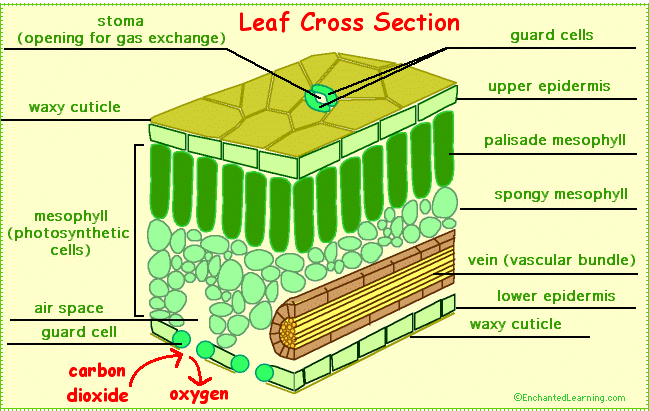
How is the leaf adapted to be an efficient exchange surface (gas exchange in plants)
many stomata - no cell is far from stomata - short diffusion pathway
Many air spaces throughout mesophyll layer - so gases readily come in contact with mesophyll cells
Large surface area of mesophyll cells for rapid diffusion
Thin - short diffusion pathway
How are leaves adapted to limit the amount of water lost by transpiration (gas exchange in plants)
waxy cuticle - provides waterproof coating
Ability to close stomata - in the dark the plant can’t photosynthesis so closes more of its stomata to minimise water loss
Which gases are exchanged in plant for which processes (gas exchange in plants)
carbon dioxide in, oxygen out for photosynthesis
Oxygen in, CO2 out for respiration
What is transpiration and the transpiration stream (gas exchange in plants)
Transpiration - loss of water in a plant
Transpiration stream - movement of water through a plant
What are xerophytes (gaseous exchange in plants)
a plant that has adaptations to survive in ana environment with little water (desert)
Common xerophyte adaptations (gaseous exchange in plants)
To reduce water loss:
rolled leaves - trap humid air inside, eliminates diffusion gradient - less transpiration
Spines for leaves - reduces surface area - less transpiration
Thick waxy cuticle - reduces evaporation
Sunken stomata - traps humid air leaving the leaf, reducing water potential gradient, slows the rate water leaves the leaf
Hairs on leaves - traps moisture close to leaf surface to decrease diffusion gradient
Efficient water uptake:
Extensive root systems to absorb water quickly
2 examples of xerophytes and there adaptations (gaseous exchange in plants)
Cacti (desert xerophyte)
leaves reduced to spines
Thick waxy cuticle
Sunken stomata
Extensive shallow roots
Marram Grass (sand dune xérophyte)
rolled leaves
Hairs on inner leaf surface - reduced air movement - reduced transpiration
Thick waxy cuticle
Sunken stomata
Long roots - reach deeper water
Why do insects have a high oxygen demand (gaseous exchange in insects)
very active
Very high rate of metabolism
the tracheal system of an insect (gaseous exchange in insects)
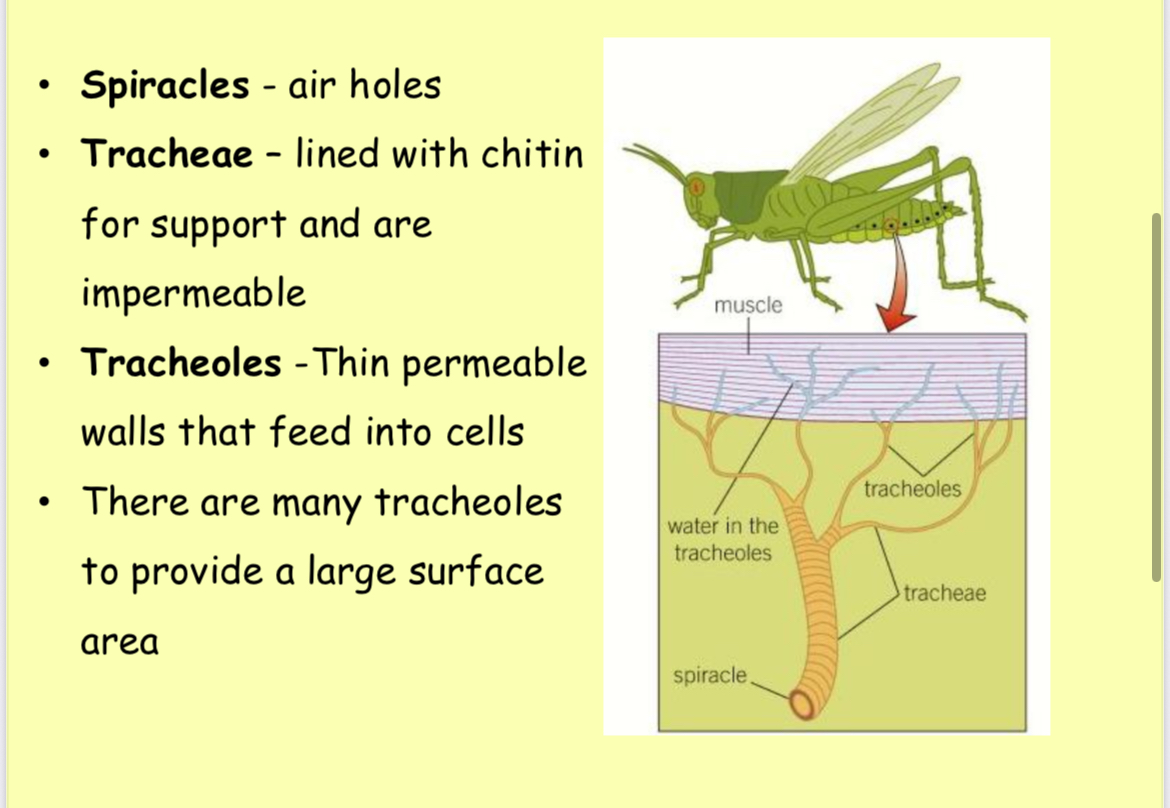
what happens when insects are active and respire anaerobically to get additional oxygen (gaseous exchange in insects)
tracheoles contain tracheal fluid
when insects are active they respire anaerobically and produce lactic acid in muscle cells
this lowers the water potential of the muscle cells so the water moves from the tracheoles to the muscle cells
so air can be drawn in closer to the muscle cells and therefore reduces diffusion distance speeding up diffusion when oxygen is needed most
why do insects not require a circulatory system to transport oxygen (gas exchange)
oxygen is delivered directly to tissues through tracheoles
how do insects minimise water loss (gaseous exchange in insects)
exoskeleton made from chitin - coated with a waxy substance - waterproof
can close their spiracles to prevent water loss
hairs around the spiracles - trap water - decreases water potential gradient - decreases water loss
adaptation of tracheae in insects (gaseous exchange in insects)
rigid rings in their walls to keep air passages open - similar to rings of cartilage
lined with chitin for support
what do insects do when active to increase oxygen supply (gaseous exchange in insects)
contract abdominal muscles - lowers pressure in the tracheal system - more air is drawn in
tracheal fluid moves to muscles cells to break down lactic acid - decreases diffusion distance - faster rate of diffusion
Adaptations for efficient gaseous exchange in insects (gas exchange in insects)
spiracles supply oxygen directly to cells - short diffusion distance
thin walls - short diffusion distance
Tracheae have rigid rings in walls to keep air passages open
tracheoles are highly branched - large surface area
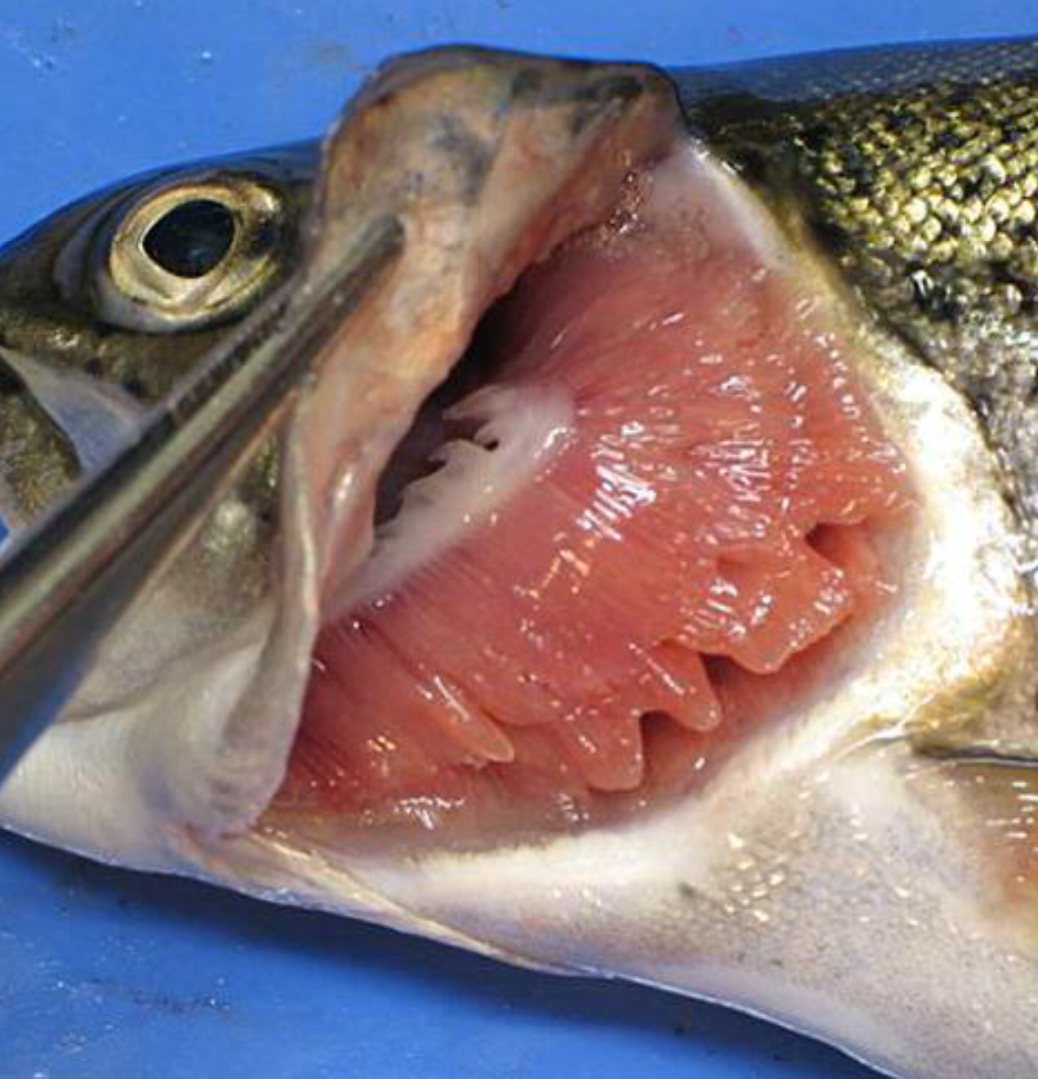
Structure of a fish gill and where gaseous exchange takes place (gaseous exchange in fish)
gill lamellae
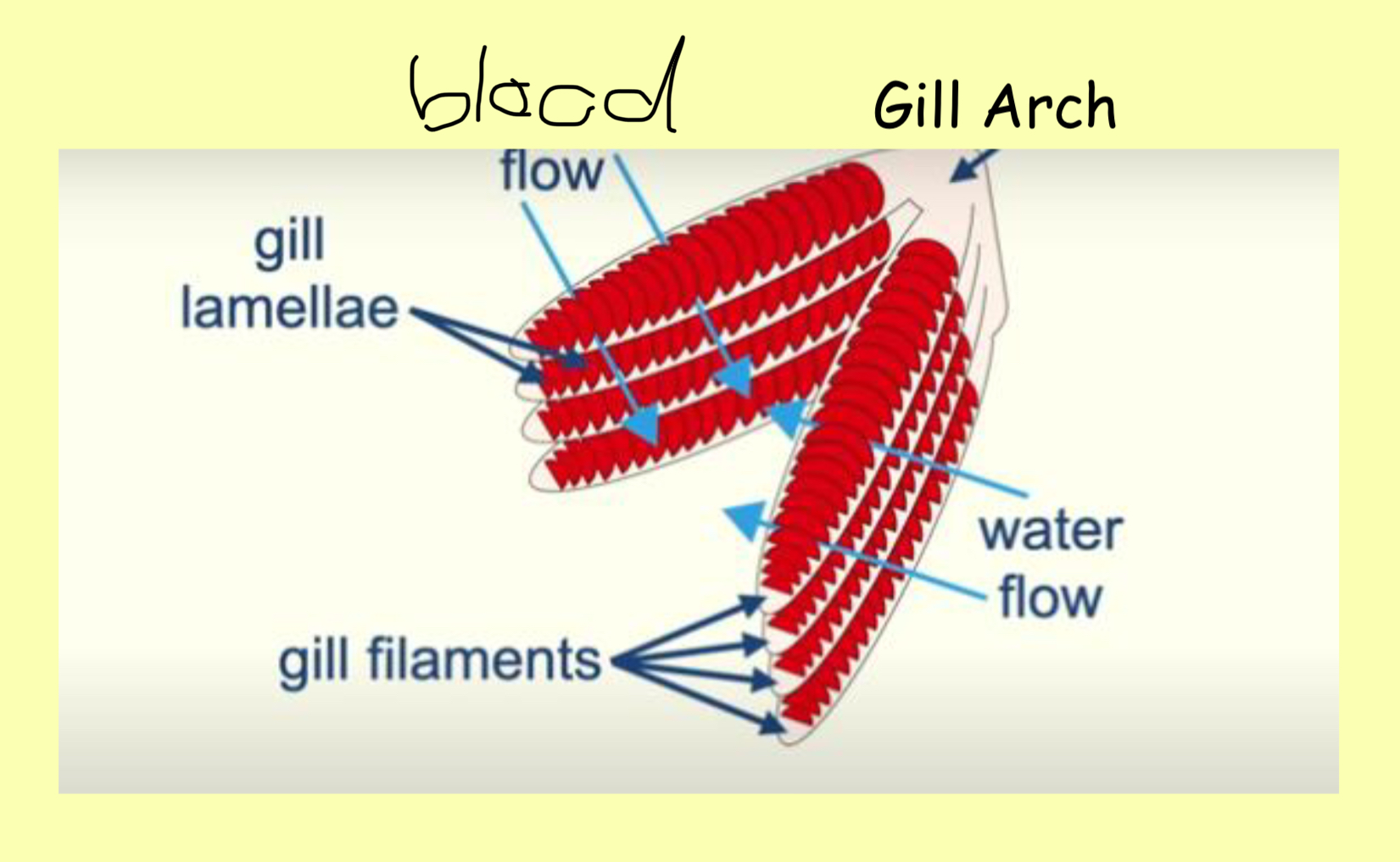
Adaptations in fish for efficient gaseous exchange (gas exchange in fish)
very thin lamellae epithelium
lamellae covers an extensive network of capillaries - good bloody supply
many lamellae - a large surface area
Large concentration gradient - more diffusion
counter- current flow system
Pathway water travels through a fish (gaseous exchange in fish)
Water passes through the mouth + over gills
Oxygen diffuses into blood
Carbon dioxide diffuses into water
Water passes out of the Operculum
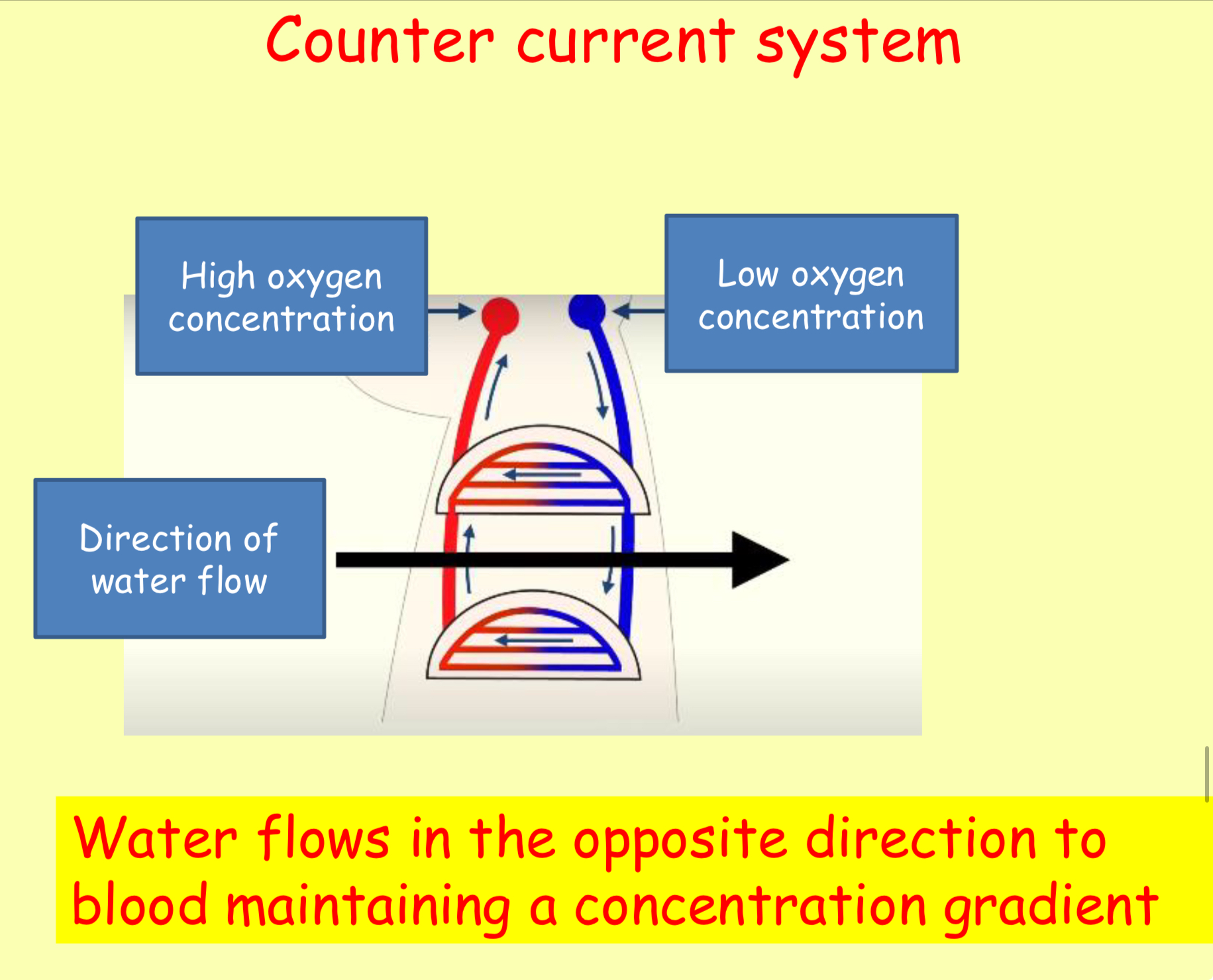
Explain the counter current system in fish and the importance of it (gaseous exchange in fish)
Water flows in the opposite direction to blood
Maintains a diffusion gradient the full length of the capillary
maximises oxygen uptake - 80% oxygen uptake
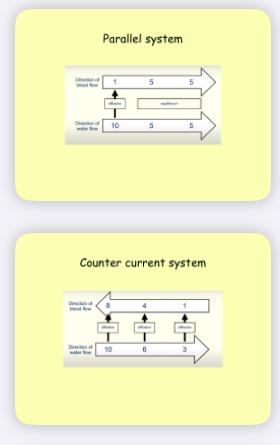
The difference between a parallel and counter current system in a fish (gas exchange in a fish)
Parallel - diffusion gradient quickly decrease - diffusion only happens at the start
Counter-current - maintains diffusion gradient - diffusion the full length of capillary
How does the Operculum help ventilation in bony fish (gaseous exchange in fish)
by maintaining a one-way water flow
What is gaseous exchange (gaseous exchange in mammals)
diffusion of oxygen into the blood and carbon dioxide into the alveoli
What is breathing and ventilation (gaseous exchange in mammals)
taking air in and expelling air out
What is respiration (gaseous exchange in mammals)
chemical reaction that uses oxygen to release energy in the form of ATP
what is the passage of air in the lungs (gas exchange in mammals)
Nose/mouth
trachea
Bronchi (bronchus - single)
Bronchioles
Alveoli

Adaptations of the alveoli for efficient gaseous exchange (gas exchange in mammals)
Capillaries & alveoli - 1 cell thick, constists of squamous epithelial cells (flattened cells) - short diffusion distance
Large surface area - faster diffusion
A high concentration gradient - high oxygen in alveoli & low in blood - opposite for CO2 - faster diffusion
Moist lining - makes the membrane permeable - permeable to oxygen & CO2 - faster diffusion
Moist lining - lubricant - stops lungs drying out
surfactant reduces surface tension and prevent collapse
what happens when we inhale (gas exchange in mammals)
diaphragm contracts and flattens
thoracic volume increase
pressure in lungs decreases (lower than the atmospheric air pressure outside)
external intercostal muscles contract
internal intercostal muscles relax
air moves in
what happens when we exhale (gas exchange in mammals)
diaphragm relaxes and becomes domed
thoracic volume decreases
pressure in lungs increases (above atmosphere air pressure)
external intercostal muscles relax
internal intercostal muscles contract
air moves out
structure of the trachea (gas exchange - tissues in the lungs)
16-20 rings of hyaline cartilage - provides support, prevent from collapsing
ring are in C shapes - provides flexibility if food goes down
elastic fibres and smooth muscle - also provides flexibility
lined with a ciliated epithelium with goblet cells in-between
→ goblet cells - secrete mucus to trap tiny particles in the air
→ cilia - sweep the mucus to the throat

structure of the bronchi (gas exchange - structure of the lungs)
similar to trachea but smaller
small sections of hyaline cartilage - provides support, prevent from collapsing
ring are in C shapes - provides flexibility if food goes down
elastic fibres and smooth muscle - also provides flexibility
lined with a ciliated epithelium with goblet cells in-between
→ goblet cells - secrete mucus to trap tiny particles in the air
→ cilia - sweep the mucus to the throat

structure of bronchioles (gas exhange - tissues in the lungs)
do not have hyaline cartilage (only large bronchioles)
only have elastic fibres and muscle - to they can contract and expand easily
still has ciliated epithelium with goblet cells

explain how the bronchioles constrict and relax and why (gas exchange - tissues in the lungs)
contains smooth muscle
smooth muscle contract - bronchioles constrict as elastic fibres deform (close)
→ less harmful substances in gases reaching alveoli
smooth muscle relaxes - bronchioles dilate as elastic fibres recoil to original size and shape (open)
compare the structure of bronchioles and trachea (gas exhange - tissues in the lungs)

structure of the alveoli and features of the structures (gas exchange - tissues in the lungs)
elastic fibres
→ become deformed when we breathe in so the alveoli can stretch without bursting
→ recoil when we breathe out forcing the air out
squamous epithelial cells
→ flattens cells - reduces diffusion distance
→ permeable - allows diffusion of gases
compare the difference in structure between the trachea, bronchi, bronchioles and alveoli (gas exchange - tissues in the lungs)

what does gas exchange efficiency depend on (gas exchange)
SA
thickness
concentration gradient
What is tidal volume (gas exchange - measurements of lung capacity)
the volume of air inspired or expired per breath when at rest
What is vital capacity (gas exchange - measurements of lung capacity)
the largest volume of air that can be inspired or expired in one breath
What is residual volume (gas exchange - measurements of lung capacity)
the volume of air that always remains in the lungs
What is dead space (gas exchange - measurements of lung capacity)
the air in the bronchioles, bronchi and trachea - no gaseous exchange between this air and the blood
What is inspiratory reserve volume and expiratory reserve volume (gas exchange - measurements of lung capacity)
Inspiratory - how much more air can be breathed in above normal tidal volume when taking in a deep breath
Expiratory - how much more air can be breathed out above normal tidal volume
How to work out total lung capacity (gas exchange - measurements of lung capacity)
vital capacity + residual volume
Diagram of the measurements of lung capacity from a spirometer (gas exchange)

How does a spirometer work (gas exchange - measurements of lung capacity)
a chamber filled with medical grade oxygen
when a person breathes in - oxygen leaves the chamber and sinks down (volume decreases)
breathe out - fills the chamber - floats upwards and volume increases
picked up by a kymograoh to produce a trace
soda lime absorbs carbon dioxide exhaled
volume in spirometer decreases over time as oxygen is used in respiration

spirometer health and safety (gas exchange- measurements of lung capacity)
disposable mouth piece
soda lime to absorb CO2
medical grade oxygen
what is pulmonary ventilation and the calculation (gas exchange - measurements of lung capacity)
the total volume of air that moves in or out lungs per minute
pulmonary ventilation rate = tidal volume x breathing rate
what is a risk factor (gas exchange - lung disease)
any factor that is linked with with an increased chance of suffering from a particular condition or disease
what is the incidence of disease (gas exchange - lung disease)
the number of cases that occur within a particular group of people within a given time
e.g the number of smokers that develop cancer in a year
what is correlation (gas exchange - lung disease)
an association between two variable
a positivite correlation doesn’t equal causation
lung disease risk factors (gas exchange - lung disease)
smoking
air pollution
genetic makeup
infections - frequent chest infections increase incidence
occupation - dust, chemical exposure
general symptoms of lung diseases + why (gas exchange - lung disease)
shortness of breath - loss of elasticity - reduced oxygen levels
wheezing - air passing through constricted bronchi and bronchioles
pain and discomfort in chest - tissue causing pressure on the lungs
fatigue - reduced intake of oxygen - less energy from respiration
what is prospective and retrospective study (gas exchange - lung disease)
prospective - collecting data as it becomes available
retrospective- collecting data from the past
difficulties when collecting data on health risks (gas exchange - lung disease)
it’s hard to find enough people with similar lifestyles for the control group
data from asking people about their past is often unreliable
studies with multiples follow ups cost time and money
what to consider when looking at the results of a health risk study (gas exchange - lung disease)
sample size - larger sample is more reliable
control group - did it match close enough
levels of exposure - pay attention to the different levels of exposure to the risk factor in the study e.g how many cigarettes smoked a day
What is the alimentary canal (digestion and absorption)
The passage from the mouth to the anas
Mouth
oesophagus
stomach
small intestine
large intestine
Rectum
Anus

What is digestion (digestion and absorption)
the hydrolysis of large insoluble biological molecules into smaller soluble molecules that can be absorbed across cell membranes and used in the body
What are lacteals (digestion and absorption)
lymphatic vessels found at the centre of the villi
What is the lumen (digestion and absorption)
The hollow part of a structure
What are micelles (digestion and absorption)
Emulsified fat droplets
What are chylomicrons (digestion and absorption)
the product of triglycerides associating with cholesterol and lipoproteins
What is the Ileum and Colon (digestion and absorption)
Ileum - small intestine
Colon - large intestine
What is assimilate (digestion and absorption)
nutrients in food are taken into the cells of the body
What is emulsification (digestion and absorption)
breakdown of fat into smaller molecules
To provide a large surface area
The two stages of digestion (digestion and absorption)
physical breakdown
teeth and muscles (churning)
Chemical breakdown
enzymes hydrolyse large insoluble molecules into smaller ones
Where are the three main enzymes produced, what does the reaction catalyse and where does the reaction occur (digestion and absorption)

How are carbohydrates digested (digestion and absorption)
saliva (contains salivary amylase - SA) is mixed with food
Starch → maltose
in stomach, acid denatures SA to prevent further breakdown of starch
In small intestine, mixes with pancreatic juices contains pancreatic amylase - remaining starch is hydrolysed into maltose
Small intestine muscles pushes food along - maltase a ‘membrane-bound disaccharide’ hydrolyses maltose into alpha glucose

How are sucrose and lactose broken down - carbohydrates (digestion and absorption)
sucrose + sucrase → glucose + fructose
Lactose + lactase → glucose + galactose
Adaptations of the Ileum (small intestine) (digestion and absorption)
thin
Villi give it a large surface area
Steep concentration gradient as dense capillary network
What do the three digesting proteins do (digestion and absorption)
endopeptidases
hydrolyse peptide bonds in the middle of the protein molecule to produce polypeptides
exopeptidases
hydrolyse end amino acids of polypeptide to release dipeptides
Dipeptidases
hydrolyse bonds between two amino acids of a dipeptide to release single amino acids
These are membrane bound, part of the epithelial cell lining of the Ileum
How are proteins digested (digestion and absorption)
Stomach:
Stomach acid conditions start to denature proteins for enzymes to work better
Endopeptidases are released into stomach lining e.g pepsin
small intestine:
endopeptidases from the pancreas continue breaking down polypeptides e.g trypsin
Exopeptidases then release dipeptides
Dipeptidases in the epithelial membrane hydrolyse peptides into single amino acids - absorbed into the bloodstream
How are lipids digested (digestion and absorption)
in the small intestine:
emulsification - bile salts split lipids into micelles (emulsified fat droplets)
This increases surface area to ensure lipases work more effectively
Lipase (produced in the pancreas) hydrolyses the ester bonds in triglycerides to produce monoglycerides and fatty acids
How are lipids absorbed (digestion and absorption)
fatty acids + monoglycerides (micelles) re associate with bile salts - so they don’t clump together and can move through Ileum
Micelles break down when they come in contact with epithelial cells -release monoglycerides and fatty acids and enter epithelial cells by diffusion
Link to form triglycerides
Combine with proteins at Golgi apparatus to form chylomircons
Move out by exocytosis and enter lymphatic capillaries - transported away from Ileum

How are amino acids and monosaccharides e.g glucose absorbed (digestion and absorption)
Facilitated diffusion - when there is a high concentration of glucose in the lumen
Or
Co-transport:
Active transport of sodium ions out of the cell + into the blood to lower concentration in the epithelial cells
So sodium ions can move from the Ileum down the concentration gradient with glucose (co-transport) by facilitated diffusion
Constant diffusion of glucose from cells to blood as blood is moved around body so conc in always lower in the blood


