Population Distribution and Abundance
 Call Kai
 Learn
Learn Practice Test
 Spaced Repetition
 Match
Match Flashcards
 Knowt Play
1/32

There's no tags or description
Looks like no tags are added yet.
Name | Mastery | Learn | Test | Matching | Spaced | Call with Kai |
|---|
No analytics yet
Send a link to your students to track their progress
33 Terms
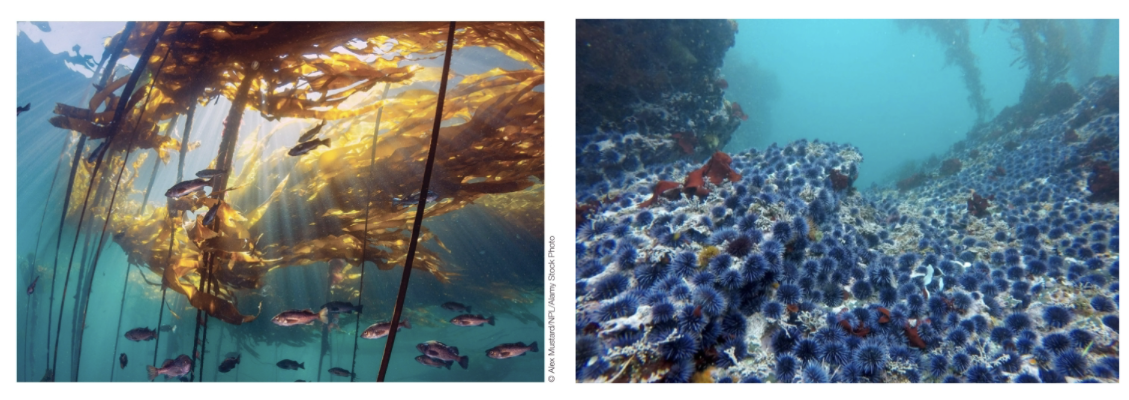
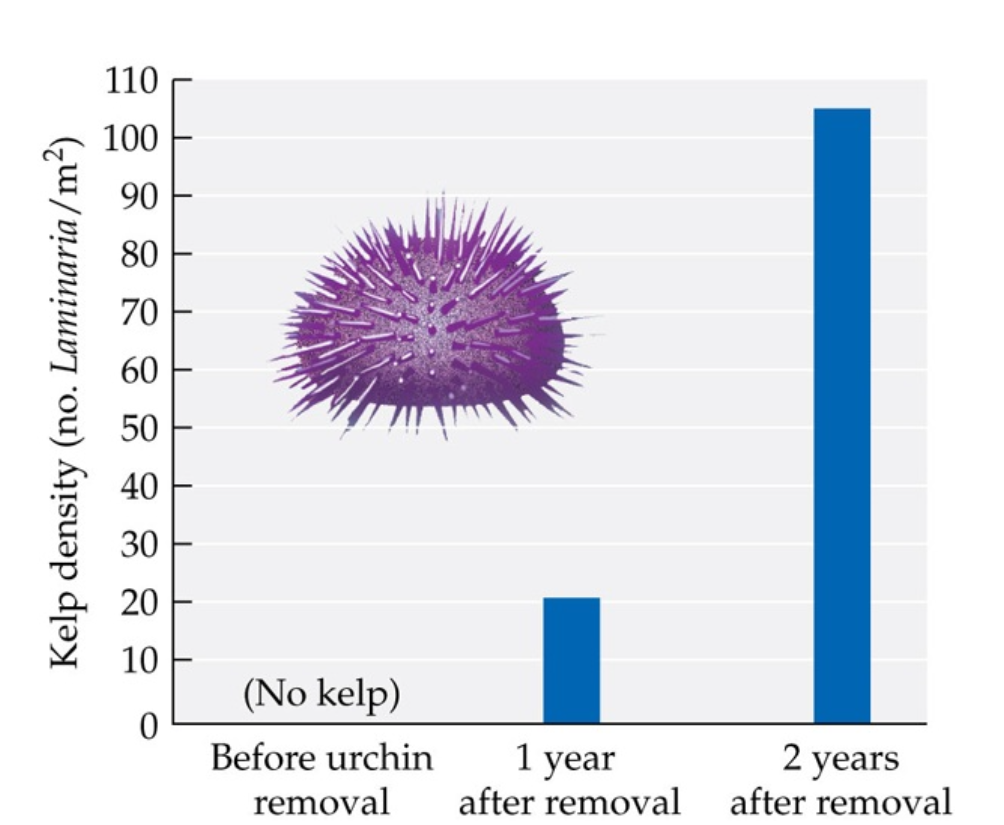
Case Study: Distribution of Kelp Forests
Areas with large numbers of urchins are called “urchin barrens” because they lack kelp forests.
Urchins feed on algae and can significantly reduce kelp populations, leading to ecological imbalances.
This was tested in the Aleutian Islands and along the Alaskan coast. It showed that urchins might determine where kelp forests are located.
Population
A group of individuals of the same species that live in a particular area and interact with one another.
Population Size
Number of individuals
Population Density
Number of individuals per unit area
Distribution
Geographic area where individuals of a species occur
Abundance
Number of individuals in a given area of a specific species or population.
Populations are _____. Distribution and abundance can change over time.
Dynamic
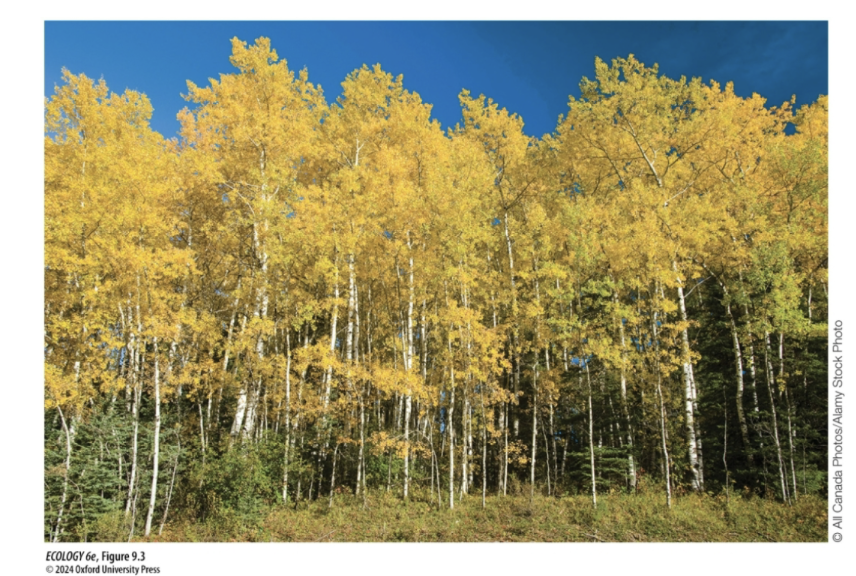
Aspen Groves: One Tree or Many?
Represents multiple different genetic individuals, each established from a seed. However, it is possible to be reproduced asexually from the root buds of a single genetic individual.
Genet
Reproductive units sharing a single identical genotype
Ramet
If members of a genet are independent physiologically, each member is known as a ramet
Absolute Population Size
Actual population abundance
Relative Population Size
Number of individuals in one time period or place relative the number in another
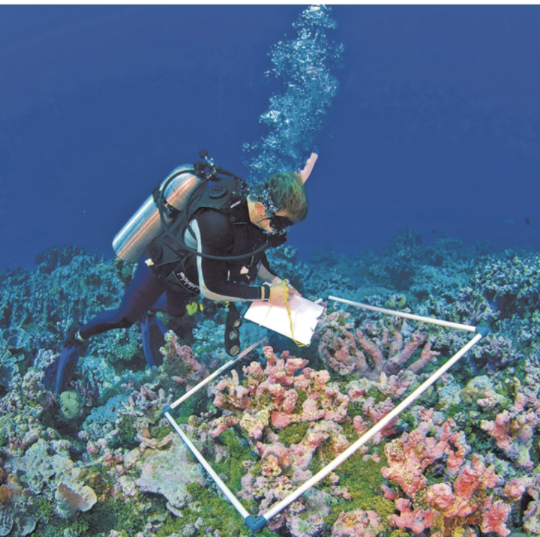
Area-Based Counts
The number of individuals in a given area or volume are counted.
This is used to estimate absolute population sizes of organisms that are sessile (plants) or can move only short distances during the time it takes to count the individuals in a quadrat.
Also for more mobile organisms, such as in aerial surveys…can help provide estimates of relative population sizes.
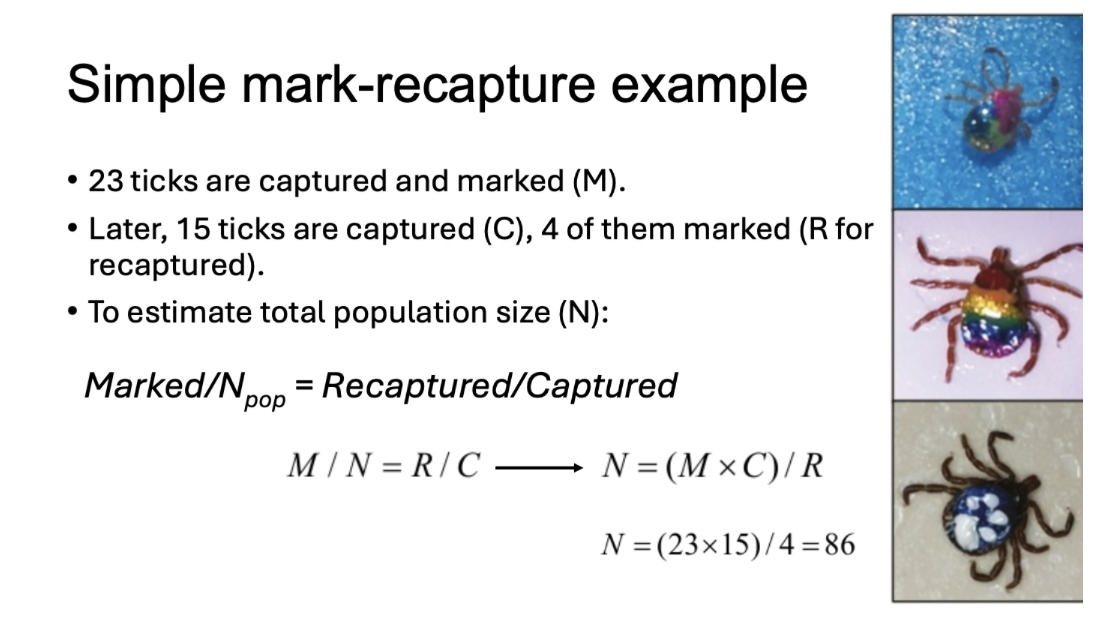
Mark-Recapture
Estimates the absolute population size of mobile organisms, they are also used to obtain data on the survival or movement of individuals.
Formula: Marked/ Pop = Recaptured/Captured
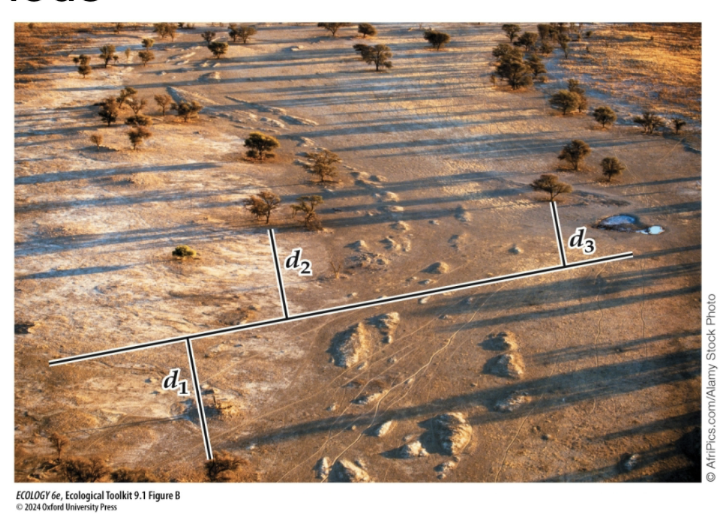
Distance methods: Line transects
In distance methods, an observe measures the distances of individuals seen from a line or a point; these distances are then converted into estimates of the number of individuals per unit of area
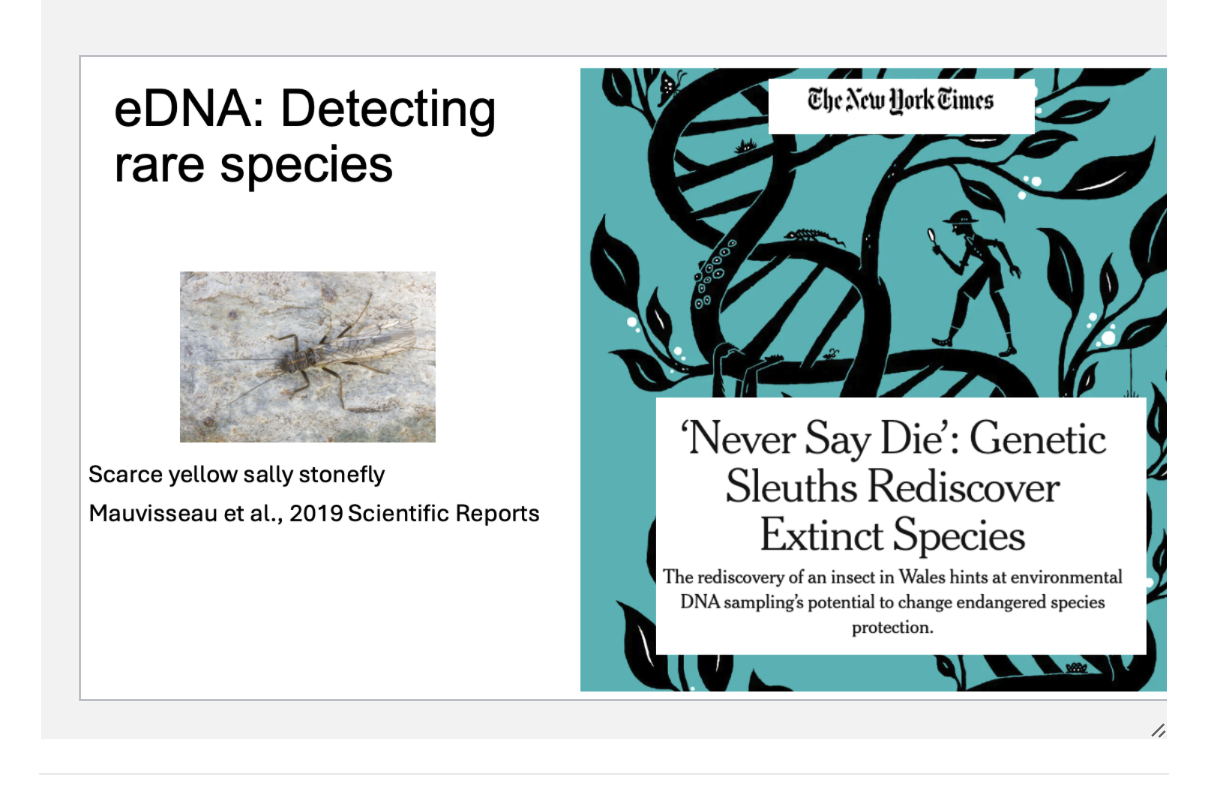
Scarce yellow sally stonefly
This image highlights a fascinating breakthrough in conservation biology: the use of environmental DNA (eDNA) to find species that experts feared were lost forever.
In this specific case, researchers used eDNA to rediscover the Scarce yellow sally stonefly (Isogenus nubecula) in Wales, a species that hadn't been seen in the UK since 1995.
Dispersion
Spatial arrangement of individuals in a population
Types of Dispersion
Regular: individuals are evenly spaced
Random: individuals are randomly spaced
Clumped: most common pattern in nature, where individuals aggregate in patches
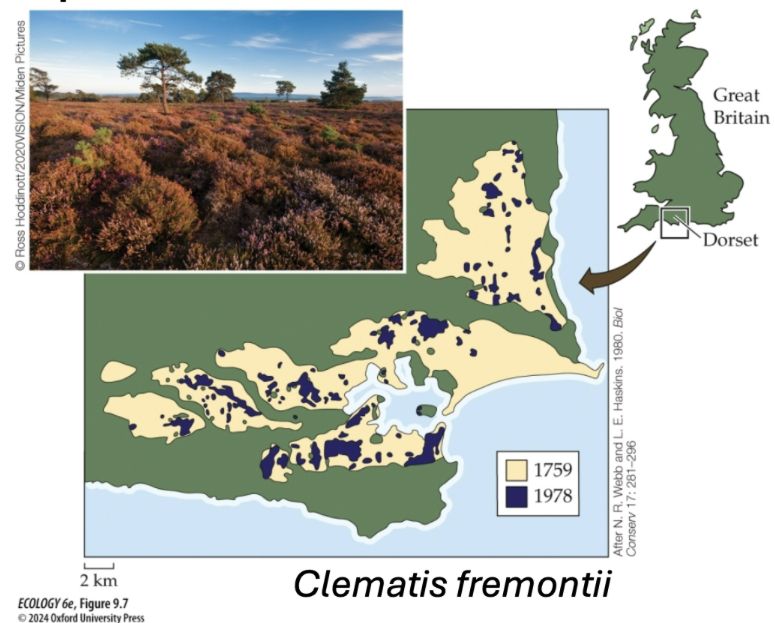
Habitat Fragmentation
the breaking of large, continuous ecosystems into smaller, isolated patches, primarily caused by human activities like road construction, agriculture, and urban development
Ex: Heathlands in England
Species Distribution Model
computer-based tools that predict a species' spatial distribution by linking known occurrences with environmental data like temperature and land cover
Geographic range
includes all the areas a species occupies during all life stages
Case-study: Sex-based conservation plans
Many migratory land birds overwinter in separate place
(i.e., sexual segregation)
Only 8% of conservation plans for North American
landbirds account for sexual segregation, with biases
for male-dominated habitat
In Golden-winged Warblers, females lost twice
as much habitat as males from 2000
Habitat
natural environment of an organism
Habitat suitability depends on a combination of abiotic and
biotic factors
Abiotic: moisture, temperature, pH, sunlight, nutrients, etc.
Biotic: food, predation, competition, herbivory, parasites
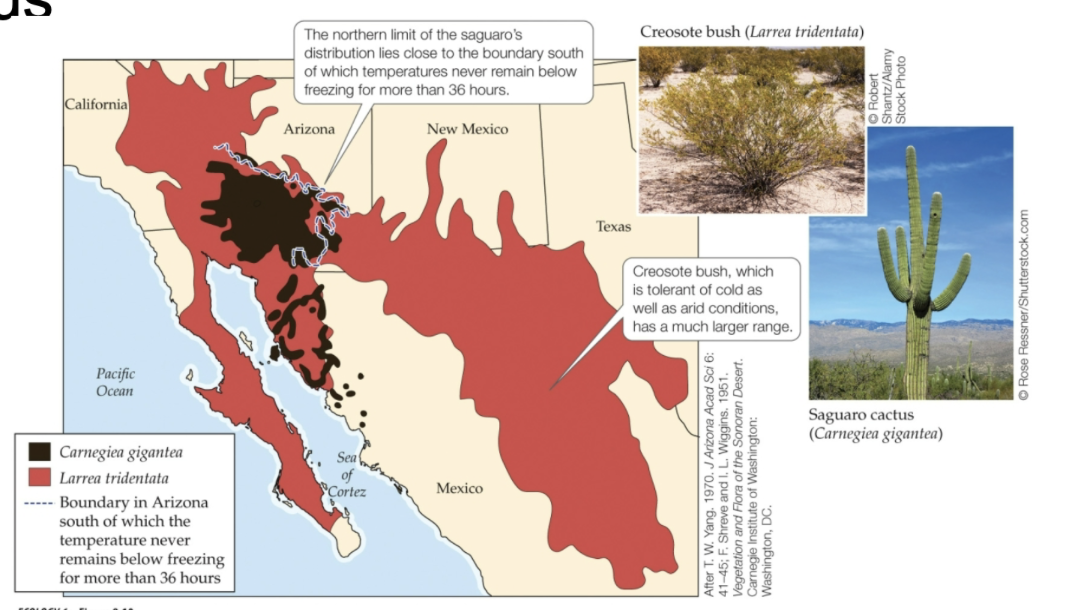
Habitat Suitability: Cresote bush vs Saguaro cactus
The geographic distribution of creosote bush (Larrea tridentata) is much larger than that of saguaro cactus (Carnegiea gigantea).
How does food availability influence habitat suitability
Seychlls warbler
Birds with high-quality territories live longer and produce more young
High quality sites are aggregated toward one end of the island
Dispersion of individuals is clumped as a result
Some species can become invasive and affect distributions
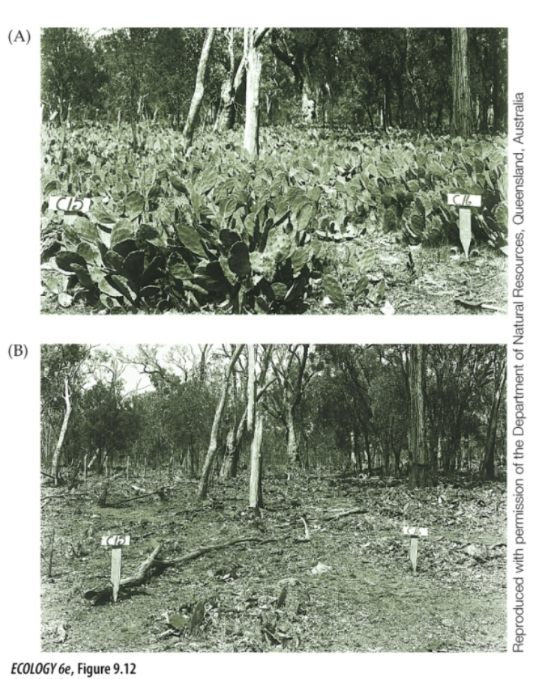
In Australia, an introduced cactus became a pest species
A moth that feeds on cactus was then released
Distribution and abundance of the cactus was been greatly reduced
Cane beetles and invasive species
Released in Queensland to control cane beetles (did not work)
Toads spread southwards and across the northwest of Australia
Harmed Australian wildlife A
Abiotic and biotic features can help determine distribution and abundance
Semiblanus balanoides’ range is restricted by temperature
Competition from other species precludes it from some areas with suitable temperatures
Some species depend on disturbance
Fire frequency can change community composition
Human suppression of fire allows non-fire tolerant species to out compete fire adapted species
Pitch pines (Pinus rigida) in the NJ Pine Barrens:
Serotinous cones only open and shed seeds after fire
Fire clears undergrowth allowing for the pine saplings to dominate
Continental Drift
Alfred Russell Wallace (1860) observed very different animal species on the Philippines and New Guinea, even though they are very close
together.
Relictual distributions
Occur when the range of a formerly widespread species contracts or is fragmented
Ex: Pine Barrens Tree Frogs

