4.1.1 Economic methodology and the economic problem
 Call Kai
 Learn
Learn Practice Test
 Spaced Repetition
 Match
Match Flashcards
 Knowt Play
1/23

Earn XP
Description and Tags
Name | Mastery | Learn | Test | Matching | Spaced | Call with Kai | Chat |
|---|
No analytics yet
Send a link to your students to track their progress
24 Terms
What is economics?
the study of how the world’s scarce resources are allocated to competing uses to satisfy society’s wants
What is a social science?
a type of science that studies society and the relationships within society
What are the similarities and differences with natural sciences?
similarities:
scientific methods
creating models
hypothesis testing
differences:
cannot conduct controlled experiments on a national economy
outcomes are influenced by human behaviour or politics (hard to predict)
What’s the difference between positive and normative statements?
positive statements are objective and can be proven/disproven
normative statements are subjective and contains a value judgement (an opinion) - often includes words like ought, should, better or unfair
How can value judgements influence economic decision making and policy?
they reflect what policy makers believe is right/fair
economists often use facts (positive) to support opinions (normative)
different economists may make different judgements from the same statistic
How are people’s views concerning the best option influenced?
by the positive consequences of different decisions and by moral and political judgements
What is the central purpose of economic activity?
the production of goods and services to satisfy needs and wants
What are the key economic decisions?
what to produce?
how to produce?
who is to benefit from the goods and services produced?
what are the factors of production (economic resources)?
CAPITAL - man-made physical equipment used to make other goods and services (e.g. machinery and computer equipment)
ENTERPRISE - entrepreneurs take business risks in combining the other FOP in order to produce a good or service
LAND - naturally occurring resources (e.g. fertile land, minerals, water, oil)
LABOUR (human capital) - people involved in production
what kind of resource is our environment?
scarce as there’s only a limited amount of resources on the plant (renewable and non-renewable)
what is the fundamental economic problem?
scarcity which results from unlimited wants and finite resources
what does scarcity mean in terms of allocating resources?
means choices have to be made about how scarce resources are allocated between different uses
what is an opportunity cost?
the cost of the next best alternative forgone (given up) when a choice is made
do choices have an opportunity cost?
yes
what is a trade-off?
occurs when you have to choose between conflicting objectives because they can’t all be achieved at the same time and involves compromising
(to do more of one, you have to do less of the other)
what does a production possibility curve (PPC) show?
the maximum combinations of two goods or services that can be produced by an economy assuming all resources are fully and efficiently employed
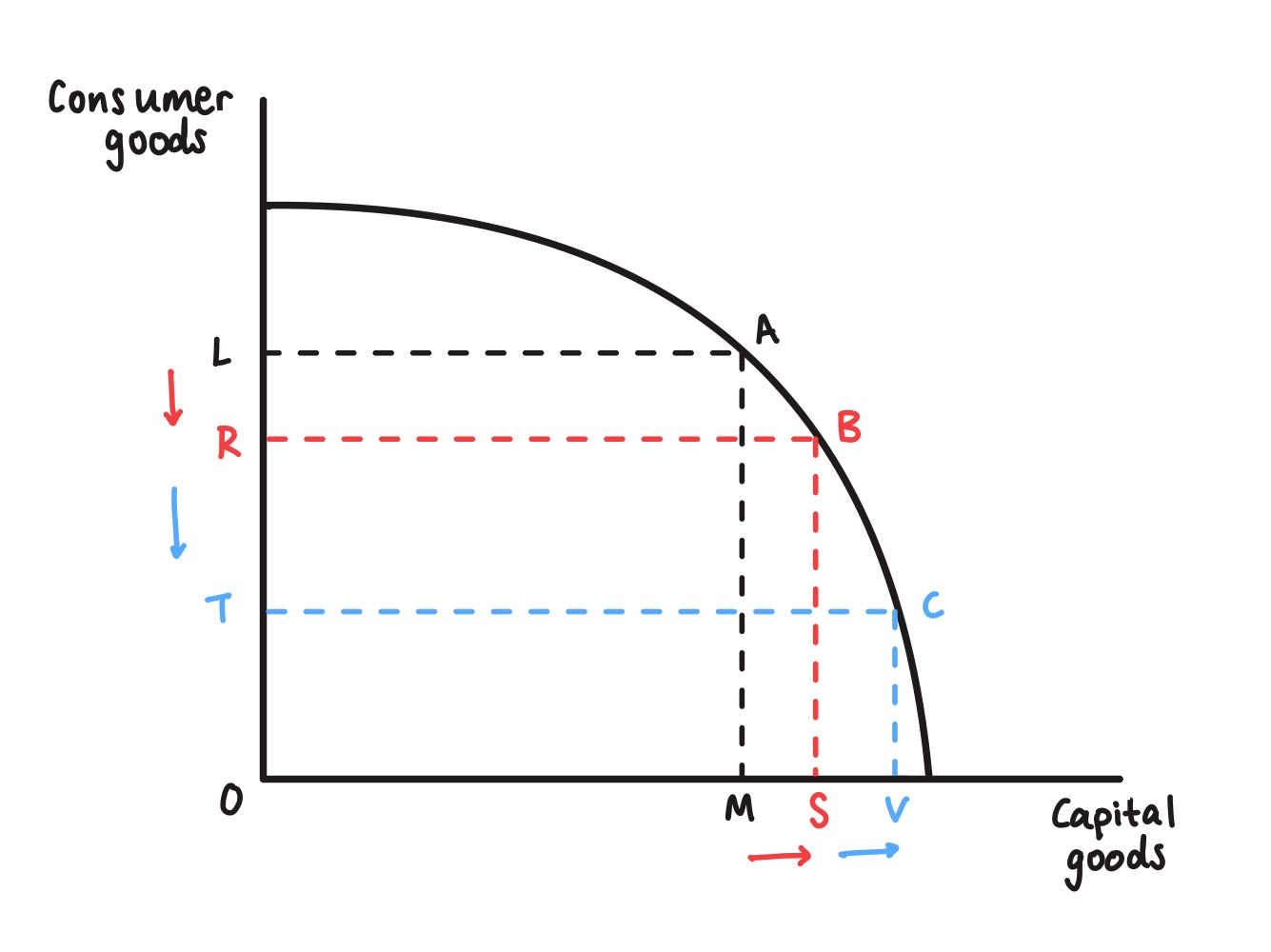
how does the PPF diagram show opportunity cost?
as more capital goods are produced, more consumer goods must be given up
an increase in the amount of capital goods from OM to OS leads to a loss of output of consumer goods from OL to OR
a subsequent increase in the production of capital goods from OS to OV leads to a proportionately larger fall in production of consumer goods from OR to OT
how is economic growth shown on the PPF? (draw diagram)
by an outward shift
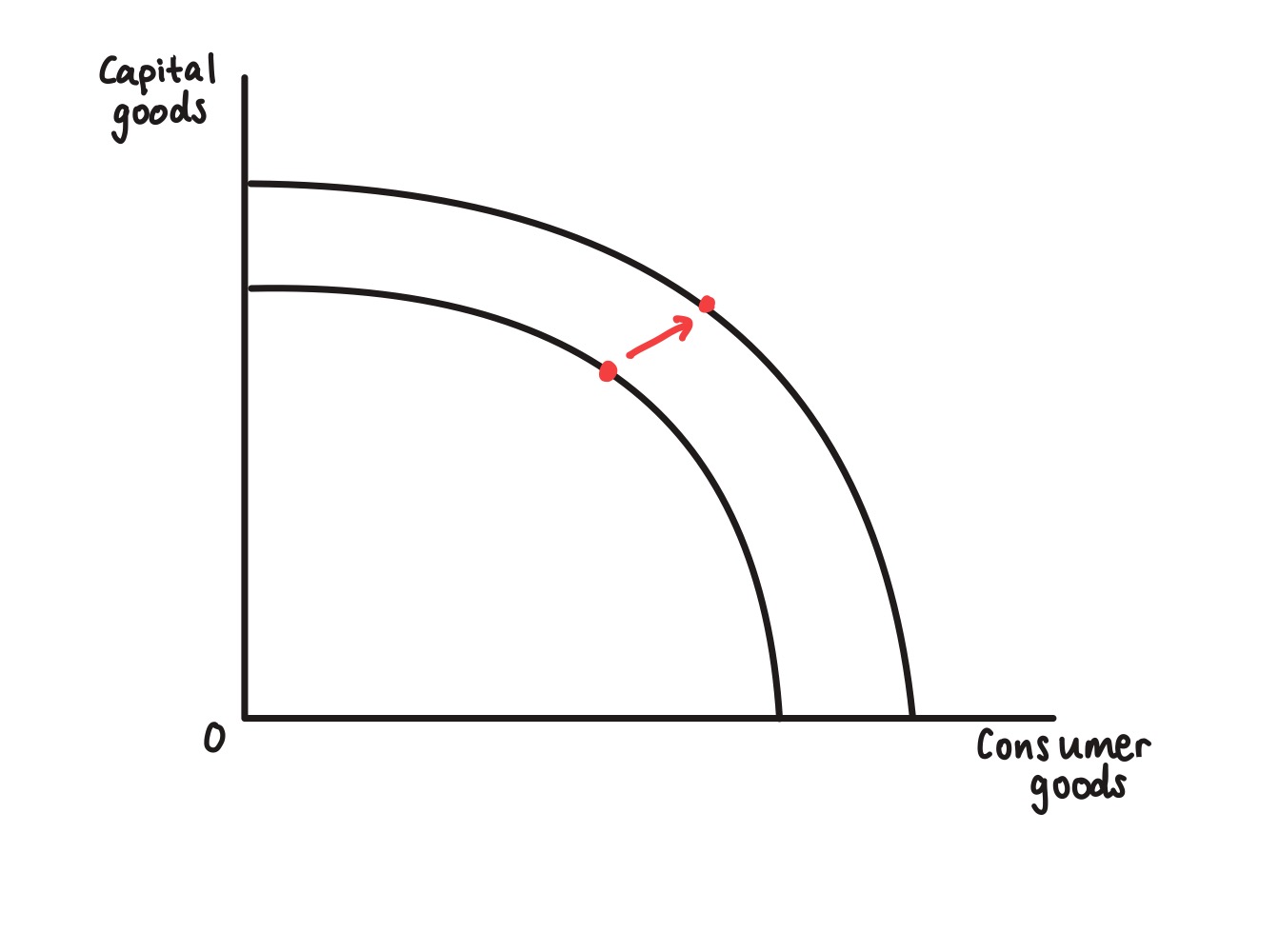
what are the factors causing an outward shift of the PPC?
technological improvements that lead to increased productivity of capital equipment
discovery of new resources (e.g. oil and gas)
improvements in education and training that lead to a more productive workforce
changes that lead to an increase in working population (e.g. increases in immigration or retirement age)
what are the factors causing an inward shift of the PPC?
natural disasters that devastate productive resources
wars
global warming/ climate change → may lead to loss of farmland, rising sea levels and more extreme weather
prolonged recession → permanent loss of productive capacity if businesses close down / workers lose skills
what is productive efficiency?
occurs when production takes place at the lowest possible cost, meaning no more output can be produced from the given output
what’s allocative efficiency?
occurs when resources are allocated in a way that maximises, meaning we are producing the specific combination of goods that people want most
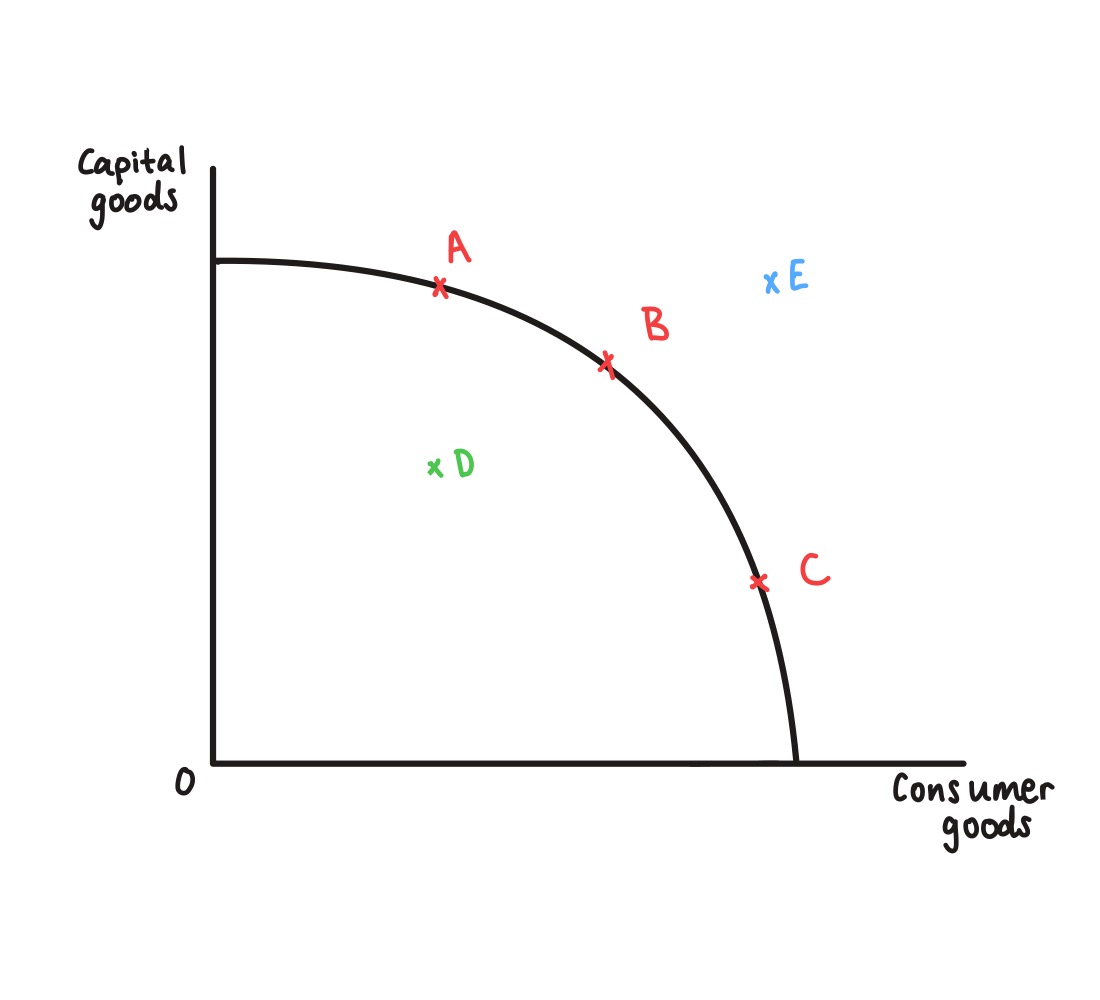
what do all the points of the PPF diagram represent?
A,B, and C - all points on the PPF are productively efficient
D - inefficient, resources are underused (unemployment of economic resources)
E - unattainable w/ current resources
why are all points on the boundary are productively efficient but not all allocatively?
productively efficient because all resources are used as efficiently as possible to produce the maximum possible output
not allocatively efficient because not all points will reflect the production of goods that people want or need
(e.g. all resources used produce vehicles might not match society’s need for houses)