BIO 120 Test 3
5.0(1)
Studied by 3 people Call Kai
 Learn
Learn Practice Test
 Spaced Repetition
 Match
Match Flashcards
 Knowt Play
Card Sorting
1/23

Earn XP
Description and Tags
Last updated 12:26 AM on 3/10/23
Name | Mastery | Learn | Test | Matching | Spaced | Call with Kai |
|---|
No analytics yet
Send a link to your students to track their progress
24 Terms
1
New cards
Which of the following statements best describes metabolism in \n its entirety in all organisms?
Metabolism consists of all the energy transformation reactions \n in an organism.
2
New cards
Which of the following statements best describes the first law of \n thermodynamics?
Energy cannot be created or destroyed.
3
New cards
Which of the following statements best describes a primary \n mechanism by which the energy released in ATP hydrolysis is \n used directly to drive endergonic chemical reactions in a cell?
The released phosphate is used to form phosphorylated \n intermediates that are more reactive than the original \n phosphorylated substrate.
4
New cards
What is the main carrier of energy for metabolic work in cells?
ATP
5
New cards
Crossing over of chromosomes normally takes place during which of the \n following processes?
Meiosis I
6
New cards
A particular organism has 46 chromosomes in its karyotype. \n Which of the following statements is correct regarding this \n organism?
It produces gametes with 23 chromosomes
7
New cards
Which diagram represents anaphase I of meiosis?
I
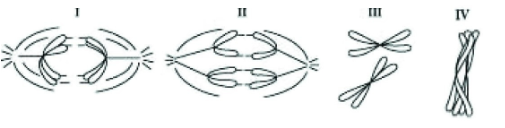
8
New cards
In addition to activating or inhibiting enzymes through allosteric \n regulation, which of these mechanisms do cells also use to \n control enzymatic activity?
localization of enzymes into specific organelles or membranes
9
New cards
Many diploid organisms produce haploid gametes for \n reproduction. Which of the following best describes how the \n diploid number of chromosomes is restored in the offspring of \n these organisms?
fertilization combines chromosomes from each parent into \n resulting zygote
10
New cards
Disruption of the active site of an enzyme would most likely result in which \n of the following?
A decreased ability of the enzyme to bind substrates.
11
New cards
Energy of activation can be decreased by?
Enzymes
12
New cards
Which of the following processes occur during meiosis but not \n mitosis?
Diploid cells form haploid cells.
13
New cards
Which of the below are differences between meiosis I and \n meiosis II?
Meiosis I increases genetic variability while meiosis II creates \n haploid cells.
14
New cards
What number and types of chromosomes are found in a human somatic cell?
44 chromosomes & 2 sex chromosomes
15
New cards
Which of the following would be unlikely to contribute to the substrate specificity of an enzyme?
the enzyme has an allosteric regulatory site
16
New cards
Which statement about the binding of enzymes and substrates is correct?
when substrate molecules bind to the active site of the enzyme, the enzyme undergoes a slight change in shape
17
New cards
Which of the following is NOT a way in which an enzyme can speed up the reaction that it catalyzes?
The active site can provide heat from the environment that raises the energy content of the substrate
18
New cards
Which of the following statements about the role of ATP in cell metabolism is true?
The energy from the hydrolysis of ATP may be directly coupled to endergonic processes by the transfer of the phosphate group to another molecule
19
New cards
Catabolic Pathways:
release energy by breaking down complex molecules into simpler compounds
20
New cards
Anabolic pathways:
consume energy to build complex molecules from simpler ones
21
New cards
What is Gibbs Free energy?
the portion of a system’s energy that can do work when temperature and pressure are uniform throughout the system, as in a living cell
22
New cards
Exergonic reaction
“energy outward” // proceeds with a net release of free energy to the surroundings
23
New cards
Endergonic reaction
“energy inward” // absorbs free energy from the surroundings
24
New cards
What is an allosteric regulation
occurs when a regulatory molecule binds to a protein at one site and affects the protein’s function at another site

