PSYCH 2AA3 IS LANGUAGE UNIQUE TO HUMANS?
 Call Kai
 Learn
Learn Practice Test
 Spaced Repetition
 Match
Match Flashcards
 Knowt Play
1/16

There's no tags or description
Looks like no tags are added yet.
Name | Mastery | Learn | Test | Matching | Spaced | Call with Kai |
|---|
No analytics yet
Send a link to your students to track their progress
17 Terms
Behaviourist Perspective
Skills are acquired through classical and operant conditioning principles
Infants and children imitate waht they hear —> rewarded for using words correctly with attention, smiles, conversation, help accomplish goals
Infants and children do not receive reward if they do not speak
Behavioursit perspective: limitations
Cannot explain novel combinations and uses of words
Tiger age 5: I know two swear words that start with s
Canot explain underextension and overextension
Parents rarely correct grammar of their children
Nativist Perspective
Noam Chomsky 1957
Humans are born with neural circuits that allow for the acquisition of grammar, the language acquisition device
Semantic bootstrapping theory: brain is ready to categorize the world into nouns (people/things) and verbs (actions)
This innate knowledge about the world allows for language acquisition
Universal grammar: every language has sibject, verb, and object. This system allows infants to acquire grammar with minimal guidance
Bootstrapping
Using existing resources to benefit you
Semantic bootstrapping: if you already know that words tend to be things and actions, you can use this knowledge to learn new words
Support for Universal Grammar
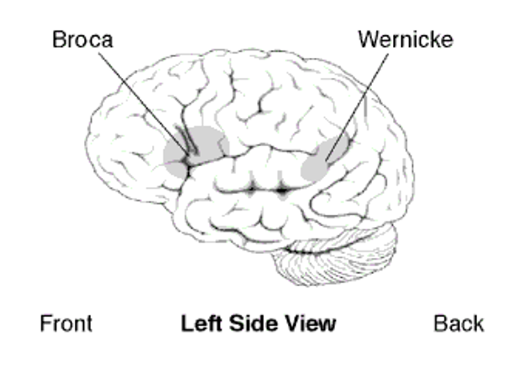
Specific brain regions for processing language including grammar
Only humans learn grammar readily
Children develop language with little/no formal input
Critical period for learning
Development of grammar is tied to the development of vocabulary
Damage to Brain Regions
Broca’s aphasia: difficulty with speech production
Wernicke’s aphasia: difficulty with meaningful speech or fluent aphasia
Words are flowing but without meaning
In healthy brains, two areas work in unison to produce meaningful speech
Animal Communication
Animals have a veriety of communicative methods
Vervet monkeys have different alarm calls to signal approach of leapords, eagles, or snakes
Apes and Sign Language
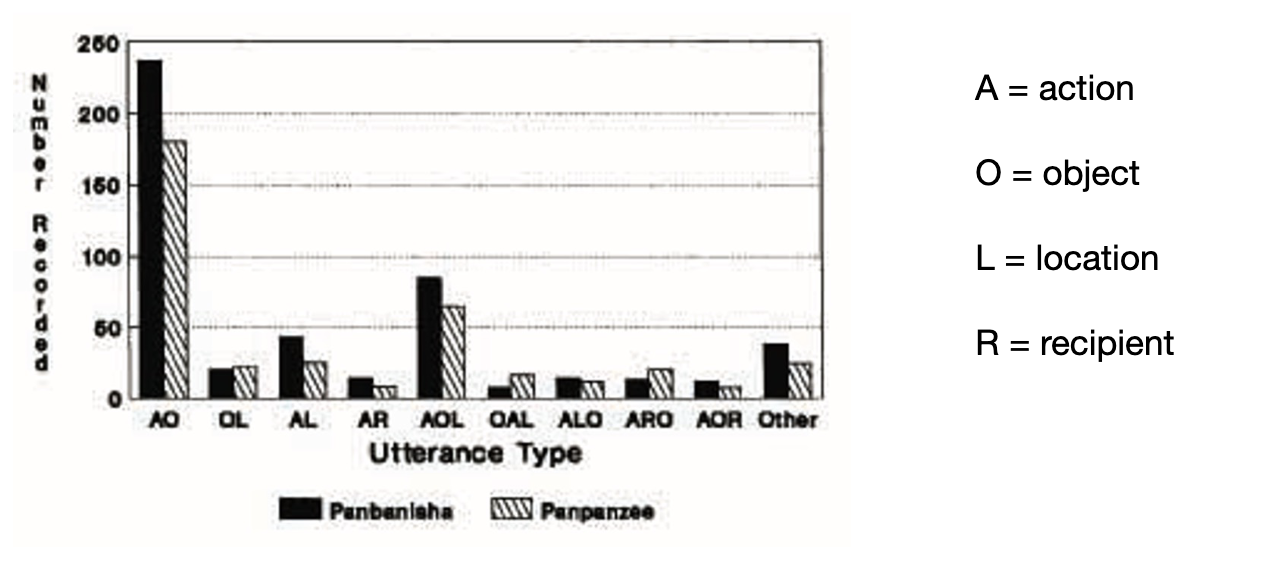
many efforts 1970s, to teach apes language (e.g Dr Sue Savage Rumbaugh)
Sign language or the use of lexicons (symbols) because their vocal apparatus does not provide fine control over voice
Smartest bonobo ape, Kanzi learned hundred of lexicons and could understand and produce english words
Bonobos use 2-word sentences
Is language unique to humans
Yes!
Non human animals can learn words as in associations between symbols and actual things/actions (one to one mapping)
No animal has shown mastery of syntax
By 4 years, children use syntax correctly without explicit instruction
Kanzi’s mastery of language is said to be about a 3yr olds level
Children learn grammar: soundless environment
Sing language has a morphology and syntax (not just symbols)
Babies learn sign language from their deaf parents in the same way as hearing children who learn spoken language
Begins with babbling (waving around of hands/fingers), then 1 eord signs, and eventually 2-3 word utterances (3 word utterance has proper syntac)
If modality does not matter, seems to support innate LAD
Children learn grammar: Lack of vision
Blind Children go through same developmental steps of acquiring language as sighted children
Interesting differences in interpretation
Eg “Look up!”
Blindfolded typical infants will tilt their head up
Blind infants will raise their hands up in the air
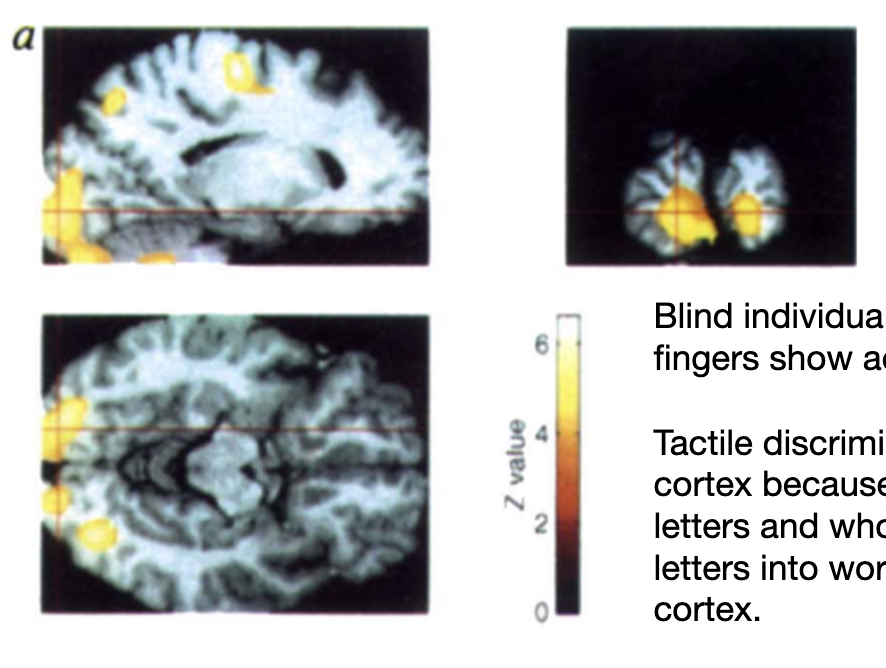
Sadato et al. (1996)
Blind individuals reading Braille with thier fingers show activation in the visual cortex
Tactile discrimination activates visual cortex bc fine discriminations of letters and wholistic interpretation of letters into words is best served by visual cortex
4. Critical/Sensitive Periods
Recall the stories of the wild boy of Aveyron and Genie
Isabelle a 6yr old was also rescued from deprivation but one year later was speaking as well as her peers
Inability to learn langauge after 13-14 years of deprivation suggests innate LAD
5. Vocabulary and Grammar
Children not only learn new words, but learn the position of words simultaneously
“You do it”, not “Do it you
Billingual children’s vocabulary and grammar are correlated within each language but not across languages
Billingual children do not confuse the grammar of two languages
Cognitive Perspective
Cognitive development allows infants and children to extract statistical regularities from their perceptual environment
Statistical inference is a manifestation of powerful cognitive abilities not a universal grammar
Evidence: Infants’ vocabulary improves as memory improves
Limitation: cannot explain WIlliams syndrome (low intelligence but high verbal ability
Social Perspective
Children master language in the context of social interactions
Note: Adults learn a new language best when their new gf/bg is a native speaker of that language (motivation)
Can incorporate behaviourist, nativist, and cognitive perspectives
Provides a different level of analysis

