bio - neurons
 Call Kai
 Learn
Learn Practice Test
 Spaced Repetition
 Match
Match Flashcards
 Knowt Play
1/13

There's no tags or description
Looks like no tags are added yet.
Name | Mastery | Learn | Test | Matching | Spaced | Call with Kai |
|---|
No analytics yet
Send a link to your students to track their progress
14 Terms
define membrane potential, resting potential and action potential:
membrane potential: the voltage that every cell has across its membrane
resting potential: voltage of a neuron not sending signals
action potential: all or none signal, potential for the neuron to fire.
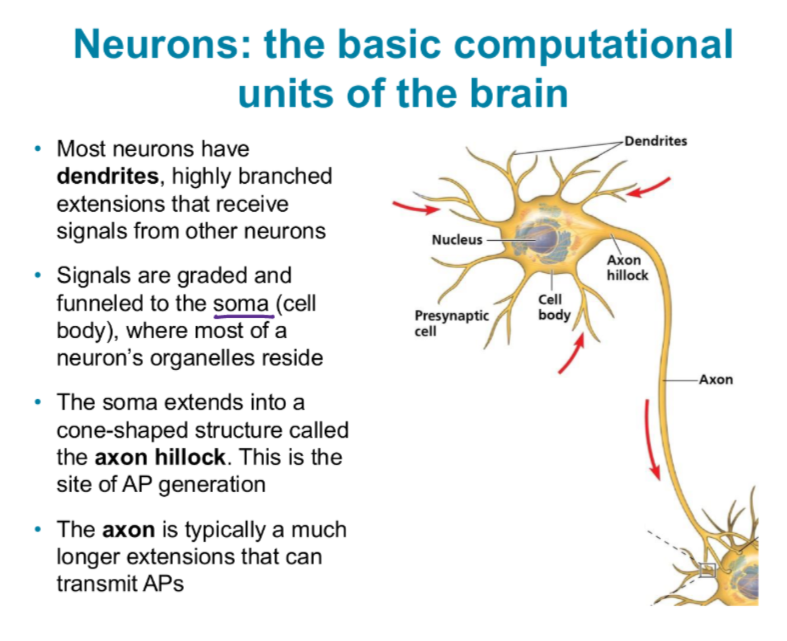
describe the structure of a neuron:
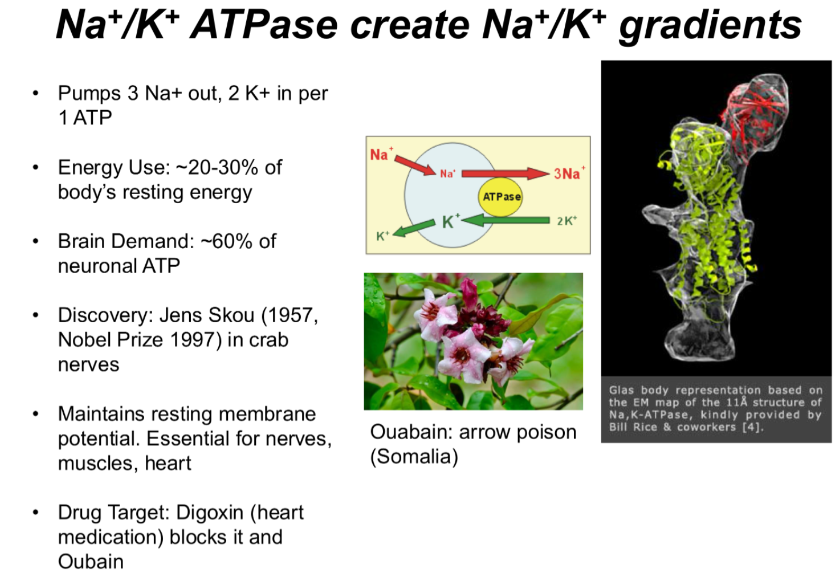
describe how the neurons use a Na+/K+ ATPase pump?
so, neurons need and electrochemical gradient of ions to work. They transport 3 sodium ions out of the cell and 2 potassium ions into the cell, using ATP. This creates a negative electrochemical gradient.
It keeps the neuron ready to fire by establishing the gradient, making the inside more negative than positive.
After the neuron fires, the pump restores the action potential, by recharging the ion gradient.
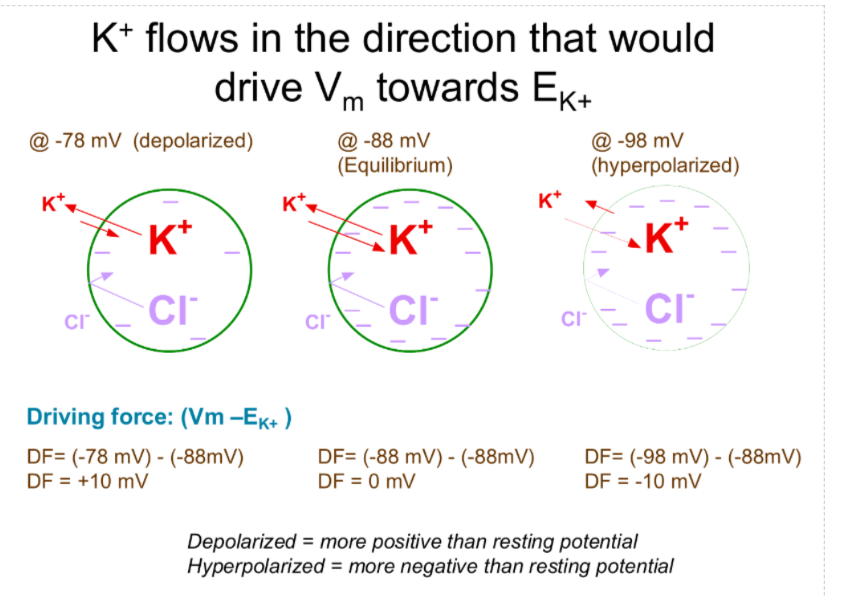
explain how the concentration gradient drives K ion flow:
inside the cell the [K+] is higher and outside is lower, they go in and out through channels of the cell. As K+ leaves, the cell becomes more negatively charged, creating an electrical force , which pulls the K+ ions back in. The force that pulls K out and the force that pulls K in cancel out, creating an equilibrium potential.
The 2 forces are electrical and chemical forces
The cell becomes more negative also because of the negative charges of Cl-
![<p>inside the cell the [K+] is higher and outside is lower, they go in and out through channels of the cell. As K+ leaves, the cell becomes more negatively charged, creating an <strong>electrical force </strong>, which pulls the K+ ions back in. The force that pulls K out and the force that pulls K in cancel out, creating an <strong>equilibrium potential.</strong></p><p>The 2 forces are electrical and chemical forces</p><p>The cell becomes more negative also because of the negative charges of Cl-</p>](https://assets.knowt.com/user-attachments/a3a08e81-f31d-4d4a-8ceb-83488c2345ad.png)
explain what the driving force is:
The driving force is the difference between the point the ion is and the point where it wants to be.
there is a point that the ion wants to be at. This is the Ek+ (upper bar). And the ion can be super low, at the medium or high of the graph.
If it is high up, then the DF will be really low because it wont want to change. This is hyperpolarized type. It will have -10mv ganas de moverse porque esta cerca a su goal.
If its at the point where it wants to be, then it will have 0V ganas de moverse, porque ya esta en mejor espacio, y no hay razon que se moveria a un lugar que no le conviene. This is equlibrium.
Finally, if its at a really bad place, it will want to move up. then they have +10mV ganas de moverse para arriba, entonces van a estar depolarized
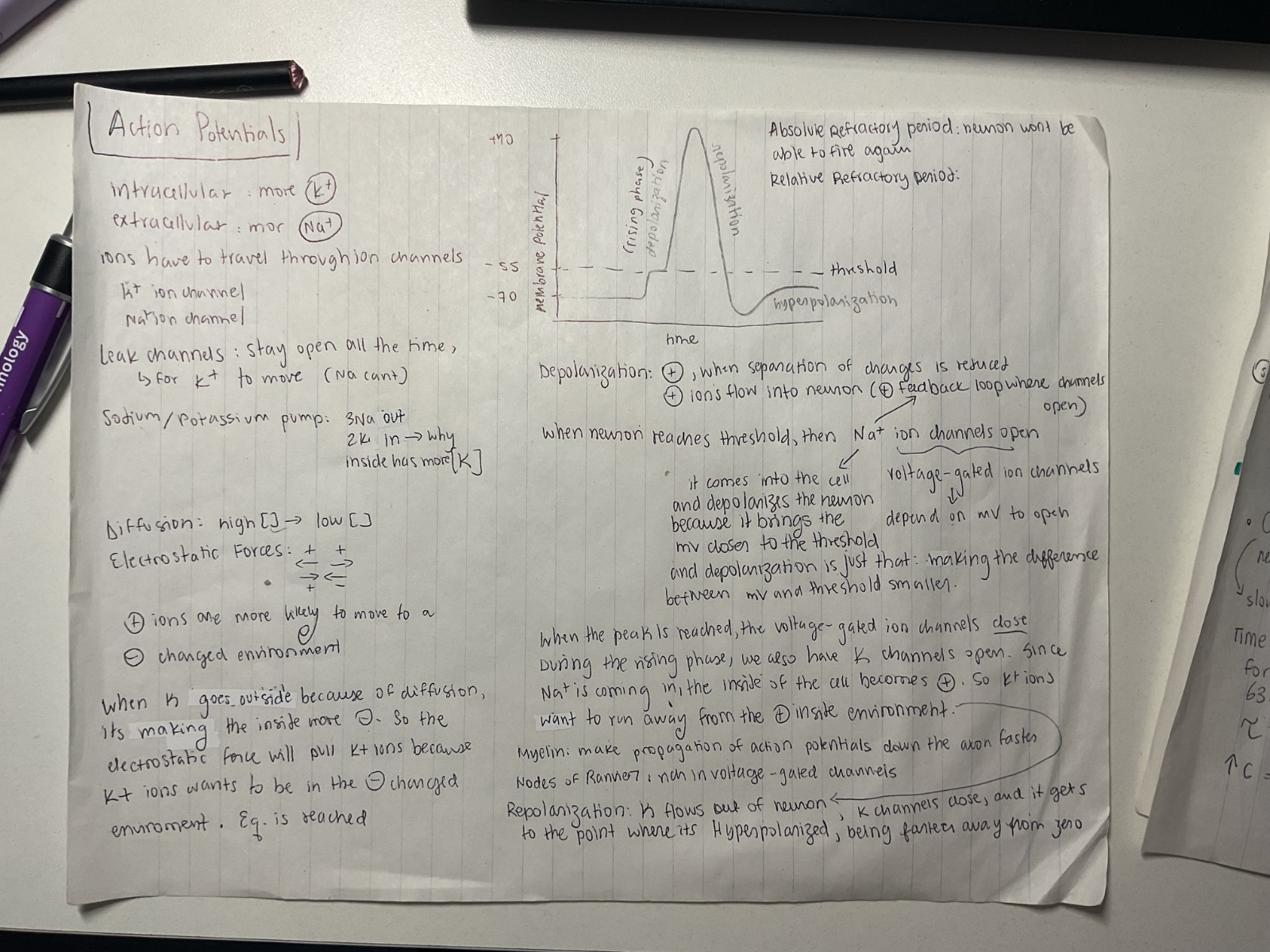
describe the difference between depolarization and hyperpolarization
depolarization: when the Na+ channels are activated, the Na+ ions come into the cell, making the cell more positively charged. The charge difference between the inside and out gets smaller thanks to that. Its a positive feedback loop: the more Na ions come in, the more channels open and the more channels open, the more Na ions come in. And this makes the cell more positive
hyperpolarization: because positive ions leave, the inside of the cell is made more negatively charged. The difference between outside and inside is bigger, more channels open to let K+ ions outside, and the inside becomes more negative.
talk about the process of action potential:
talk about the 2 passive properties of neurons: resistance and capacitance and time constant
Resistance: V=IR, its how hard it is for ions to cross membranes
Capacitance: the ability of a neuron membrane to store charge. This one slows down changes in membrane voltage.
Time constant: time taken for a cell voltage to reach 65% of its final value. It is RxC, a higher capacitance, then a slower response.
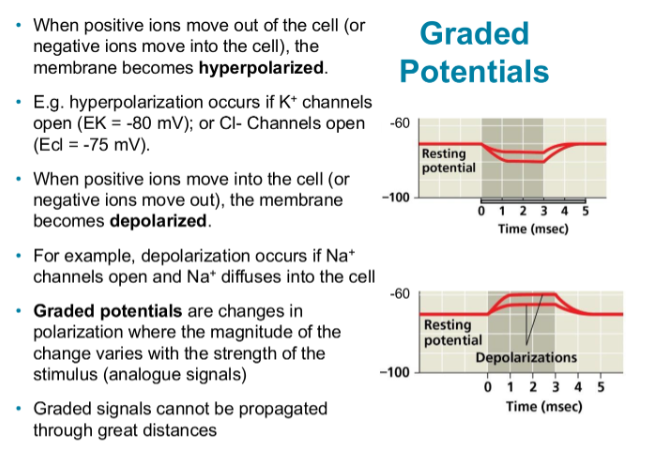
explain what graded potentials are:
they are basically changes in the membrane potentia, either more or less. Their size depends on strength and duration of stimulus.
it can either be depolarizing ( +, Na+ inters) or hyperpolarizing (-, K+ leaves)
Explore top notes

