chromosomes and cytogenetics

0.0(0)
studied byStudied by 0 people
0.0(0)
call with kaiCall with Kai
learnLearn
examPractice Test
spaced repetitionSpaced Repetition
heart puzzleMatch
flashcardsFlashcards
GameKnowt Play
Card Sorting

1/13

encourage image

There's no tags or description

Looks like no tags are added yet.

Last updated 11:34 AM on 2/2/26
Name
Mastery
Learn
Test
Matching
Spaced
Call with Kai

No analytics yet

Send a link to your students to track their progress

14 Terms
1
New cards
<p>chromatin</p>

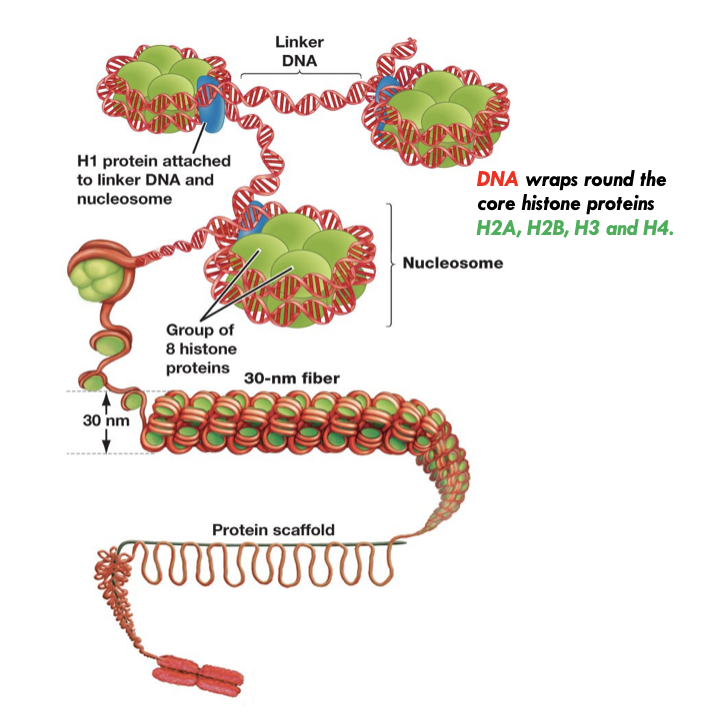
chromatin

  • In chromosomes, DNA is compacted by forming complexes with histone proteins 

  • Most condense form 

  • Can exist at euchromatin or heterochromatin 

  • Occurs during metaphase 

  • Regulated by interaction with histone proteins 

    • Wraps around twice 

    • Forms a nucleosome 

    • Can form a 30 nm fibre 

    • 30 nm fibre loops around a protein scaffold 

2
New cards

euchromatin

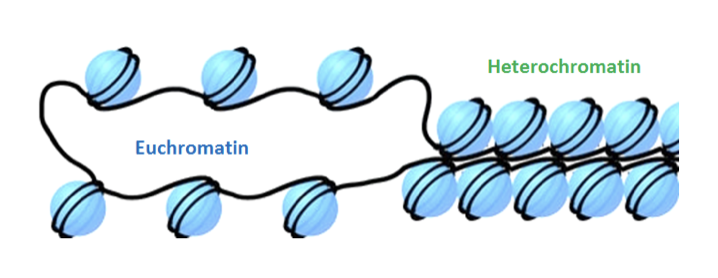
  • Most of the genome is in the form of 'euchromatin' 

  • The degree of compaction varies and can be very dynamic 

    • Can regulate association with H1, which in turn regulates rate of gene transcription 

  • Contains all of the genes 

  • Forms 90% of chromosomes 

<ul><li><p class="Paragraph SCXO7664486 BCX4" style="text-align: left;"><span style="background-color: inherit; line-height: 19.55px; color: windowtext;"><span>Most of the genome is in the form of 'euchromatin'</span></span><span style="line-height: 19.55px; color: windowtext;"><span>&nbsp;</span></span></p></li><li><p class="Paragraph SCXO7664486 BCX4" style="text-align: left;"><span style="background-color: inherit; line-height: 19.55px; color: windowtext;"><span>The degree of compaction varies and can be very dynamic</span></span><span style="line-height: 19.55px; color: windowtext;"><span>&nbsp;</span></span></p><ul><li><p class="Paragraph SCXO7664486 BCX4" style="text-align: left;"><span style="background-color: inherit; line-height: 19.55px; color: windowtext;"><span>Can regulate association with H1, which in turn regulates rate of gene transcription</span></span><span style="line-height: 19.55px; color: windowtext;"><span>&nbsp;</span></span></p></li></ul></li><li><p class="Paragraph SCXO7664486 BCX4" style="text-align: left;"><span style="background-color: inherit; line-height: 19.55px; color: windowtext;"><span>Contains all of the genes</span></span><span style="line-height: 19.55px; color: windowtext;"><span>&nbsp;</span></span></p></li><li><p class="Paragraph SCXO7664486 BCX4" style="text-align: left;"><span style="background-color: inherit; line-height: 19.55px; color: windowtext;"><span>Forms 90% of chromosomes</span></span><span style="line-height: 19.55px; color: windowtext;"><span>&nbsp;</span></span></p></li></ul><p></p>
3
New cards

heterochromatin

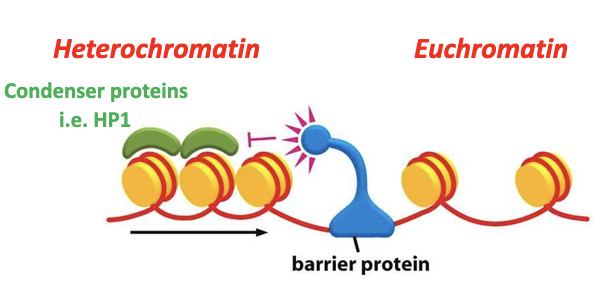
  • A smaller proportion of human chromosomes is in the form of heterochromatin, where the chromatin is more permanently compacted 

  • Forms via condenser proteins 

  • Not dynamic (cannot reverse compactness) 

  • Barrier elements recruit barrier proteins 

    • Prevent heterochromatin spilling into euchromatin 

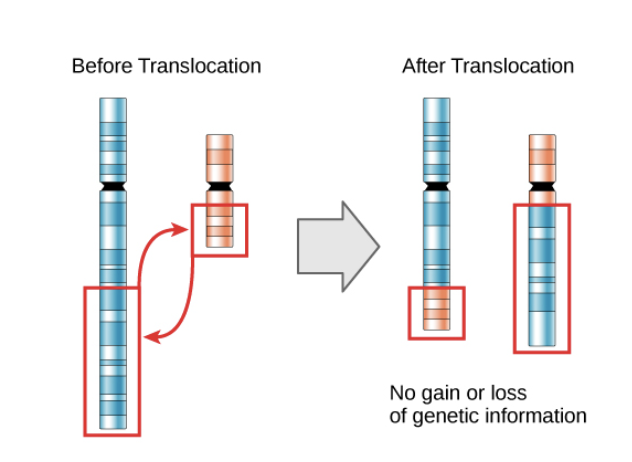
    • Can be lost following a chromosomal translocation 
<ul><li><p class="Paragraph SCXO231891875 BCX4" style="text-align: left;"><span style="background-color: inherit; line-height: 19.55px; color: windowtext;"><span>A smaller proportion of human chromosomes is in the form of heterochromatin, where the chromatin is more permanently compacted</span></span><span style="line-height: 19.55px; color: windowtext;"><span>&nbsp;</span></span></p></li><li><p class="Paragraph SCXO231891875 BCX4" style="text-align: left;"><span style="background-color: inherit; line-height: 19.55px; color: windowtext;"><span>Forms via condenser proteins</span></span><span style="line-height: 19.55px; color: windowtext;"><span>&nbsp;</span></span></p></li><li><p class="Paragraph SCXO231891875 BCX4" style="text-align: left;"><span style="background-color: inherit; line-height: 19.55px; color: windowtext;"><span>Not dynamic (cannot reverse compactness)</span></span><span style="line-height: 19.55px; color: windowtext;"><span>&nbsp;</span></span></p></li><li><p class="Paragraph SCXO231891875 BCX4" style="text-align: left;"><span style="background-color: inherit; line-height: 19.55px; color: windowtext;"><span>Barrier elements recruit barrier proteins</span></span><span style="line-height: 19.55px; color: windowtext;"><span>&nbsp;</span></span></p><ul><li><p class="Paragraph SCXO231891875 BCX4" style="text-align: left;"><span style="background-color: inherit; line-height: 19.55px; color: windowtext;"><span>Prevent heterochromatin spilling into euchromatin</span></span><span style="line-height: 19.55px; color: windowtext;"><span>&nbsp;</span></span></p></li><li><p class="Paragraph SCXO231891875 BCX4" style="text-align: left;"><span style="background-color: inherit; line-height: 19.55px; color: windowtext;"><span>Can be lost following a chromosomal translocation</span></span><span style="line-height: 19.55px; color: windowtext;"><span>&nbsp;</span></span></p></li></ul></li></ul><p></p>
4
New cards
<p>spilling of heterochromatin</p>

spilling of heterochromatin

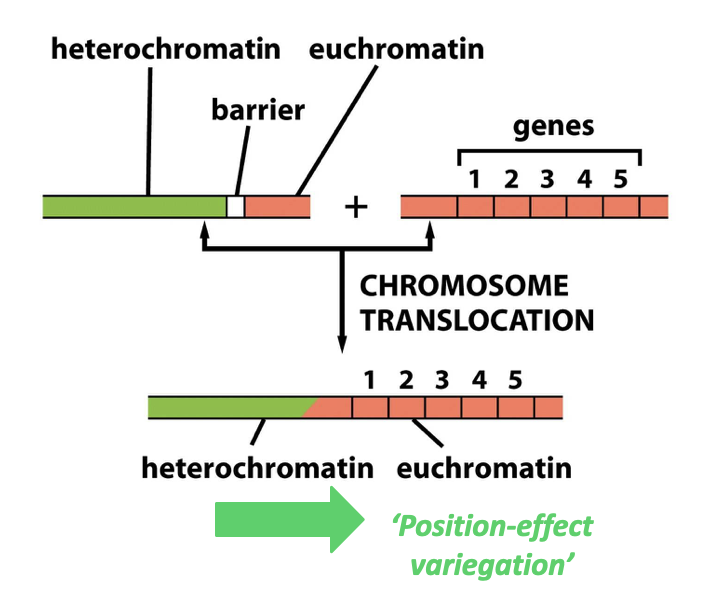
  • If heterochromatin spills = position effect variegation 

  • Shuts off all the genes in the euchromatin 

  • Heterochromatin has a tendency to spread (e.g. into neighbouring euchromatic regions) 

    • Molecular mechanisms exist to prevent this 
<ul><li><p class="Paragraph SCXO61298204 BCX4" style="text-align: left;"><span style="background-color: inherit; line-height: 19.55px; color: windowtext;"><span>If heterochromatin spills = position effect variegation</span></span><span style="line-height: 19.55px; color: windowtext;"><span>&nbsp;</span></span></p></li><li><p class="Paragraph SCXO61298204 BCX4" style="text-align: left;"><span style="background-color: inherit; line-height: 19.55px; color: windowtext;"><span>Shuts off all the genes in the euchromatin</span></span><span style="line-height: 19.55px; color: windowtext;"><span>&nbsp;</span></span></p></li><li><p class="Paragraph SCXO61298204 BCX4" style="text-align: left;"><span style="background-color: inherit; line-height: 19.55px; color: windowtext;"><span>Heterochromatin has a tendency to spread (e.g. into neighbouring euchromatic regions)</span></span><span style="line-height: 19.55px; color: windowtext;"><span>&nbsp;</span></span></p><ul><li><p class="Paragraph SCXO28885134 BCX4" style="text-align: left;"><span style="background-color: inherit; line-height: 19.55px; color: windowtext;"><span>Molecular mechanisms exist to prevent this</span></span><span style="line-height: 19.55px; color: windowtext;"><span>&nbsp;</span></span></p></li></ul></li></ul><p></p>
5
New cards
6
New cards
<p>structural heterochromatin</p>

structural heterochromatin

  • Structural heterochromatin usually contains repetitive DNA sequences known as satellite DNA 

  • It is found in structural elements such as centromeres and importantly in telomeres 

    • Prevent fusion of chromosomes 

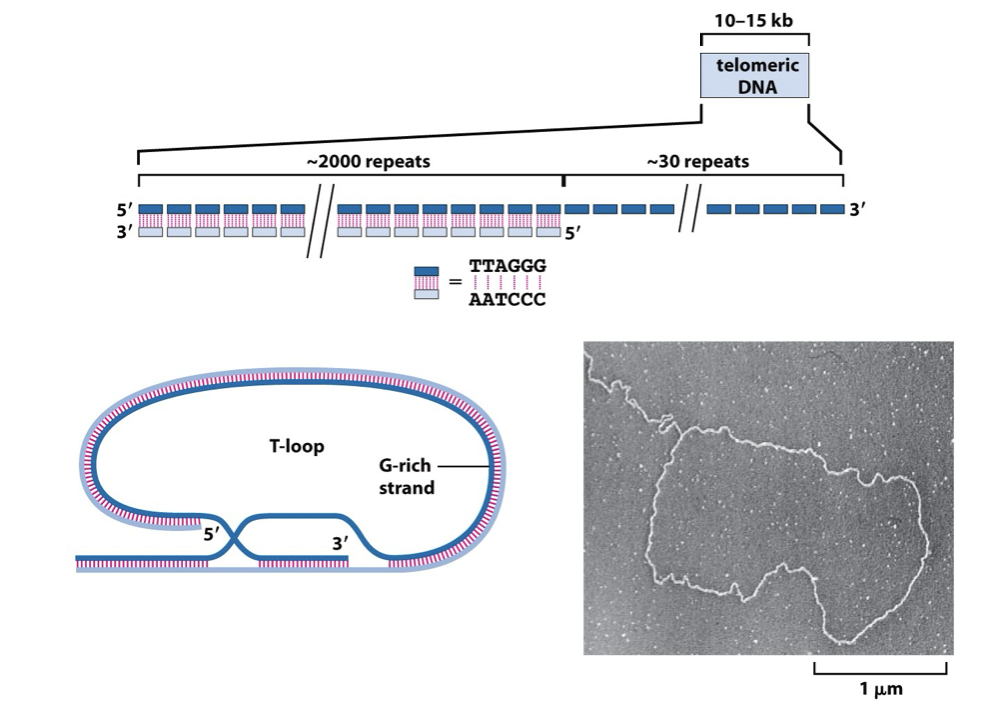
  • Telomeric DNA sequences are composed of long arrays (10-15 kilobases) of short tandem repeats 

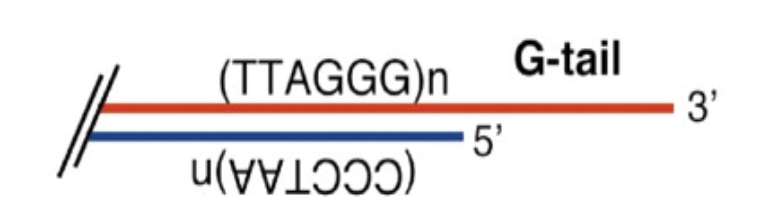
    • G rich strand = longer, resulting in an overhang called the G-tail (around 30 repeats) 

    • C rich strand = shorter 

<ul><li><p class="Paragraph SCXO260528022 BCX4" style="text-align: left;"><span style="background-color: inherit; line-height: 19.55px; color: windowtext;"><span>Structural heterochromatin usually contains repetitive DNA sequences known as satellite DNA</span></span><span style="line-height: 19.55px; color: windowtext;"><span>&nbsp;</span></span></p></li><li><p class="Paragraph SCXO260528022 BCX4" style="text-align: left;"><span style="background-color: inherit; line-height: 19.55px; color: windowtext;"><span>It is found in structural elements such as centromeres and importantly in telomeres</span></span><span style="line-height: 19.55px; color: windowtext;"><span>&nbsp;</span></span></p><ul><li><p class="Paragraph SCXO260528022 BCX4" style="text-align: left;"><span style="background-color: inherit; line-height: 19.55px; color: windowtext;"><span>Prevent fusion of chromosomes</span></span><span style="line-height: 19.55px; color: windowtext;"><span>&nbsp;</span></span></p></li></ul></li><li><p class="Paragraph SCXO260528022 BCX4" style="text-align: left;"><span style="background-color: inherit; line-height: 19.55px; color: windowtext;"><span>Telomeric DNA sequences are composed of long arrays (10-15 kilobases) of short tandem repeats</span></span><span style="line-height: 19.55px; color: windowtext;"><span>&nbsp;</span></span></p><ul><li><p class="Paragraph SCXO260528022 BCX4" style="text-align: left;"><span style="background-color: inherit; line-height: 19.55px; color: windowtext;"><span>G rich strand = longer, resulting in an overhang called the G-tail (around 30 repeats)</span></span><span style="line-height: 19.55px; color: windowtext;"><span>&nbsp;</span></span></p></li><li><p class="Paragraph SCXO260528022 BCX4" style="text-align: left;"><span style="background-color: inherit; line-height: 19.55px; color: windowtext;"><span>C rich strand = shorter</span></span><span style="line-height: 19.55px; color: windowtext;"><span>&nbsp;</span></span></p></li></ul></li></ul><p></p>
7
New cards
<p>G-tail</p>

G-tail

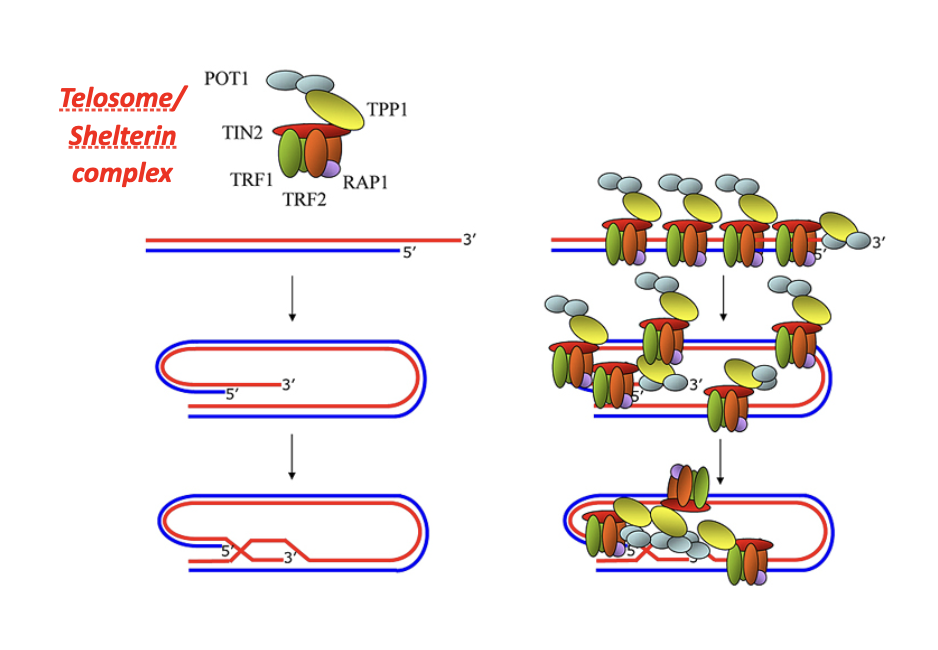
  • Protects chromosome ends 

    • Prevents chromosome ends from being recognized as DNA double-strand breaks 

    • Avoids activation of DNA damage response pathways 

  • Enables telomere capping 

    • G-tail folds back to form a T-loop 

    • The T-loop physically hides the chromosome end 

  • Recruits shelterin complex 

    • Binds telomere-specific proteins (e.g. TRF1, TRF2, POT1) 

    • Shelterin stabilizes telomere structure and maintains heterochromatin 

  • Prevents end-to-end fusions 

    • Blocks non-homologous end joining (NHEJ) at chromosome ends 

  • Maintains genomic stability 

    • Ensures proper chromosome maintenance across cell divisions 

  • Facilitates telomere replication 

    • Provides a substrate for telomerase to extend telomeres 

8
New cards

function of structural heterochromatin

  • Maintains chromosome structural integrity 

    • Provides mechanical stability to chromosomes 

  • Located at repetitive DNA regions 

    • Found at centromeres, telomeres, and other repeat-rich regions

  • Ensures proper chromosome segregation 

    • Centromeric heterochromatin is essential for kinetochore formation 

    • Prevents mis-segregation during mitosis and meiosis 

  • Suppresses recombination 

    • Prevents homologous recombination between repetitive sequences 

    • Reduces chromosomal rearrangements 

  • Silences repetitive DNA 

    • Transcriptionally inactive 

    • Prevents expression of transposons and satellite DNA 

  • Protects genome stability 

    • Limits insertional mutagenesis by mobile elements 

  • Maintains nuclear organization 

    • Anchors chromatin to the nuclear periphery 

    • Contributes to higher-order chromatin architecture 

  • Defines chromosomal domains 

    • Acts as a boundary separating active euchromatin regions 

  • Epigenetically maintained 

    • Characterized by DNA methylation 

    • Enriched in H3K9me3 and HP1 proteins 

  • Evolutionarily conserved 

    • Present in most eukaryotes with similar structural roles 

9
New cards

cytogenetics

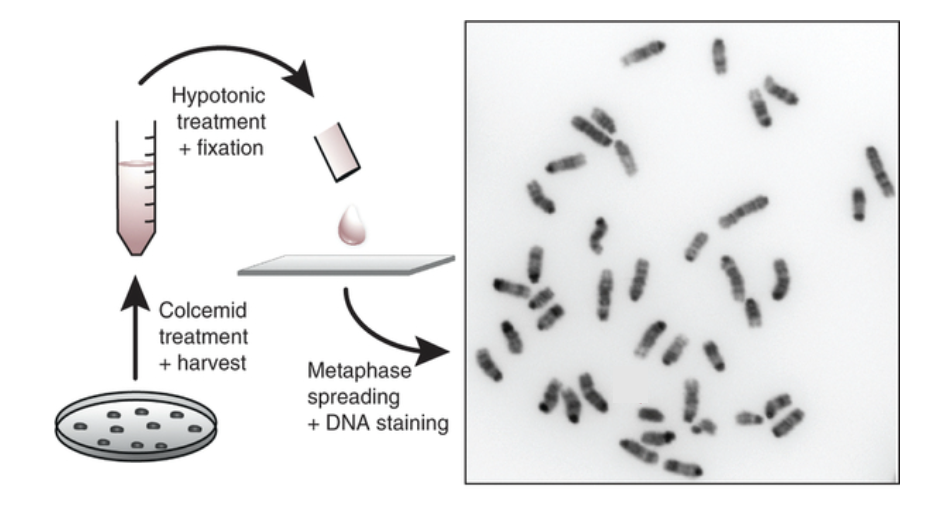
  • Chromosomes from cell preparations can be 'spread' on a microscopic slide for analysis 

    • Want to collect them in metaphase 

    • As they are more condensed 

    • Can be distinguished from each other 

    • Chromosomes in prometaphase are less compacted and thus reveal more detail 

      • Can find structural features 

<ul><li><p class="Paragraph SCXO193510334 BCX4" style="text-align: left;"><span style="background-color: inherit; line-height: 19.55px; color: windowtext;"><span>Chromosomes from cell preparations can be 'spread' on a microscopic slide for analysis</span></span><span style="line-height: 19.55px; color: windowtext;"><span>&nbsp;</span></span></p><ul><li><p class="Paragraph SCXO193510334 BCX4" style="text-align: left;"><span style="background-color: inherit; line-height: 19.55px; color: windowtext;"><span>Want to collect them in metaphase</span></span><span style="line-height: 19.55px; color: windowtext;"><span>&nbsp;</span></span></p></li><li><p class="Paragraph SCXO193510334 BCX4" style="text-align: left;"><span style="background-color: inherit; line-height: 19.55px; color: windowtext;"><span>As they are more condensed</span></span><span style="line-height: 19.55px; color: windowtext;"><span>&nbsp;</span></span></p></li><li><p class="Paragraph SCXO193510334 BCX4" style="text-align: left;"><span style="background-color: inherit; line-height: 19.55px; color: windowtext;"><span>Can be distinguished from each other</span></span><span style="line-height: 19.55px; color: windowtext;"><span>&nbsp;</span></span></p></li><li><p class="Paragraph SCXO193510334 BCX4" style="text-align: left;"><span style="background-color: inherit; line-height: 19.55px; color: windowtext;"><span>Chromosomes in prometaphase are less compacted and thus reveal more detail</span></span><span style="line-height: 19.55px; color: windowtext;"><span>&nbsp;</span></span></p><ul><li><p class="Paragraph SCXO193510334 BCX4" style="text-align: left;"><span style="background-color: inherit; line-height: 19.55px; color: windowtext;"><span>Can find structural features</span></span><span style="line-height: 19.55px; color: windowtext;"><span>&nbsp;</span></span></p></li></ul></li></ul></li></ul><p></p>
10
New cards

hypotonic treatment

  • Cells are placed in a hypotonic solution (e.g. 0.075 M KCl) 

  • Water enters cells by osmosis 

  • Cells swell due to increased internal pressure 

  • Nuclear membrane weakens and ruptures 

  • Chromosomes spread apart within the swollen cell 

  • Cell is then fixed (e.g. methanol:acetic acid) to preserve chromosome structure 

  • Chromosomes are dropped onto a slide for staining and analysis 

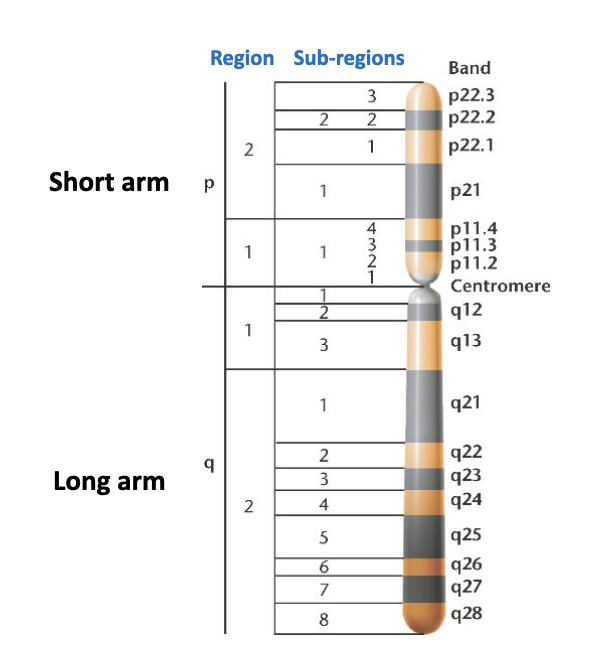
  • Stains create a banding pattern 

    • Can distinguish one chromosome from another 

    • Using karyotyping 

<ul><li><p class="Paragraph SCXO261475093 BCX4" style="text-align: left;"><span style="background-color: inherit; line-height: 19.55px;"><span>Cells are placed in a&nbsp;hypotonic solution&nbsp;(e.g. 0.075 M KCl)</span></span><span style="line-height: 19.55px;"><span>&nbsp;</span></span></p></li><li><p class="Paragraph SCXO261475093 BCX4" style="text-align: left;"><span style="background-color: inherit; line-height: 19.55px;"><span>Water enters cells by&nbsp;osmosis</span></span><span style="line-height: 19.55px;"><span>&nbsp;</span></span></p></li><li><p class="Paragraph SCXO261475093 BCX4" style="text-align: left;"><span style="background-color: inherit; line-height: 19.55px;"><span>Cells&nbsp;swell&nbsp;due to increased internal pressure</span></span><span style="line-height: 19.55px;"><span>&nbsp;</span></span></p></li><li><p class="Paragraph SCXO261475093 BCX4" style="text-align: left;"><span style="background-color: inherit; line-height: 19.55px;"><span>Nuclear membrane weakens and ruptures</span></span><span style="line-height: 19.55px;"><span>&nbsp;</span></span></p></li><li><p class="Paragraph SCXO261475093 BCX4" style="text-align: left;"><span style="background-color: inherit; line-height: 19.55px;"><span>Chromosomes&nbsp;spread apart&nbsp;within the swollen cell</span></span><span style="line-height: 19.55px;"><span>&nbsp;</span></span></p></li><li><p class="Paragraph SCXO261475093 BCX4" style="text-align: left;"><span style="background-color: inherit; line-height: 19.55px;"><span>Cell is then&nbsp;fixed&nbsp;(e.g. methanol:acetic acid) to preserve chromosome structure</span></span><span style="line-height: 19.55px;"><span>&nbsp;</span></span></p></li><li><p class="Paragraph SCXO261475093 BCX4" style="text-align: left;"><span style="background-color: inherit; line-height: 19.55px;"><span>Chromosomes are dropped onto a slide for staining and analysis</span></span><span style="line-height: 19.55px;"><span>&nbsp;</span></span></p></li><li><p class="Paragraph SCXO261475093 BCX4" style="text-align: left;"><span style="background-color: inherit; line-height: 19.55px; color: windowtext;"><span>Stains create a banding pattern</span></span><span style="line-height: 19.55px; color: windowtext;"><span>&nbsp;</span></span></p><ul><li><p class="Paragraph SCXO80695567 BCX4" style="text-align: left;"><span style="background-color: inherit; line-height: 19.55px; color: windowtext;"><span>Can distinguish one chromosome from another</span></span><span style="line-height: 19.55px; color: windowtext;"><span>&nbsp;</span></span></p></li><li><p class="Paragraph SCXO80695567 BCX4" style="text-align: left;"><span style="background-color: inherit; line-height: 19.55px; color: windowtext;"><span>Using karyotyping</span></span><span style="line-height: 19.55px; color: windowtext;"><span>&nbsp;</span></span></p></li></ul></li></ul><p></p>
11
New cards

molecular cytogenetics

  • Higher resolution analysis (e.g. detection of specific DNA sequences within chromosomes) 

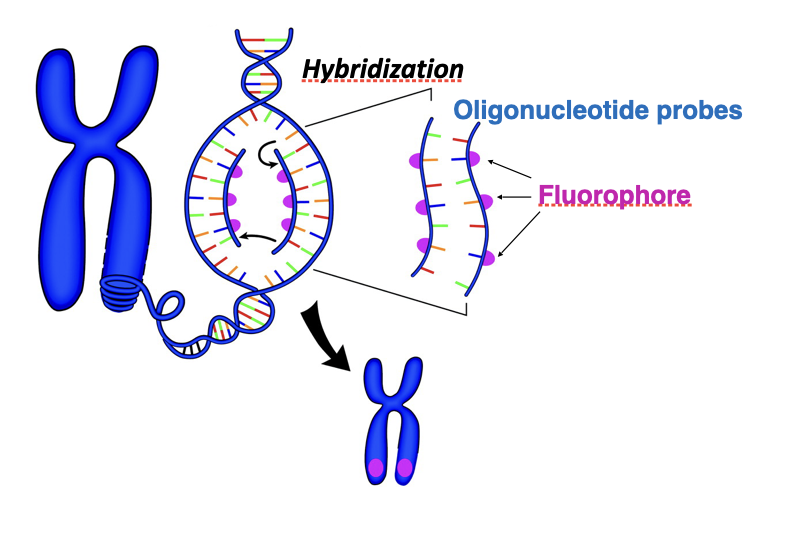
  • Achieved by designing and chemically synthesising an 'oligonucleotide probe' directed against a target DNA sequence 

    • Labelled with a fluorophore 

<ul><li><p class="Paragraph SCXO112696617 BCX4" style="text-align: left;"><span style="background-color: inherit; line-height: 19.55px; color: windowtext;"><span>Higher resolution analysis (e.g. detection of specific DNA sequences within chromosomes)</span></span><span style="line-height: 19.55px; color: windowtext;"><span>&nbsp;</span></span></p></li><li><p class="Paragraph SCXO112696617 BCX4" style="text-align: left;"><span style="background-color: inherit; line-height: 19.55px; color: windowtext;"><span>Achieved by designing and chemically synthesising an 'oligonucleotide probe' directed against a target DNA sequence</span></span><span style="line-height: 19.55px; color: windowtext;"><span>&nbsp;</span></span></p><ul><li><p class="Paragraph SCXO112696617 BCX4" style="text-align: left;"><span style="background-color: inherit; line-height: 19.55px; color: windowtext;"><span>Labelled with a fluorophore</span></span><span style="line-height: 19.55px; color: windowtext;"><span>&nbsp;</span></span></p></li></ul></li></ul><p></p>
12
New cards
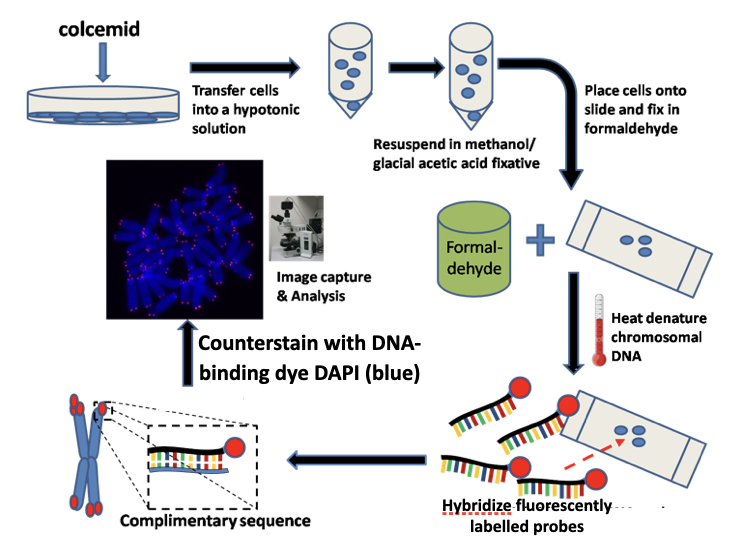
<p>how does FISH (fluorescence in situ hybridisation) work</p>

how does FISH (fluorescence in situ hybridisation) work

  • Purpose: 

    • Detects and localizes specific DNA (or RNA) sequences on chromosomes or in cells 

  • Starting material: 

    • Metaphase chromosomes or interphase nuclei fixed on a slide 

  • Denaturation: 

    • Chromosomal DNA is heated or chemically treated 

    • Double-stranded DNA separates into single strands 

  • Probe preparation: 

    • Short, single-stranded DNA oligonucleotide probes 

    • Labelled with a fluorescent dye 

  • Hybridization: 

    • Probe is applied to the slide 

    • Incubation allows probe to find and bind its complementary sequence 

  • Washing: 

    • Removes unbound or weakly bound probes 

    • Ensures specific binding 

  • Detection: 

    • Slide viewed under a fluorescence microscope 

    • Bound probes appear as bright fluorescent signals 

13
New cards

how does the oligonucleotide probe attach

  • Base pairing 

    • Probe binds by complementary base pairing 

    • A–T and G–C hydrogen bonds form between probe and target DNA 

  • Hybridization conditions 

    • Temperature, salt concentration, and time control stringency 

    • High stringency → only perfect matches bind 

    • Low stringency → partial mismatches may bind 

  • No covalent bonds 

    • Attachment is non-covalent (hydrogen bonds only) 

    • Binding is reversible under denaturing conditions 

  • Probe length matters 

    • Short oligos → high specificity 

    • Longer probes → stronger binding, lower specificity 

14
New cards

chromosome painting

  • Uses a large cocktail of probes that will bind to many different locations along the length of a single type of chromosome 

  • Spectral karyotyping (SKY) can allow for the entire set of chromosomes to be analysed 
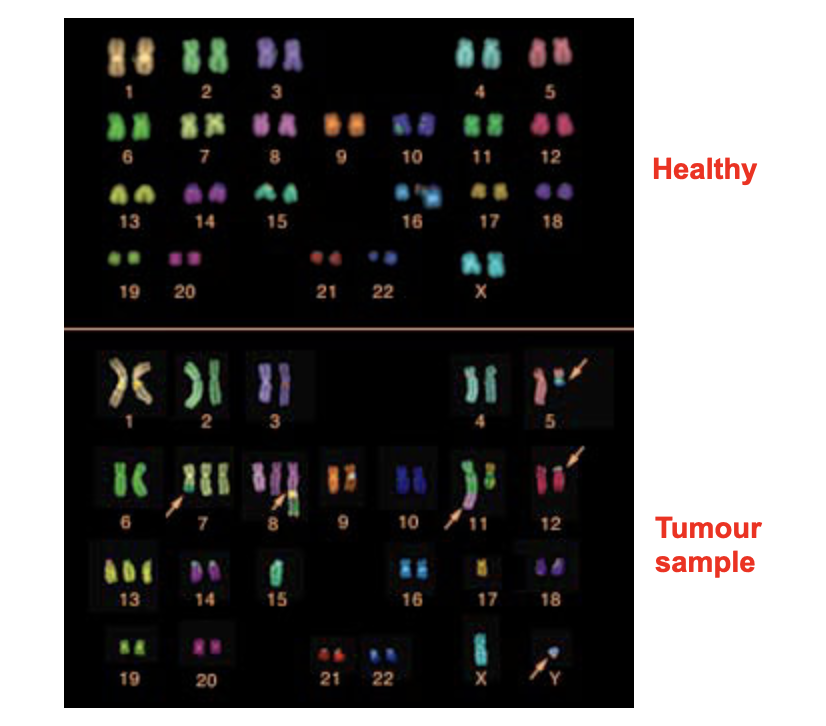
<ul><li><p class="Paragraph SCXO126963512 BCX4" style="text-align: left;"><span style="background-color: inherit; line-height: 19.55px; color: windowtext;"><span>Uses a large cocktail of probes that will bind to many different locations along the length of a single type of chromosome</span></span><span style="line-height: 19.55px; color: windowtext;"><span>&nbsp;</span></span></p></li><li><p class="Paragraph SCXO126963512 BCX4" style="text-align: left;"><span style="background-color: inherit; line-height: 19.55px; color: windowtext;"><span>Spectral karyotyping (SKY) can allow for the entire set of chromosomes to be analysed</span></span><span style="line-height: 19.55px; color: windowtext;"><span>&nbsp;</span></span></p></li></ul><p></p>