PHA 334 - ANS (Lecture #3) AFTER QUIZ #1
 Call Kai
 Learn
Learn Practice Test
 Spaced Repetition
 Match
Match Flashcards
 Knowt Play
1/159

There's no tags or description
Looks like no tags are added yet.
Name | Mastery | Learn | Test | Matching | Spaced | Call with Kai |
|---|
No analytics yet
Send a link to your students to track their progress
160 Terms
G proteins (SCAG)
Gq Increases intracellular Ca2+ via IP3/DAG Smooth muscle contracts Cardiac muscle contracts Glands increase secretion Gs Increases cAMP Smooth muscle relaxes Cardiac muscle increases HR and contractility Adipose increases lipolysis Glands increase secretion Gi Decreases cAMP Smooth muscle contracts Cardiac muscle decreases HR and contractility Adipose decreases lipolysis Glands decrease secretion
Gs Gi Gq effects depend on cell type
Gs activation relaxes smooth muscle (β2 β3) contracts cardiac muscle (β1) Gi activation contracts smooth muscle (α2) relaxes cardiac muscle (M2) Gq activation contracts smooth muscle (α1 M3) contracts cardiac muscle (α1)
Ligand-gated ion channels
Neurotransmitter binds opens channel Rapid response Nicotinic receptors Found at ganglia
GPCR receptors
Seven transmembrane receptors Activate G proteins Slower longer-lasting responses Found on SCAG
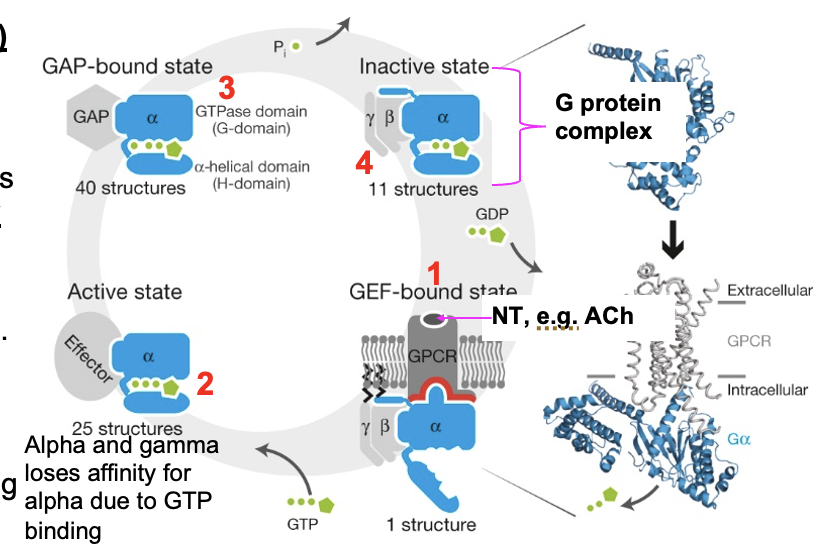
G protein activation
NT binds to a GPCR (which is a guanine nucleotide exchange factor, GEF) which binds to the G protein complex—GDP releases from α subunit
α subunit binds GTP and recruits downstream effectors
GTP is hydrolyzed by a GTPase activating protein (GAP)
the inactive, GDP-bound state
Second messengers
cAMP cGMP DAG IP3 Ca2+ regulate enzymes ion channels gene expression
Kinases
Add phosphate groups to proteins using ATP
Phosphatases
Remove phosphate groups from proteins
Phosphodiesterases (PDEs)
Break down cAMP and cGMP 11 isoforms
Effect of PDE inhibition
Increases cAMP and cGMP Smooth muscle relaxation
cAMP pathway
Activates PKA Decreases Ca2+ Inhibits MLCK Leads to relaxation
cGMP pathway
Activates PKG Promotes MLCP Leads to relaxation
Smooth muscle contraction mechanism
Ca2+ + calmodulin → MLCK activation → myosin phosphorylation → contraction
Smooth muscle relaxation mechanism
1⃣ Decrease MLCK activity (cAMP pathway – Gs)
Seen with:
β2
β3
Some Gs receptors
Mechanism:
↑ cAMP
Activates PKA
PKA ↓ intracellular Ca²⁺
PKA inhibits MLCK
Less myosin phosphorylation
→ Relaxation
Think:
👉 Gs → cAMP → PKA → inhibits MLCK → relaxation
2⃣ Increase MLCP activity (cGMP pathway – NO)
Seen with:
Nitric oxide (NO)
Endothelium-dependent M3 vasodilation
Mechanism:
NO → ↑ cGMP
Activates PKG
PKG activates MLCP (myosin light chain phosphatase)
MLCP dephosphorylates myosin
→ Relaxation
Think:
👉 cGMP → PKG → MLCP → dephosphorylate → relax
Acetylcholine release
PNS and SNS preganglionic neurons All PNS postganglionic neurons
Norepinephrine release
SNS postganglionic neurons except sweat glands
ACh termination
Acetylcholinesterase
NE termination
Norepinephrine transporter (NET)
PNS characteristics
Local short-lived effects ACh rapidly degraded Low divergence
SNS characteristics
Diffuse long-lasting effects NE slower degradation High divergence Epinephrine hormone release
Nicotinic receptors
Ion channel Excitatory Always stimulatory
NG receptor
Ganglia
NN receptor
Neuronal
NM receptor
Neuromuscular junction
Muscarinic receptors overview
PNS GPCR SSLUDDD-C Located on SCAG M1 M3 M5 = Gq M2 M4 = Gi
M1 M3 M5 receptors
M1 Gq Gland secretion
M3 Gq Smooth muscle contraction and secretion Sweat glands SNS exception
M5 Gq CNS role
M2 M4 receptors
M2 Gi Decreases heart rate SA AV nodes
M4 Gi CNS inhibitory
SSLUDDD-C
◦Slow heart rate (effect generated by cardiac muscles “C”)
◦Salivation (effect generated by glands, “G”)
◦Lacrimation/crying (effect generated by “G”)
◦Urination (effect generated by smooth muscles, “S”)
◦Digestion (effect generated by S and G)
◦Defecation (effect generated by S)
◦Dilation of sexual organs (effect generated by S, indirectly)
◦Constriction of bronchioles & pupils (effect generated by S)
Adrenergic receptors overview
SNS GPCR Alpha 1 = Gq Alpha 2 = Gi Beta 1 2 3 = Gs
Alpha 1 receptor
Gq Smooth muscle contraction Vasoconstriction
α1A receptor
Gq Bladder neck prostate contraction
α1B receptor
Gq Vasoconstriction arteries veins Cardiac growth
α1D receptor
Gq Vasoconstriction aorta coronary arteries
Alpha 2 receptor
Gi Inhibits NE release Decreases sympathetic outflow
α2A receptor
Gi Presynaptic inhibits NE Hypotension sedation analgesia
α2B receptor
Gi Postsynaptic smooth muscle contraction
α2C receptor
Gi Presynaptic inhibits catecholamine release adrenal medulla
Beta receptors
Gs Increase cAMP
β1 receptor
Gs Heart increased HR contractility Kidney renin release
β2 receptor
Gs Smooth muscle relaxation Bronchodilation Vasodilation
β3 receptor
Gs Adipose lipolysis Bladder relaxation
Adrenal medulla exception
Preganglionic ACh directly to adrenal medulla Releases epinephrine norepinephrine
Dual innervation
Organs receive both SNS and PNS input Opposing effects
Presynaptic regulation
M2 M4 alpha 2 inhibit neurotransmitter release
SKAVAS
Skin Kidneys Adipose Vasculature Adrenal glands Sweat glands
Net physiological response depends on
Receptor density Receptor affinity Cell type Signal pathway Drug concentration
Dilator pupillae
SNS α1 Gq Contraction pupil dilation
Sphincter pupillae
PNS M3 Gq Contraction pupil constriction
Ciliary muscle
PNS M3 Contracts near vision SNS β2 Relaxes distance vision
M3 in blood vessels
Located on endothelium NOT smooth muscle
M3 vasodilation mechanism
M3 → Gq → Ca2+ → NO synthase → NO → cGMP → relaxation
Nitric oxide (NO)
Paracrine molecule Causes smooth muscle relaxation
Endothelium requirement
ACh causes vasodilation only if endothelium intact
SNS eyes
α1 Pupils dilate Lenses flatten
SNS skin
α1 Piloerection Emotional sweating M3 heat sweating
SNS salivary glands
α1 Inhibit secretion β thick saliva
SNS blood vessels
α1 vasoconstriction β2 vasodilation
SNS lungs
β2 relax bronchi decrease mucus
SNS heart
β1 increase HR contractility
SNS GI sphincters
α1 contract sphincters
SNS GI motility
β2 decrease motility
SNS pancreas
α2 decrease insulin β2 increase glucagon
SNS liver
α1 β2 increase glycogenolysis gluconeogenesis
SNS gallbladder
β2 decrease bile secretion
SNS adrenals
NN release epinephrine norepinephrine
SNS kidneys
β1 increase renin
SNS bladder
β2 β3 relax detrusor α1 contract sphincter
SNS genitals
α1 ejaculation
PNS eyes
M3 pupils constrict lenses bulge
PNS glands
M1 M3 salivation lacrimation
PNS heart
M2 decrease HR
PNS lungs
M3 bronchoconstriction mucus
PNS GI
M3 increase motility relax sphincters
PNS pancreas
M3 pancreatic secretion insulin glucagon somatostatin
PNS gallbladder
M3 bile secretion
PNS bladder
M3 contract detrusor relax sphincter
PNS genitals
M3 vasodilation erection
Pilocarpine (Vuity Salagen)
Muscarinic receptor agonist Causes miosis Contracts ciliary muscle Used for glaucoma xerostomia
Methacholine (Provocholine)
Muscarinic receptor agonist Causes bronchoconstriction Used for asthma test
Atropine
Muscarinic receptor antagonist Blocks PNS Mydriasis increased HR decreased secretions Antidote organophosphate poisoning
Scopolamine
Muscarinic receptor antagonist Motion sickness CNS effects
Pyridostigmine (Mestinon)
Acetylcholinesterase inhibitor Increases ACh Treats myasthenia gravis
Varenicline (Chantix)
Nicotinic receptor partial agonist Smoking cessation
Nicotine (Nicorette)
Nicotinic receptor agonist
Prazosin (Minipress)
Alpha 1 antagonist Vasodilation decreases BP
Clonidine (Catapres)
Alpha 2 agonist Decreases sympathetic outflow
Guanfacine (Tenex)
Alpha 2 agonist ADHD decreases SNS
Lofexidine (Lucemyra)
Alpha 2 agonist Opioid withdrawal decreases SNS
Propranolol
Nonselective beta antagonist Decreases HR BP
Metoprolol
Beta 1 selective antagonist Decreases HR
Albuterol (Ventolin)
Beta 2 agonist Bronchodilation SABA
Formoterol (Perforomist)
Beta 2 agonist Long acting bronchodilation LABA
Mirabegron (Myrbetriq)
Beta 3 agonist Relaxes bladder
Sympathomimetics
Increase SNS activity Methamphetamine Propylhexedrine Pseudoephedrine increase NE
Fluticasone (Flovent)
Inhaled corticosteroid Anti-inflammatory asthma COPD
Fluticasone + Salmeterol (Advair Diskus)
◦Anti-inflammatory drug for chronic asthma or COPD
◦Inhaled corticosteroid (ICS)
◦Often used in combination therapy, e.g. fluticasone+salmeterol (beta2 agonist) (Advair Diskus)
Budesonide + Formoterol (Symbicort)
ICS + beta2 agonist asthma COPD
Trelegy
Combination steroid + muscarinic antagonist + beta2 agonist
Roflumilast (Daliresp)
PDE4 inhibitor Increases cAMP Smooth muscle relaxation COPD
Ensifentrine (Ohtuvayre)
PDE3 PDE4 inhibitor Increases cAMP cGMP Smooth muscle relaxation

