8. Transport in plants
 Call Kai
 Learn
Learn Practice Test
 Spaced Repetition
 Match
Match Flashcards
 Knowt Play
1/31

There's no tags or description
Looks like no tags are added yet.
Name | Mastery | Learn | Test | Matching | Spaced | Call with Kai |
|---|
No analytics yet
Send a link to your students to track their progress
32 Terms
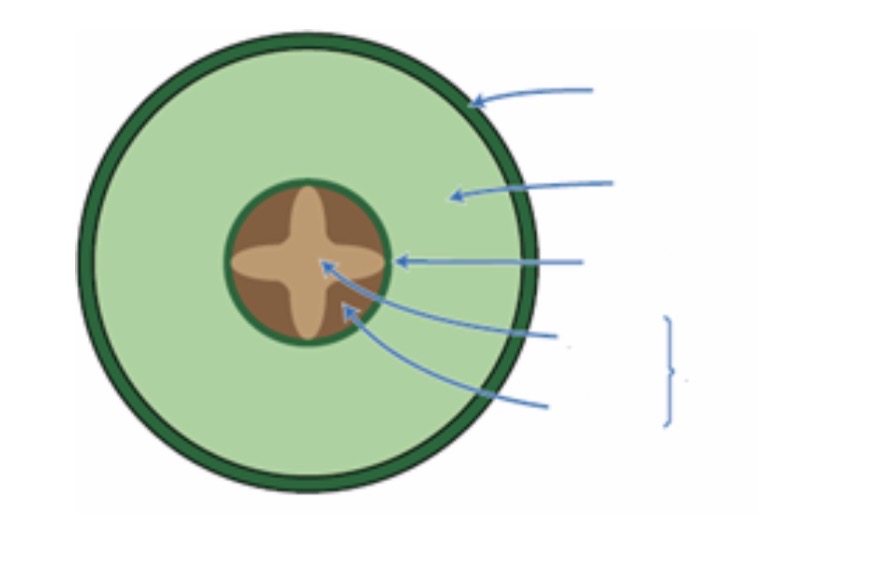
Structure plant roots diagram
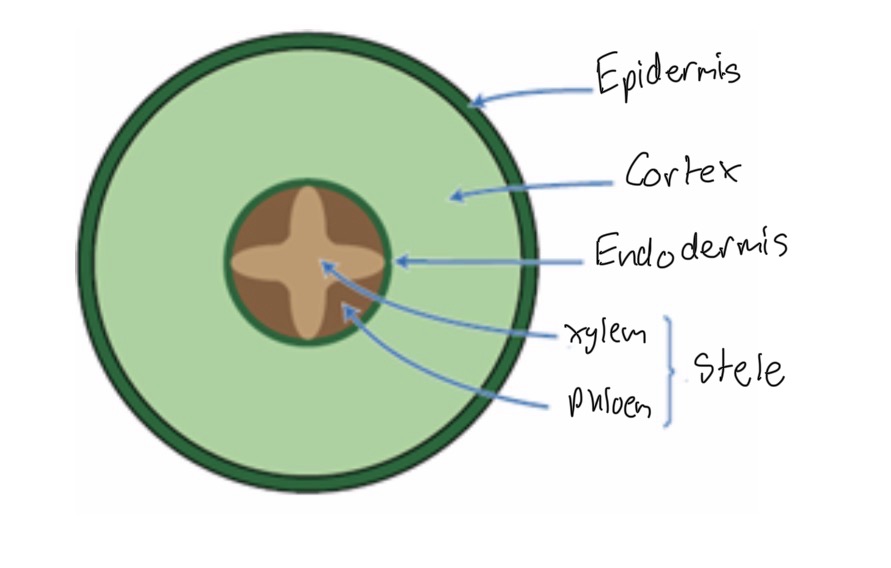
What is the stele composed of?
Mainly composed of the xylem tissue with a smaller amount of phloem tissue.
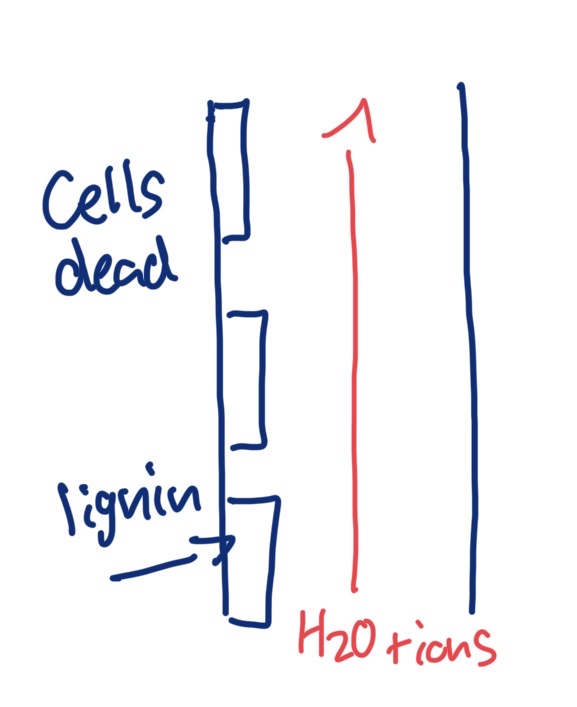
What is the role of the xylem vessel?
Water and ion transport - upwards
How are xylem vessels highly specialised for this role?
No end wall, no cell contents and are dead
what is lignin
cells walls are specially thickened with an impermeable substance
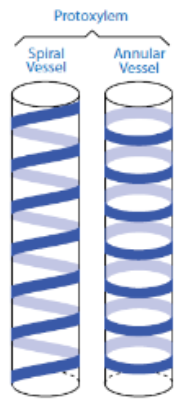
Protoxylem:
First formed – lignin laid down in annular or spiral thickening arrangement – this does not restrict elongation of xylem as growth takes place
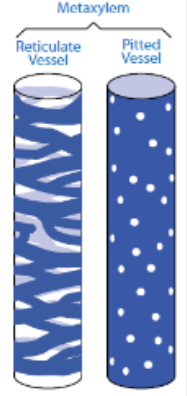
Metaxylem: describe pattern reason
Mature parts – lignin arranged in a reticulate or pitted pattern. Pitted – contains pits to allow movement of water between adjacent vessels and cells
What are the two important properties of lignin?
Provides great strength to prevent collapse under pressure + support
Waterproof to prevent leakage of water
sieve tube elemtents fully grown
No nuclei, reduced volume of cytoplasm which is displaced to side walls, few organelles
What are companion cells and what is their role?
Have dense cytoplasm, rich in mitochondria and other organelles. They have a high metabolic rate and provide ATP to the sieve tube.
How are companion cells linked to the sieve tube elements?
Plasmodesmata
Structure of plant stems
Describe the arrangement of the vascular bundles in the stem.
Vascular tissue arranged as vascular bundles to provide greater support to branch
Protoxylem – vascular bundles closer to the centre and metaxylem – vascular bundles closer to the outer edges
Vascular bundle continues into the leaves as the midrib.
Plants continuously lose water by evaporation. What is transpiration?
Evaporation of water from the mesophyll surface and diffusion of water vapour through the stomata + into the atmosphere
Water entering
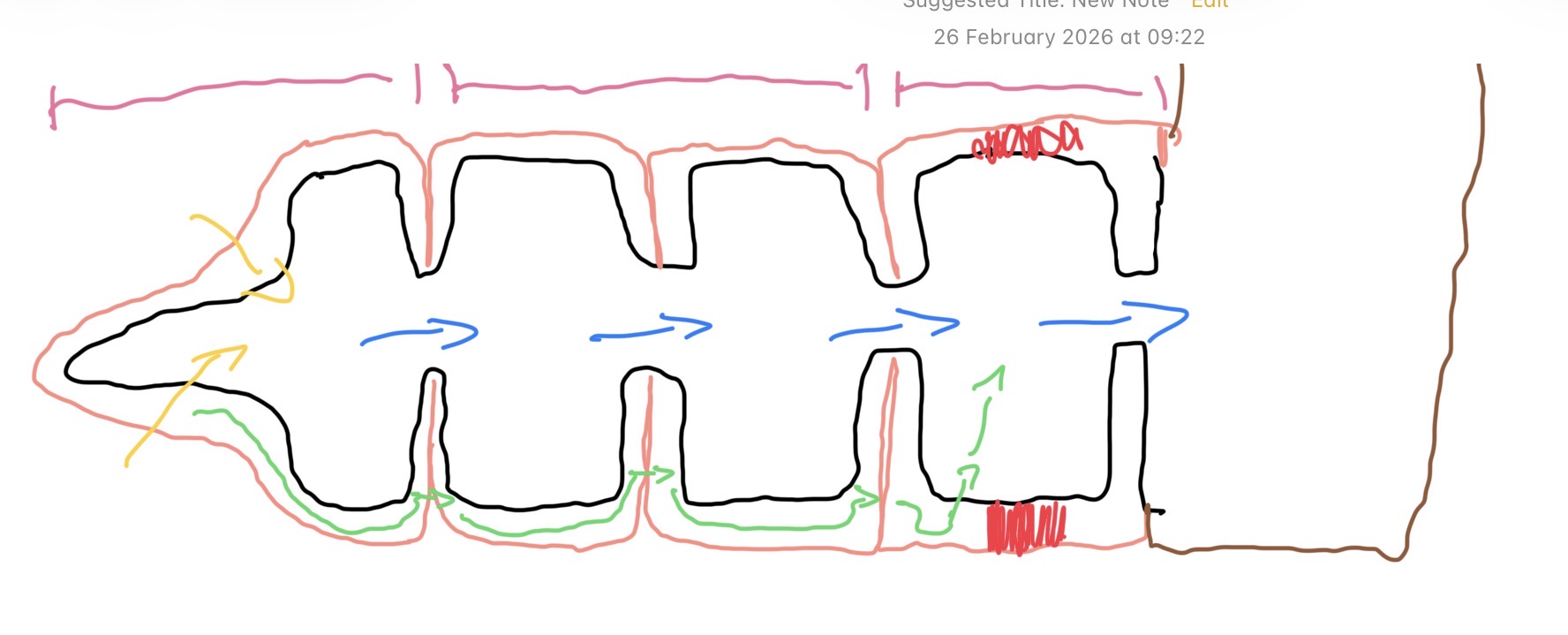
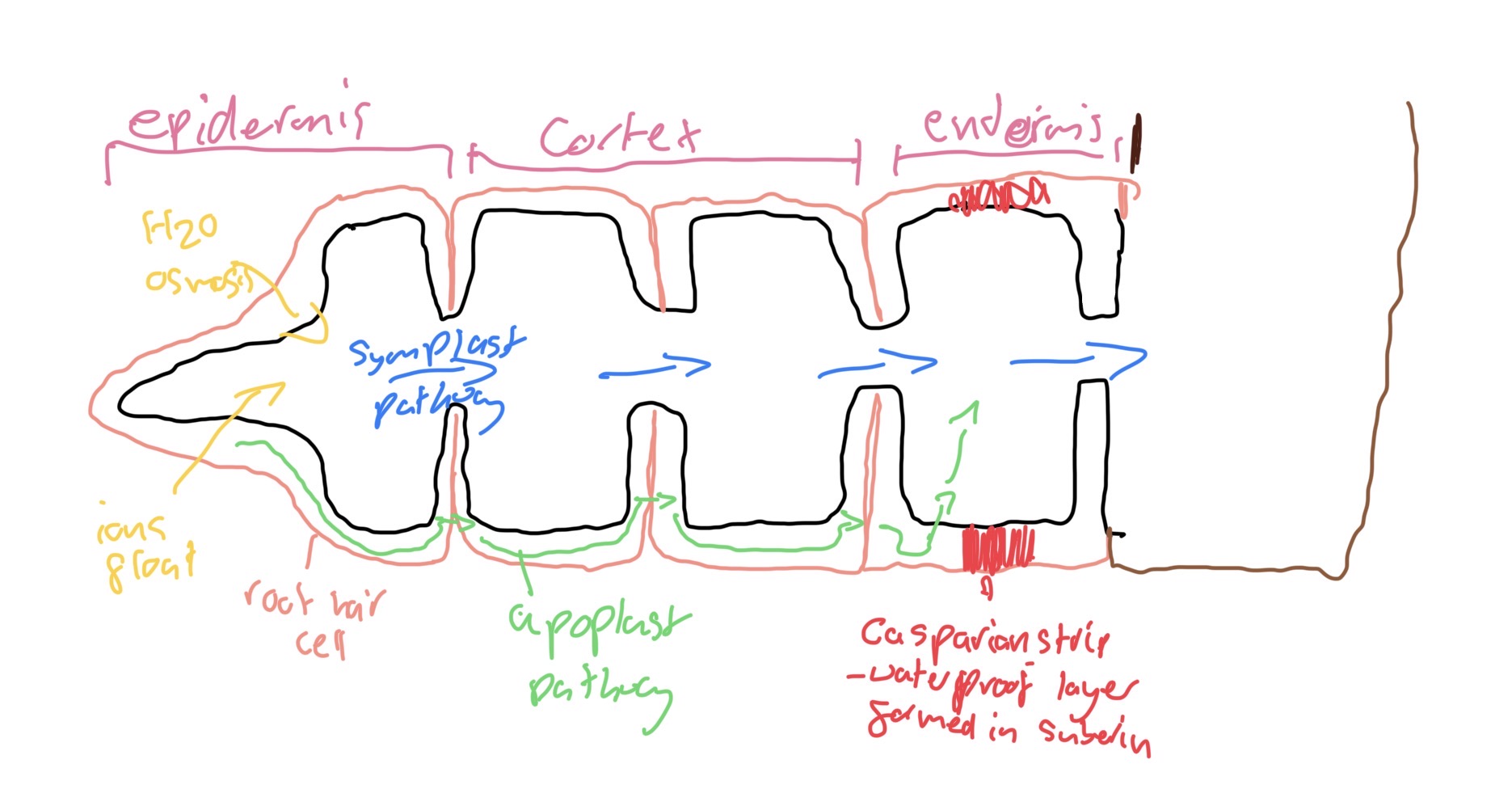
Root hair cell epidermis - large SA increase uptake of water into root by osmosis . Water in soil less neg water potential than root hair cell due to sugars in cell,
Water moves from less negative water potential in soil to more negative water potential in root hair cell due cell, ions also enter tops hair cell by active transport facilitated diffusion.
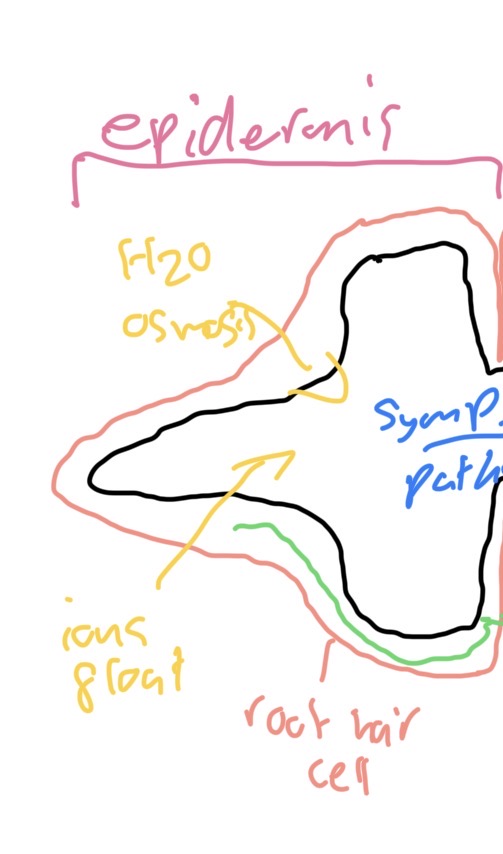
How do ions enter the root hair cells?
By facilitated diffusion and active transport (depending on concentration gradients)
What two pathways does water move
Symplast pathway , apoplast pathway
Water in root hair cell 2
Moves across cortex into xylem in the stele by two pathways.
Apoplast pathway - water moves through cellulose microfibrils or cell wall, cohesive properties of water - pull water column along, most water move by pathway due to limited resistance to water movement
Symplast pathway - moves osmosis cell to cell across cortex via plasmodesmata
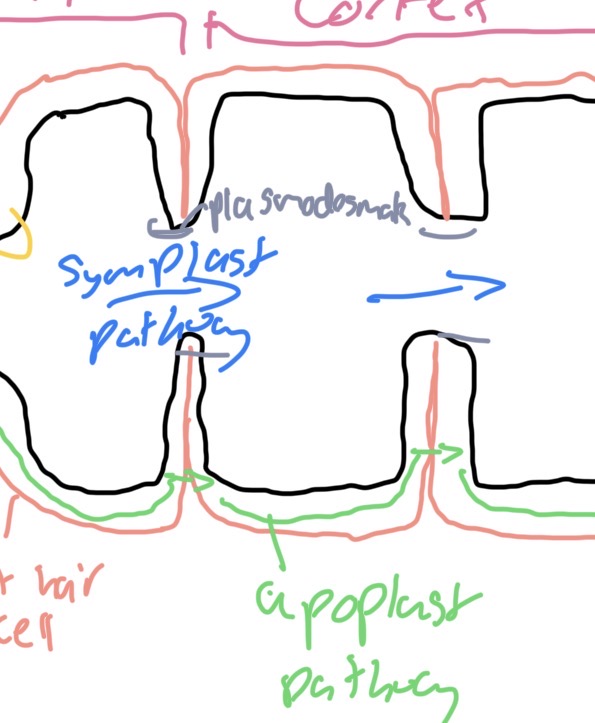
Endodermis outside stele
Waterproof layer formed suberin - called casparian strip, embedded in cellulose cell wall prevents water moving by apoplast pathway due
Water moves into protoplasm joins symplast pathway, all water entering stele - symplast pathway, ensure water transport in under metabolic control
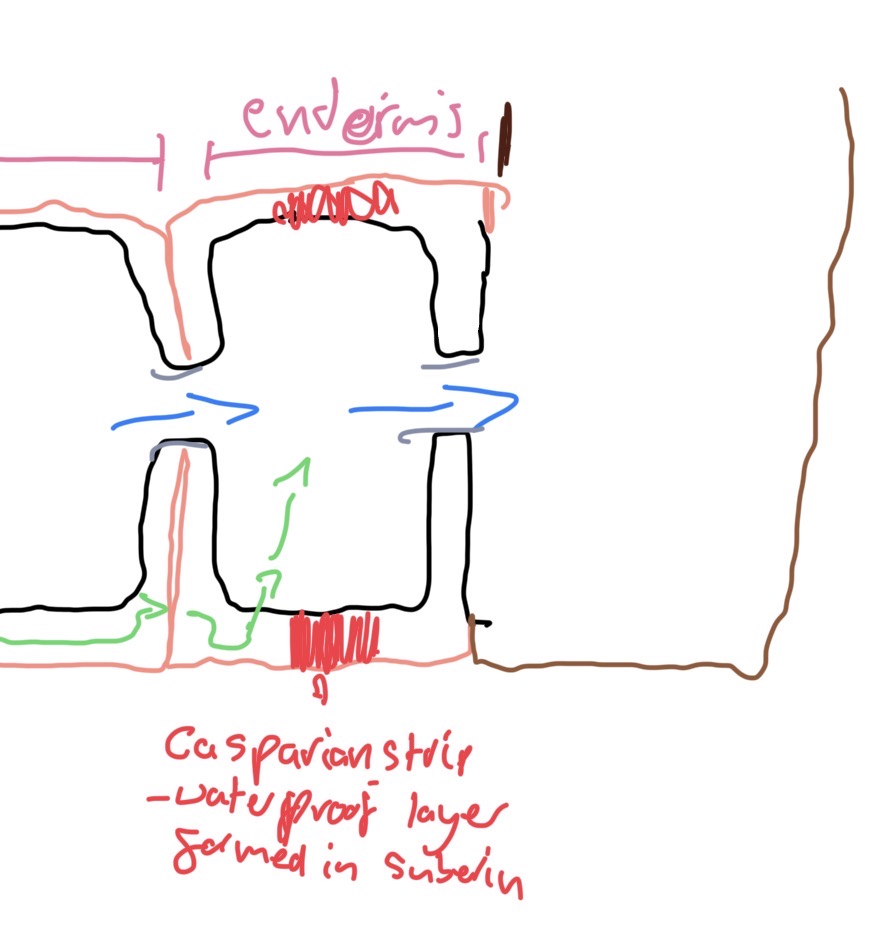
4 into xylem we go!
Endodermal cells pump ions into xylem - involved energy expenditure, creates more neg water potential in xylem, water potential gradient - less neg in endodermal cells to more neg in xylem.
Water in xylem - root -reassure helps move water up xylem
In xylem nyah!
Pressure difference pulls water column up through xylem - mass flow movement . Water column unbroken transpiration system in xylem -
Water ,molecules form hydrogen bond with each other - cohesion tension theory , allow water to be sucked - driving force of evaporation of water of leaves resulting in transpiration pull ,
Adhesive property water - water molecules stick to sides of xylem - capillarity
5+6. Water evaporates out of the stomata in the leaves of the plant creating a negative pressure (sink). Water evaporates from the cell surface membrane of the spongy mesophyll cells into the air spaces of spongy mesophyll. Water diffuses down the concentration gradient out of the stomata. This creates a negative pressure (sink).
What are xerophytes adapted for
reduce water loss by transpiration e.g. cacti.
xerophytes
Leaf curvature
Folding creates a layer of humid air which reduces the water potential gradient. Lowering evaporation
Reduced surface area
Many cacti have spines or needles – lower surfaces area = less evaporation and transpiration
Cuticular thickening
Thick cuticle – makes waterproof layer more efficient in reducing evaporation.
Leaf hairs
Layer of hairs – restrict air flow and trap a layer of humid area reduces water potential gradient.
Sunken stomata
Humid air gets trapped and reduces water potential gradient
Succulent tissue
Leaves that store large amounts
of water that can be used in
drought
Deep roots
Roots that penetrate deep into the soil to reach water well below the ground are common. Shallow roots – desert plants –ensures that when rain does fall it is absorbed before it can evaporate.
Hydrophytes are adapted for living on water.
Explain how they are adapted.
Stomata are restricted to upper leaf surfaces to prevent them being submerged in water and allowing gas exchange with the atmosphere.
Presence of large air spaces that enables the plant to float.

