Business Ethics Final
 Studied by 0 people
 Call with Kai
 Learn
Learn Practice Test
 Spaced Repetition
 Match
Match Flashcards
 Knowt Play
1/40

There's no tags or description
Looks like no tags are added yet.
Name | Mastery | Learn | Test | Matching | Spaced | Call with Kai |
|---|
No study sessions yet.
41 Terms
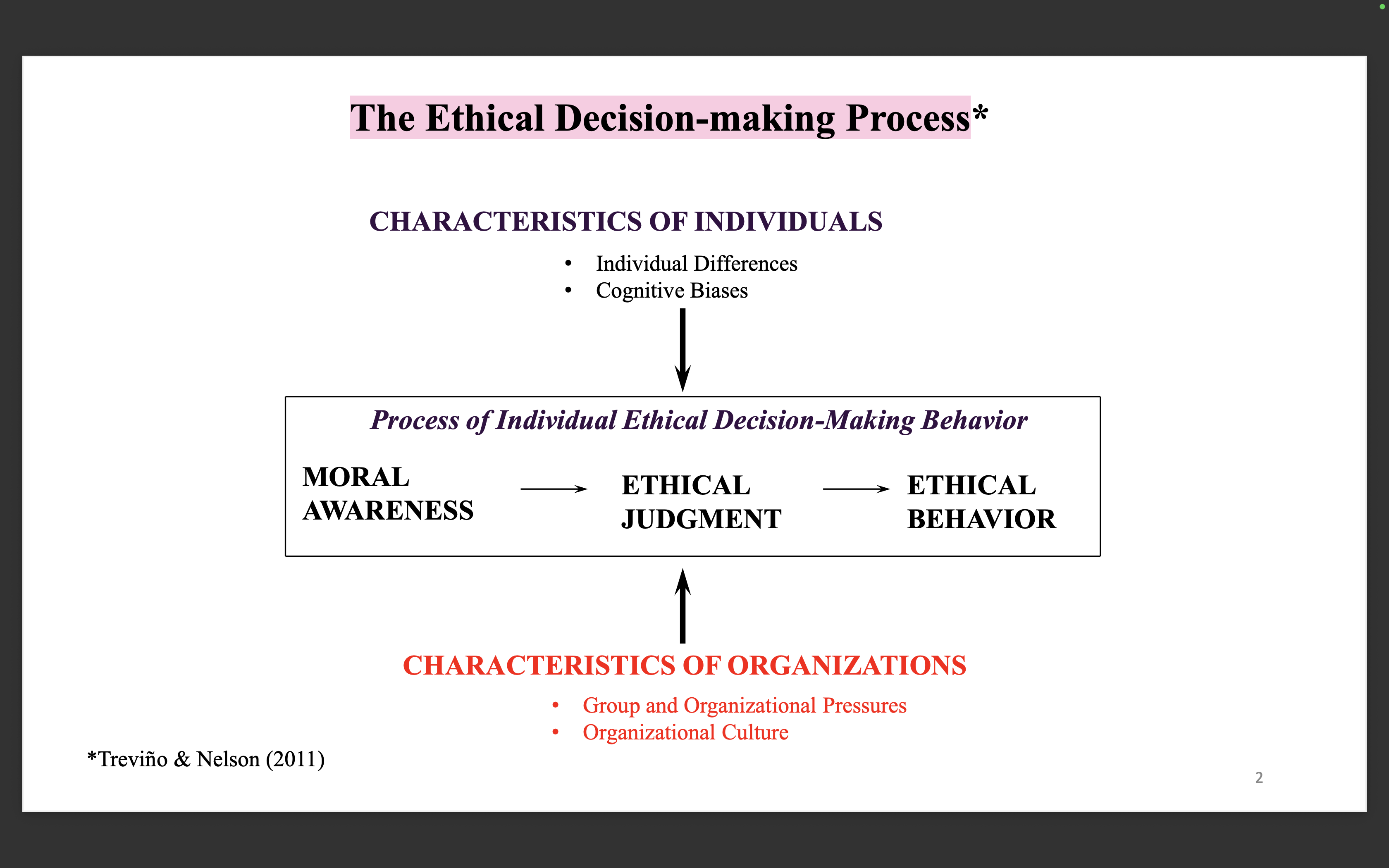
The Ethical Decision-making Process
Ethical decisions happen in three steps: first recognizing an ethical issue (moral awareness), then deciding what is right (ethical judgment), and finally acting on it (ethical behavior).
These steps are influenced by individual factors like personal differences and cognitive biases.
They are also shaped by organizational factors such as culture and group pressure.
Whats the definition of culture?
A body of learned beliefs, traditions, and guides for behavior shared among members of a group.It appears in rules and policies, daily behavior norms, physical settings, dress, language, myths, rituals, heroes, and stories.
Organizational cultures can be strong or weak according to level of alignment. Weak culture is not necessarily bad. In some situations, weak cultures are desirable. They allow for strong subcultures featuring diversity of thought and action. The important thing is to have consistency on ethical issues.
How Cultures influence behavior: Socialization
• Employees are brought into the organization’s culture through a process called enculturation, or socialization.
• Socialization can occur through formal or informal transmission of norms of daily behavior by peers and superiors.
• When effectively socialized into a strong culture, employees behave in ways that are consistent with expectations of the culture (or subculture).
How Cultures influence behavior: Internalization
With internalization, individuals have adopted the external cultural standards as their own.
Ethical Culture framework
Ethical culture is part of an organization’s overall culture and strongly shapes ethical behavior at work.
It is built and sustained through formal systems (leadership, policies, training, rewards, structure) and informal systems (role models, norms, rituals, stories, language).
When these systems are aligned they push employees in the same ethical direction; when misaligned they send mixed signals.
Ethical Leadership
Senior leaders shape organizational culture through their actions, messages, and support of formal policies and informal norms, with founders playing a key role in creating it.
Lasting culture change is only possible with the active involvement and support of top leadership, especially the CEO.
Leadership Matrix
The moral person dimension refers to a leader being and acting ethically.
The moral manager dimension refers to communicating, influencing ethical behavior, and shaping an ethical culture.
An ethically neutral leader is personally ethical but weak in leadership and does not speak up on ethical issues.
Formal Systems
1. The selection system
2. Values and mission statements
3. Policies and codes
4. Orientation and training programs
5. Performance management systems
6. Organizational authority structure
7. Decision-making processes
Informal Systems
1. Role models, mentors, and heroes
2. Norms ‘‘The Way We Do Things around Here’’
3. Rituals are tangible norms, e.g. meetings, parties, banquets, barbecues, awards ceremonies
4. Myths and stories
5. Language, e.g. calling the whistleblower a ‘snitch’.
Employees experience the “real” organizational culture through these informal systems, and information about them is carried through informal communication systems such as the grapevine and water cooler gatherings
Why an ethical culture can become unethical?
1. Change of top management, especially the CEO
2. Change of priorities
3. Lack of alignment between formal and informal systems
4. Silent leadership
5. Change of business environment and governing policies
Changing the ethical culture of an organization
Changing organizational culture is more difficult than developing it, due to:
• the human tendency to want to conserve the existing culture, i.e. cultural persistence, or inertia.
• The unethical culture tends to feed on itself
The ability to overcome these forces could come from:
1. external pressures, e.g. consumer activism, change of policies, the board, etc.
2. internal pressures, e.g. change of top management, internal crisis
How to improve the ethical culture of an organization?
1. Top management (especially the CEO) commitment to building an ethical culture.
2. Diagnosis: Conduct audit of the ethical culture (formal and informal systems)
3. Develop an intervention plan
4. Implement and evaluate results
Legal Compliance
Many businesses are allocating significant funds to formal ethics and legal Compliance programs.
Note: Legal Compliance is ensuring that all business actions and decisions follow applicable laws, regulations, and standards.
Corporate Ethics Office
Are responsabile for The assignment of specific high-level individuals with responsibility to oversee legal compliance standards.
Ethics and Compliance Officer
The officer may be an insider or outsider, often with a legal background, and must be seen as fair, credible, trustworthy, and discreet. They also report to the CEO
Corporate Ethics Committee
An ethics committee made up of senior managers from different functions supports and oversees ethics efforts.
Communicating Ethics
Basic Communication Principles (sensitivity to the word “ethics”)
1. Align the formal and informal communication systems
2. Analyze the audience (good soldiers, loose canons, grenades)
Types of audience
Good Soldiers -
Characteristics: Good moral compass, Know the rules
Needs: Encouragement, Reinforcement
Loose Canons -
Characteristics: Good moral compass, Don’t know the rules
Needs: Training, Heightened supervision
Grenades -
Characteristics: No moral compass, Personal agenda, May or may not know rules
Needs:Senior management example, Swift discipline
The Reward System
The reward system is vital to the alignment of formal and informal systems in an ethical culture.
• Performance appraisal needs to be devoted to how an employee did his or her job. Measuring the how and not just the what (results achieved) is an excellent and proven way to drive desired behavior and discourage unethical behavior.
• Reward system should evaluate people based on attributes that include ethics, excellence, integrity, and people and teamwork.
• It is required also to base their salary increase recommendations on these attributes (along with bottom-line performance expectations).
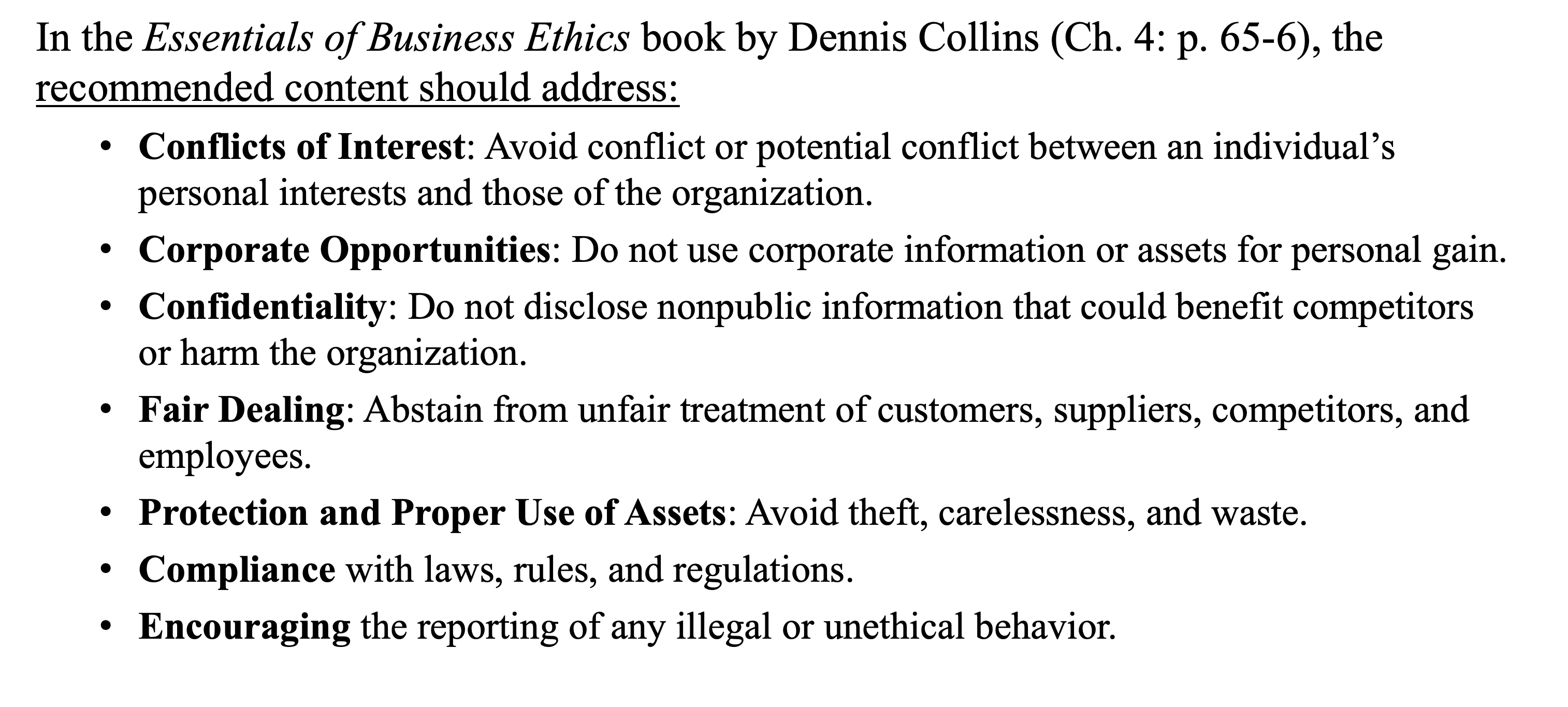
Code of Conduct Content Should Address:
Conflicts of Interest
Corporate Opportunities
Confidentiality
Fair Dealing
Protection and Proper Use of Assets
Compliance
Encouraging
Evaluating the Ethics Program
Surveys are probably the most common approach to evaluation Surveys can target knowledge, attitudes, skills, and behaviors.
• Don’t ask questions if you’re not willing to accept the answer.
• Employees will expect action based on survey results.
• If you’ve asked them to take the time to complete a survey, you should communicate the results and planned action.
Compliance versus Value-based approaches Definitions
Compliance-Based:
Rooted in law & regulations
Reactive
Limited senior management involvement
Obvious penalties
“Signatures required”
Values-Based:
Rooted in culture & driven by values
Proactive and aspirational
Commitment from senior management
Aligned with performance measures
Compliance versus Value-based approaches Employee Behavior
Compliance-Based:
Employees are more likely to:
think company is protecting itself
seek advice outside
be cynical
Less likely to:
report bad news
be committed
Values-Based:
Employees are more likely to:
seek advice inside
be willing to report
be committed
support decisions
be aware of ethical & legal issues
Less likely to:
to be unethical
Influencing ethical behavior of employees
Unethical behavior is rarely as simple as a bad apple. It’s often something about the work environment that allows the bad apple to behave badly.
For most people ethical conduct depends largely on external factors such as
1. the rules of the work context,
2. rewards and punishments,
3. what peers are doing,
4. what authority figures expect,
5. and the roles people are asked to play.
It’s the manager’s responsibility to create a work environment that supports ethical behavior and discourages unethical behavior just as much as it’s the manager’s responsibility to manage for productivity or quality.
The Multiple Selves
People are socialized to behave according to the context.
• We behave differently depending on the situation we confront.
• Although we might prefer to think that we take a single ethical self from situation tos ituation, reality suggests that most people behave differently in different contexts.
• This means that we can and often do have multiple ethical selves depending on expectations.
• Integrity is defined as “that quality or state of being complete, whole, or undivided.”
• Individuals of strong character and high integrity are thought to be consistent and ethical across contexts.
Reward and Discipline
People do what’s rewarded and avoid doing what’s punished
• The performance appraisal system
• The exclusive focus on goals frequently obscures the method of reaching a goal.
People will go the extra mile to achieve goals set by their managers
• Incentives and goals setting
• The “Pygmalion effect”
Recognize the power of indirect rewards and punishments
• The social learning theory
• Employees are constantly observing what behavior is accepted and what’s not.
• Disciplinary action has to be fair and consistent
“Everyone is doing it”
Individuals are much more likely to engage in unethical behavior if they’re convinced that others are doing it too.
• People follow group norms
• Social consensus on what is ethical and unethical
• Norms help in rationalizing unethical behavior
• Pressure to get along
• Ostracism by the group to the ‘goody-goody’ ethical people
Practical advice to managers:
1. Be aware of the power of the group norms
2. Influence group norms to be ethical
3. Identify the group leader and attempt to influence
4. Consider the reward system as a way of shaping group norms
People fulfill assigned roles
Roles are strong forces that guide behavior.
• Individuals act “in-role” and do what is expected of them inside organizations.
• Focusing on the role reduces the individual’s awareness of the self as an independent individual who is personally responsible for an outcome
(deindividuation).
• Perfectly normal people can behave cruelly and aggressively when placed in a role where these behaviors are expected or allowed.
Practical advice to managers:
1. Be aware that roles influence behavior.
2. Minimize conflicting role demands.
3. Consider the extent to which organizational roles encourage either ethical or unethical behavior.
People do what theyre told (أنا عبد المأمور)
Organizations are authority structures whose members accept the idea that, to be members in good standing, they must give up a certainamount of independence and autonomy.
Individuals often feel that they owe the organization and their manager their loyalty, thus further reinforcing the pressure to comply.
Practical advice to managers:
1. Be aware of the power authority figures have
2. Don’t assume that individuals act without influence from an
authority figure.
3. Send message that employees are expected to question authority
figures if asked to do something they believe is wrong.
Diffused responsibility in organizations
The sense of personal responsibility is a prerequisite for moral action.
In organizations, the individual often becomes disconnected from the consequences of his or her actions and doesn’t feel personally responsible for them.
Responsibility is diffused because it is taken away, shared with others in decision-making groups, obscured by the organizational hierarchy, or diluted by psychological distance to potential victims.
Practical advice to managers:
1. Spell out the responsibilities associated with specific positions, and hold individuals to those expectations.
2. When it comes to groups, make it clear that every group member will be held personally responsible for the outcome of group decisions.
Corporate Social Responsibility
It is difficult to separate ‘‘internal’’ organizational ethics from ‘‘external’’ social responsibility
CSR focuses on relationship between the organization and external stakeholders.
Stakeholder: “any party (e.g., customers, employees, suppliers, the government, stockholders, the community) who is affected by the business and its actions and who has a stake in what the organization does and how it performs.’’
Why Corporate Social Responsibility (CSR)? pragmatic
1. For pragmatic reasons
• Corporation must use power responsibly or risk losing it.
• Maltreated employees can strike.
• Dissatisfied customers can boycott products
• Interest groups can create harmful publicity.
• Government can pass laws that limit the firm’s activities or close it
So under the pragmatic approach to corporate social responsibility, a firm’s managers scan the environment and are on alert to act in ways that avoid economic harm, maintain legitimacy, and ensure a good corporate reputation.
Why Corporate Social Responsibility (CSR)? ethical
2. For ethical reasons
• Businesses, as part of society, have a responsibility to behave ethically.
• Executives have an ethical duty to care about multiple stakeholders because it is simply the right thing to do.
• Support proactive corporate policies and practices that extend beyond current legal or regulatory requirements.
• Executives weigh the harms and benefits to multiple stakeholders (including shareholders) of the firm’s activities, and they aim to make decisions that benefit the societal greater good.
Therefore, those who argue for the duty-based perspective argue that the positive ethical duty exists whether or not an economic payoff is likely to result.
Why Corporate Social Responsibility (CSR)? strategic
3. For strategic reasons
• Being socially responsible creates shared value and can differentiate a company from its competitors.
• When society prospers, business prospers, because business needs a healthy society because only a healthy society can produce a productive workforce, trust, and integrity that make business transactions possible.
• Each firm should analyze its competences in search for initiatives that will create shared value – e.g. by scrutinizing the social impact of the company’s value chain.
Therefore, this approach is more proactive than the pragmatic approach as companies add a social dimension to the firm’s overall competitive strategy.
Types of Corporate Social Responsibility: The Economic Responsibility
It involves its primary function of producing goods and services that consumers need and want, while making an acceptable profit.
Fulfilling this responsibility effectively is considered to represent an important purpose of business because it provides good jobs, important products and services, and contributes to a vibrant economy.
Types of Corporate Social Responsibility: The Legal Responsibility
Beyond economic responsibilities, business is expected to carry out its work within the current law and government regulations (e.g. advertising in the pharmaceutical industry).
The law can be viewed as representing the minimum norms and standards of business conduct agreed upon within a society.
Types of Corporate Social Responsibility: The Ethical Responsibility
The Ethical Responsibility It goes beyond legal responsibilities to encompass the more general responsibility to avoid harm and do what’s right.
Example: It is illegal to sell cigarettes to minors in the US. But that’s what tobacco companies do in many parts of Asia.
Types of Corporate Social Responsibility: The Philanthropic Responsibility
The Philanthropic Responsibility Participation in activities that promote human welfare or goodwill generally through donations of time and money or products and services.
Example: The Bill and Melinda Gates have decided to give away 95 percent of their wealth. They are particularly interested in health (AIDS, malaria, tuberculosis), agricultural development, and education.
The Triple Bottom line
A firm’s economic, social, and environmental impacts.
1. The economic bottom line - the economic impacts of a firm, e.g. jobs, welfare
2. The social bottom line - a firm’s impacts on multiple stakeholders such as employees, customers, suppliers, and the broader community.
3. The environmental bottom line- the impact of business on the natural environment.
The term Sustainability has sometimes been used to represent harmony among these three dimensions. It is also used to focus on the environmental impact ‘‘long- term growth that doesn’t deplete natural resources and lowers emissions of greenhouse gases.’’
The term ‘greenwashing’ have been used to describe corporate efforts that are seen as disingenuous attempts at public relations rather than sincere efforts to reduce environmental harm or to do good.
What do businesses owe their stakeholders?
Stakeholders are those individuals or groups who have a stake in what the organization does or how it performs.
1. Primary stakeholders are those groups or individuals with whom the organization has a formal, contractual relationship. In most cases this means customers, employees, shareholders or owners, suppliers, and perhaps even the government.
2. Secondary stakeholders are other individuals or groups to whom the organization has obligations, but who are not formal, contractual partners.
What do businesses owe customers? “Due Care Theory”
Design. Products and services should meet all government regulations and specifications and be safe under all foreseeable conditions, including misuse by the consumer.
Materials. Materials should meet government regulations and be durable enough to withstand reasonable use.
Production. Products should be made without defects.
Quality control. Products should be inspected regularly for quality.
Packaging, labeling, and warnings. Products should be safely packaged, should include clear, easily understood directions for use, and should clearly describe any hazards.
Notification. Manufacturers should have a system in place to recall products that prove to be dangerous at some time after manufacture and distribution.
 Note
Note  Flashcards (26)