Exam 2 SOCY
 Call Kai
 Learn
Learn Practice Test
 Spaced Repetition
 Match
Match Flashcards
 Knowt Play
1/75

There's no tags or description
Looks like no tags are added yet.
Name | Mastery | Learn | Test | Matching | Spaced | Call with Kai |
|---|
No analytics yet
Send a link to your students to track their progress
76 Terms
Crime
Behavior that violates criminal law and is punishable with fines, jail terms, and/or other negative sanctions
Deviance
Anytime you do something that goes against the social norm, the society or group in which it occurs.
White Collar Crime
The crime that's committed by those who have wealth and power, like corporate America
Corporate crime is a this type
Examples of White Collar Crime
Embezzlement: When you steal money from the company you work for
Insider trading: Where you have confidential information about a stock that you give advantage that the other shareholders don’t have
Stigma
A label that identifies the deviant as socially unacceptable. It is negative and, as such effects the person's construction of their social self
Example of Stigma
-Pedophile wife beater
-somebody engaged in criminal sexual conduct with a minor
Social Stratification
The hierarchical arrangement(arranged in order of rank) of large social groups based on their control of basic resources like wealth, income, race, education, and power
Putting people into different categories and different layers.
Slavery
The most extreme form of legalized social
inequalitya stratification system where Individuals are owned as property, usually for Criminal sanction, Debt, or war
Caste
a stratification system where its Hereditary (inherited) ranking. Often based in religious dogma -core, authorized beliefs in a faith.
You were born into it. It had nothing to do with your efforts. That would literally affect the rest of your life. What kind of ..……
occupation
Marriage within caste
Social life restricted to "own kind.”
False Consciousness
A Marxist sociological concept describing how subordinate classes (e.g., workers) unknowingly adopt the ideology of the dominant class (e.g., owners), preventing them from recognizing their own oppression
Is not understanding who the players are and what their actual concerns are and what their actual goals are.
False Consciousness examples
The CEO makes 100 times more than I do. OK, well, maybe he just works 100 times harder, or maybe what he does is 100 times more important, right? But in reality, it is the unequal structure or some other factor
Voting Against Interests: A low-income worker voting for policies that reduce taxes on corporations and cut social services, often believing in "trickle-down" economics or that they too will soon be wealthy.
Proletariat
The working class,
Capitalist
bourgeoisie, those who own and control the means of production
Social Class
A group of people who have a similar level of wealth and income
Status Group
People who share the same prestige or lifestyle, usually through membership in a desirable group, meaning that they do something similar.
They tend to socialize with one another, marry within their own group of social equals, spend, etc.
Example: A plumber and a college professor have the same social class in terms of money but not status group.
Power
Is the ability of people or groups to achieve their goals despite opposition from others. (Marx)
Influence
The process by which individuals or groups change their behaviors, opinions, or beliefs due to social interactions, norms, and pressures.
Prestige
The respect or regard that a person or a status position is given by others. It's how well you're respected in society.
usually a Positive position in society,
Esteem
A particular type of prestige, the reputation one earns within their field or occupation
Concerted cultivation
The way the middle class raises its kids
Talk, talk, talk: they start talking to the kids like the kids are older than they are.
Negotiation: example- extra x-box time if you clean your room
Routine activities designed to develop skills
Challenge Authority
Natural Growth
The way the lower class/poor raise their kids
Unstructured
Authoritarian- example: go clean your room!
Long periods of free time with no scheduled activities: usaully they play outside until it gets dark
Independent earlier
Status symbol
those things which have been given a social meaning that identifies a status in society.
Example: When someone wears firefighter suit or a Rolex (means they are wealthy)
Prejudice
Rigid and unfair generalization about an entire category of people
Often based on stereotypes: overgeneralizations about the appearance, behavior, or other characteristics of members of categories.
Not always negative
Example: All Irish people have red hair or Asians are good at math
is an attitude
Discrimination
Unequal treatment of various categories of people is usually based on prejudice
Is an action
Race
• Socially constructed category
often on the basis of physical characteristics such as skin color, hair texture, eye shape, or other selected attributes.
Example: European descent, White, Black, Mixed
Ethnicity
is defined by cultural traits, such as ancestry, language, or religion.
Shared cultural heritage
can be more complex than race
Example: Irish, Argentinian, Hispanic/Latino, Arab, Chinese,
Genocide
systematic killing of one category of people by another
Example: Holocoust , Armenian Genocide
Amalgamation
when members of one group marries those of other social or ethnic groups
Segregation
physical and social separation of people into categories on purpose.
Example:
Jim Crow laws (black and whites were separated into different public facilities like bathrooms and schools,
Internment camps (Japanese put into one neighborhood in the USA during World War II)
Assimilation
a social and cultural merging. In this form, the immigrating culture adopts cultural aspects of the dominant culture
For example, Salad and Soup are made from similar ingredients, but in soup, you can’t really distinguish the ingredients. Assimilation is like the soup
Sex
refers to the biological and anatomical differences between females and males.
Primary sex characteristics
Refer to the genitalia used in the reproductive process.
Secondary sex characteristics
Refer to the physical traits that identify an individual's sex.
Gender
Refers to the culturally and socially constructed differences between females and males
Functions of deviance
can help to clarify and define social norms- like “you see what that guy's doing? Don't do that.”
can increase group solidarity- especially in fear when 911 happened, or any other bad event against the norm
can bring about needed change in the social system. Sometimes you can bring about a social change by what is technically engaging in deviance, such as a protest
makes conformity(obedience to laws/rules, etc.) seem more desirable- when someone commits a deviance, they go to jail, prison, or pay fines, etc. When someone sees that happen, they say, I don't know. That doesn't look very desirable to me. I don't think I want any part of that,
Dysfunctions of deviance
The presence of deviance can destroy other people’s motivation to conform.- When you see somebody engaging in deviant or criminal behavior, and they seem to be rewarded for it, that makes you not want to conform.
Deviance can destroy the trust necessary to preserve organized social life. controversy, scandals, people, a lot of people enriching themselves in gov’t leading to mistrust.
Example: political corruption
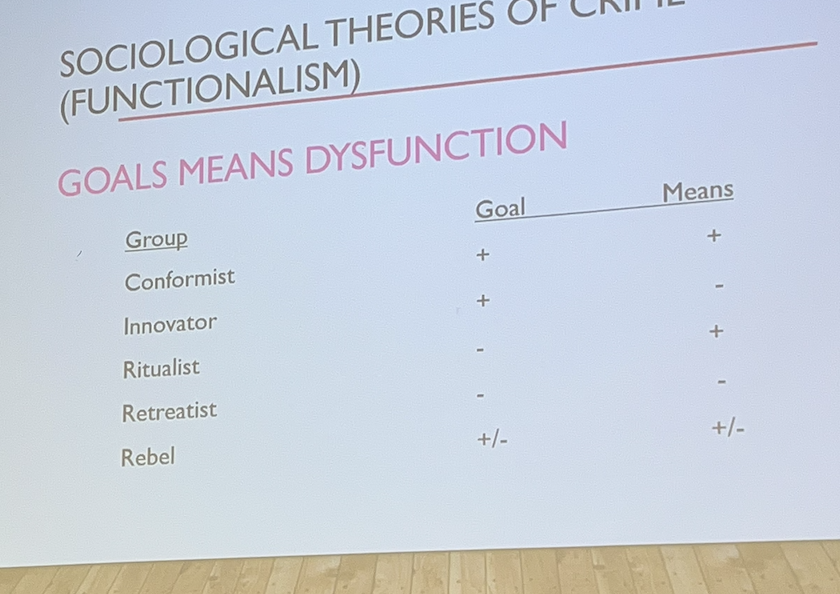
The four types of Goals-Means Dysfunctions,(sociological theories of crime (functionalism) )
Conformist
Innovator
Ritualist
Retreatist
Conformist
Wanting to go the traditional route of being successful and having stuff. Which is going to college to get a better job and make more money.
Innovator
Wanting to be successful and have stuff, but not in a traditional route (such as conformist). Instead, a different means, such as gambling, swinging dope, robbing banks, or creating a business without a degree.
Ritualist
Opposite of an innovator. They are going the traditional route of college and working to get more money, but their goal is not necessarily to be that successful
Retreatist
They're not interested in either being successful or the traditional route.
Examples: Drug addicts, homeless person
The four types of Goals-Means Dysfunctions digram
What is strain theory?
Crime is a “coping mechanism”. Crime is the result of excessive stress and strain placed on individuals by societal structure. They are unable to obtain goals because they do not have access to culturally approved means of achieving those goals.
Part of the strain theory is goals means dysfunction.
Comes from financial strain, it's achievement strain, etc.
What is Social Bond Theory
Most people don't commit crimes because they form a healthy and functional bond with their society.
A type of social control theory (The ability to control the behavior of institutions, groups, or individuals)
Has four components of why people don’t commit crimes because they form a healthy and functional bond with their society.
What are the four components of Social Bond Theory
Attachment
Involvement
Commitment
Belief
Attachment of Social Bond Theory
Your ability to relate to others through interest. The number of people you have in your life that are important to you, that you would not want to lose so you don’t commit a crime
Involvement of Social Bond Theory
Conventional activities that you have that are healthy and functional, but also limit your time to engage in criminal activity.
Commitment of Social Bond Theory
The time, energy, and effort expended on conventional actions, such as getting an education. You don’t want to lose it, so you don’t commit a crime.
Belief of Social Bond Theory
Your moral belief in those institutions, your morals don’t align with crimes so you don’t commit a crime.
Marx’s view of class as it relates to capitalism
Marx stated that capitalistic societies consist of two classes—the capitalists and the workers—and class relationships involve inequality and exploitation, as capitalists profit by paying workers less than the value of their labor, creating an inevitable class conflict.
How Interactionists view the effect of class on lifestyle
Mainly concerned with the effect of social class on one's lifestyle. Such as
Education- effects of where you went and go to school, how much schooling you have (master’s, bachelor's, or just high school, or whether private or public or get extra help for SAT or other school resources etc.)
Health- health insurance, quality of medicine, quality of food.
Family Life-
-Single Parent-Two-parent households are better than 1 household income.
-Choice of Husband or Wife-The choice of husband or wife is usually from the same class, because usually, two opposite classes will end up in dispute. After all, they view things differently, like housing, paying a certain amount
-Child Rearing (Annette Lareau, University of Pennsylvania)-Class also affects how you raise your kids, either Concerted Cultivation (Middle Class) or Natural Growth (lower Class/Poor)
Davis & Moore’s explanation of inequality
Their explanation was….
Inequality is necessary to ensure that certain important positions are filled
Rewards( money, prestige) are based on the importance of the position and the scarcity of qualified personnel
Greater rewards need to be offered in order to entice qualified people
For example, going to med school is extremely hard, but people step up because of the amount of money that comes with being a doctor.
Both had a functionalist perspective where
Class structure provides a competitive arena
Class structure provides a motivating force: because people from different classes see others from a better class and want it for themselves, so they try to achieve it.
Criticism of Davis and Moore explanation of inequality
Doesn't address other motivations
Values
Intrinsic satisfaction
Personal pleasure
Doesn't apply to Societies where status is inherited
Doesn't explain Athletes and celebrities. (really not that necessary in society, but makes more money than doctors)
How the poverty line is established
Determined by the US Dept. of Agriculture and other
Government Agencies each yearAdjusted by family size and related to food consumption
2026
Family of 4 earning less than $33,000 per annum
(approximately $2,540 /month take-home)
Absolute poverty
The the minimum level of subsistence that no family should live below.
Relative poverty
A standard by which people are defined as being disadvantaged when compared to the nation as a whole.
*We look at folks, and we say, " Is this person poor compared to the rest of the country? not necessarily specific, like annual income or anything like that. When we talk about relative poverty, we can either compare nations. Let's take the person who in America we would consider impoverished, and we can look at how that person lives, what they have access to. And take that person and compare them to a standard of living in another country
Herbert Gan’s explanation of the role of the poor
Herbert Gans identified a number of social, economic, and political functions that the poor perform for society:
Menial(like McDonald’s) jobs are performed at low cost (because we need jobs that don't necessarily require a whole lot of skill)
Creates jobs for those that serve the poor
Perception of the poor as deviants upholds the legitimacy of conventional social norms (motivates you or demotivates you to get an education or work hard)
Existence of poor guarantees the higher status of the more affluent (rich )- creates a society where we have a top (rich people) and the bottom (poor) rather than a horizontal society like communism tried to achieve.
What is Social Mobility?
Movement of individuals or groups from one position of a society's stratification system to another.
What are the different types of mobility
Intergenerationalk
Intragenerational
Horizontal
Vertical
Intergenerational Mobility
refers to changes in the social position of children relative to their parents.
Your position has improved or decreased relative to where your parents work, doing better or worse than your parents
Intragenerational Mobility
refers to changes in social position within a person's adult life.
Horizontal Mobility
is movement within the same range of prestige.
Vertical Mobility
movement from one position to another of a different rank, and this movement can be upward or downward.
What are the two main reasons for world inequality
Modernist Theory
Dependence Theory
Modernist Theory
A model of economic and social development that explains global inequality as the result of technological and cultural differences between nations, eventually, all nations will catch up.
Dependence Theory
A model of economic and social development that explains global inequality as the result of the historical exploitation of poor nations by rich ones
World systems analysis
a macro-level framework developed by Immanuel Wallerstein to study global social, economic, and political inequality.
World systems analysis types
Core
Semi periphery
Periphery
Core
Complex bureaucracy- Very large, very effective. Political system and administration, government
Diversified economy-economy is made up of a lot of different industries.
Complex infrastructure-roads, power grids, water systems, sewer systems.
Free public education
Powerful military used to project influence
Usually designs devices such as phones and gets the most money out if it
Semi periphery
Lies between the two extremes
Core in decline or periphery in ascension
Less diversified economy and political influence abroad
usally were assemply of devices such as phones happens
Periphery
Least developed countries-the vast bulk of their economy is centered on one or two industries, usually raw materials and inexpensive labor
Exploited for cheap labor and raw materials
Poor infrastructure
Poor access to education
Military largely for internal control
usally were raw materials come from for devices such as phones
Meaning of sexual orientation
Sociological meaning of gender
In sociology, gender refers to the social and cultural meanings, roles, behaviors, and expectations that a society assigns to people based on their perceived sex.
culturally and socially constructed differences between females and males, including gender roles. identity, Sexism
Gender Roles
refers to the culturally relative attitudes, behavior, and activities that are socially defined as characteristic of each sex and are learned through the socialization process.
Masculinity: Attributes considered appropriate for males
Femininity: Attributes considered appropriate for females
Gender identity
a person's perception of the self as female or male and acknowledging one's sex and internalizing the norms, values, and behaviors associated with its gender expectations
Sexism
The subordination of one sex, based on the assumed superiority of the other sex.
directed at women has three components:
Negative attitudes
Stereotypical beliefs
Discrimination

