A&P - 12.1 Basic Structure and Function of the Nervous System

0.0(0)
studied byStudied by 0 people
0.0(0)
full-widthCall with Kai
learnLearn
examPractice Test
spaced repetitionSpaced Repetition
heart puzzleMatch
flashcardsFlashcards
GameKnowt Play
Card Sorting

1/21

encourage image

There's no tags or description

Looks like no tags are added yet.

Study Analytics
Name
Mastery
Learn
Test
Matching
Spaced
Call with Kai

No study sessions yet.

22 Terms

1
New cards

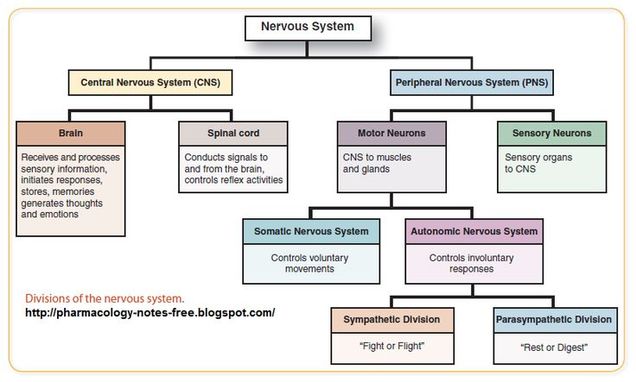
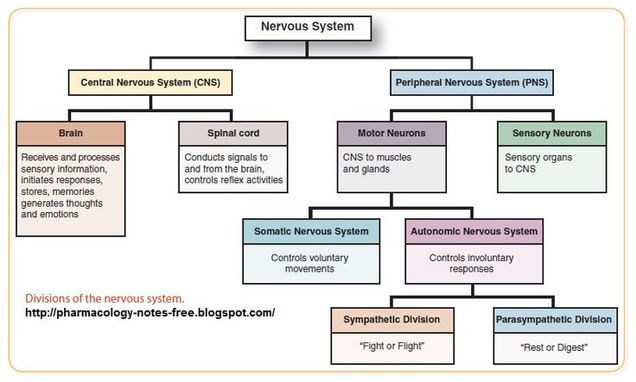
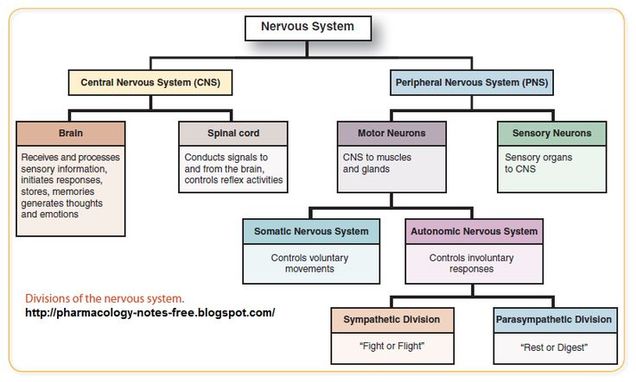
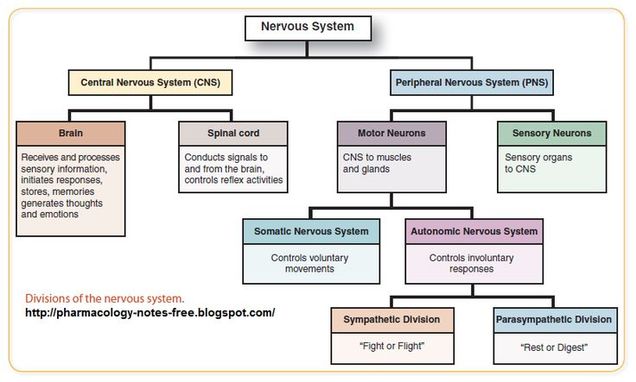
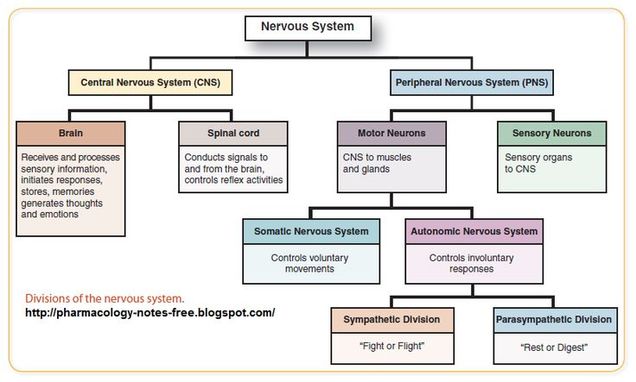
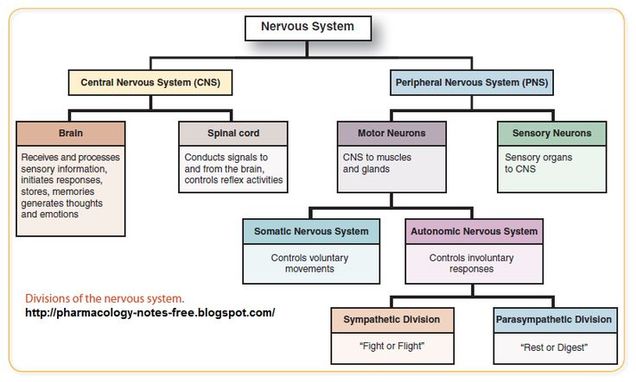
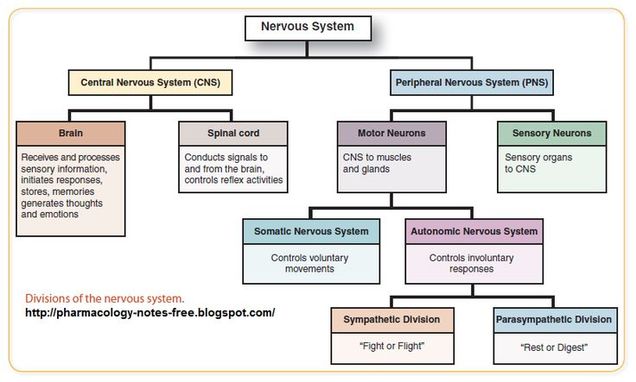
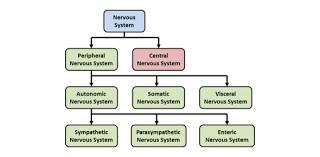
divisions of the nervous system

  • central nervous system (CNS)

  • peripheral nervous system (PNS)

<ul><li><p>central nervous system (CNS)</p></li><li><p>peripheral nervous system (PNS)</p></li></ul><p></p>
2
New cards

central nervous system (CNS)

interprets sensory input and dictates motor responses based on past experiences, reflexes, and current conditions

  • “seat of all mental activity”

<p>interprets sensory input and dictates motor responses based on past experiences, reflexes, and current conditions</p><ul><li><p>“seat of all mental activity”</p></li></ul><p></p>
3
New cards

main structures of central nervous system (CNS)

  • brain

  • spinal cord

<ul><li><p>brain</p></li><li><p>spinal cord</p></li></ul><p></p>
4
New cards

brain

receives and processes sensory information, initiates responses, stores memories, generates thoughts and emotions

  • the large organ of the central nervous system composed of white and gray matter, contained within the cranium and continuous with the spinal cord
<p>receives and processes sensory information, initiates responses, stores memories, generates thoughts and emotions</p><ul><li><p>the large organ of the central nervous system composed of white and gray matter, contained within the cranium and continuous with the spinal cord</p></li></ul><p></p>
5
New cards

spinal cord

conducts signals to and from the brain, controls reflex activities

  • organ of the central nervous system found within the vertebral cavity and connected with the periphery through spinal nerves; mediates reflex behaviors
<p>conducts signals to and from the brain, controls reflex activities</p><ul><li><p>organ of the central nervous system found within the vertebral cavity and connected with the periphery through spinal nerves; mediates reflex behaviors</p></li></ul><p></p>
6
New cards

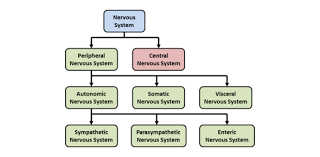
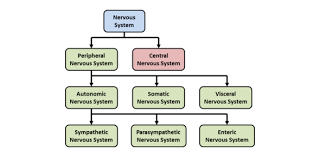
peripheral nervous system (PNS)

cranial & spinal nerves are the communication lines between the CNS and the rest of the body

  • functional divisions of the peripheral nervous system:

    • sensory division (somatic and visceral subdivisions)

    • motor division (somatic and visceral subdivisions)

      • somatic nervous system

      • autonomic nervous system

      • enteric nervous system

<p>cranial &amp; spinal nerves are the communication lines between the CNS and the rest of the body</p><ul><li><p>functional divisions of the peripheral nervous system:</p><ul><li><p>sensory division (somatic and visceral subdivisions)</p></li><li><p>motor division (somatic and visceral subdivisions)</p><ul><li><p>somatic nervous system</p></li><li><p>autonomic nervous system</p></li><li><p>enteric nervous system</p></li></ul></li></ul></li></ul><p></p>
7
New cards

main structures of peripheral nervous system (PNS)

  • cranial nerves

  • spinal nerves

  • specialized receptors

<ul><li><p>cranial nerves</p></li><li><p>spinal nerves</p></li><li><p>specialized receptors</p></li></ul><p></p>
8
New cards

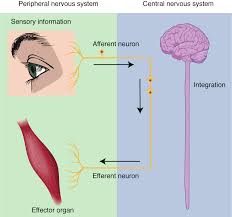
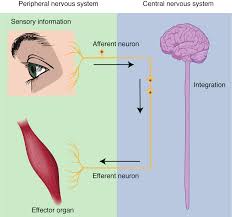
sensory (afferent) division

sensory organs to CNS

conducts impulses of the body into the CNS (carries signals from receptors to CNS)

  • considered the “input” region

<p><strong>sensory organs to CNS</strong></p><p>conducts impulses of the body into the CNS (carries signals from receptors to CNS)</p><ul><li><p>considered the “input” region</p></li></ul><p></p>
9
New cards

somatic sensory division

carries signals from receptors in the skin, muscles, bones, and joints - and then transmits the stimulus to the brain and spinal cord for interpretation
<p>carries signals from receptors in the skin, muscles, bones, and joints - and then transmits the stimulus to the brain and spinal cord for interpretation</p>
10
New cards

visceral sensory division

carries signals from the viscera (heart, lungs, stomach, and urinary bladder) - and then transmits the stimulus to the brain and spinal cord for interpretation
<p>carries signals from the viscera (heart, lungs, stomach, and urinary bladder) - and then transmits the stimulus to the brain and spinal cord for interpretation</p>
11
New cards

motor (efferent) division

CNS to muscles and glands

carries signals (motor neurons conduct impulses) from CNS to effectors (glands and muscles that carry out the body’s response) to produce a response to a stimulus

  • considered the “output” region

  • further subdivided functionally into:

    • somatic nervous system (SNS)

    • autonomic nervous system (ANS)

    • enteric nervous system (ENS)

<p><strong>CNS to muscles and glands</strong></p><p>carries signals (motor neurons conduct impulses) from CNS to effectors (glands and muscles that carry out the body’s response) to produce a response to a stimulus</p><ul><li><p>considered the “output” region</p></li><li><p>further subdivided functionally into:</p><ul><li><p>somatic nervous system (SNS)</p></li><li><p>autonomic nervous system (ANS)</p></li><li><p>enteric nervous system (ENS)</p></li></ul></li></ul><p></p>
12
New cards

somatic nervous system (SNS) - somatic motor division

controls voluntary movements

carries signals to skeletal muscles

  • a voluntary system that conducts impulses from the CNS to skeletal muscles

  • output produces muscular contraction as well as somatic reflexes (involuntary muscle contractions)
<p><strong>controls voluntary movements</strong></p><p>carries signals to skeletal muscles</p><ul><li><p>a voluntary system that conducts impulses from the CNS to skeletal muscles</p></li><li><p>output produces muscular contraction as well as somatic reflexes (involuntary muscle contractions)</p></li></ul><p></p>
13
New cards

autonomic nervous system - visceral motor division 

controls involuntary responses

carries signals to glands, cardiac and smooth muscle

  • involuntary because it conducts impulses from the CNS to cardiac muscles, smooth muscle, and glands

  • its involuntary responses are visceral reflexes

  • further subdivided functionally into:

    • parasympathetic nervous system

    • sympathetic nervous system

<p><strong>controls involuntary responses</strong></p><p>carries signals to glands, cardiac and smooth muscle</p><ul><li><p>involuntary because it conducts impulses from the CNS to cardiac muscles, smooth muscle, and glands</p></li><li><p>its involuntary responses are visceral reflexes</p></li><li><p>further subdivided functionally into:</p><ul><li><p>parasympathetic nervous system</p></li><li><p>sympathetic nervous system</p></li></ul></li></ul><p></p>
14
New cards

parasympathetic nervous system

“rest or digest”

conserves energy and maintains homeostasis

  • tends to have calming effect

  • slows heart rate and breathing

  • stimulates digestive and urinary systems
<p><strong>“rest or digest”</strong></p><p>conserves energy and maintains homeostasis</p><ul><li><p>tends to have calming effect</p></li><li><p>slows heart rate and breathing</p></li><li><p>stimulates digestive and urinary systems</p></li></ul><p></p>
15
New cards

sympathetic nervous system

“fight or flight”

mobilizes the body to respond to “emergency” situations or when the body has moved outside of homeostasis

  • tends to arouse body for action

  • accelerating heart beat and respiration, while inhibiting digestive and urinary systems
<p><strong>“fight or flight”</strong></p><p>mobilizes the body to respond to “emergency” situations or when the body has moved outside of homeostasis</p><ul><li><p>tends to arouse body for action</p></li><li><p>accelerating heart beat and respiration, while inhibiting digestive and urinary systems</p></li></ul><p></p>
16
New cards

enteric nervous system (ENS)

frequently considered a part of the ANS but is specifically responsible for controlling the smooth muscle and glands of the digestive tract

  • involved with digestive system (neural tissue associated with the digestive system)

  • it is a large part of the PNS, and is not dependent on the CNS
<p>frequently considered a part of the ANS but is specifically responsible for controlling the smooth muscle and glands of the digestive tract</p><ul><li><p>involved with digestive system (neural tissue associated with the digestive system)</p></li><li><p>it is a large part of the PNS, and is not dependent on the CNS</p></li></ul><p></p>
17
New cards

functions of the nervous system

  • sensory input

  • integration

  • motor output

  • homeostasis

<ul><li><p>sensory input</p></li><li><p>integration</p></li><li><p>motor output</p></li><li><p>homeostasis</p></li></ul><p></p>
18
New cards

stimulus

an event in the external or internal environment that registers as activity in a sensory neuron

19
New cards

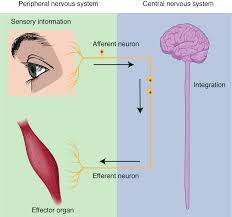
sensory input

sensation = use of sensory receptor to detect stimuli both inside and outside the body and then transmit those stimuli to the central nervous system

  • receives information from the environment and translates it into the electrical signals of nervous tissue
<p>sensation = use of sensory receptor to detect stimuli both inside and outside the body and then transmit those stimuli to the central nervous system </p><ul><li><p>receives information from the environment and translates it into the electrical signals of nervous tissue</p></li></ul><p></p>
20
New cards

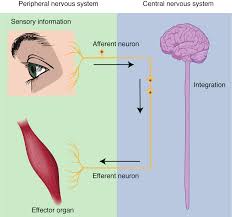
integration

process and interpret sensory stimuli and then determine and/or trigger and appropriate motor response to those stimuli

  • combines sensory perceptions and higher cognitive functions (memories, learning, emotion, etc.) to produce a response
<p>process and interpret sensory stimuli and then determine and/or trigger and appropriate motor response to those stimuli</p><ul><li><p>combines sensory perceptions and higher cognitive functions (memories, learning, emotion, etc.) to produce a response</p></li></ul><p></p>
21
New cards

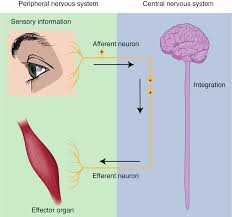
motor output

response = effects a response appropriate to the stimulus by sending an impulse from the central nervous system to the effector organs of the body such as the muscles and glands

  • causes a target tissue (muscle or gland) to produce an event as a consequence to stimuli
<p>response = effects a response appropriate to the stimulus by sending an impulse from the central nervous system to the effector organs of the body such as the muscles and glands</p><ul><li><p>causes a target tissue (muscle or gland) to produce an event as a consequence to stimuli</p></li></ul><p></p>
22
New cards

homeostasis

maintain homeostasis by acting as a regulatory or control center through sensory input, motor output, and integration functions
<p>maintain homeostasis by acting as a regulatory or control center through sensory input, motor output, and integration functions</p>