Psychology in the workplace
 Studied by 0 people
 Call with Kai
 Learn
Learn Practice Test
 Spaced Repetition
 Match
Match Flashcards
 Knowt Play
1/561

There's no tags or description
Looks like no tags are added yet.
Name | Mastery | Learn | Test | Matching | Spaced | Call with Kai |
|---|
No study sessions yet.
562 Terms
Industrial/Organisational Psychology (I/O psychology)
applies psychological concepts to optimize human behavior in workplaces. It extends beyond just the workplace because work behavior is influenced by external factors like family responsibilities, culture, and nonwork events.
Key Roles in I-O Psychology:
Scientists: Derive principles of individual, group, and organizational behavior through research.
Consultants/Staff Psychologists: Apply scientific knowledge to solve real-world problems in the workplace.
Teachers: Train others in the field.
Personnel (industrial) psychology
A subfield of I/O psychology often seen as aprt of HRM.
One of three major concentrations.
It focuses on managing the employee lifecycle: recruitment, selection, placement, training, appraisal, transfer, termination, and development.
It is based on two core assumptions:
People differ in their attributes (skills, personality) and work behavior.
Information about these differences can be used to predict, maintain, and increase both work performance and job satisfaction.
Organisational Psychology
A subfield of I/O psychology. One of three major concentrations.
It combines ideas from social psychology and organizational behavior.
It is concerned with the emotional and motivational side of work, including attitudes, fairness, motivation, and stress.
“Reaction of people to work and the results of those reaction”
Human Engineering
A subfield of I/O psychology, also called Human Factors Psychology. One of three major concentrations.
It is the study of human capacities and limitations with respect to their work environments.
Its goal is to develop an environment compatible with human characteristics. This is the opposite of Personnel Psychology, which finds people to fit into existing jobs.
It includes the design of tools, workspace, shift work, machine controls, and safety evaluation.
It integrates knowledge from many disciplines (e.g., engineering, psychology, physiology).
Green Behavior
It's an individual's actions to promote environmental sustainability
Conserving: Finding new uses for discarded/surplus items.
Avoiding Harm: Disposing of waste properly.
Transforming: Using innovation to reduce environmental impact.
Influencing Others: Persuading others to be more environmentally friendly.
Taking Initiative: Being environmentally responsible even when inconvenient.
employees do this consistently only when they perceive workplace support for it.
Society for Industrial and Organisational Psychology (SIOP)
It is the main professional association for I/O psychologists, serving both practitioners and researchers. It is Division 14 of the APA (American Psychological Association).
It is considered the single best resource for the field.
The goal of its new strategic initiative is to:
Promote the science of I/O psychology.
Increase SIOP's contribution to organizations and society.
Educate future I/O psychologists and their collaborators.
GOHWP - Contributions to society
It is an extension of I-O Psychology that applies its principles to humanitarian areas, such as poverty reduction.
It suggests that I-O knowledge and skills—like team building, training, reducing stereotypes, organizational justice, and changing mental models—are necessary to help reduce world poverty.
NU Cultural Agility Leadership Lab - Contributions to society
It is a program that partners with organizations like the Peace Corps.
It connects corporate-sponsored international volunteers with NGOs (Non-Governmental Organizations).
The goal is to provide valuable experience to the volunteers while delivering needed expertise to the NGOs.
Corporate Social Responsibility, CRS
It involves organizational actions and policies based on stakeholders' expectations across economic, social, and environmental performance. An example is donating a portion of sales. Benefits include an enhanced reputation and community good. I-O psychology research studies how CSR affects employee and customer attitudes and behaviors.
Bottom line of any organisation
Tends to be performance
Influences on performance
The system: I/O psychology is a multilevel science.
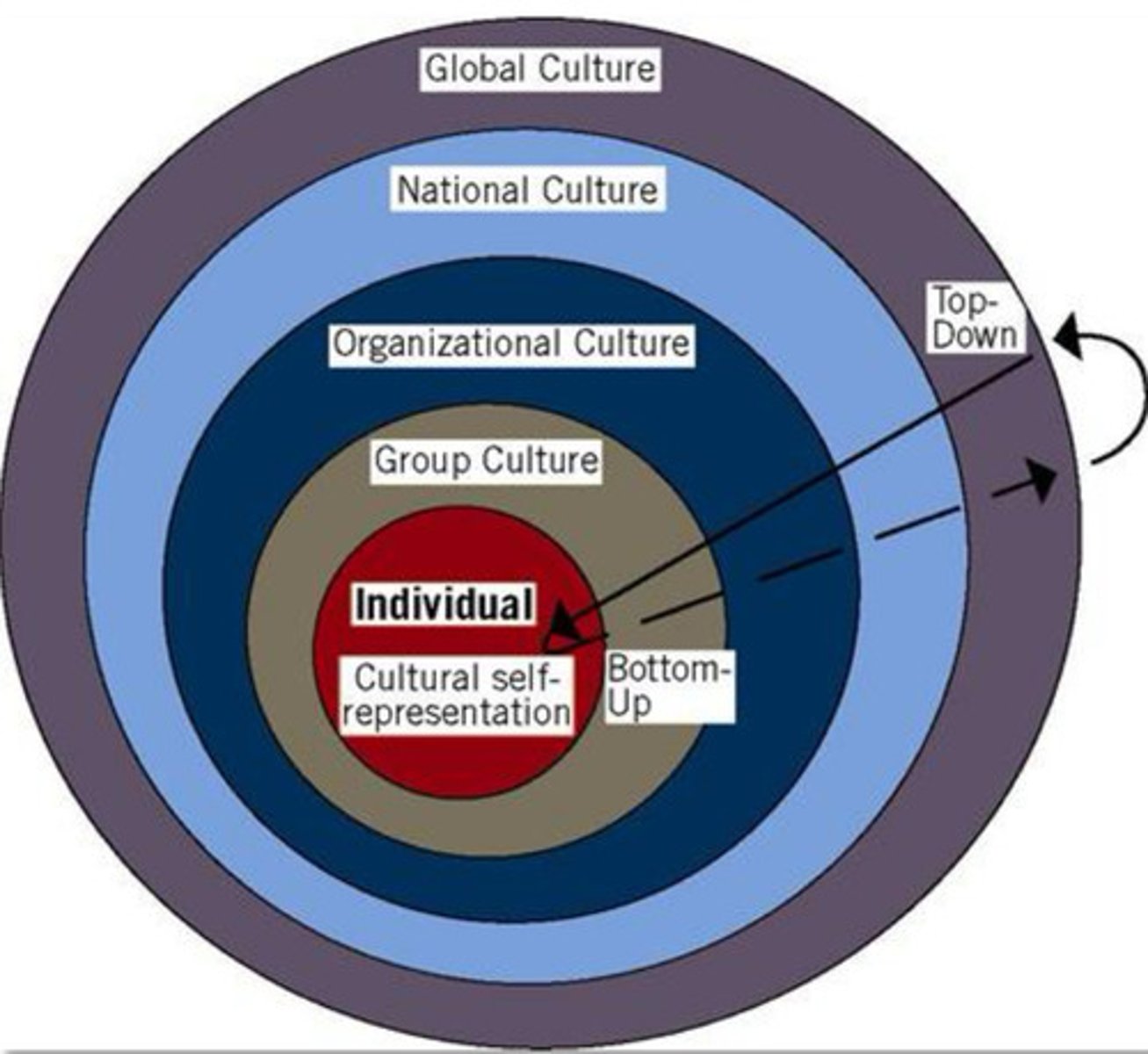
The Red Queen Effect
Idea: you must keep running and adapting just to keep up with your environment or competition.
This principle can be applied to many domains, including biological evolution and workplace psychology
Hawthrone Studies
Research in the 1920s-30s at the Western Electric company investigated how work setting characteristics (like illumination, rest breaks, and work hours) affected worker fatigue and performance.
The initial hypothesis was that intensity (e.g., of light) directly affects productivity.
The key discovery was that the presence of researchers was affecting the results, because employees reacted to the attention of being studied. This phenomenon is the Hawthorne Effect.
The studies led to a new emphasis on the human factor in organizations.
While its scientific value has been criticized, it remains a major influence on understanding the importance of human resources.
Answering I/O questions
Follow science by using evidence-based practices and scientific management.
However, the workplace sometimes adopts fads (like yoga balls and standing desks) before there is solid evidence to support their effectiveness.
Importance of work
Studies indicate roughly 70% of people would continue working even if given enough money to stop: points to importance of work as a noneconomic experience, and the meaning of work in defining who we are.
GoodWork Project vs. Compromised work
GoodWork Project: Create work that has high levels of expertise and involves regular concern for the wider implications of that work (e.g., a consultant working to restore civil order).
Achieving it is difficult due to pressures for low cost, high profits, doing more in less time, and rigid job roles.
Compromised work: not illegal/unethical but undermines the core values of a trade (e.g., a lawyer padding bills, a builder using cheap tools).
The responsibility for achieving Good Work lies in the hands of both the individual worker and the employer.
"Authenticity"
Trend of interest, “what consumers really want” in their work
In I/O, “an emotionally appropriate, significant, purposive, and responsible mode of human life”, reflected in the search for good work.
Young Workers
Aged 19-24 or younger, understudied.
Research suggests they find jobs developing or using their skills more satisfying. Without this, cynicism, a negative view of work, and lack of interest can result.
They are a valuable resource because they are often more educated, tech-savvy, globally aware, connected, and open-minded.
When problems occur, the culprits are often management and supervision, not the young workers themselves.
Student workers and academic performance
If nature of work is related to student's major, increases school performance and satisfaction.
If long hours and no/little control given to student, decreased academic performance.
Human Resources Management (HRM)
Involves practices such as recruitment, selection etc., in order to achieve individual and organizational goals
Organizational Psychology
Subfield of I-O Psychology that combines research from social psychology and organizational behavior and addresses the emotional and motivational side of work
Human Engineering (Human Factors Psychology)
The subfield of I-O Psychology that studies capacities and limitations of humans with respect to a particular environment
Scientist-Practitioner Model
A model that uses scientific tools and research in the practice of I-O psychology
TIP (The Industrial Organizational Psychologist)
Quarterly newsletter published by the SIOP
Welfare-to-Work Program
Program that requires individuals to work in return for government subsidies
Scientific Management - Taylorism
It is a movement based on the principles of Frederick W. Taylor.
Idea: there was one best and most efficient way to perform various jobs
Time and Motion Studies
method of Scientific Management (Taylorism)
These studies broke every job action into its constituent parts.
They timed those movements with a stopwatch.
The goal was to develop new, more efficient movements to reduce fatigue and increase productivity.
Revery Obsession
proposed by Elton Mayo.
It is a mental state caused by mind-numbing, repetitive, and difficult factory work in the early 20th century.
This state caused workers to become unhappy and resistant to management attempts to increase productivity.
Hawthorne Effect
A change in a subject's behavior caused simply by the awareness of being studied
Human Relations Movement
The results of the Hawthorne studies; focused on work attitudes and the newly discovered emotional world of the worker
The VII of the Civil Rights Act of 1964
Federal legislation that prohibits employment discrimination on the basis of race, color, religion, sex, or national origin, which define what are known as protected groups
"West versus the Rest" Mentality
Tendency for researchers
to develop theories relevant to U.S situations, with less concern given to their applicability in other countries
Expatriate
The manager or professional assigned to work
in a location outside his or her home country
Hofstede's theory
Proposes five basic elements that can be distinguished between cultures
Individualism vs. Collectivism
Power Distance
Masculinity vs. Femininity
Uncertainty Avoidance
Long-Term vs. Short-Term Orientation
Horizontal Culture
A culture that minimizes distances between individuals
Vertical Culture
A culture that accepts and depends upon distances between individuals
'I' part of IO
Industrial, how to find the right people for the right job
'O' part of IO
Organisational, how to keep people in the organisation
Research methods in IO
1. Quantitative (Non-experimental):
Uses correlational design, without treatment, often with validated scales (questionnaires).
Result: No causality can be inferred. Can test non-linear relationships (like an inverted U-model of stress).
2. Experimental:
Assigns participants randomly to treatment and control groups.
Manipulates an independent variable to measure effect on a dependent variable. Uses t-tests or ANOVA.
Result: Can more confidently infer causality.
3. Quasi-experiment:
Has attributes of both. Uses two pre-defined groups (no random assignment), like a "natural experiment".
Measures variables via surveys, but third-variables are a confounding problem.
4. Qualitative:
Studies with a small n (sample size). Uses interviews to understand a phenomenon and produce a narrative description.
Exploratory, gathers information not easily expressed in numbers.
Key Other Terms:
Reliability: Consistency of a measure.
Validity: Accuracy of a measure (does it measure what it claims?).
Generalisability: How well results apply to other settings/people.
Triangulation: Using multiple methods to study one thing, to increase confidence in findings.
The contingency approach
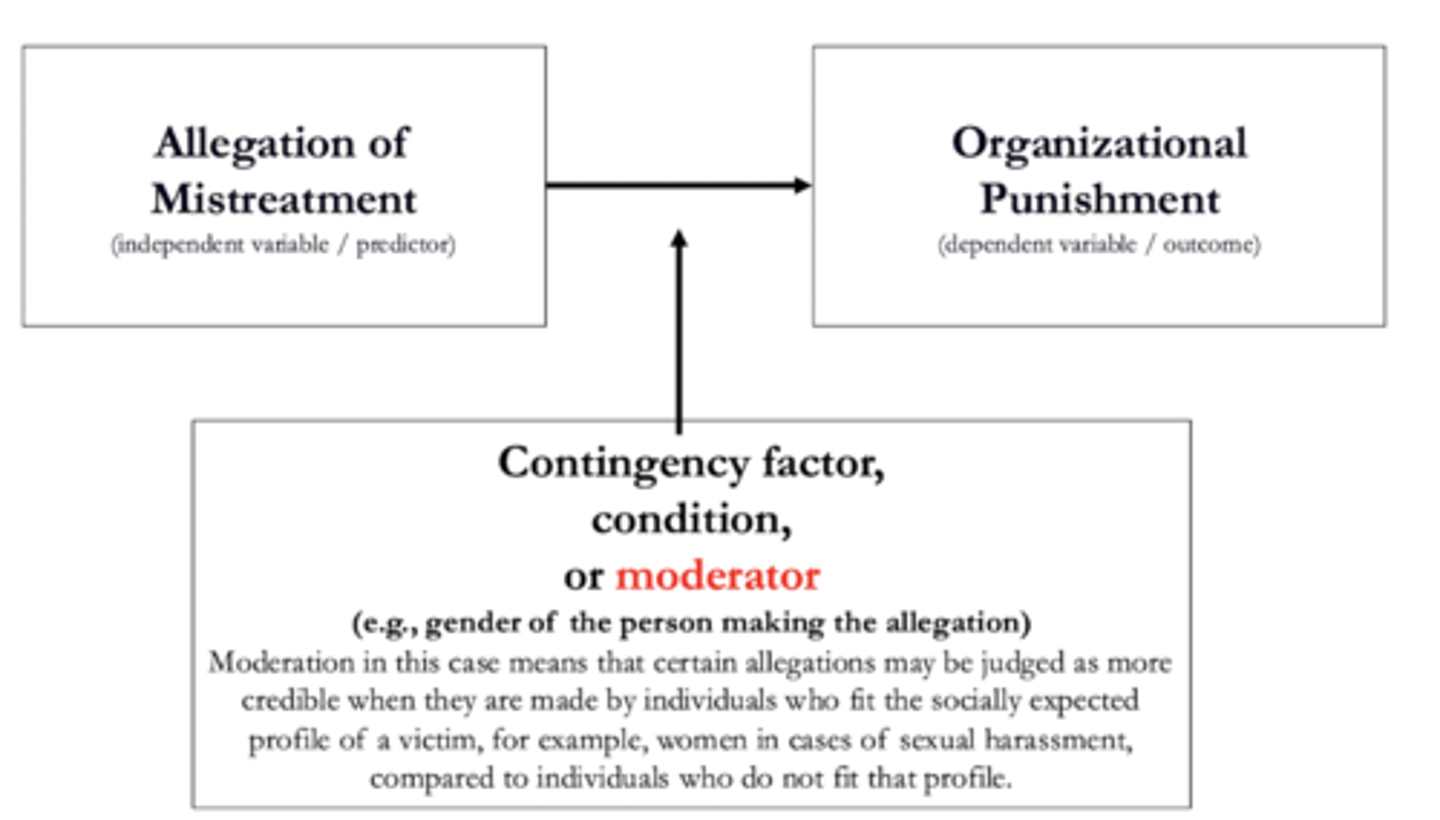
There is no single best way to manage or solve problems in organizations. The effectiveness of any action, trait, or strategy depends on the specific situation.
Situation-type variables that influence outcomes are called contingency factors, conditions, or moderators.
Contingency Factors
Or moderator
Situation-type variables (like gender) that influence a outcome of a event to people.
Example: The moderating effect of gender on the believability of mistreatment accusations, which in turn affects the organizational punishments given.
Mediatiors
why one thing causes another.
Example: High workload (predictor) → causes stress (mediator) → which leads to burnout (outcome).

Latent constructs
a hidden trait or concept (like intelligence or job satisfaction) that cannot be directly observed.
It must be measured using indicators (like survey questions) in a way that is reliable (consistent) and valid (accurate)
Triangulation
Approach in which researchers seek converging information from different sources.
1. Quantitative data
2. Qualitative data
3. Surveys
Issues to consider in interpreting research:
Statistical vs. practical significance,
Face validity vs. evidence based outcomes,
Effect size, power
Meta-analysis: most definite current standard of evidence (quality of included studies and publication bias)
Biased evidence standards
Occasionally, the enthusiasm precedes the evidence, also disinterestedness
Disinterestedness
scientific norm that researchers should be impartial and not let personal gain or bias influence their work. They must follow the evidence wherever it leads, regardless of their personal hopes or financial interests.
Micro-, Macro-, and Meso-research
Micro: Focus on individual behavior (e.g., motivation, personality).
Macro: Focus on group/organizational behavior (e.g., team dynamics, culture).
Meso: Integrates both levels.
Expert witness
Witness in a lawsuit who is permitted to voice opinions about organizational practices.
Fielder's contingency theory of leadership
The effectiveness of leader style depends on the kind of situation the leader is dealing with.
Quasi-experimental research design
Uses pre-existing groups (e.g., different departments, day shift vs. night shift) as the "treatment" and "control" group to see if a change (like a new policy) had an effect.
Nonexperimental research design
measures variables as they naturally occur, no treatment or assignment
A researcher surveys 100 employees to measure their current job stress and their intention to quit.
Experimental design
randomly assigns participants to different groups (e.g., a treatment group and a control group), manipulates an independent variable (e.g., a new training program), and measures its effect on a dependent variable (e.g., job performance)
Introspection
Early scientific method in which the participant was also the experimenter, recording his or her experiences in completing an experimental task; considered very subjective by modern standards.
e.g., asking trained subjects to describe their sensory experiences
To generalize
Applying the results from one study or sample to other participants or situations.
Experimental control
Characteristic of research in which possible confounding influences that might make results less reliable or harder to interpret are eliminated.
Statistical control
The process of using statistical techniques to control for the influence of certain variables.
Big data
Term that describes using large data sets to examine relationships among variables and to make organizational decisions based on such data.
Statistical artifacts
results or patterns in data that are not "real," but are produced by statistical methods, measurement errors, or research design flaws (like small sample sizes).
They are misleading findings created by the numbers themselves, not by an underlying truth.
Generalizability theory (G-Theory)
checks if a test score is reliable in all situations—not just one. It asks: "Would we get the same result with different raters, on a different day, or with different questions?"
Predictive validity design
measures if a selection tool (like a test or interview score) taken now can accurately predict future job performance.
How it works: Give applicants a test, hire some of them, then later measure their job performance. See if the test scores correlated with the performance scores.
Concurrent validity design
new measurement tool (like a personality test) is accurate by giving it at the same time to current employees whose job performance is already known.
Content-related validation design
checks if a test fully represents the actual job content.
test what it is supposed to trst
General Assumptions about Differences in IO
People have attributes and differ ("individual differences")
Differences are relatively stable
Different jobs require different attributes
These attributes can be measured (psychometrics)
Differences are associated with different workplace outcomes ("well, it depends")
Intelligence vs Personality in the workplace
Intelligence, "can do"
Personality, "will do"
Stereotypes about typical job profiles
Often do not align with reality.
E.g. "Young Tech Founder" Myth- average age of successful startup founder is 45
KSAOs
Knowledge, Skills, Abilities, and Other characteristics
Traits that a job requires
Information about individual differences to predict a individual's future job performance
Abilities vs Skills
Abilities: relatively stable capabilities people have to perofrm a particular range of different but related abilities (can be cognitive, emotional (intelligence), physical..)
Skills: trainable and improvable (unstable).
Kinds of abilities
Cognitive: Reasoning, planning, problem-solving, "g". Predicts performance in virtually all jobs.
Physical: Numerous kinds (strength, movement, endurance), predicts performance only in jobs requiring high levels of them
Sensory: Physical functions of vision, hearing, touch, taste, smell, kinaesthetic feedback - e.g., "top nose" (perfume maker)
Psychomotor Ability: Physical functions associated with movement, coordination (fine motor skills, dexterity) - e.g., neurosurgeon, electrician
Physical abilities tests
Hogan's Three-Ability Taxonomy: For most physically demanding jobs, the key physical abilities are:
Muscular strength
Cardiovascular endurance (stamina)
Movement quality
Use: These tests can predict future injury.
Group Differences:
Age: Older adults are less likely to perform well.
Sex: Females are, on average, less likely to perform as well as males on strength-based tests.
Training: Performance increases with specific training.
Societal Implications of abilities
Every society values different abilities based on contextual factors like its environment and economy. Abilities are valued when they help the society function or thrive.
Adaptive Success: Excelling at what your society rewards (e.g., analytical skills in a knowledge economy) leads to higher status, success, and resources.
If your abilities don't align with societal values (e.g., visual-spatial thinking in a verbal-centric school system), you may struggle for recognition, fulfillment, and must work harder to adapt.
Example: A hunter-gatherer society values physical prowess and environmental awareness more than a formal academic degree.
Knowledge Economy
A society whose basis is the production of knowledge (science, engineering, medicine), not material goods.
However, this focus can lead to:
Elitism towards "knowledge workers."
Discrimination against those in non-knowledge roles.
Ignoring the essential contributions of other workers (e.g., cleaners, cashiers).
Personality
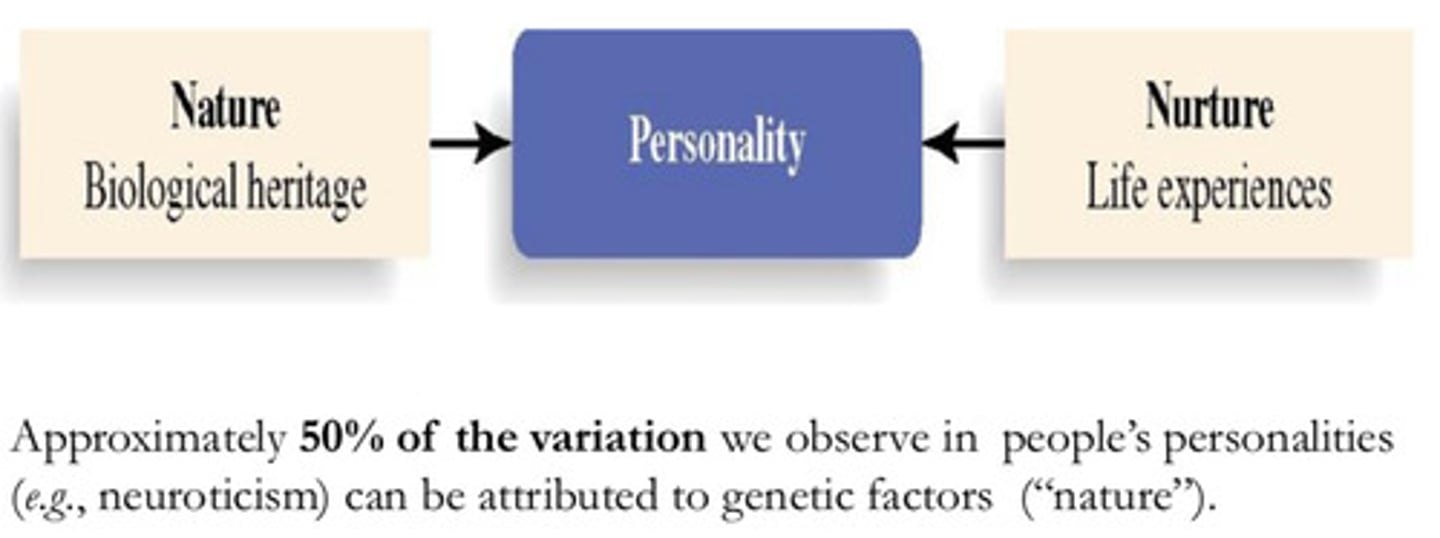
It is the behavioral and emotional characteristics of an individual that are generally stable over time and across situations—their habitual way of responding.
Traits are the core building blocks, seen as recurring regularities in how a person reacts to their environment.
Predictive Power: It is much more predictive of performance when employees have a great deal of control over their work.
It can predict general behavior and happiness, and specifically work-related outcomes like work performance, career success, job satisfaction, and occupational status.
Personality Types- Big Five (OCEAN), HEXACO
Most personalities we come up with cluster around 5 (to 6) general dimension:
OCEAN: Openess, Conscientiousness, Extraversion, Agreeableness, Neuroticism.
HEXAGO: All the above, + Honesty - humility
See Personality in the Workplace flashcard.
Personality in the Workspace
The combination of different types of personalities functional across different situations predicts success.
Honesty-humility: predicts integrity, fairness, resistance to corruption, low counter productivity.
Agreeableness: supports conflict resolution and teamwork.
Conscientiousness: links to reliability, planning, performance.
Extraversion: supports leadership emergence, social engagement..
Openness: aids learning and innovation.
Emotionality: informs stress response, support needs.
Conscientiousness in the workplace
First to attract attention, may be the most important personality variable in the workplace- equivalent of "g" in noncognitvie domain.
Best considered as a combination of achievement and dependability, with each predicting different more specific behaviour.
May be correlated with a wide range of work behaviours, but not highly so. Extraversion is often as highly correlated.
Functional Personality at Work
The way that an individual behaves, handles emotions, and accomplishes tasks in a work setting; a combination of Big Five factors.
Not just one factor predicts success, but a combination.
E.g., combination of conscientiousness, agreeableness, and emotional stability tended to have higher integrity.
Emotional Intelligence (E.Q.) (and better terms)
"ability to perceive, express, understand, and regulate emotions"
→ Contested (controversial, critiqued) term in academia, especially its operationalisation as a construct - too nonspecific (can't put a number on it). (Weak construct validity)
Tests include the MSCEIT, a scale for measuring organisational E.Q. And general E.Q.
————————
More precise:
→ Trait Empathy: E.g., imagining other's perspective and feeling care and concern for them (measured with, e.g., Single-Item trait empathy scale, or SITES). Matters in leadership: not too little, nor too much (curvilinear pattern).
→ Self-appraisal: Accurately evaluating own behaviour.
Competencies
A set of behaviours necessary in accomplishing various activities; a combination of individual characteristics, their combined “KSAOs”.
Only have meaning in the context of organisational goals.
Structure Interviews - Selection Technique
Assessment procedure that consists of very specific questions asked of each candidate; includes tightly crafted scoring schemes with detailed outlines for the interviewer with respect to assigning ratings or scores based on interview performance.
Subcategories:
Situational Interview: Applicant is asked to describe in specific and behavioural detail how he or she would respond in a hypothetical situation.
Behaviour Description Interview: Asks the applicant what he or she did do in the past. (Research’s preferred format, especially for high-level executive positions => greater influence from verbal/presentation skills, assesses experience more than abilities or characteristics).
AI Interviewing - Selection Technique
AI to do job application/selection interviews.
Provides consistency in results and detecting pattern across large datasets, thus minimising decision-making noise. Based on past data entirely. However.. Debates on whether it amplifies or reproduces hidden biases, overlooking certain qualities.
Human judgement is more holistic (flexible, contextual sensitivity).
(Both have values and risks)
g-ocentric model
A tendency to only examine general mental ability "g" to understand and predict the behaviour of worker.
"G" in the workplace
As the complexity of the job increases, the predictive value of "g" also increases.
However, high "g" does not guarantee success- if other noncognitive traits/skills/etc are required, as these will also play a role.
More specific cognitive abilities have no been been as researched in the work space.
Broad vs Narrow Personality Models implication
Refers to, e.g., the Big Five, as opposed to "narrow" traits which are sub factors of those dimensions.
Broader ones → predict broader job behaviours, narrow ones -> predict more specific job behaviour.
As work performance gets broken down into more discrete categories, narrower personality characteristics show more value over the broader ones.
Skills
Practiced acts, coming with hours, days and week of practice.
Depends on certain abilities, personality characteristics, and knowledge.
They can be technical and job-related, but there are also nontechnical skills that are more widespread such as "people skills" (negotiating, communicating, conflict resolution).
Knowledge
Collection of discrete but related facts and information about a particular domain, acquired through education, training, or specific experience. Supports skills development.
Can be closely related to skill when considered job-related skills.
Procedural knowledge: Familiarity with a procedure of knowledge, knowing “how” (“tacit knowledge”)
Declarative knowledge: Understanding what is required to perform a task, knowing information about a job or job task. (“Academic knowledge”)
See also O*NET system and knowledge flashcard.
O*Net System and knoweldge
Present the name of the knowledge domain, the definition of the knowledge and examples of what someone is capable of depending on the level of knowledge in different domains.
Assessment Content vs Process
Difference between what attribute is being assessed and how it is being assessed.
Important because validity depends on the content gathered.
E.g., applying for a company and going through a personality test, a cognitive test, an interview, and a background check. The tests are the content of the assessment and the other two are the process.
Wonderlic Personnel Test
Single-score cognitive ability test.
A 12-minute, 50-items test of general cognitive ability (verbal, numerical, spatial ability) used to hire job applicants. Speed test, with elaborate norms.
Popular, very common - ease of use and correlate with more elaborate tests of intelligence.
Bennett Mechanical Comprehension Test
Test of specific cognitive abilities.
A sample item asks which of two cutting instruments is best suited for a specific job.
Cognitive Test Batteries
Provides more detailed information about particular manifestation of cognitive ability that may be more important in one job than another.
E.g., Armed Services Vocational Aptitude for the armed services, or General Aptitude Test Battery for the federal government, the SET/GRE for students,..
Knowledge Tests
Tests that measure a person's information or knowledge about a specific domain, usually tailor-made.
Administered for licensing and certification purposes.
Physical Ability Testing
Tend to use simulated pieces of work to asses 7 basic physical abilities combined, because most physically demanding jobs require a combination of them.
Substantial evidence of improved prediction of job success.
Psychomotor Abilities Testing
Usually assessed using a task or test requiring dexterity.
Screen-out vs screen-in tests
Screen-outs are (usually) for identifying signs of psychopathology, while screen-ins are used to identify variations of normal personality.
Screen-outs are usually not administered until after an offer has been made, if it is necessary, because otherwise it may be considered discrimination (usually for public trust jobs).
Screen-ins, on the other hand, are usually used before an offer has been made.
Integrity Testing
Assessment of the likelihood that an individual will be dishonest (e.g., stealing) in the future.
Rise in popularity the last few decades for economic reasons (it is cheaper and theft accumulated is expensive) and legislations (e.g., harder to use polygraphs).
Two types:
Overt Integrity Tests: Asks questions directly about behaviour and attitudes toward various behaviours such as stealing. Predicting job performance (r = .41) vs Counterproductive behaviour (R = .32).
Personality-based Integrity Tests: Measures with less direct questions dealing with broader constructs. Predicting job performance (r = .23) vs Counterproductive behaviour (R = .51).
Advantages: Good predictive value (those scoring poorly will be poorer employees)
Concerns: Difficulty to know what they measure (some include long lunch hours as theft!), applicants are not informed of their scores, reported as pass-fail, often treated like a stable trait (people cannot “go straight”)
Individual Assessment (Job application)
Usually only very few candidates, assessed on many different attributes, such as selecting a CEO for a very successful company.
Usually individually scored and administered, may be used to create a profile of the candidate rather than compared.
Can also be used for identifying training needs/career counselling/performance feedback to key organisational members.
Assessment Centers
Collection of procedures for evaluation that is administered to groups of individuals; assessments are typically performed by multiple assessors.
Generally 12 people, assessment typically by multiple managers unfamiliar with candidates, multiple methods of assessment, usually more "real" situations.
Results can be:
→ May or may not qualify for job/job level, assesses ranked and placed in categories representing speed of promotion, predicted long-range potential, and/or recommendations for development and learning experiences for aiding in personal/professional growth.
Not a lot of agreement as to why they work, but valuable procedures of selection, promotion, and training needs.
Work Sample Tests
Tests that require applicants to perform tasks that are actually done on the job.
Valid assessment devices, but validity depends on the attributes being assessed by the format.
SItuational Judgement tests
Tests that measure a person's judgement in work settings.
Substantial evidence of validity or job relatedness., with mental ability at the strongest component and incremental validity above personality and intelligence tests.
Improve prediction of performance, best used to measure procedural knowledge, and less difference between racial groups than typically found in cognitive abilities, and are well accepted by test takers.
However, susceptible to faking.
 Note
Note  Flashcards (62)