Phylogeny
 Studied by 0 people
 Call Kai
 Learn
Learn Practice Test
 Spaced Repetition
 Match
Match Flashcards
1/10

Earn XP
Description and Tags
for quiz 1
Name | Mastery | Learn | Test | Matching | Spaced | Call with Kai |
|---|
No analytics yet
Send a link to your students to track their progress
11 Terms
Phylogenetic Tree
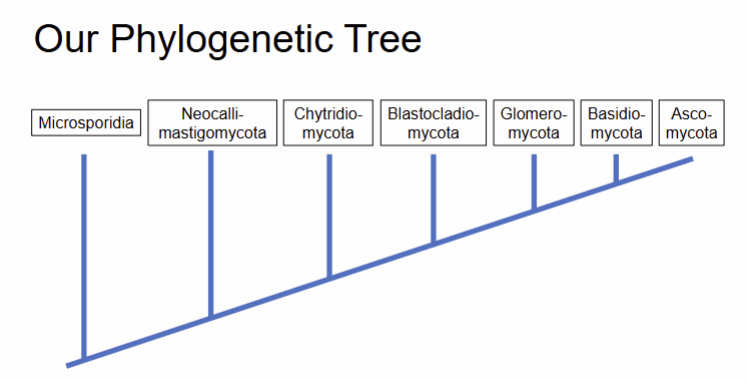
Microsporidia
• Form spores
• Unicellular
• Obligate parasites that exploit animals,
especially insects
• Cause castration, gigantism, or change of sex of
the host in insects
• Cause microsporidiosis in humans (diarrhea and
wasting if immunocompromised); e.g.,
Enterocytozoon bieneusi and Encephalitozoon
intestinalis.
• Possibly a sister group to fungi.
Neocallimastigomycota
• Anaerobic
• Symbionts in the digestive tracts of
herbivores
• Form zoospores that are released from
sporangia.
• Zoospore: a motile asexual spore that uses a
flagellum to move through a wet or damp
environment. (General term; some protists,
bacteria, and fungi form zoospores.)
• Can survive for months in aerobic
environments, which helps them colonize
new hosts.
example: Cows will eat them, digest them, and release them back into the environment as fertilizer and then another cow will come along and digest them again and the cycle continues.
Chytridmycota
• Form zoospores
• Like other fungi, have chitinous cell walls, a
posterior whiplash flagellum, absorptive
nutrition, use of glycogen as an energy storage
compound, synthesis of lysine by the α-amino
adipic acid pathway.
• Saprobic (eat decayed organic matter).
• Break down chitin and keratin.
• Sometimes are parasites.
• Includes Batrachochytrium dendrobatidis, which
causes chytridiomycosis in frogs.
Blastidiomycota
• Called “blastoclads”
• Zoosporic true fungi: Blastocladiomycota,
Chytridiomycota, Neocallimastigomycota
• The first to exhibit alternation of generations
(haploid sexual phase (gametophyte) and
diploid asexual phase (sporophyte)).
• Can grow on pollen, keratin, cellulose, and
chitin.
• Parasites of nematodes, midges,
crustaceans, tardigrades, Daphnia.
• Some are obligate plant parasites.
Glomeromycota
• Many form arbuscular mycorrhizas with
vascular land plants and sometimes
mosses.
many species for symbiotic relationships with plants and aid in finding nutrients and water in return for the plants sharing photosynthetic byproducts produced by the plants
Basidiomycota
• Basidiomycota + Ascomycota = “higher fungi”
• Agarics (“mushrooms”), puffballs, stinkhorns,
bracket fungi and other polypores, jelly fungi,
boletes, chanterelles, earth stars, smuts,
bunts, rusts, mirror yeasts, Cryptococcus.
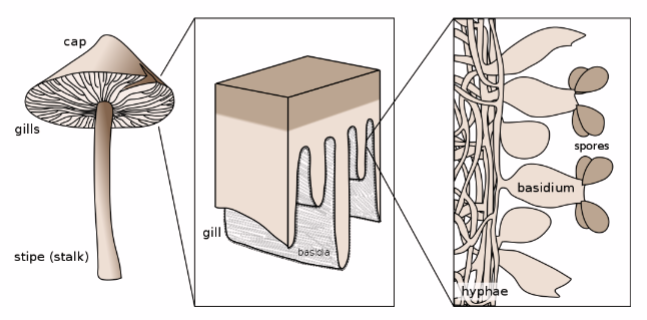
• Most reproduce sexually by forming basidia
(club-shaped cells) that produce
basidiospores.
• Some only reproduce asexually
Ascomycota
• Sac fungi
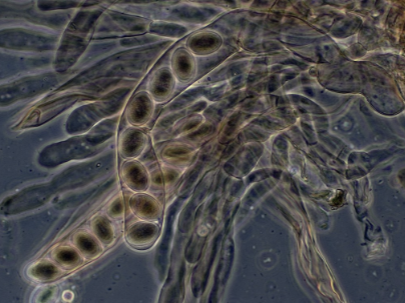
• Form an ascus (from the Greek word for sac),
which is a microscopic sexual structure in
which ascospores are formed.
• Some ascomycetes are asexual, so they don’t
form asci or ascospores.
• Morels, truffles, baker’s yeast, cup fungi, dead
man’s fingers, Penicillium, ergot fungi,
powdery mildews.
• They are the fungal partner in most lichens.
• Used for antibiotics, fermenting bread/alcoholic
beverages/cheese.
• Many are pathogens; some parasitize and kill
insects (entomopathogenic fungi).
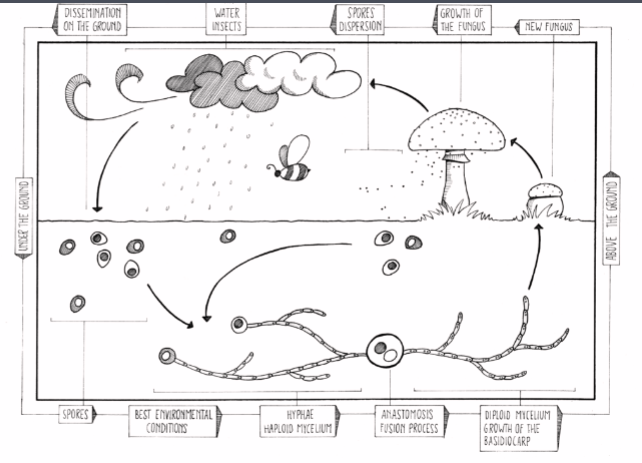
Sexual lifecycle of Basidio-mycetes
A Typical Basidiocarp
Asci of Morchella elata
 Note
Note  Flashcards (25)