Bacterial Genetics

0.0(0)
studied byStudied by 0 people
0.0(0)
full-widthCall Kai
learnLearn
examPractice Test
spaced repetitionSpaced Repetition
heart puzzleMatch
flashcardsFlashcards
GameKnowt Play
Card Sorting

1/18

encourage image

There's no tags or description

Looks like no tags are added yet.

Study Analytics
Name
Mastery
Learn
Test
Matching
Spaced

No study sessions yet.

19 Terms

1
New cards

How is bacterial DNA organized compared to eukaryotic DNA?

Bacteria: single circular chromosome, no nuclear membrane, compact nucleoid, ~4,300 genes, 87% coding DNA. Eukaryotes: multiple linear chromosomes, histones, introns, ~1.5% coding DNA.

2
New cards

What are exceptions to the single chromosome rule in bacteria?

Vibrio cholerae has >1 chromosome; Myxococcus is multicellular with complex genome organization.

3
New cards

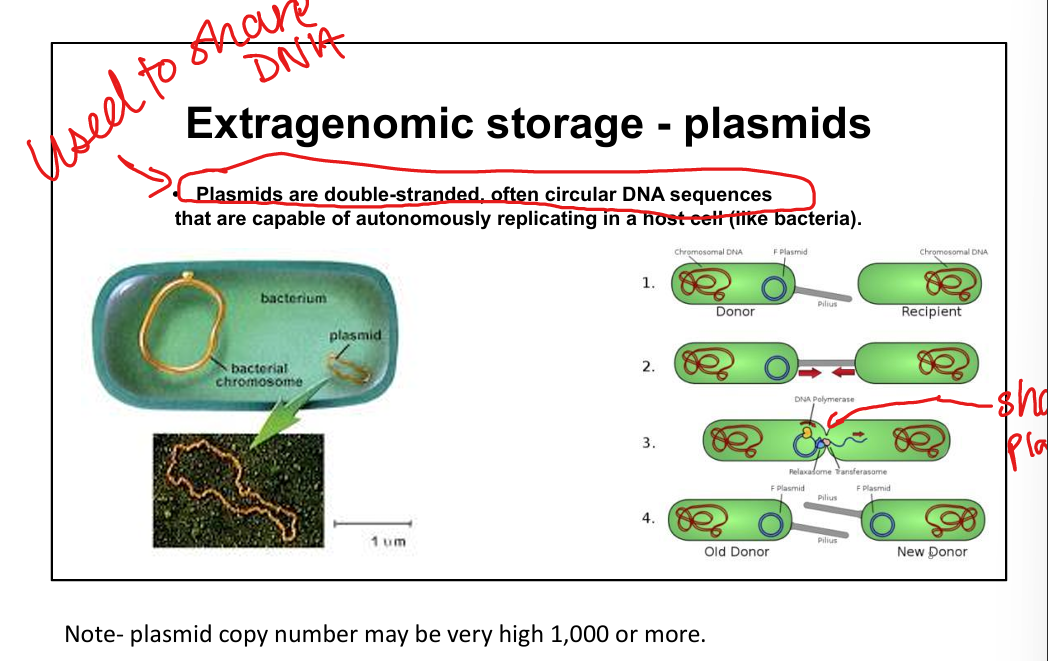
What are plasmids and why are they clinically important?

Extrachromosomal, circular dsDNA; autonomously replicate; can carry antibiotic resistance, toxin genes, virulence factors, novel metabolic functions.
knowt flashcard image

<p>Extrachromosomal, circular dsDNA; autonomously replicate; can carry antibiotic resistance, toxin genes, virulence factors, novel metabolic functions.</p><img src="https://knowt-user-attachments.s3.amazonaws.com/56831160-1465-449b-9654-a6ab5f48405c.png" data-width="100%" data-align="center" alt="knowt flashcard image"><p></p>
4
New cards

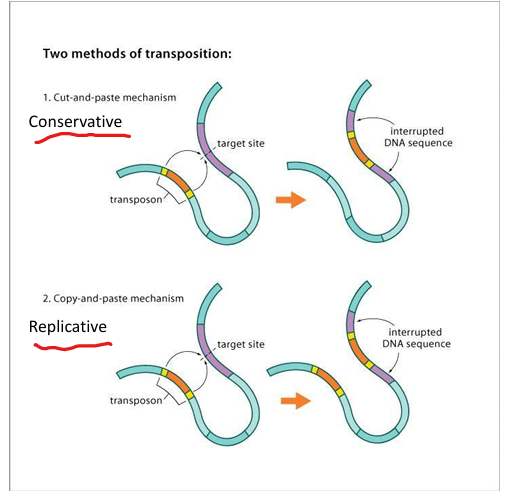
What are transposons?

Mobile genetic elements; can move within genome by cut-and-paste (conservative) or copy-and-paste (replicative); often carry resistance genes (e.g., Tn3 with β-lactamase, Tn10 with tetracycline resistance).
knowt flashcard image

<p>Mobile genetic elements; can move within genome by cut-and-paste (conservative) or copy-and-paste (replicative); often carry resistance genes (e.g., Tn3 with β-lactamase, Tn10 with tetracycline resistance).</p><img src="https://knowt-user-attachments.s3.amazonaws.com/015ebc08-1b39-4c88-83ab-a120176d2c24.png" data-width="100%" data-align="center" alt="knowt flashcard image"><p></p>
5
New cards

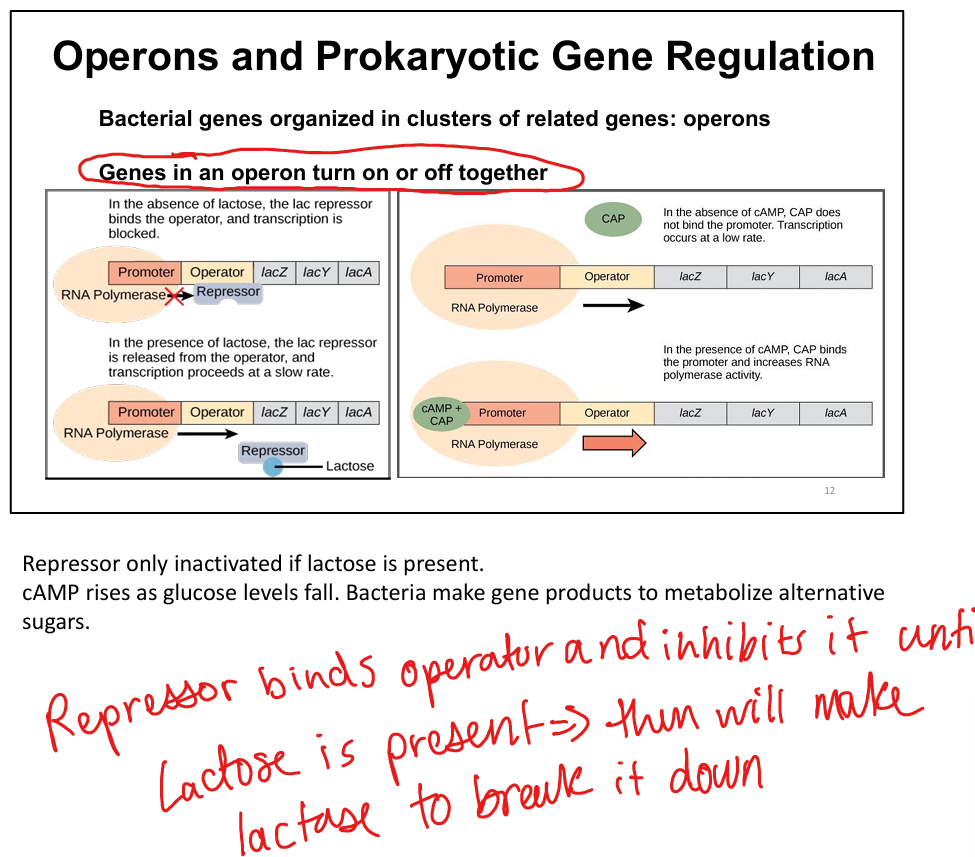
What is an operon?

Cluster of genes under one promoter/operator; allows coordinated regulation. Example: lac operon (induced by lactose, enhanced by cAMP-CAP when glucose low).
knowt flashcard image

<p>Cluster of genes under one promoter/operator; allows coordinated regulation. Example: lac operon (induced by lactose, enhanced by cAMP-CAP when glucose low).</p><img src="https://knowt-user-attachments.s3.amazonaws.com/80dde81c-185f-45f8-8d10-88ee749fdf6c.png" data-width="100%" data-align="center" alt="knowt flashcard image"><p></p>
6
New cards

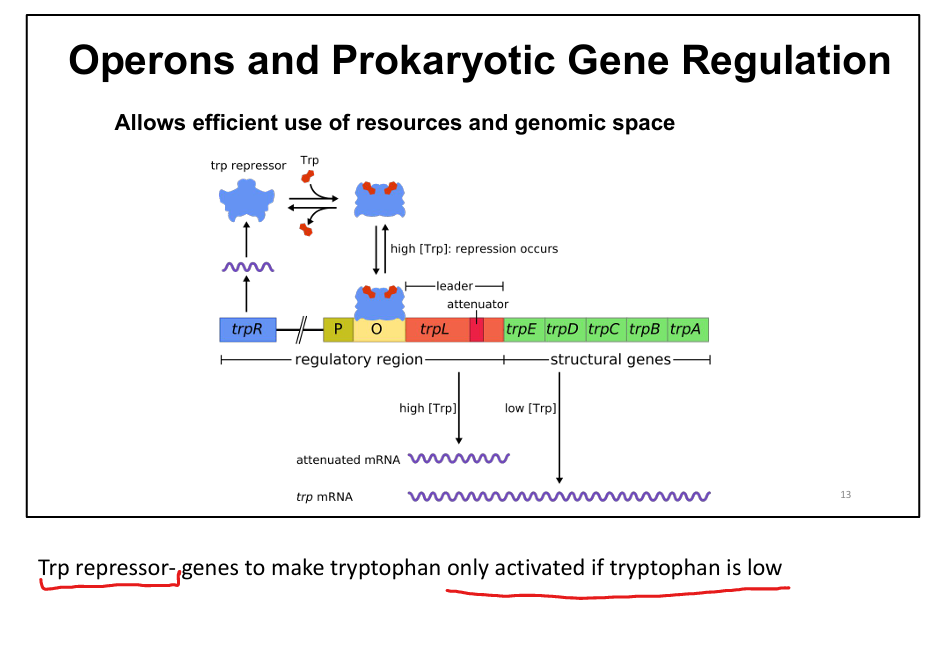
What is the trp operon?

Genes for tryptophan synthesis; repressed when tryptophan high; attenuation mechanism fine-tunes expression.
knowt flashcard image

<p>Genes for tryptophan synthesis; repressed when tryptophan high; attenuation mechanism fine-tunes expression.</p><img src="https://knowt-user-attachments.s3.amazonaws.com/502f0461-281c-459e-803e-367ac53e0938.png" data-width="100%" data-align="center" alt="knowt flashcard image"><p></p>
7
New cards

What is the van operon?

Encodes vancomycin resistance (vanHAX); alters peptidoglycan D-Ala-D-Ala → D-Ala-D-Lac, preventing vancomycin binding.
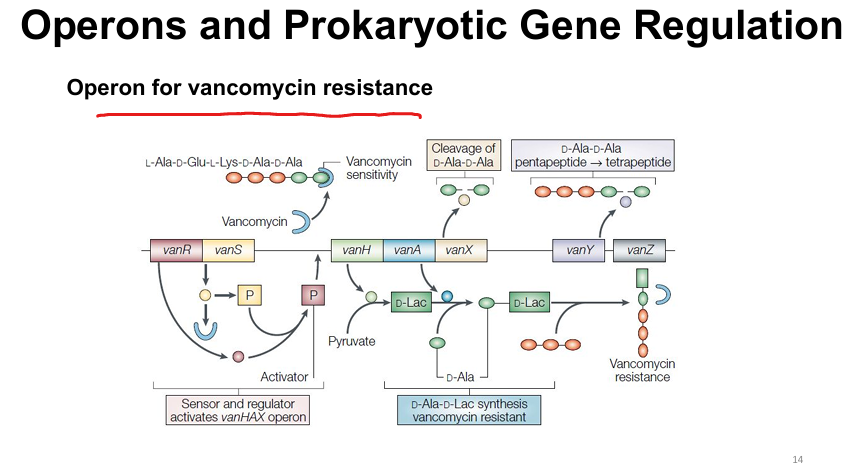
knowt flashcard image

<p>Encodes vancomycin resistance (vanHAX); alters peptidoglycan D-Ala-D-Ala → D-Ala-D-Lac, preventing vancomycin binding.</p><img src="https://knowt-user-attachments.s3.amazonaws.com/204d0045-03a8-4de9-8925-ad87b3a55cf2.png" data-width="100%" data-align="center" alt="knowt flashcard image"><p></p>
8
New cards

How does bacterial replication occur?

Bidirectional from a single origin; replication forks proceed until termination; tightly coupled to cell division.
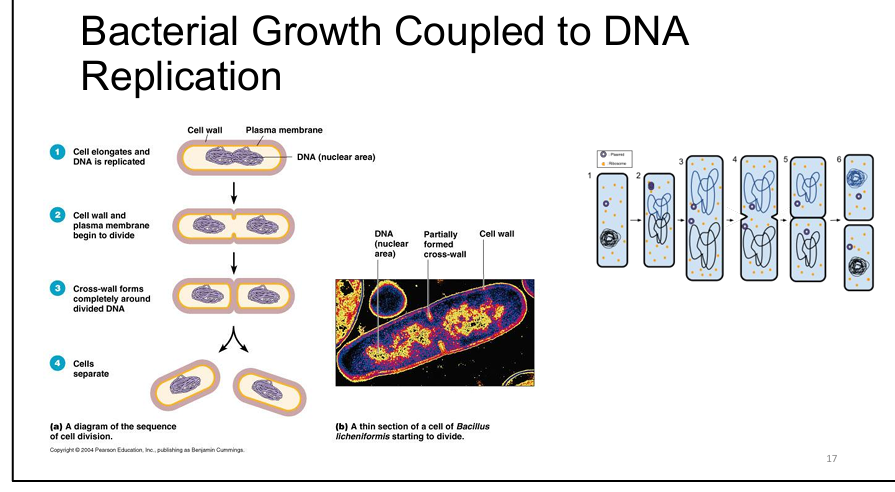
knowt flashcard image

<p>Bidirectional from a single origin; replication forks proceed until termination; tightly coupled to cell division.</p><img src="https://knowt-user-attachments.s3.amazonaws.com/ff104a5d-09f2-40d4-b4a8-38611fa16aad.png" data-width="100%" data-align="center" alt="knowt flashcard image"><p></p>
9
New cards

What are the two main sources of genetic diversity in bacteria?

Spontaneous mutations (vertical transmission, slow) and horizontal gene transfer (rapid).
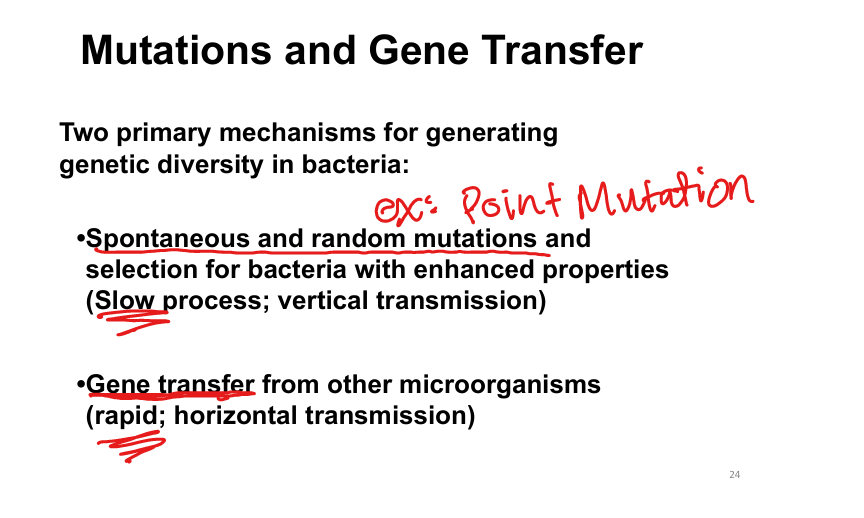
knowt flashcard image

<p>Spontaneous mutations (vertical transmission, slow) and horizontal gene transfer (rapid).</p><img src="https://knowt-user-attachments.s3.amazonaws.com/200930eb-80f4-4b7d-a4f1-71d160db7a5a.png" data-width="100%" data-align="center" alt="knowt flashcard image"><p></p>
10
New cards

What is gene amplification and why is it important?

Duplication of genes increases dosage; e.g., Vibrio cholerae ctx gene amplification → more cholera toxin; Staph aureus efflux pump duplication → multidrug resistance.
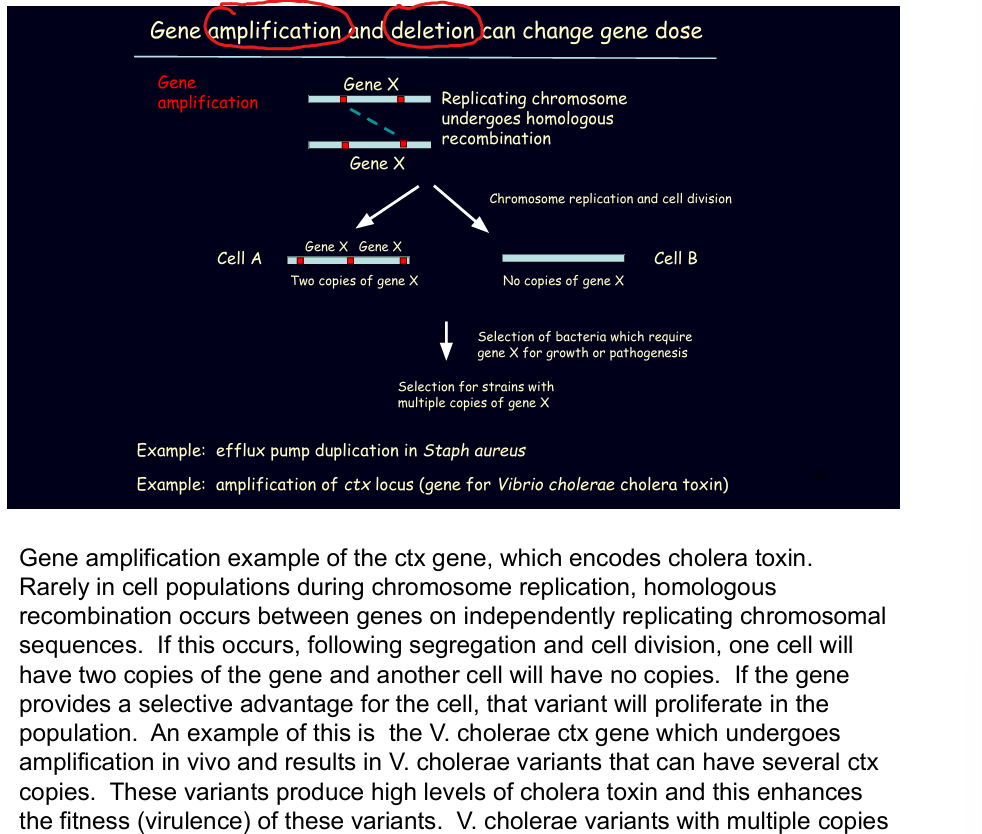
knowt flashcard image

<p>Duplication of genes increases dosage; e.g., Vibrio cholerae ctx gene amplification → more cholera toxin; Staph aureus efflux pump duplication → multidrug resistance.</p><img src="https://knowt-user-attachments.s3.amazonaws.com/fd2f6d7d-cf78-4c4f-ba70-256eb4b21a03.png" data-width="100%" data-align="center" alt="knowt flashcard image"><p></p>
11
New cards

What is vertical transmission?

Genetic information passed from parent to daughter cells during binary fission.

12
New cards

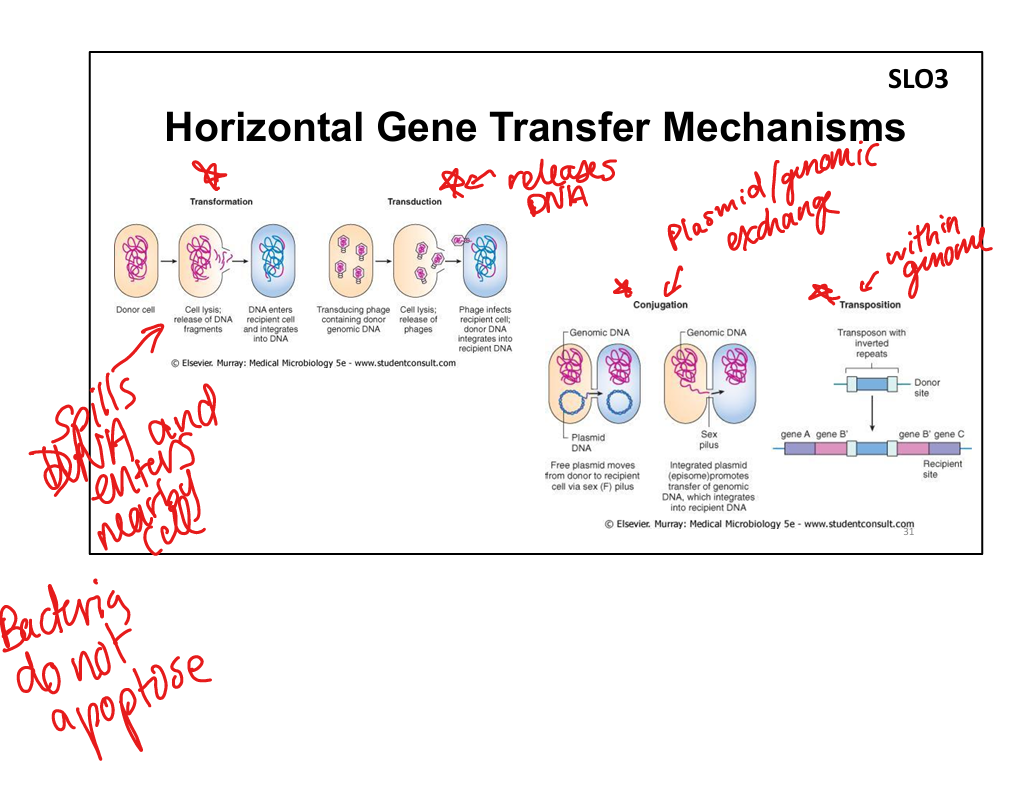
What is horizontal transmission?

Gene transfer between unrelated bacteria; rapid acquisition of new traits (e.g., resistance, virulence).
knowt flashcard image

<p>Gene transfer between unrelated bacteria; rapid acquisition of new traits (e.g., resistance, virulence).</p><img src="https://knowt-user-attachments.s3.amazonaws.com/75e59777-f200-4dc0-b0ce-149792f3f918.png" data-width="100%" data-align="center" alt="knowt flashcard image"><p></p>
13
New cards

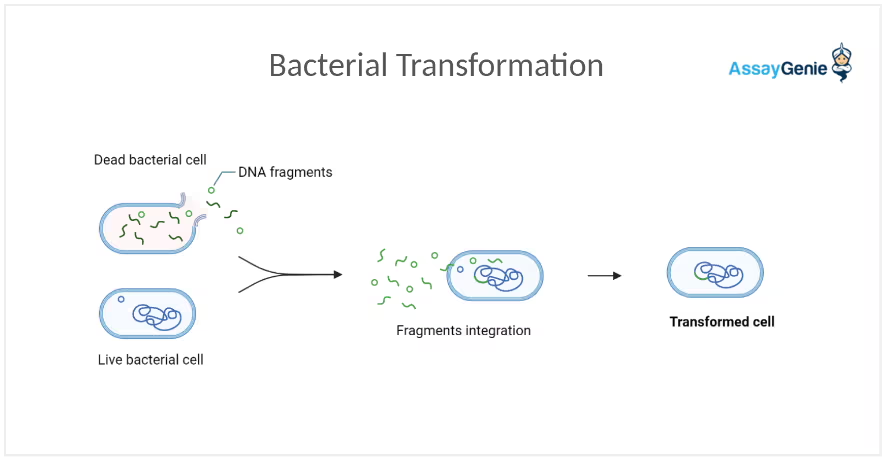
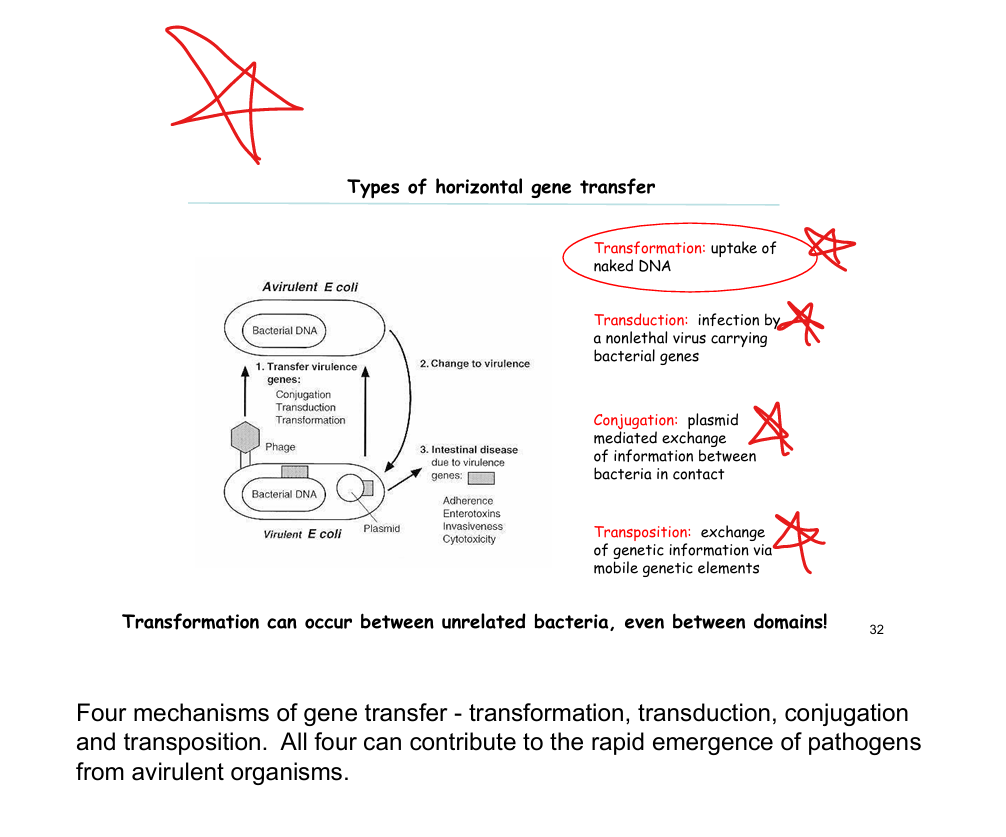
What is transformation?

Uptake of naked DNA from environment; requires competence. Example: Streptococcus pneumoniae acquiring capsule genes → virulence. (dies and is absorbed)
knowt flashcard imageknowt flashcard image

<p>Uptake of naked DNA from environment; requires competence. Example: Streptococcus pneumoniae acquiring capsule genes → virulence. (dies and is absorbed)</p><img src="https://knowt-user-attachments.s3.amazonaws.com/a823aaae-0f18-42aa-8647-d361fdb20fa9.png" data-width="100%" data-align="center" alt="knowt flashcard image"><img src="https://knowt-user-attachments.s3.amazonaws.com/b5a1ede7-569c-47b1-a350-085eec0d2e60.png" data-width="100%" data-align="center" alt="knowt flashcard image"><p></p>
14
New cards

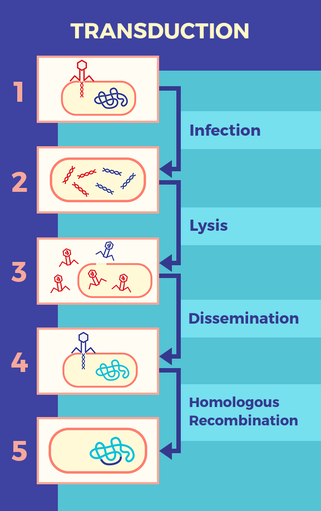
What is transduction?

Phage-mediated gene transfer. Generalized: random bacterial DNA packaged. Specialized: specific genes near phage integration site transferred.
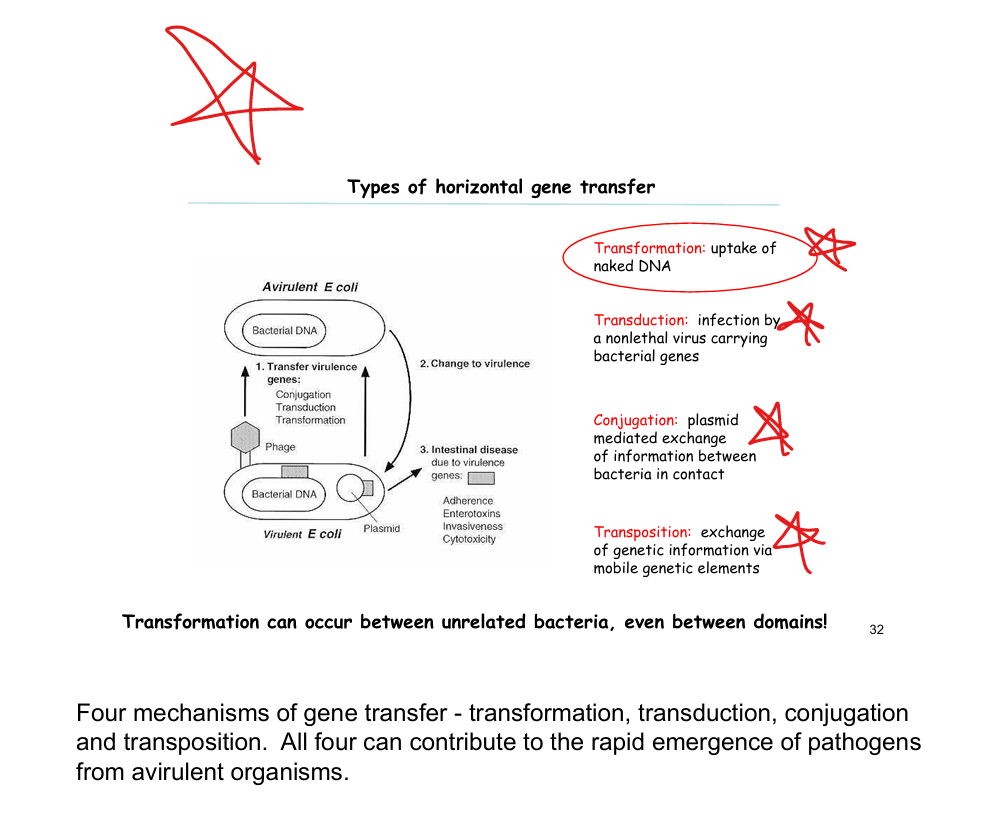
knowt flashcard image

knowt flashcard image

<p>Phage-mediated gene transfer. Generalized: random bacterial DNA packaged. Specialized: specific genes near phage integration site transferred.</p><img src="https://knowt-user-attachments.s3.amazonaws.com/20996c1c-c0a1-4e20-9c00-4c7784882b8e.png" data-width="100%" data-align="center" alt="knowt flashcard image"><p></p><img src="https://knowt-user-attachments.s3.amazonaws.com/847b296b-cdcd-4985-8355-e25e216be477.png" data-width="100%" data-align="center" alt="knowt flashcard image"><p></p>
15
New cards

What is conjugation?

Plasmid-mediated transfer via sex pilus (Gram-negative) or adhesins (Gram-positive). F+ donor transfers F plasmid to recipient → both become F+.
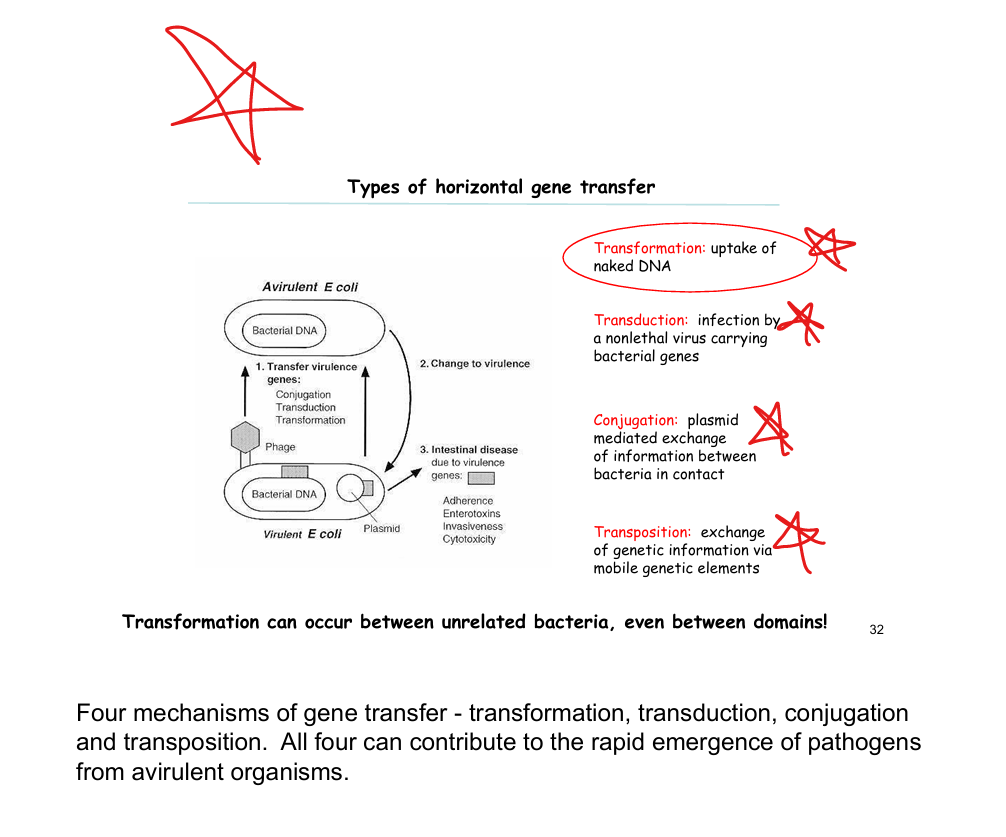
knowt flashcard image

<p>Plasmid-mediated transfer via sex pilus (Gram-negative) or adhesins (Gram-positive). F+ donor transfers F plasmid to recipient → both become F+.</p><img src="https://knowt-user-attachments.s3.amazonaws.com/0d690455-08b2-4f1a-a99d-52fc08a6a61e.png" data-width="100%" data-align="center" alt="knowt flashcard image"><p></p>
16
New cards

What is transposition?

Movement of transposable elements within genome or plasmids; can spread resistance genes (e.g., Tn10 tetracycline resistance).
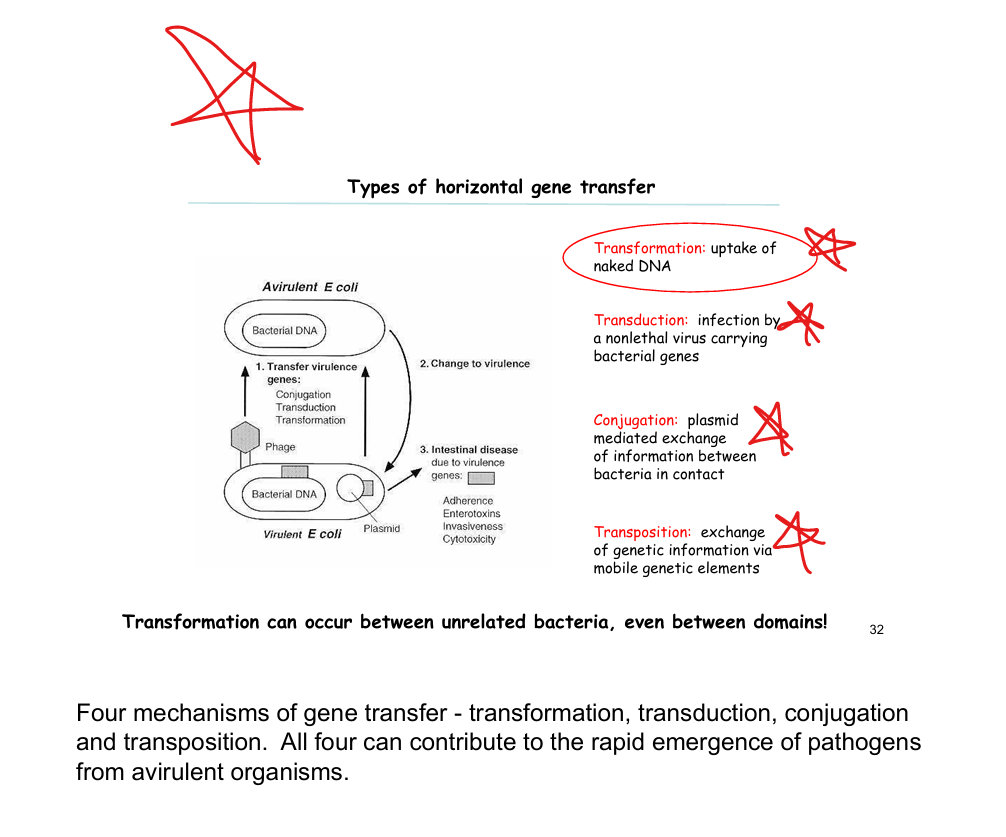
knowt flashcard image

<p>Movement of transposable elements within genome or plasmids; can spread resistance genes (e.g., Tn10 tetracycline resistance).</p><img src="https://knowt-user-attachments.s3.amazonaws.com/6663f039-f476-49f0-aa38-998ef96a0147.png" data-width="100%" data-align="center" alt="knowt flashcard image"><p></p>
17
New cards

What is lysogenic conversion?

Integration of prophage DNA into bacterial genome → new properties (e.g., toxin production).
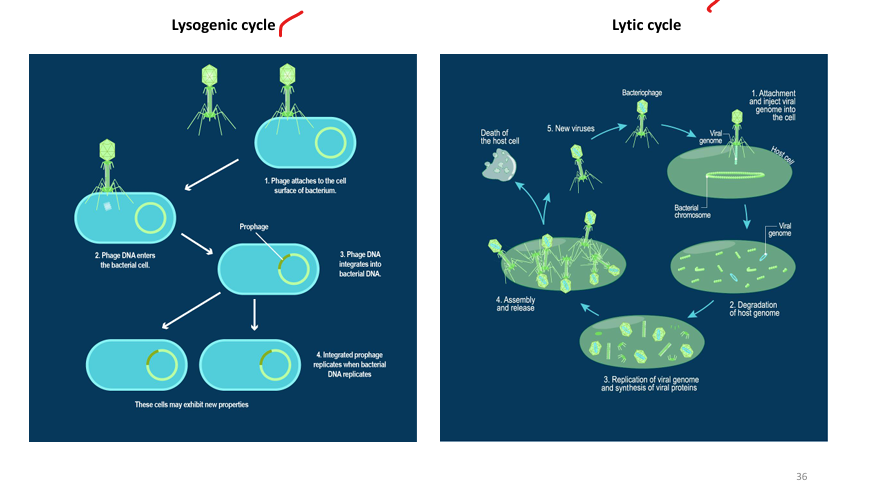
knowt flashcard image

<p>Integration of prophage DNA into bacterial genome → new properties (e.g., toxin production).</p><img src="https://knowt-user-attachments.s3.amazonaws.com/37118ac9-500f-442b-a26b-67b54b9ead2f.png" data-width="100%" data-align="center" alt="knowt flashcard image"><p></p>
18
New cards

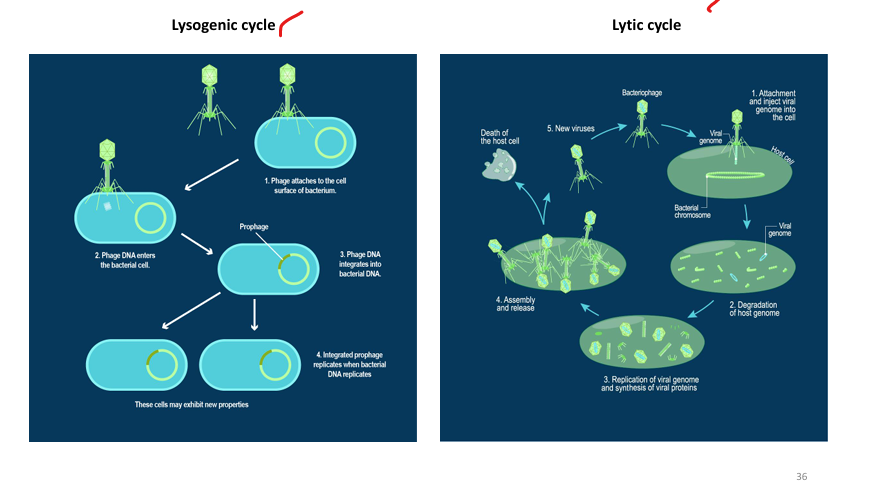
What is the difference between lytic and lysogenic phages?

Lytic: immediate replication, host cell lysis. Lysogenic: phage integrates as prophage, replicates with host, can later induce lytic cycle.
knowt flashcard image

<p>Lytic: immediate replication, host cell lysis. Lysogenic: phage integrates as prophage, replicates with host, can later induce lytic cycle.</p><img src="https://knowt-user-attachments.s3.amazonaws.com/1685f489-0bda-41c2-9b98-6ee0e1d3fe2f.png" data-width="100%" data-align="center" alt="knowt flashcard image"><p></p>
19
New cards

What is the clinical relevance of horizontal gene transfer overall?

Drives emergence of multidrug-resistant organisms (MRSA, VRE, NDM-1 Enterobacteriaceae) and new virulent strains (capsulated pathogens, toxin-producing bacteria).