Chapter 18: Digestive system
0.0(0)
Studied by 7 people Call Kai
 Learn
Learn Practice Test
 Spaced Repetition
 Match
Match Flashcards
 Knowt Play
Card Sorting
1/96

Earn XP
Description and Tags
Last updated 5:29 PM on 12/6/24
Name | Mastery | Learn | Test | Matching | Spaced | Call with Kai |
|---|
No analytics yet
Send a link to your students to track their progress
97 Terms
1
New cards
what is the digestive system also called?
the gastrointestinal system
2
New cards
what does the word "gastro" refer to?
the stomach
3
New cards
what is the overall function of the digestive systm?
To process food into molecular form in order for the circulatory system distributes among the cells in the body.
4
New cards
what is 'motility'
the general movement of food within the digestive tract
(ex. mastication, deglutition and contraction of smooth muscle)
(ex. mastication, deglutition and contraction of smooth muscle)
5
New cards
what does digestion refer to?
the chemical AND mechanical breakdown to smaller and smaller pieces for absorption
[chemical = enzymes, mechanical = mastication]
[chemical = enzymes, mechanical = mastication]
6
New cards
what dies 'secretion' refer to?
the release of exocrine and endocrine secretions into the lumen of GI tract for digestion
[think bile, hormones, enzymes... to help aid digestion]
[think bile, hormones, enzymes... to help aid digestion]
7
New cards
define 'lumen'
the hollow interior of an autonomical structure
8
New cards
what is 'absorption'
the movment of digested end products into the blood and lymph
9
New cards
what does 'storage and elimination' refer to?
temporary storage following by elimination of indigestible food molecules
(waste like urine feces n sweat)
[ex. fiber, additives in food = indigestible ]
(waste like urine feces n sweat)
[ex. fiber, additives in food = indigestible ]
10
New cards
what is the 'immune barrier' and give me an example.
Physical barrier to pathogens and toxins due to tight junctions in the epithelial lining of the intestine
[ex. GI mucosa (aka mucous membrane) has 80% of total immune system cells in the body]
[ex. GI mucosa (aka mucous membrane) has 80% of total immune system cells in the body]
11
New cards
digestion of food molecules occur through what type of reaction?
digestion occurs by hydrolysis reactions
[hydrolysis reaction = chemical breakdown involving reaction with water]
[hydrolysis reaction = chemical breakdown involving reaction with water]
12
New cards
where does the most digestion happen?
in the small intestine
13
New cards
what structures are in the gastrointestinal (GI) tract?
(or in other words, where does the food pass through?)
(or in other words, where does the food pass through?)
mouth ,pharynx , esophagus, stomach, small intestine, large intestine
14
New cards
what is the GI tract also known as?
the Alimentary canal
15
New cards
What are the accessory organs/tissues in the digestive system?
teeth, tongue, salivary glands, liver, gallbladder and pancreas
16
New cards
why are the accessory organs called accessory organs?
because the food/chyme doesn't pass though these structures, but they help digestion
[ex.. gallbladder = food doesn’t pass through here but it will secrete bile to help digest food]
[ex.. gallbladder = food doesn’t pass through here but it will secrete bile to help digest food]
17
New cards
where does most absorption of nutrients occur and what does this tell you?
most absorption occurs in the Small Intestine
... this tells you that most digestion happens before or inside the small intestine
... this tells you that most digestion happens before or inside the small intestine
18
New cards
name the four layers/tunics of the gut wall
(innermost to outermost pls :)
(innermost to outermost pls :)
Mucosa, submucosa, muscularis externa, serosa)
(think... MSMS
(think... MSMS
19
New cards
what is the mucosa and what are it's functions?
it is the innermost layer
functions: absorption, section and mucus secretion
functions: absorption, section and mucus secretion
20
New cards
when referring to mucus in the digestive system, what is its main function?
protects gut wall from digesting itself!!
[think whenever you see mucus, always think protection]
[think whenever you see mucus, always think protection]
21
New cards
what are the two layers in the mucosa?
lamina propria and muscularis mucosae
22
New cards
what is the muscularis mucosae and what does it do?
it is the smooth muscle layer in the mucosa and has lots of folds
-the folds help increase surface area for better absorption
-the smooth muscle layer helps produce movement to move the chyme
-the folds help increase surface area for better absorption
-the smooth muscle layer helps produce movement to move the chyme
23
New cards
what does the submucosa contain and what does it help do?
it is the 2nd most inner-layer
contains blood/lymph vessels and the submucosal plexus ( plexus=a collection of neurons). These neurons help control the smooth muscle in the mucosa
contains blood/lymph vessels and the submucosal plexus ( plexus=a collection of neurons). These neurons help control the smooth muscle in the mucosa
24
New cards
what is the muscularis externa and what does it do
it is the 2nd OUTERmost later
helps segmental and peristaltic contraction of the muscles to move food throughout the tract. This also mixes it with digestive enzymes
helps segmental and peristaltic contraction of the muscles to move food throughout the tract. This also mixes it with digestive enzymes
25
New cards
what are the two layers of the muscularis externa?
inner circular layer and the outer longitudinal layer
(both made with smooth muscle)
(both made with smooth muscle)
26
New cards
what is the serosa and explain it's structure.
-Sersoa is the outermost layer of the gut wall
-it is made with connective tissue and cover with epithelium
-it is made with connective tissue and cover with epithelium
27
New cards
define mastication
chewing of food in mouth
28
New cards
even though mastication is a mechanical process, how does it help with chemical digestion?
chewing mixes the food with saliva. Inside the saliva are salivary amylase (an enzyme)
29
New cards
salivary amylase is secreted by what?
salivary glands
30
New cards
what does salivary amylase help digest? is it full digestion or partial?
it partially digest starch (a carbohydrate)
31
New cards
where does digestion of carbs start and by what enzyme?
in the mouth by salivary amylase
32
New cards
define deglutition and what does it refer to?
Deglutition is swallowing and it refers to when food/drink stimulate receptors in the pharynx with pressure, thus telling the brain to swallow
33
New cards
define bolus
food that is mixed with saliva and is ready to be swallowed
34
New cards
t/f the upper esophageal sphincter needs to contract in order to swallow.
false, the sphincter needs to relax in order to let the food in the esophagus
35
New cards
what is the main function of the esophagus?
Motility, it transports the bolas from the mouth the to stomach.
36
New cards
t/f absolutely no digestion occurs in the esophagus
true
[remember, its main function is motility]
[remember, its main function is motility]
37
New cards
define peristalsis and name the two types of muscles it uses.
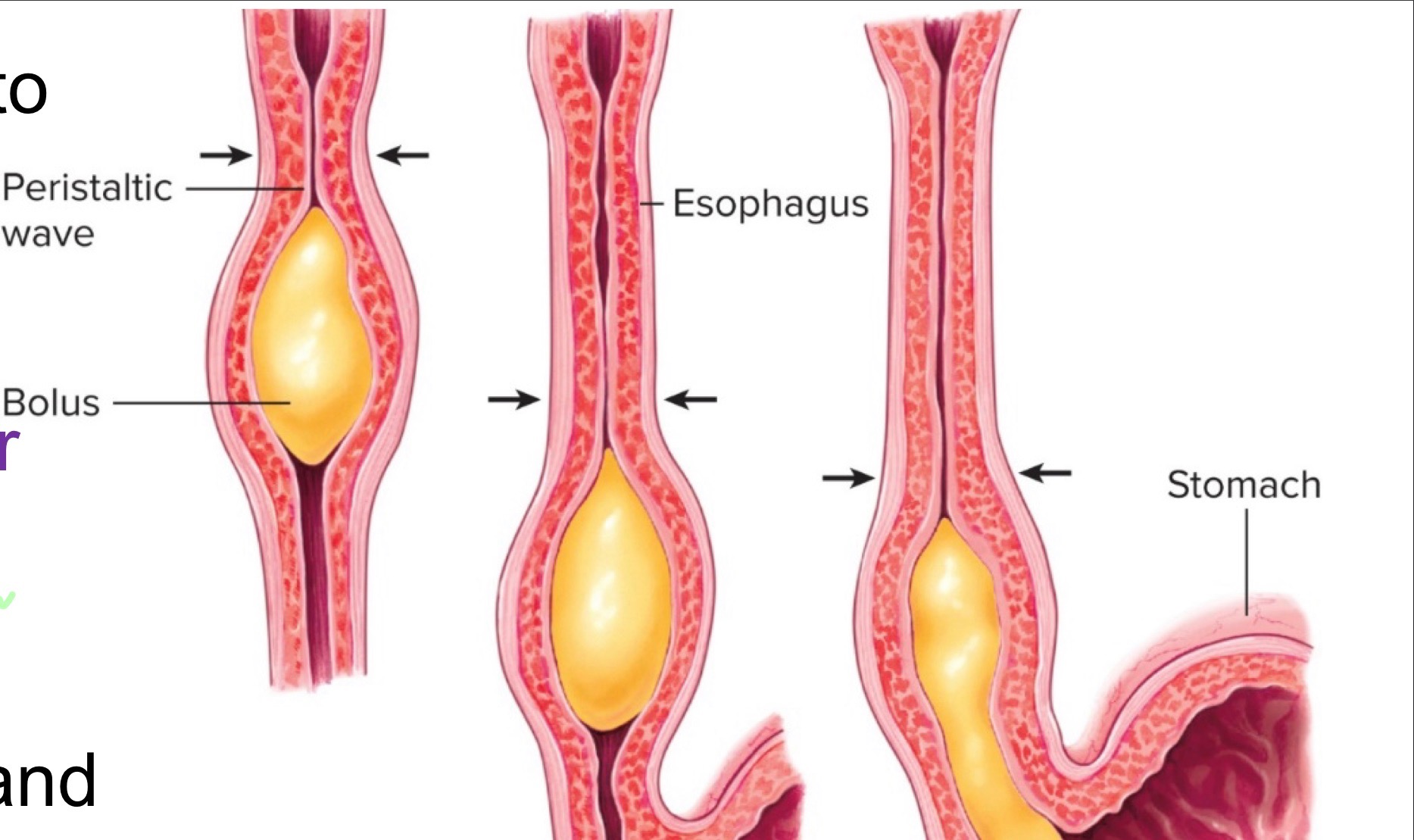
the wavelike muscular contractions that push the bolus down the esophagus to the stomach.
uses circular smooth muscle and longitudinal muscle
uses circular smooth muscle and longitudinal muscle
38
New cards
how do circular and longitudinal work together to transport the bolus?
the circular muscle contracts above the bolas and relaxes below it while the longitudinal muscle shortens and lengthens to move it down.
(refer to picture
(refer to picture
39
New cards
t/f the most digestion occurs in the stomach
FALSE,
the most happens in the small intestine
the most happens in the small intestine
40
New cards
Stomach turns the bolus into ____
chyme
[chyme = chewed food w/ gastric juice]
[chyme = chewed food w/ gastric juice]
41
New cards
after the stomach, where does the chyme go?
to the small intestine
42
New cards
what are the main functions of the stomach?
-stores food (moves chyme slooooowly)
-kills bacteria w/ acidity of gastric juice
-starts digestion of proteins
-kills bacteria w/ acidity of gastric juice
-starts digestion of proteins
43
New cards
what do proteins digest into?
amino acids, the building blocks of proteins
[think... you have to eat protein in order to gain muscle (aka protein) ]
[think... you have to eat protein in order to gain muscle (aka protein) ]
44
New cards
where does carb digestion start?
in the mouth (with salivary amylase)
45
New cards
what are special about the cells in the stomach?
they synthesize and secrete...
-mucus
-enzyme precursors (enzymes that are in an inactive state)
-hydrochloric acid (HCl) (aka. stomach acid)
-hormones
-mucus
-enzyme precursors (enzymes that are in an inactive state)
-hydrochloric acid (HCl) (aka. stomach acid)
-hormones
46
New cards
what are the folds in the side of the stomach called and what are they used for?
gastic rugae are used for gastic motility
47
New cards
what type of glands are found in the stomach?
Gastric glands
[remember.. gastric refers to the stomach]
[remember.. gastric refers to the stomach]
48
New cards
Cells of the gastic glands in stomach
refer to my "cells of gastric glands in stomach" knowt or the matching game.
(pls this part is important)
(pls this part is important)
49
New cards
how does bicarbonate effect the stomach?
bicarbonate protects the stomach from acid damage
50
New cards
where can you find the small intestine?
in between the stomach and large intestine
51
New cards
What are the two main functions of the small intestine?
digestion and absorption
52
New cards
what organic molecules does the small intestine digest?
carbohydrate, lipids, proteins
53
New cards
After molecules are absorbed into the small intestine, where do they go?
into the blood stream to be transported to other cells that need nutrients
54
New cards
t/f the small intestine ABSORBS proteins
false, they absorb amino acids because protein molecules are too big
55
New cards
what are the folds in the mucosa called?
villi
56
New cards
the folds on the villi called what?
micovilli (or brush border)
57
New cards
what is the function of the villi/microvilli?
to increase surface area for more efficient absorption
58
New cards
what is embedded into the microvilli?
brush boarder enzymes to help digestion
59
New cards
t/f all digestion must be finished in the small intestine
true
60
New cards
t/f digestion in the small intestine is fast
false, it is slow to ensure proper absorption of all nutrients in chyme
61
New cards
what is the main contraction in the smooth muscle of the small intestine?
segmentation... contraction of the small intestine in different segments but occurring simultaneously
( like a wave ~~~~~)
( like a wave ~~~~~)
62
New cards
how does segmentation help digestion and how is it controlled?
-helps by mixing and moving chyme
-controlled by autonomic nervous system in the gut wall (not voluntary)
-controlled by autonomic nervous system in the gut wall (not voluntary)
63
New cards
t/f some digestion happens in the large intesine
false, no digestion occurs here
64
New cards
what is the large intestine also called?
the colon
65
New cards
t/f the large intestine has villi
false,
(villi is used for digestion and no digestion happens here)
(villi is used for digestion and no digestion happens here)
66
New cards
instead of villi, the large intestine has _____
Haustra... pouches on the outer surface
( looks like --u-- instead of __n__)
( looks like --u-- instead of __n__)
67
New cards
what are the main functions of the colon?
-absorption of electrolytes, water and vitamins
-excretion of waste in the form of feces
-excretion of waste in the form of feces
68
New cards
what does the liver produce?
bile
69
New cards
how are the liver and gallbladder connected?
the liver produces bile and the gallbladder stores the bile
70
New cards
what is the function of the pancreas?
synthesizes pancreatic juice for digestion
(ex. Pancreatic lipase)
(ex. Pancreatic lipase)
71
New cards
what are the main functions of the liver?
-detoxifies blood
-carbohydrate metabolism
-lipid metabolism
-protein synthesis
- secretes bile
-stores carbs and lipids
-carbohydrate metabolism
-lipid metabolism
-protein synthesis
- secretes bile
-stores carbs and lipids
72
New cards
t/f the liver has a lumen
false, has tight junctions and is highly vascular
73
New cards
What are hepatocytes and what happens in them?
hepatocytes are liver cells
-all functions of the liver happen inside the hepatocytes
-all functions of the liver happen inside the hepatocytes
74
New cards
explain the tract of bile
-bile is produced by hepatocytes --> secreted into bile canaliculi --> canaliculi empties into bile ductules --> ductules empties into gallbladder where it is stored
75
New cards
what is the portal triad explain each one
three tight knit vessels within the liver
- Hepatic artery: where blood enters liver
-Bile canaliculi: brings bile to ductule
-Bile ductule: brings bile to gallbladder
- Hepatic artery: where blood enters liver
-Bile canaliculi: brings bile to ductule
-Bile ductule: brings bile to gallbladder
76
New cards
in what structure in the liver does the blood leav?
central vein
77
New cards
what is the most important component of bile?
(pertaining to our class, not the actual most important)
(pertaining to our class, not the actual most important)
bile salts
78
New cards
what are bile salts and what do they do?
-cholesterol based salts that help emulsify fat for lipid digestion
[has cholesterol bc like dissolves like]
[has cholesterol bc like dissolves like]
79
New cards
t/f micelles are amphipathic
true, this helps with the breakdown/emulsification of fat
[amphipathic = has both nonpolar and polar sides]
[amphipathic = has both nonpolar and polar sides]
80
New cards
explain emulsification
breakdown of large fat globules by bile salts into smaller globules to help further digestion.
[further digestion is done by lipase enzymes]
[further digestion is done by lipase enzymes]
81
New cards
through what structure does bile enter the small intestine?
via the common bile duct.
[remember... liver makes bile, gallbladder stores it, small intestine uses it]
[remember... liver makes bile, gallbladder stores it, small intestine uses it]
82
New cards
the pancreases has endocrine and exocrine functions, name them within their categories.
endocrine functions: synthesizes insulin and glucagon\
exocrine function: synthesizes pancreatic juice
exocrine function: synthesizes pancreatic juice
83
New cards
What components make up pancreatic juice?
bicarbonate, ~20 enzymes and water
84
New cards
what are the three enzymes you should know within pancreatic juice and are they active within the pancreases?
amylase, trypsin, lipase
no, they are only activated in the small intestine
no, they are only activated in the small intestine
85
New cards
why are digestive enzymes only active within the small intestine?
ex. if enzymes were active inside the pancreases, they would digest the pancreases. Enzymes should only be active in the small intestine because it has a mucus layer to protect it from being digested.
86
New cards
what does amylase do?
digests starch
87
New cards
what does trypsin do?
digest protein
88
New cards
what two types of enzymes help accomplish complete digestion in the small intestine?
pancreatic enzymes and bush boarder enzymes help aid digestion in the SI
89
New cards
what are the three main enzymes that help with carb digestion?
Salivary amylase, pancreatic amylase and brush boarder enzymes
90
New cards
where does carb digestion start and where is it mostly completed?
starts in the mouth by salivary amylase and is mostly completed in the Small intestine by the pancreatic amylase
91
New cards
how does amylase help digestion? (more specifically pancreatic amylase)
amylase breaks down big carb molecules into smaller ones for easier absorption.
once small enough, carbs are actively transported into the blood stream
once small enough, carbs are actively transported into the blood stream
92
New cards
what enzymes help digest proteins?
pepsin, trypsin and brush border enzymes
93
New cards
where does protein digestion start?
it starts within the stomach with pepsin
94
New cards
explain how protein is digested, how does it enter the blood stream
protein is broken down into smaller molecules, amino acids --> then amino enter the epitheial layer of the small intestine through active transport --> then are finally secreted into the ISF to be absorbed into the capillaries.
95
New cards
lipids in chime stimulate what?
Secretion of bile, thus resulting in emulsification of fats
96
New cards
what enzymes digest lipids and what do the lipids turn into?
pancreatic lipase helps lipids turn into fatty acids and monoglycerides
97
New cards
explain the steps of lipid digestion
1. lipids in chyme stimulate secretion of bile into SI
2.bile breaks down lipids into smaller fats (by bile salts)
3. Lipase further breaks down lips into fatty acids and monoglycerides and enter the epithelial cell
4. once in epithelial cell, fatty acid and monoglycerides combine to become trigylcerides
5. tryglycerides combine with cholesterol and protein to form chylomicrons that enter lymphatic vessels (eventually entering blood)
2.bile breaks down lipids into smaller fats (by bile salts)
3. Lipase further breaks down lips into fatty acids and monoglycerides and enter the epithelial cell
4. once in epithelial cell, fatty acid and monoglycerides combine to become trigylcerides
5. tryglycerides combine with cholesterol and protein to form chylomicrons that enter lymphatic vessels (eventually entering blood)

