CH. 10 | Classification of Microorganisms
 Call Kai
 Learn
Learn Practice Test
 Spaced Repetition
 Match
Match Flashcards
 Knowt Play
1/8

There's no tags or description
Looks like no tags are added yet.
Name | Mastery | Learn | Test | Matching | Spaced | Call with Kai |
|---|
No analytics yet
Send a link to your students to track their progress
9 Terms
10 - 1 Define taxonomy, taxon, and phylogeny.
Taxonomy
Classification and naming of organisms based on their shared characteristics, evolutionary relationships, and biological traits
Uses similarities of organisms to identify, describe, name, and classify them. It does not account for evolutionary history
→ E. coli, a bacterium found in your gut. At the broadest level, it belongs to the domain Bacteria, meaning it's a single-celled organism with no nucleus. Zooming in further, it belongs to the family Enterobacteriaceae, a group of gut-dwelling bacteria. Its genus is Escherichia, and its full species name is Escherichia coli — the "coli" referring to the colon, where it lives.
Taxon
Subdivisions are used to clarify organisms
Examples include domain, kingdom, phylum, genes, species, etc
Phylogeny
The evolutionary history of organisms, and the hierarchy of taxa, reflects their evolutionary, or phylogenetic, relationships
How closely related they are through evolutionary history and shared ancestors
10 - 4 Discuss the advantages of the 3-domain system.
Reflective of evolutionary history, rather than cell history
Before this 3-domain system, organisms were divided into prokaryotes and eukaryotes. However, differences in rRNA analysis revealed that 3 distinct cell lineages/types emerged (Bacteria, Archaea, and Eukarya)
Supports evidence based on the classification of organisms into 3 domains because of their differences in rRNA
By having 3 separate domains, the system more accurately captures the evolutionary split, rather than oversimplifying it into 2 groups
Archaea are fundamentally different from Bacteria
Although archaea and bacteria are both prokaryotes, having them together in the old system was misleading
Archaea lack peptidoglycan in their cell walls, and live in extreme environments, etc
The 3-domain system gave Archaea its own domain, which is beneficial overall
Supported by molecular and genetic evidence
Prokaryotic cells — 70S Ribosomes
Eukaryotic cells — 80S Ribosomes
Eukaryotic organelles, such as mitochondria, have 70S ribosomes, which share more similarities with prokaryotes than eukaryotes themselves
These differences support separating life into 3 distinct domains rather than 2
Supports the Endosymbiotic Theory
Eukaryotic organelles, such as mitochondria and chloroplasts, share similar characteristics with those of prokaryotes
Same circular DNA, 70S ribosomes, binary fission reproduction
The 3-domain system reveals how the eukarya domain evolved from early prokaryotic ancestors through endosymbiosis
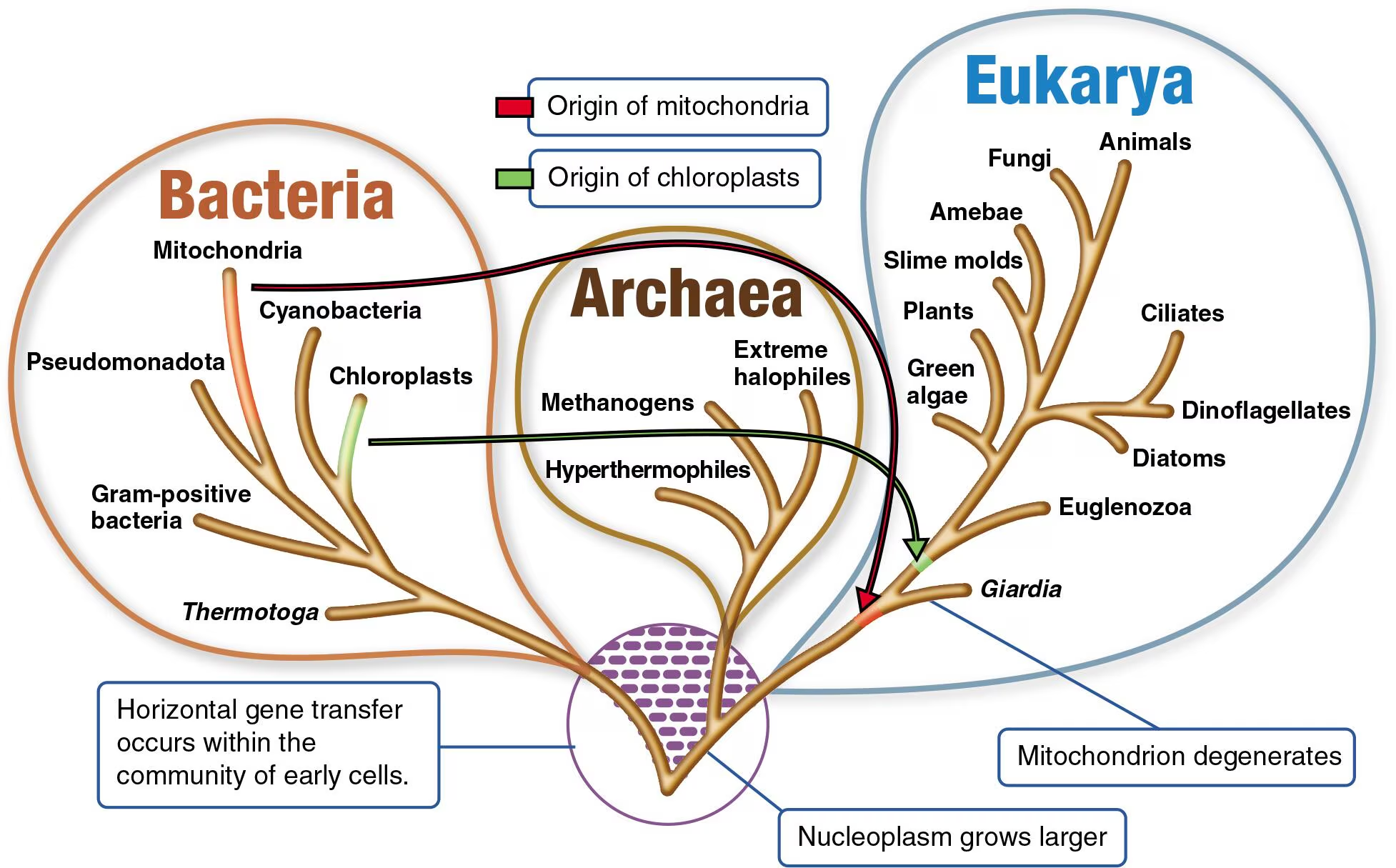
10 - 5 List the characteristics of the Bacteria, Archaea, and Eukarya domains.
Bacteria
Prokaryotes
DNA is circular (some have two circular; some have linear)
70S ribosomes
Cell Wall: Peptidoglycan
Reproduction: binary fission
Ester linkages
Archaea
Prokaryotes
DNA is circular
70S ribosomes
Lack of peptidoglycan as their cell wall but have psudeomuerin
Live in extreme environments — three major groups: Methanogens (produce methane), Extreme halophiles (require high salt), and Hyperthermophiles (grow in extremely hot environments)
Ether linkages
Eukarya
Eukaryotes
DNA is linear
They have 80S ribosomes
Reproduction: mitosis
They include the kingdoms Fungi, Plantae, and Animalia, as well as Protists
Their organelles, like mitochondria and chloroplasts, share similarities with prokaryotes, supporting the endosymbiotic theory
10 - 6 Explain why scientific names are used.
Scientific names are used to identify the specific organism being discussed. Hence, explaining why common names are not good to use and are misleading
Each organism is assigned 2 names, the genus, and the specific epithet (species) — both are underlined or italicized — the genus name is always capitalized — the specific epithet is always lowercase
Binomial nomenclature
Ensures taxonomic accuracy
Taxonomic Hierarchy
Domain - the broadest category; all life falls into Bacteria, Archaea, or Eukarya
Kingdom - groups organisms by very broad characteristics (e.g., Animalia, Plantae, Fungi)
Phylum - groups organisms by general body plan or fundamental biological traits
Class - narrows down the phylum into more specific shared characteristics
Order - groups families that are related to each other
Family - groups of closely related organisms with fairly specific shared characteristics
Genus - very specific grouping; becomes the first part of the scientific name
Species - the most specific level; the second part of the scientific name
E. COLI EXAMPLE
Domain → Bacteria
Kingdom → Bacteria
Phylum → Pseudomonadota
Class → Gammaproteobacteria
Order → Enterobacterales
Family → Enterobacteriaceae
Genus → Escherichia
Species → Escherichia coli
10 - 8 Differentiate culture, clone, and strain.
Culture
Microbes grown in culture media
Clone
The population of cells derived from a single parent cell
Strain
Genetically different subgroup of cells within a clone
They are species
Often distinguished using numbers, letters, or names that follow the specific epithet
Examples include K-12 (Strain of E. coli)
10 - 9 List the major characteristics used to differentiate the 3 kingdoms of multicellular Eukarya.
Kingdom Fungi
Can be unicellular or multicellular, or both
Includes unicellular yeasts, multicellular molds, and macroscopic species such as mushrooms
Obtains nutrients by absorbing dissolved organic matter through its plasma membrane (Heterotrophic)
Multicellular fungal cells are joined to form thin tubes called hyphae
Develops and replicates from spores or from fragments of hyphae
→ Differentiate endospores v. fungal spores
Kingdom Plantae
Includes mosses, ferns, conifers, and flowering plants
All members are multicellular
Obtains energy through photosynthesis
Kingdom Animalia
Includes sponges, worms, insects, and animals with backbones
All members are multicellular
Obtains nutrients and energy by ingesting organic matter through a mouth (Heterotrophic)
No cell walls
Differing Characteristics
Fungi absorb dissolved organic matter
Plants produce their own energy through photosynthesis
Animals ingest organic matter through a mouth
10 - 10 Define protist.
Protist
Eukaryote, but is neither part of the fungi, plantae, or animalia kingdom
Catchall kingdom for a variety of organisms
Made up of diverse groups with differing characteristics
Unicellular
→ Examples include amoeba, plasmodium, paramecium
10 - 11 Differentiate eukaryotic, prokaryotic, and viral species.
Eukaryotic
Closely related organisms that can interbreed
Prokaryotic
Reproduction is asexual
Population of cells with similar characteristics
Example includes E. coli | K12 & E. coli 0157: H7) — both shares similar characteristics
Similar characteristics include morphology, biochemical reactions, and DNA sequences
Viral
Having similar characteristics
Morphology
DNA structure
Similar ecological niche
→ Host
→ Ecological niche, meaning where the virus lives
10 - 13 Explain the purpose of Bergey’s Manual.
Bergey’s Manual is a reference for bacterial ID and classification
It is the standard taxonomic reference on bacteria
Provides identification based on criteria such as cell wall composition, morpohlogy, differential staining, oxygen requirements, and biochemical testing

