Higher Biology Unit 2.2
 Call Kai
 Learn
Learn Practice Test
 Spaced Repetition
 Match
Match Flashcards
 Knowt Play
1/11

There's no tags or description
Looks like no tags are added yet.
Name | Mastery | Learn | Test | Matching | Spaced | Call with Kai |
|---|
No analytics yet
Send a link to your students to track their progress
12 Terms
What is the word equation for respiration?
Glucose + Oxygen → Carbon Dioxide + Water + Energy (ATP)
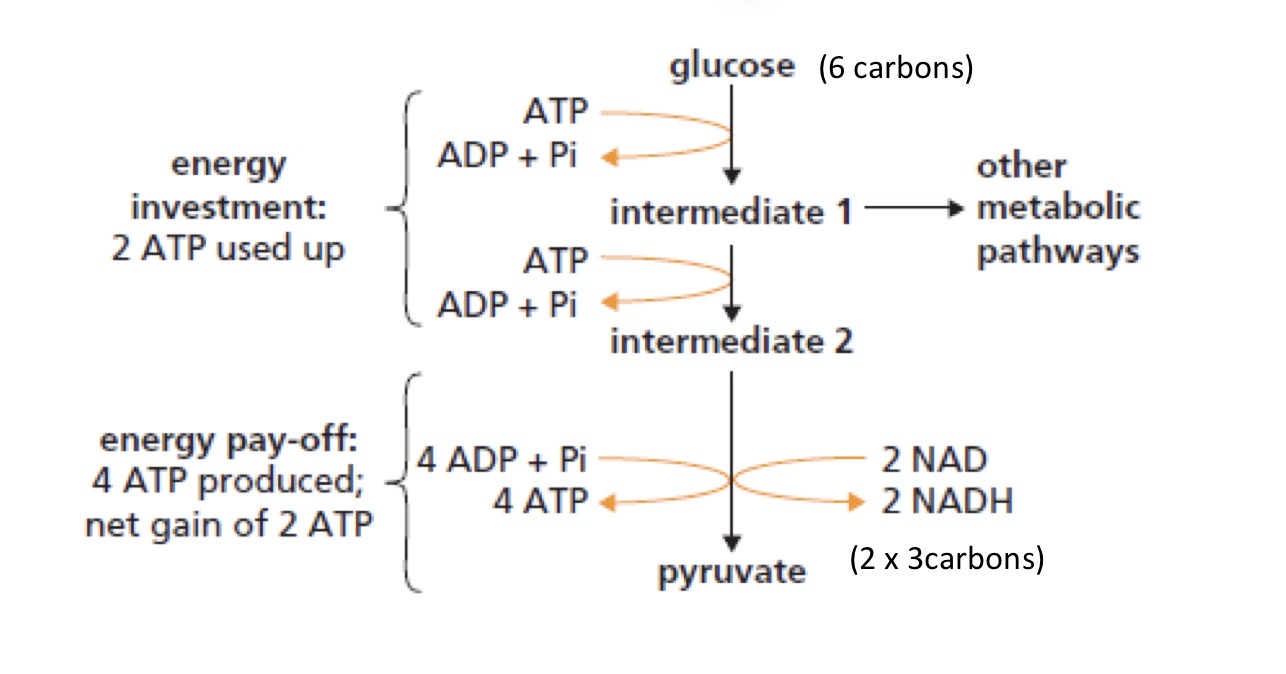
Describe the two stages of glycolysis and describe the location
Glycolysis, the breakdown of glucose to pyruvate, occurs in the cytoplasm of the cell. ATP is required for the phosphorylation of glucose and intermediates during the energy investment phase of glycolysis. This leads to the generation of more ATP during the energy pay-off stage and results in a net gain of ATP.
Describe the electron transport chain. State the location
The electron transport chain is a series of carrier proteins attached to the inner mitochondrial membrane. Electrons are passed along the Electron Transport Chain releasing energy. This energy allows Hydrogen ions to be pumped across the inner mitochondrial membrane. The flow of these ions back through the membrane protein ATP Synthase, results in the production of ATP. Finally, hydrogen ions and electrons combine with oxygen to form water. Oxygen is required during the aerobic phase of respiration since it is the final hydrogen acceptor, combining with hydrogen ions & electrons to form water.
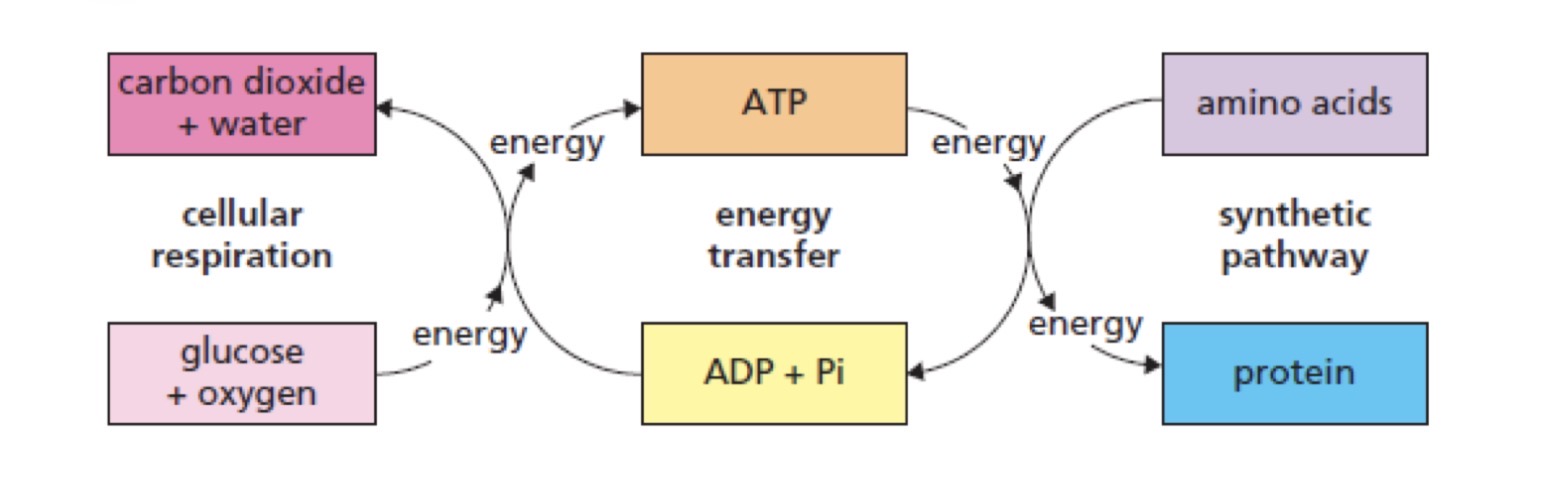
Describe the function of and draw a diagram of ATP and its formation
ATP is used to transfer energy to cellular processes which require energy. E.g the ATP released during aerobic respiration provides the energy required for Protein Synthesis.
Describe the role of NAD in cell respiration
Dehydrogenase enzymes remove hydrogen ions and electrons and pass them to the
Coenzyme NAD it’s role is to form NADH
Describe the role of dehydrogenase in cell respiration
Dehydrogenase enzymes remove hydrogen ions and electrons and pass them to the Coenzyme NAD
Describe the role hydrogen in cell respiration
The primary energy source
Describe the role of ATP synthase in cellular respiration
ATP is used to transfer energy to cellular processes which require energy
Describe the role of oxygen in cellular respiration
Oxygen is required during the aerobic phase of respiration since it is the final hydrogen acceptor, combining with hydrogen ions & electrons to form water.
Describe the citric acid cycle. Include: oxaloacetate, citrate and CoA. State the location
The Aerobic phase of respiration takes place in the Matrix of Mitochondria. In the presence of oxygen, Pyruvate is then broken down to an Acetyl Group that combines with Coenzyme A forming Acetyl Coenzyme A. In the Citric Acid Cycle, the Acetyl group from Acetyl Coenzyme A combines with Oxaloacetate to form Citrate. During a series of enzyme controlled steps, Citrate is gradually converted back into Oxaloacetate which results in the generation of ATP and release of Carbon Dioxide. Dehydrogenase enzymes remove hydrogen ions and electrons and pass them to the Coenzyme NAD, forming NADH. This occurs in both Glycolysis and the Citric Acid Cycle. The hydrogen ions and electrons from NADH are passed to the Electron Transport Chain on the inner mitochondrial membrane.
Describe fermentation in plant/yeast
In the absence of oxygen, fermentation takes place in the cytoplasm. In plant & yeast cells, the Pyruvate is converted to Ethanol and CO2 in a reversible reaction. Fermentation results in much less ATP being produced than in aerobic respiration.
Describe fermentation in animal cells
In animal cells, the Pyruvate is converted to Lactate in a reversible reaction.

