K3 ATC Support
 Studied by 4 people
 Call Kai
 Learn
Learn Practice Test
 Spaced Repetition
 Match
Match Flashcards
 Knowt Play
1/46

There's no tags or description
Looks like no tags are added yet.
Name | Mastery | Learn | Test | Matching | Spaced | Call with Kai |
|---|
No analytics yet
Send a link to your students to track their progress
47 Terms
What are the 4 segments of an IFR approach?
• Initial Approach
• Intermediate Approach
• Final Approach
• Missed Approach
What is an instrument approach?
An instrument approach is a series of predetermined manoeuvres for the orderly transfer of an aircraft under instrument flight conditions from the beginning of the initial approach to a landing or to a point from which a landing may be made visually.
Initial approach (segment)
That part of an instrument approach procedure between the initial approach fix or waypoint and the intermediate approach fix or waypoint during which the aircraft departs the enroute phase of flight and manoeuvres to enter the intermediate segment.
Intermediate approach (segment)
This segment blends the initial approach into the final approach segment. In this segment, aircraft configuration, speed, and positioning adjustments are made for transition to the final approach. The intermediate segment begins at the intermediate fix.
Final Approach (segment)
That part of an instrument approach procedure from the time that the aircraft does one of the following:
◾ Completes the last procedure turn or base turn, where one is specified
◾ Crosses the final approach fix (FAF), waypoint or point
◾ Intercepts the last track specified for the procedure until it reaches the missed approach point (MAP); alignment and descent for landing accomplished here
Procedure Turn
Where no suitable fix is available to construct a straight-in approach procedure, the pilot must make a procedure turn. In this case, the initial approach fix and the final approach fix are the same. The aircraft will cross the fix and fly outbound on the specified heading(s), descending as necessary to the minimum level at which the procedure turn should be completed.
Missed Approach Procedure
The procedure to be followed after an instrument approach procedure if, for any reason, a landing is not effected and that occurs normally when the aircraft either
◾ Has descended to the decision height, or has descended to the minimum descent altitude and reached the missed approach point or waypoint, and has not established the required visual reference to land
◾ Is directed by ATC to pull up or to go around.
What are the following abbreviations?
IAP
IAF
IF
FAF
DH
MDA
MAP
Initial approach procedure
Initial approach fix
Intermediate fix
Final approach fix
Decision height
Minimum descent altitude
Missed approach point
Precision approach vs non-precision approach?
Precision approach - Precision approaches provide both vertical and lateral guidance (Azimuth and glide path) to assist the aircraft in establishing visual reference to the ground.
Non-precision approaches only provide lateral guidance (azimuth only)
Decision height
A specified height in the precision approach or approach with vertical guidance at which a missed approach must be initiated if the required visual reference to continue the approach to land has not been established.
Ex. of visual references
Runway
Runway lights
Approach lights
Minimum descent altitude (MDA)
The altitude above sea level specified in the Canada Air Pilot or the route and approach inventory for a non-precision approach, below which descent must not be made until the required visual reference to continue the approach to land has been established.
What two types of precision approaches use a glide slope?
ILS and Precision Approach Radar (PAR)
Additionally, LPV (localizer performance with vertical guidance, RNAV approaches with LNAV/VNAV (lateral and vertical navigation) can be considered precision approaches.
What are the non-precision approaches?
These primarily consist of the localizer, VOR and NDB (ADF) approaches, GPS (RNAV alone, without the VNAV component) approaches as well as circling.
GPS overlay non-precision approaches are based on VOR, VOR/DME, non-directional beacon (NDB) and NDB/DME approaches identified in the Canada Air Pilot (CAP).
What will happen if the pilot reaches the decision height and does not have the required visual reference to continue the arrival?
A missed approach must be performed as per published procedures.
What is the minimum descent altitude?
The lowest altitude to which descent is authorized on final approach during a non-precision approach
Types of Instrument approaches?
Straight in Approach
Contact Approach
Visual Approach
What is a straight in approach?
A VFR approach in which the aircraft enters the aerodrome traffic circuit on the final leg without having executed any other part of the circuit.
An IFR approach in which the aircraft begins the final approach without first having executed a course reversal manoeuvre such as a procedure turn (PT) or a hold in lieu of procedure turn (HILPT).
Straight in approaches are mainly designed to improve fuel economy.
What is a contact approach?
An a/c flying IFR may deviate from the instrument approach procedure and proceed to the destination airport by visual reference to the surface of the earth with these requirements:
• Clear of cloud
• At least 1NM flight visibility
• Reasonable expectation to continue in this weather
• Proceed with visual reference to the earth
• Approved, functioning I.A.P or GPS approach
What is a visual approach?
An approach wherein an aircraft on an IFR flight plan, operating in visual meteorological conditions under the control of ATC and having ATC authorization, may proceed to the airport of destination.
What is a Simulated Approach?
An instrument approach procedure conducted in visual meteorological conditions by an aircraft not on an IFR clearance.
• IAP conducted without an ATC clearance
• Conducted in VMC
• Conducted mainly for training and testing
• Frequent occurrence at many aerodromes
What is a restricted approach?
These approaches are also known as “Company” approaches because are often specifically approved for an operator or company.
• Procedures not authorized for public use
• Must be approved by Transport Canada (TC)
• Operational requirements must be met
• Also known as “Company” Approaches
ATS Surveillance arrivals:
• Intercept final approach 2 NM or more prior to final descent
• Intercept final approach course at an angle of 30 degrees or less
Reporting Procedures for IFR Aircraft When Approaching or Landing at an Uncontrolled Aerodrome:
Pilot-in-command shall report their intentions:
• 5 minutes before estimated time of commencing the approach
procedure,
• When commencing circling manoeuvre
• As soon as practicable after initiating a missed approach procedure
Pilot-in-command shall report aircraft’s position:
• When passing the fix outbound, if conducting a procedure turn or if
no procedure turn intercept final approach course.
• When passing the final approach fix or three minutes before the ETL where no final approach fix
• On final approach
What is an ATC Clearance?
An authorization issued by an ATC unit for an aircraft to proceed within controlled airspace in accordance with the conditions specified by that unit.
What is an ATC instruction?
A directive issued by an air traffic control unit for air traffic control purposes.
ATC Prefixes:
• ATC Clears
• ATC Instructs
• ATC Advises
• ATC Suggests
• ATC Requests
Service priority when handling ATC communications:
◾ When intended for aircraft with flight priority, handle without delay.
◾ When control or safety of aircraft is concerned, handle with minimum delay.
Transmit messages of the same priority in the order that they are received.
What is a clearance limit?
The clearance limit, as specified in an ATC clearance, is the point to which an aircraft is cleared. Further clearance is delivered to a flight prior to arrival at the clearance limit.
What are the 9 clearance items?
1. Prefix+
2. Clearance limit
3. SID+
4. Route+
5. Altitude+
6. Speed+
7. Departure, enroute, approach, or holding instructions+
8. Special instructions or information
9. Traffic information+
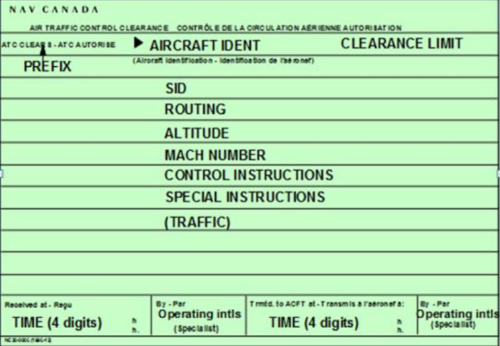
5 requirements when completing ATC clearance form.
Legibility
Content
Format
Endorsement
Readback
What do you say to omit reading back traffic information?
TRAFFIC RECIEVED
What are the 6 types of clearances that FSS can relay to pilots?
Initial/Departure clearance
Enroute Clearance
Approach Clearance
Missed Approach Clearance
Controlled VFR Clearance
Holding Clearance
ATC Interphone message priority
1. Distress message (including ESCAT)
2. Urgency message
3. IFR, CVFR, and SVFR movement and control message
4. CIRVIS message
5. Search and rescue message
6. Communications search message
7. DVFR and VFR movement message, including flight itinerary message
8. Approval request message concerning long-range IFR flight and altitude reservation message
9. ESCAT test message
10. Message concerning the malfunctioning of NAVAIDs
What is a time based restriction?
A time restriction becomes effective when the minute stated in the restriction is displayed on the clock; the seconds are disregarded.
When to complete a time check?
If an ATC clearance contains a DO NOT DEPART UNTIL, CLEARANCE CANCELLED, or other time-based restriction, provide a time check after the correct readback of the clearance.
What do you do if you are unable to deliver an ATC clearance or instruction within 3 minutes of receipt?
Notify the ACC
If you become aware of an IFR aircraft that may not be airborne by the time restriction specified in the IFR departure clearance:
• Inform the pilot of the clearance time restriction and, request intentions.
• Inform the appropriate ACC of pilot intentions.
• Relay any instructions received from the ACC to the pilot.
What does APREQ stand for?
Approval Request
What is Flow control/APREQ?
Measures designed to adjust the flow of traffic into a given airspace, along a given route, or bound for a given aerodrome, so as to ensure the most effective utilization of the airspace.
If you receive a phone call from an IFR pilot using a portable telephone as a substitute for radio communication:
• Obtain the following information:
- Aircraft identification
- Type of aircraft
- ACC assigned
- Frequency assigned
- Aircraft position
- Time at position
- Altitude or flight level
- Nature of the problem
- Pilot’s intentions
- Contact number, including area code
• Advise the pilot to keep the telephone line open until further instructions are received from the ACC.
• Inform the appropriate ACC.
What is the difference between estimate, estimating and estimated?
Estimate: The time, in UTC, at which an IFR aircraft is calculated, by either the controller, pilot or through automated means, to arrive over a significant point
Estimated: An expression used within ATS when communicating an ATC estimate.
Estimating: An expression used within ATS when communicating a pilot estimate
What is cancelling IFR?
An expression used by a pilot when flying on an IFR flight plan or flight itinerary, to change flight rules from IFR to VFR. As a result, ATC discontinues providing IFR separation, but does not close the IFR FP or FI or open a VFR FP or FI.
When a pilot of a VFR aircraft that is not on a FP/FI air files an IFR FP/FI:
• Obtain the appropriate flight information.
• Forward the relevant IFR FP/FI information to the appropriate ACC.
• Relay ATC messages to the pilot.
What to say when advising ACC on missed approach?
(aircraft ID) ON MISSED APPROACH (Runway ID), at (Time)
What are the items in an IFR Position Report?
1-Identification
2-Position
3-Time
4-Altitude
5-Type of flight plan or flight itinerary*
6-Next reporting point and ETA**
7-name only of the next succeeding reporting point
8-Remarks
Types of TCAS (Traffic Alert and Collision Avoidance System)
• TCAS I provides traffic advisories.
• TCAS II provides traffic advisories and vertical resolution advisories (RA)
• TCAS IV, when developed, will provide traffic advisories and vertical and horizontal RAs.
When to Request a Report Off Runway?
- The intended runway and taxiway are not visible from the operating position.
- You will not be in a position to see the aircraft leave the runway.
 Note
Note  Flashcards (58)