Prokaryotic vs Eukaryotic cells
 Call Kai
 Learn
Learn Practice Test
 Spaced Repetition
 Match
Match Flashcards
 Knowt Play
1/14

There's no tags or description
Looks like no tags are added yet.
Name | Mastery | Learn | Test | Matching | Spaced | Call with Kai |
|---|
No analytics yet
Send a link to your students to track their progress
15 Terms
Extremophiles
These early organisms were adapted to living in extremes of salinity, pH and temperature
More recently extremophiles have been found in more hospitable environments. (e.g. [...] and [...])
More recently extremophiles have been found in more hospitable environments. (e.g. soil and the human digestive system)
The structure of DNA contained within prokaryotes is fundamentally the same as in eukaryotes but it is [...] differently.
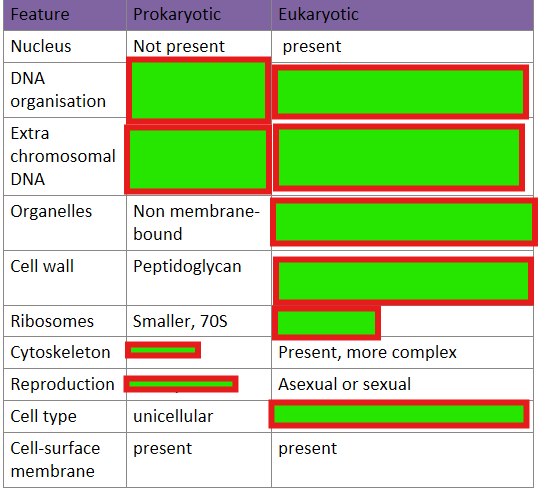
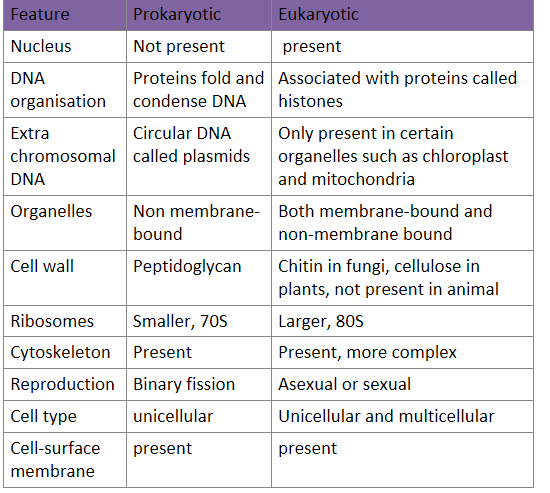
The structure of DNA contained within prokaryotes is fundamentally the same as in eukaryotes but it is packaged differently.
Prokaryotes generally only have [...] molecule of DNA, a [...], which is [...] to make it more compact. The genes on the chromosome are often grouped into [...] So, the number of genes are switched on or off at [...].
Prokaryotes generally only have one molecule of DNA, a chromosome, which is supercoiled to make it more compact. The genes on the chromosome are often grouped into operons So, the number of genes are switched on or off at the same time.
What is the difference in ribosomes between prokaryotic and eukaryotic cells.
The ribosomes in prokaryotic cells are smaller (70S) than eukaryotic cells ones (80S).
How are ribosomes relative size determined in prokaryotic and eukaryotic cells.
Their relative size is determined by the rate at which they settle, or form a sediment in solution.
The larger eukaryotic ribosomes are designated 80S and smaller prokaryotic ribosomes, 70S.
The larger 80S ribosomes are involved in the formation of more complex proteins.
What are Prokaryotic cells, cell wall made from
peptidoglycan/murein
peptidoglycan is a complex polymer from […] and […]
peptidoglycan is a complex polymer from
amino acids and sugars
Features of Flagella
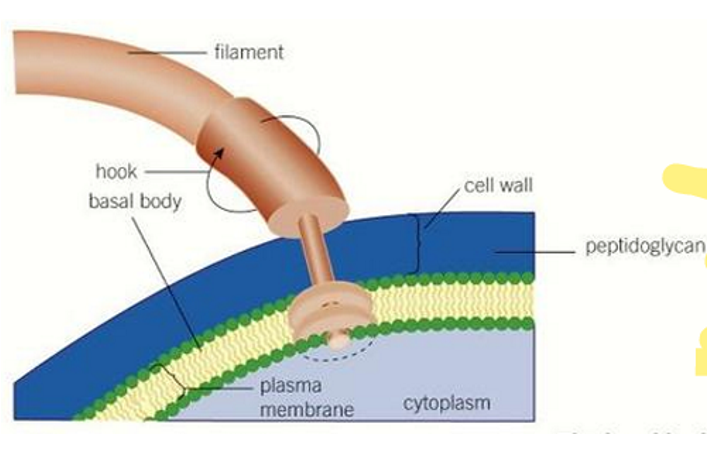
The flagella of prokaryotes is thinner than the equivalent structure of eukaryotes and does not have 9+2 arrangement.
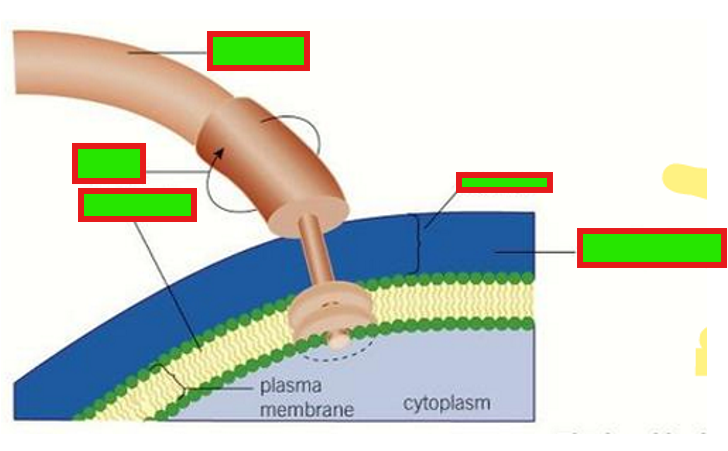
The flagellum is attached to the cell membrane of a bacterium by a basal body and rotated by a molecular motor.
how is the energy to rotate the filament that forms the flagellum supplied?
The energy to rotate the filament that forms the flagellum is supplied from the process of chemiosmosis, not from ATP
Describe how the cell propels in terms of filaments and basal body
The basal body attaches the filament comprising the flagellum to the cell-surface membrane of a bacterium.
A molecular motor causes the hook to rotate giving the filament a whip like movement, which propels the cell.
Fill in the blanks
answers
True or false. Eukaryotic cells are much more complex than prokaryotic cells.
True
How are eukaryotic cell’s DNA present within the nucleus?
Eukaryotic cell's DNA is present within a nucleus and exists as multiple chromosomes
which are supercoiled
Each one wraps around a number of proteins -> histones
Forming a complex for efficient packaging.
This complex is called chromatin
Chromatin coils and condenses to form chromosomes.
Eukaryotic genes are generally switched on and off individually.
Fill in the blanks
answers
Explore top notes

Explore top flashcards
