BSCI170: DNA Replication

0.0(0)
studied byStudied by 0 people
0.0(0)
full-widthCall Kai
learnLearn
examPractice Test
spaced repetitionSpaced Repetition
heart puzzleMatch
flashcardsFlashcards
GameKnowt Play
Card Sorting

1/12

flashcard set

Earn XP

Description and Tags

notes from 12/3 and 12/5

Study Analytics
Name
Mastery
Learn
Test
Matching
Spaced

No study sessions yet.

13 Terms

1
New cards

What does the double-helix model suggest about DNA replication?

The strands will separate from each other and each strand will serve as a template where the new complementary strand will be copied from

2
New cards

What is the conservative replication model?

DNA strands remain tg and the daughter strands are formed together
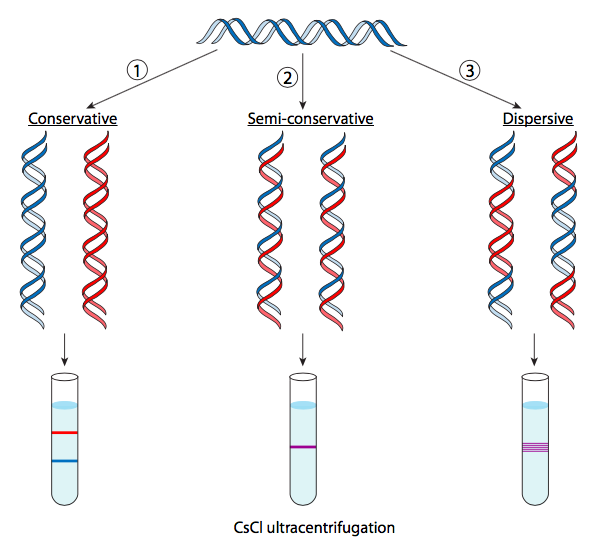
<p><span style="background-color: transparent; font-family: &quot;Times New Roman&quot;, serif;"><span>DNA strands remain tg and the daughter strands are formed together</span></span></p>
3
New cards

What is the semi-conservative DNA model?

 2 parental DNA strands are a template for new DNA to be synthesized (1 parental strand and one daughter strand tg) 
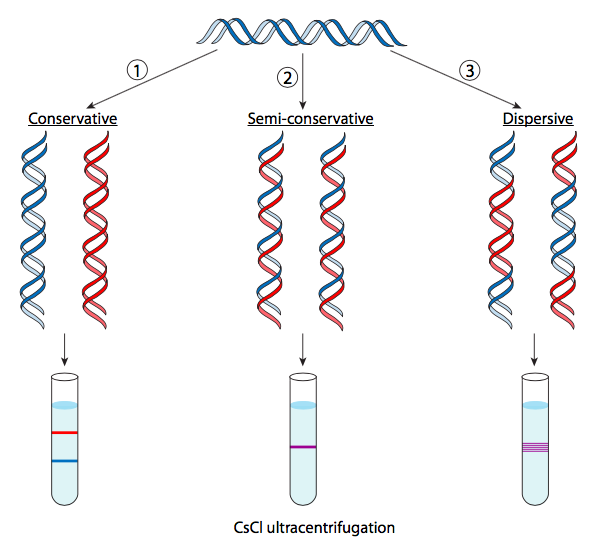
<p><span style="background-color: transparent; font-family: &quot;Times New Roman&quot;, serif;"><span>&nbsp;2 parental DNA strands are a template for new DNA to be synthesized (1 parental strand and one daughter strand tg)&nbsp;</span></span></p>
4
New cards

What is the dispersive replication model?

both copies of DNA have both parental and daughter strands of DNA mixed together
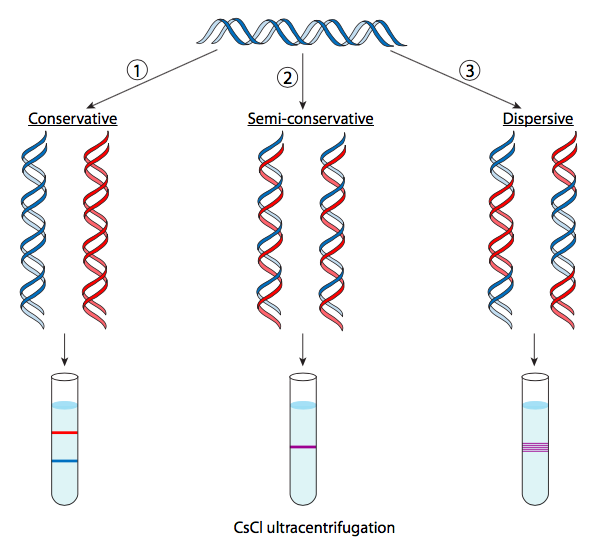
<p>both copies of DNA have both parental and daughter strands of DNA mixed together</p>
5
New cards

What was the basic overview of the Messelhon and Stahl experiments?

studied DNA replication in bacteria grown in different nitrogen isotopes (N14 and N15)

6
New cards

Steps of the Messelhon and Stahl experiments

  1. Bacteria grown in N15 (darker color)

  2. Some bacteria grown in N15 get transported to N14 (light color), and growth continues

  3. Samples are taken every 20 mins

  4. DNA is extracted from bacteria and placed in a salt gradient, where the - charged DNA sugar backbone will bind to + charged salt (now you have a mix of N15 and N14 dna): DNA sample of N15 from T0, DNA sample of N14+N15 at T20, and sample of N14+N15 at T40

7
New cards

Conclusion of the Messelhon and Stahl experiments

 after 1 generation of growth, they saw an intermediate single band: meaning conservative was ruled out, but they don’t know if it’s semi-conservative or dispersive


After 2 rounds, they saw 1 light and 1 intermediate band, meaning DNA is semi conservative.


<p><span style="background-color: transparent; font-family: &quot;Times New Roman&quot;, serif;"><span>&nbsp;after 1 generation of growth, they saw an intermediate single band: meaning conservative was ruled out, but they don’t know if it’s semi-conservative or dispersive</span></span></p><p><br></p><p><span style="background-color: transparent; font-family: &quot;Times New Roman&quot;, serif;"><span>After 2 rounds, they saw 1 light and 1 intermediate band, meaning DNA is semi conservative.</span></span></p><p><br></p>
8
New cards

What are the 3 phases of DNA replication

  • Initation

  • Elongation

  • Termination

9
New cards

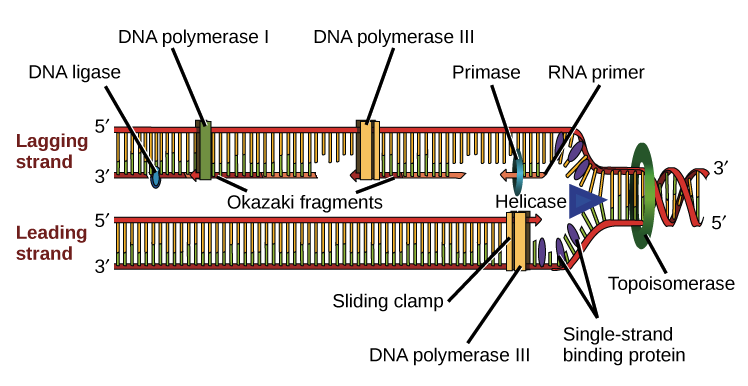
Enzymes involved in initiation

  • DNA HELICASE: unwinds the 2 strands of DNA

  • Single-strand binding proteins: bind to each strand to stop them from recoiling

  • Primase: binds to the single strand of DNA and makes RNA primer

  • RNA primer: makes a small nucleotide that acts like a starting point; goes in the 5’ to 3’ direction

  • Topoisomerase: binds to double helix to prevent even more coiling
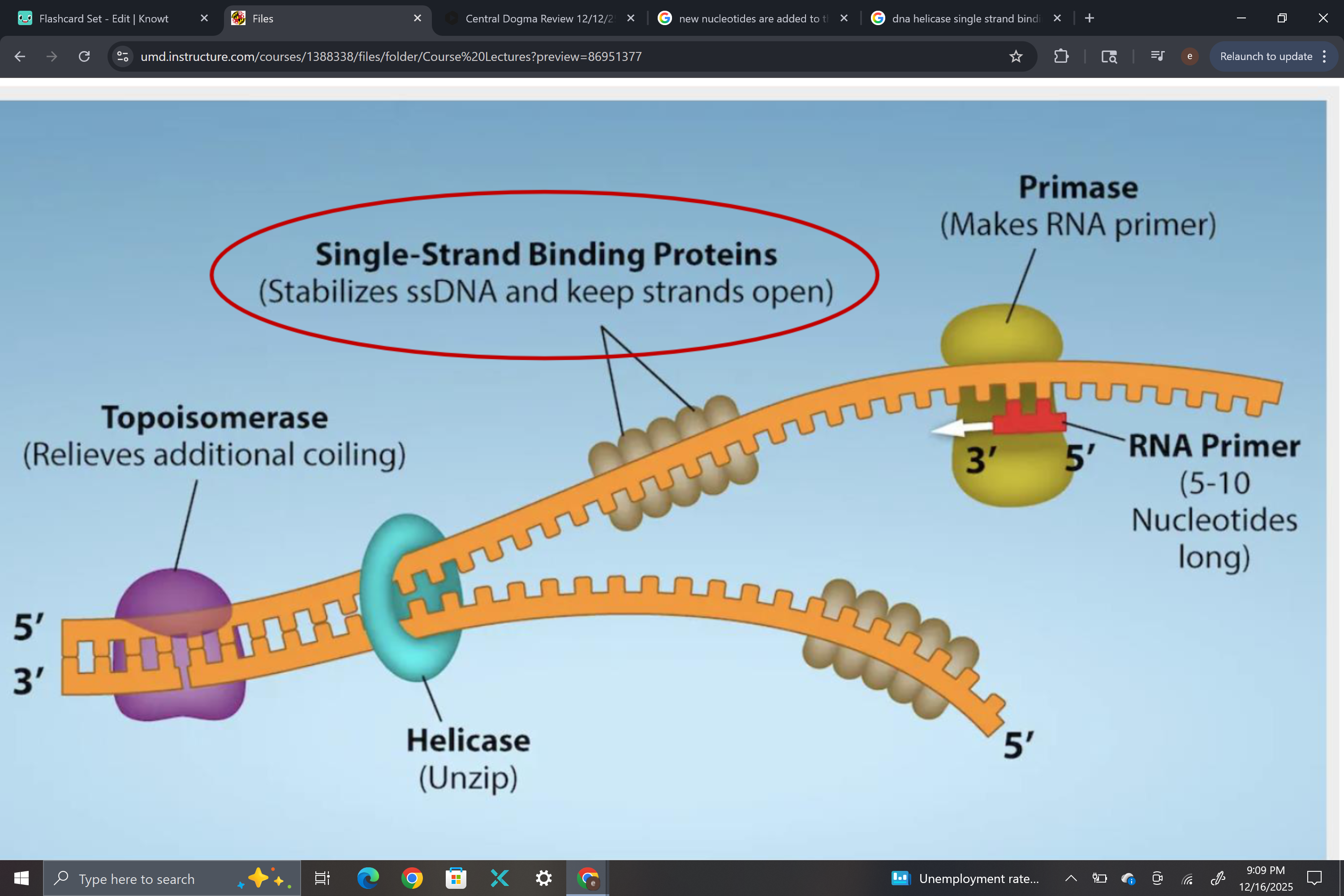
<ul><li><p><span style="background-color: transparent; font-family: &quot;Times New Roman&quot;, serif;"><span>DNA HELICASE: unwinds the 2 strands of DNA</span></span></p></li><li><p><span style="background-color: transparent; font-family: &quot;Times New Roman&quot;, serif;"><span>Single-strand binding proteins: bind to each strand to stop them from recoiling</span></span></p></li><li><p><span style="background-color: transparent; font-family: &quot;Times New Roman&quot;, serif;"><span>Primase: binds to the single strand of DNA and makes RNA primer</span></span></p></li><li><p><span style="background-color: transparent; font-family: &quot;Times New Roman&quot;, serif;"><span>RNA primer: makes a small nucleotide that acts like a starting point; goes in the 5’ to 3’ direction</span></span></p></li><li><p><span style="background-color: transparent; font-family: &quot;Times New Roman&quot;, serif;"><span>Topoisomerase: binds to double helix to prevent even more coiling</span></span></p></li></ul><p></p>
10
New cards

What is the origin of replication

DNA replication starts at the origin of replication, which makes a replication bubble 

  • If you have 1 chromosome (like prokaryotes), you have1 origin of replication 

  • Eukaryotes, since they have multiple chromosomes, you have multiple origins of replication

11
New cards

Enzymes involved in elongation

Elongation:

  • DNA polymerase: adds new DNA strands (DNA can only be added to the 3’, AKA the 5’ to 3’ direction)

    • In Prokaryotes, it’s called DNA Pol III

    • 5’ to 3’ is the same as saying new nucleotides get added to the 3’ end

  • Leading strand: the strand being synthesized closest to the replication fork

  • Lagging strand: made by OKAZAKI fragments at the replication fork bc DNA polymerase only goes one way so it doesn’t get the parts before the origin

    • Primase repeatedly synthesizes primers on the lagging strand

  • Ligase: glues okazaki fragments tg through phosphodiester bonds

    • Prokaryotes: DNA Pol I removes rna primers and extends strands made my DNA pol III
<p><span style="background-color: transparent; font-family: &quot;Times New Roman&quot;, serif;"><span>Elongation:</span></span></p><ul><li><p><span style="background-color: transparent; font-family: &quot;Times New Roman&quot;, serif;"><span>DNA polymerase: adds new DNA strands (DNA can only be added to the 3’, AKA the 5’ to 3’ direction)</span></span></p><ul><li><p><span style="background-color: transparent; font-family: &quot;Times New Roman&quot;, serif;"><span>In Prokaryotes, it’s called DNA Pol III</span></span></p></li><li><p><span style="background-color: transparent; font-family: &quot;Times New Roman&quot;, serif;"><span>5’ to 3’ is the same as saying new nucleotides get added to the 3’ end</span></span></p></li></ul></li><li><p><span style="background-color: transparent; font-family: &quot;Times New Roman&quot;, serif;"><span>Leading strand: the strand being synthesized closest to the replication fork</span></span></p></li><li><p><span style="background-color: transparent; font-family: &quot;Times New Roman&quot;, serif;"><span>Lagging strand: made by OKAZAKI fragments at the replication fork bc DNA polymerase only goes one way so it doesn’t get the parts before the origin</span></span></p><ul><li><p><span style="background-color: transparent; font-family: &quot;Times New Roman&quot;, serif;"><span>Primase repeatedly synthesizes primers on the lagging strand</span></span></p></li></ul></li><li><p><span style="background-color: transparent; font-family: &quot;Times New Roman&quot;, serif;"><span>Ligase: glues okazaki fragments tg through phosphodiester bonds</span></span></p><ul><li><p><span style="background-color: transparent; font-family: &quot;Times New Roman&quot;, serif;"><span>Prokaryotes: DNA Pol I removes rna primers and extends strands made my DNA pol III</span></span></p></li></ul></li></ul><p></p>
12
New cards

Termination in prokaryotes vs eukaryotes

  • Prokaryotes: straightforward - once the replication reaches the bottom of the circle (bc replication still goes two ways and DNA is circular) the termination sequence happens and it leaves us w 2 replicated circular DNA

  • Eukaryote: RNA primer is removed and you are left with the daughter strand being shorter than the parent strand, and telomerase adds telomeres to the shortened strand, 

13
New cards

What is telomerase

  • adds telomeres: Telomeres are short repeated sequences that don’t code for proteins or RNA

    • As we age. Telomeres get shorter and shooter, which leads to cell death

    • Telomerase is only found in sex cells

    • Active telomerase is found in cancer cells