Chapter 5
 Studied by 0 people
 Call Kai
 Learn
Learn Practice Test
 Spaced Repetition
 Match
Match Flashcards
 Knowt Play
1/91

There's no tags or description
Looks like no tags are added yet.
Name | Mastery | Learn | Test | Matching | Spaced | Call with Kai |
|---|
No analytics yet
Send a link to your students to track their progress
92 Terms
how is froid like a tree?`
Like a giant oak standing in the middle of a grove, Freud’s theory is the oldest and most formidable of the many psychoanalytic approaches to understanding personality. Just as the oak drops acorns that sprout into their own trees, so did Freud’s Psychoanalytic Society generate several scholars who went on to develop their own theories of personality. However, like the surrounding saplings that resemble the great oak, the ancestry of these later personality theories is clearly Freudian.
neofroidians vs froid?
For the most part, neo-Freudian theorists retained the unconscious as a key determinant of behavior. Most also agreed with Freud about the impact of early childhood experiences on personality development, although many felt that later experiences also influenced adult personality. These theorists also readily accepted such Freudian concepts as defense mechanisms and dream interpretation. In short, the neo-Freudian theories should be viewed as different perspectives within the general psychoanalytic approach to personality.
One feature that remains from the tradition of loyalty and divisions found in that early group of theorists is the tendency to treat the theory’s developer more as a prophet than a theorist. Thus, people often identify themselves as a Jungian or an Adlerian psychologist.
First, many of these theorists rejected the idea that the adult personality is formed almost in its entirety by experiences in the first 5 or 6 years of life. adolescence and early adulthood, are also important in shaping personality. Erik Erikson, maintained that important aspects of personality continue to develop into old age.
Second, many neo-Freudians challenged Freud’s emphasis on instinctual sources of personality. In particular, Freud failed to appreciate many social and cultural forces that also shape who we are. For example, Freud attributed many of the differences he saw between the personalities of men and women to inherent biological differences between the sexes. Later theorists, most notably Karen Horney, argued that the culture we grow up in plays a large role in creating these differences.
Third, many psychologists disliked the generally negative tone of Freudian theory. Freud painted a pessimistic and, in some ways, degrading picture of human nature—people largely controlled by instincts and unconscious forces. Later theorists, both psychoanalytic and otherwise, presented a more positive view of humankind and human personality.
Burger Section Quiz 5.1
According to traditional Freudian theory, personality is formed almost entirely by experiences that occur during ________. This is a concept that has been challenged by neo-Freudians whose work moved Freudian theory in new directions.
infancy
the first 5 or 6 years of life
all of our childhood up to adolescence
adolescent years
the first 5 or 6 years of life
How did Freud regard the social and cultural forces that can play a part in shaping personality?
He noted that they are positive forces for women (who he felt were born disadvantaged) but negative forces for men.
They made up the majority of this theory, as he felt that all that we are from our earliest years is shaped by our surroundings.
He felt that they were very important during adulthood, but almost irrelevant during childhood and adolescence.
He gave them almost no attention, emphasizing instead inborn biological determinants of behavior.
He gave them almost no attention, emphasizing instead inborn biological determinants of behavior.
Dr. Shandler is a humanistic personality theorist, who believes that people are generally good, driven to become the best they can be, and limitless in their potential. How might Dr. Shandler respond to the psychoanalytic model of Sigmund Freud?
He’d probably see Freud’s model as being as optimistic and positive as his own.
Like others, he may find Freud’s model too negative and depressing in its conceptualization of human beings.
He would appreciate Freud’s positivity but not accept the lack of scientific validation of the model.
He would not distinguish between the two, since the Freudian model was derived from early humanistic concepts.
Like others, he may find Freud’s model too negative and depressing in its conceptualization of human beings.
who was the first member of the psychoanalytic group to break with Freud.
Alfred Adler was the first member of the psychoanalytic group to break with Freud. The year was 1911, and it was clear to both men that their differences were fundamental. Unfortunately, the professional dispute became personal as well. Freud saw Adler’s disagreements more as defections than points of discussion. When Adler left the Vienna group, several members left with him. Friendships were severed, and accusations were tossed about.
Alfred Adler contributed what ideas?
Adler went on to develop his own society, establish his own journal, and even select a name for his new psychology. He called his approach individual psychology. Among Adler’s important contributions to our understanding of personality are the notion of striving for superiority, the role of parental influence on personality development, and the effects of birth order.
the story of Alfred Adler: what were his life struggels, and how did he becme friends eith froid, then enimies?
Alfred Adler’s career provides an excellent example of one man’s lifelong striving to overcome feelings of inferiority. Adler was born in Vienna in 1870, the third of six children. Alfred spent much of his childhood in his older brother’s shadow. A series of childhood illnesses, particularly rickets, left Adler physically unable to keep up with his brother and other playmates in athletic and outdoor games. He almost died of pneumonia at age 4 and twice was nearly killed when run over by carts in the streets. Because of his physical inferiority, Adler received special treatment from his mother. However, this ended with the birth of his brother. “During my first two years my mother pampered me,” he recalled. “But when my younger brother was born she transferred her attention to him, and I felt dethroned” (cited in Orgler, 1963, p. 2).
Adler also experienced feelings of inferiority in the classroom. He achieved only mediocre grades and did so poorly at mathematics one year that he had to repeat the course. His teacher advised his father to take the boy out of school and find him an apprenticeship as a shoemaker. But this episode only seemed to motivate Adler. He studied furiously and soon became the best mathematics student in the class. He went on to receive his medical degree from the University of Vienna in 1895.
Adler never studied under Freud, nor did he ever undergo psychoanalysis, as required for becoming a practicing psychoanalyst (Orgler, 1963). The two theorists’ association began in 1902 when Freud invited Adler to attend his discussion group after Adler had defended Freud’s theory of dream interpretation against attacks in the local newspaper. Adler eventually was named the first president of the group in 1910.
However, growing disagreements with Freud led to Adler’s resignation in 1911. Several members joined Adler in forming what was originally called the Society for Free Psychoanalytic Research—a name intended to express their objection to Freud’s required adherence to his theory. Adler later changed the name of the association to Individual Psychology, established a journal, and received wide acceptance for his alternate interpretation of strict Freudian theory. As in his earlier battles to overcome feelings of inferiority, Adler devoted much of his professional life to catching and trying to surpass Sigmund Freud.
One of the key differences between Freud and Adler was what?
One of the key differences between Freud and Adler was their description of human motivation. Whereas Freud depicted motivation in terms of sexual and aggressive themes, Adler identified a single motivating force he called striving for superiority
striving for superiority
The primary motivational force in Adler’s theory, which is the person’s effort to overcome feelings of inferiority.
how and why do we overcome feelings of infeiriority
Ironically, striving for superiority begins with feelings of inferiority. In fact, Adler maintained that each of us begins life with a profound sense of inferiority. This is to be expected from a weak and helpless child, dependent on larger and stronger adults for survival. The moment children become aware of their relative weakness marks the beginning of a lifelong struggle to overcome their sense of inferiority.
For Adler, virtually, everything we do is designed to establish a sense of superiority over life’s obstacles. Why do we work so hard to obtain good grades, to excel at athletics, or to reach a position of power? Because achieving these things moves us a step further away from our feelings of inferiority. As a rule, the more inferior we see ourselves, the stronger our striving for superiority. Franklin Roosevelt was disabled by polio. Nonetheless, Adler might have said that because of this disability, he aspired to become one of the most influential figures of the 20th century.
inferiority complex
However, in some cases, excessive feelings of inferiority can have the opposite effect. Some people develop an inferiority complex, a belief that they are vastly inferior to everyone else. The result is feelings of helplessness rather than an upward drive to establish superiority. Children and adults who suffer from an excessive sense of inferiority avoid or run away from challenges rather than work to overcome them.
What is the difference between Adler and Freuds analysis of highly successful business people?
The difference between Adler and Freud can be seen in their analysis of highly successful business people. Freud often described these individuals in terms of sublimation. Commercial and financial achievements are merely misplaced unconscious impulses. Freud also might say that, for businessmen (not businesswomen), defeating rivals satisfies an unconscious desire to compete with and defeat one’s father, a motive left over from the Oedipus complex. In contrast, Adler saw business success as an expression of superiority striving. Each increase in salary and each step up the corporate ladder provides another reminder that one is not inferior.
But for Adler, achievement alone was not indicative of mental health…
he key is to combine superiority striving with a concern for Gemeinschaftsgefuhl, which roughly translates from German to social interest. Successful businesspeople achieve a sense of superiority and personal satisfaction through their accomplishments, but only if they reach these goals with consideration for the welfare of others. Success means providing consumers with a good product at a fair price that will make everyone’s life a little happier. In contrast, poorly adjusted people express their striving for superiority through selfishness and a concern for personal glory at the expense of others. Politicians who seek public office for personal gain and a sense of power reflect a poor sense of social interest. Those who seek office to serve and to help right some of society’s wrongs exhibit appropriate and constructive superiority striving.
how does adler differ from froids view??
Adler believed the first few years of life are extremely important in the formation of the adult personality. However, Adler also placed great emphasis on the parents’ role in this process. He identified two parental behaviors, in particular, that are almost certain to lead to problems for children later in life…
pampering
parents who give their children too much attention. robs the child of independence and adds to feelings of inferiority. Parents who keep their sons and daughters away from carnival rides, aggressive playmates, and scary movies may leave their children unable to deal the inevitable challenges life throws their way.
how to avoid pampering?
Allowing children to struggle with problems and make some of their own decisions, even if this means making mistakes, is good for them in the long run. Parents can avoid pampering by allowing children the freedom to make many of their own choices.
\
neglect
Children who receive too little attention from their parents grow up cold and suspicious. As adults, they are incapable of warm personal relationships. They are uncomfortable with intimacy and may be ill at ease with closeness or touching.
addlers view on birth order: what happens if yr 1st, 2 or baby 3?
According to Adler, firstborn children are subject to excessive attention from their parents and thus to pampering. First-time parents can never take enough photos and seldom miss an opportunity to tell friends and relatives about the new arrival. However, this pampering is short-lived. With the arrival of the second child, the firstborn is “dethroned.” Now attention must be shared with, if not relinquished to, the newest member of the family. As a result, the firstborn’s perception of inferiority is likely to be strong. Adler suggested that among firstborns we often find “problem children, neurotics, criminals, drunkards, and perverts.”
On the other hand, Adler’s assessment of middle children—Adler himself was a middle child—was more positive. These children are never afforded the luxury of being pampered, for even when they are the youngest there is always another sibling or two demanding much of the parents’ time. Adler argued that middle children develop an intense superiority striving. They are not quite as strong, not quite as fast, and not quite as smart as older brothers and sisters. It’s as if they are always just a step behind. As a result, middle-born children spend a lifetime trying to catch up. They are always looking at the person slightly ahead of them in school or in the office, always putting in a little extra effort to close the gap. Consequently, Adler said, middle-born children are the highest achievers.
Although Adler believed firstborns made up the greatest proportion of difficult children, he felt last-borns had their problems as well. Last-born children are pampered throughout their childhood by all members of the family. Older children often complain that their little brother or sister “gets away with murder,” which would not have happened “when I was that age.” However, Adler argued that this special treatment carries a price. A spoiled child is a very dependent child—a child without personal initiative. Last-born children also are vulnerable to strong inferiority feelings because everyone in their immediate environment is older and stronger.
is birth order a good way to measure/predict a childs personality?
Before applying Adler’s theory to the members of your own family, you should note that studies do not always support Adler’s predictions. Birth order often does not predict how people will score on personality measures (Jefferson, Herbst, & McCrae, 1998; Parker, 1998), and effects found in one study frequently fail to replicate in another (Michalski & Shackelford, 2002; Pollet, Dijkstra, Barelds, & Buunk, 2010). One recent investigation looked at birth order in a sample of more than 377,000 high school students (Damian & Roberts, 2015). The researchers found the overall effect of birth order on personality to be extremely small and often at odds with predictions. In other words, although Adler succeeded in drawing attention to the role family dynamics play in the development of personality, most likely the impact of birth order is more complex and perhaps more subtle than he imagined
Burger Section Quiz 5.2
The personality approach of Alfred Adler has been called ____ psychology.
analytic
object-relations
individual
self-
individual
Fourteen-year-old Dharma is just a few pounds overweight, but she is extremely self-conscious about it. Nobody has ever said a thing to her, and even her physician has told her that it is nothing to worry about. Nonetheless, Dharma feels that she is very heavy, and is now essentially starving herself to lose weight. Alfred Adler would say that Dharma is experiencing
an inferiority complex.
defensive compensation.
difficulty with healthy attachments.
an overactive id.
The correct answer
an inferiority complex.
Adler warned that parents should avoid doting on their children, giving them too much attention. He argued that this sort of behavior, which he called blank 1, reduces a child’s ability to experience independence.
ruminating
pampering
spoiling
hovering
pampering
Carl Jung
Perhaps, the most bitter of the defections from the Freudian camp was Carl Jung’s break with the psychoanalytic circle. In Freud’s eyes, Jung was the heir apparent to the leadership of the movement; Jung served as the first president of the International Psychoanalytic Association. However, in 1914, after long and intense disagreement with some of the basic aspects of Freud’s theory, Jung resigned from the association. In the years that followed, he continued his work as a psychotherapist, traveled extensively to observe other cultures, and eventually established his own school of psychology, named analytic psychology.
the collective unconscious, a
The part of the unconscious mind containing thoughts, images, and psychic characteristics common to all members of a culture.
EX; we all have strong attachment to mom, we all feared the fdark, we all accepted that there was a God or some sort of higher being that controlled the world around us etc.
the collective unconscious consists of thoughts and images that are difficult to bring into awareness. However, these thoughts were never repressed out of consciousness. Instead, each of us was born with this unconscious material, and it is basically the same for all people.
According to Jung, just as we inherit physical characteristics from our ancestors, we also inherit unconscious psychic characteristics.
primordial images.
The collective unconscious is made up of primordial images. Jung described these images in terms of a potential to respond to the world in a certain way. Thus, newborns react quickly to their mothers because the collective unconscious holds an image of a mother for each of us. Similarly, we react to the dark or to God because of unconscious images inherited from our ancestors. Jung referred to these images collectively as archetypes. Among the many archetypes Jung described were the mother, the father, the wise old man, the sun, the moon, the hero, God, and death. He maintained there are “as many archetypes as there are typical situations in life.”
archetypes.
Jung referred to these images collectively as this thing... Among the many archetypes Jung described were the mother, the father, the wise old man, the sun, the moon, the hero, God, and death. He maintained there are “as many archetypes as there are typical situations in life.”
anima
the feminine side of the male
deep inside every masculine man is a feminine counterpart.
animus
the masculine side of the female.
Deep inside every feminine woman is a masculine self
why do we have this anima or animus side of us?
A principal function of these archetypes is to guide the selection of a romantic partner and the direction of the subsequent relationship. Jung explained that we look for a romantic partner by projecting our anima or animus onto potential mates. In his words, “a man, in his love choice, is strongly tempted to win the woman who best corresponds to his own unconscious femininity—a woman, in short, who can unhesitatingly receive the projection of his soul” (1928/1953, p. 70). Less poetically, Jung is saying that each of us holds an unconscious image of the man or woman we are looking for. The more someone matches our projected standards, the more we’ll want to develop a relationship with that person. Whereas people in love might prefer to “count the ways,” Jung believed the real reason for romance lies in the hidden part of our minds.
shadow
contains the unconscious part of ourselves that is essentially negative, or to continue the metaphor, the dark side of our personalities. It is the evil side of humankind. The shadow is located partly in the personal unconscious in the form of repressed feelings and partly in the collective unconscious. Jung pointed out that evil is often personified in myths and stories from various cultures. In many religions, this archetype is symbolized as the Devil. Good-versus-evil is perhaps the most common theme in literature because the collective unconscious of all people readily grasps the concept.
Evidence for the Collective Unconscious
One criticism sometimes directed at Jung is that his theory is difficult to examine through scientific methods. However, Jung was not indifferent to the need for evidence to support his ideas. Through a lifelong study of modern and ancient cultures, and in his role as a psychotherapist, Jung arrived at what was for him indisputable evidence for the collective unconscious and other constructs in his theory. Rather than rely on data from rigorous investigations, he turned to sources like mythology, cultural symbols, dreams, and the statements of schizophrenics. Jung argued that if the collective unconscious is basically the same for each of us, then primordial images should be found in various forms across all cultures and throughout human history.
Carl Gustav Jung 1875–1961
childhood and adulthood
Whereas biographers debate the extent to which Freud’s personality theory reflects his own unconscious thoughts, Carl Jung candidly described how his ideas about personality came from introspection and his own experiences. Jung was born in 1875 in Kesswil, a small town in Switzerland. He was a highly introspective child who kept to himself, largely because he felt no one would understand the inner experiences and thoughts with which he was preoccupied. Jung spent many childhood hours pondering the meaning of the dreams and supernatural visions he experienced. When he was 10, he carved a 2-inch human figure out of wood. He kept the figure hidden, spoke to it when alone, and sometimes wrote to it in secret codes. During his teenage years, he was preoccupied with the feeling that he was someone else. He began a lifelong search to identify what he called his Number Two personality.
Jung’s desire to understand himself led him to the young field of psychiatry. He earned his medical degree from the University of Basel in 1900, and then went to Zurich to study with Eugen Bleuler, a leading authority on schizophrenia. Later, he worked in Paris with Pierre Janet, who was conducting pioneering work on consciousness and hypnosis. Naturally, Jung’s curiosity about the human mind soon brought him into contact with Freud’s work. After reading The Interpretation of Dreams, Jung began a correspondence with Freud. When they finally met in 1907, the two men are said to have engaged in a conversation that lasted 13 hours. Jung soon became a close colleague of Freud’s, even accompanying him on his 1909 trip to lecture at Clark University. It was during this trip that Jung came to appreciate how intolerant Freud was of their disagreements about the nature of personality. Jung formally parted with the Vienna group in 1914.
Jung spent the next 7 years in virtual isolation, exploring the depths of his own unconscious. He immersed himself in his fantasies, dreams, and visions in an effort to discover the true nature of personality. Scholars disagree on whether this was a period of voluntary introspection or a lengthy psychotic episode. Jung’s autobiography, published just before his death, provides evidence for both interpretations. “An incessant stream of fantasies had been released, and I did my best not to lose my head but to find some way to understand these strange things,” he wrote. “From the beginning … I had an unswerving conviction that I was obeying a higher will” (1961, pp. 176–177).
Jung reports visits by various figures and images during these years. He came to see these figures as the archetypal characters that make up the collective unconscious. Jung described in detail conversations with a figure he called Philemon. “I held conversations with him, and he said things which I had not consciously thought,” Jung wrote. “For I observed clearly that it was he who spoke, not I.… I went walking up and down the garden with him, and to me he was what the Indians call a guru” (1961, p. 183).
Jung emerged from these years of introspection with a new theory of personality. He devoted the rest of his career to private practice, traveling, reading, and studying. His observations during these experiences, combined with his continued introspection, resulted in numerous volumes and lectures. Many of Jung’s writings have been controversial, including those that some say hint at anti-Semitism (Noll, 1997). Nonetheless, his ideas about human personality continue to mystify and excite readers from around the world.
Carl jungs crazy theories, he supported his nutso ideas off of what speciifc story?
Jung pointed to the recurrence of certain symbols in dreams and hallucinations, as well as the images found in art, folklore, and mythology. Why does a symbol like a vulture appear in the dreams of people today in the same basic way it appears in religious writings and ancient mythologies of cultures unknown to the dreamer? Jung described an early discovery of this type when he spoke with a mental patient suffering from schizophrenia:
“One day I came across him there, blinking through the window up at the sun, and moving his head from side to side in a curious manner. He took me by the arm and said he wanted to show me something. He said I must look at the sun with eyes half shut, and then I could see the sun’s phallus. If I moved my head from side to side the sun-phallus would move too, and that was the origin of the wind. (1936/1959, p. 51)“
A few years later, while reading Greek mythology, Jung came across a description of a tube-like element hanging from the sun. According to the myth, the tube was responsible for the wind. How could such an image appear in both the hallucinations of the patient and the stories of the ancient Greeks? Jung maintained that the image existed in the collective unconscious of the Greek storytellers as well as in those of psychotic patients and, therefore, in the collective unconscious of us all.
Burger Section Quiz 5.3
An early colleague and heir-apparently to Freud in the psychoanalytic model, Carl Jung broke from Freud’s approach and went on to develop his own paradigm called blank 1 psychology.
object relations
analytic
self-
individual
analytic
Melissa is bored at the movie she has gone to see. Afterward, she tells her friend “It is just so tired. Every movie has a hero and a villain, and they always end the same way. I’m so sick of every movie being so darn predictable!” Jung would say that these figures are examples of blank 1 that are contained in the collective unconscious.
archetypes
god-figures
mantras
mandalas
Sherrod doesn’t like his friends to know it, because they all enjoy doing “manly” activities together, but sometimes when he’s alone, he likes to run a bubble bath, turn on some music, and just soak and relax. He feels that these are feminine interests and doesn’t want to be teased about enjoying them. Jung would say that Sherrod’s enjoyment of baths are an expression of his
animus
anima
shadow
anamagus
anima
pick up at “5.4. Erik Erikson” on page 92
How did eric erickson get to practice?
In the summer of 1927, a young artist wandering about Europe took a job in a school established for the children of Sigmund Freud’s patients and friends. That artist, Erik Homburger, who never received a university degree, became friendly with the psychoanalysts and was later trained by them. After changing his name from Homburger to Erikson, he began to practice psychotherapy and eventually to espouse his own views on the nature of human personality.
difference between froid and ericsons view?
Whereas Freud saw the ego as the mediator between id impulses and superego demands, Erikson believed the ego performed many constructive functions. To Erikson, the ego is a relatively powerful, independent part of personality. For this reason, Erikson’s approach to personality has been called ego psychology. To Erikson, the ego is a relatively powerful, independent part of personality. For this reason, Erikson’s approach to personality has been called ego psychology.
To Freud, personality development for the most part ends when the superego appears at about age 6. In contrast, Erikson (1950/1963) maintained that personality development continues throughout a person’s lifetime. He outlined eight stages we all progress through, each crucial in the development of personality (Figure 5.1).
Erick erickson coined what kind of psychology name?
ego psychology
According to Erikson, the principal function of the ego is what?
According to Erikson, the principal function of the ego is to establish and maintain a sense of identity. People with a strong sense of personal identity are aware of their uniqueness—what makes them special—and maintain a strong sense of continuity with their past self and what they imagine is their future self
identity crisis
refer to the confusion and despair we feel when we lack a strong sense of who we are. Perhaps, you have experienced a time when you felt uncertain about your values or the direction your life was headed. Episodes of identity crises are typical in adolescence but are by no means limited to young people. Many middle-aged people experience similar trying periods.
Erikson’s struggle with his identity led him to behavior he would later identify as somewhere between neurotic and psychotic. Yet, these struggles also provided him with a keen insight into the problems associated with identity, particularly among adolescents and young adults.
His Danish father abandoned the family before Erik was born. Three years later, his mother married a Jewish physician, Theodor Homburger, and for many years, told her son that Dr. Homburger was his real father. It was not until he was an adolescent that Erikson learned the truth—that his birth was the result of an extramarital affair, a fact Erikson kept secret until he was 68
Erikson’s identity was further confused by his physical features. Although living in a Jewish family, he retained most of the physical features of his Scandinavian father—tall, blond hair, blue eyes. “Before long, I was referred to as ‘goy’ in my stepfather’s temple,” he wrote, “while to my schoolmates I was a ‘Jew’” (1975, p. 27). World War I broke out during Erik’s early adolescence, leaving the boy with torn feelings of loyalty between Germany and his growing identity as a Dane.
upon graduation from public school. His stepfather pushed medical school, but Erik resisted. He decided instead that he was an artist and spent the next few years wandering about Europe. His travels eventually brought him to Vienna and into contact with Anna Freud, Sigmund’s daughter and a noted psychoanalyst herself. Except for a Montessori teaching credential, his psychoanalytic training with Anna Freud was the only formal education he received after leaving home. Somewhere during these years, Erik changed his name to Erik Homburger Erikson, obviously reflecting his changing sense of identity.
basic explination of ericsons 8 stages of developement.
Erikson’s stages of personality development bring to mind the image of a path. We continue down this path from infancy to old age, but at eight different points along the way we encounter a fork—two directions in which to proceed. In Erikson’s model, these forks represent turning points in personality development, what he called crises. How we resolve each crisis determines the direction our personality development takes and influences how we resolve later crises. Of the two alternatives for resolving each crisis, one is said to be adaptive, the other not. Individuals who take a wrong turn on this path and fail to adaptively resolve a crisis may need to return to the critical juncture later in life during psychotherapy to set things right (Marcia & Josselson, 2013). For example, a therapist might trace a man’s problems with intimacy back to his failure to establish a sense of basic trust before he was even a toddler.
Basic Trust versus Mistrust
During the first year or so of life, newborns are almost totally at the mercy of those around them. Whether infants are given loving care and have their needs met or whether their cries go unnoticed is the first turning point in the development of personality. The child whose needs are met develops a sense of basic trust. For this child, the world is a good place and people are loving and approachable. Unfortunately, some infants never receive the loving care they need. As a result, they develop a sense of basic mistrust. These children begin a lifelong pattern of suspicion about and withdrawal from other people.
Autonomy versus Shame and Doubt
By the second year of life, children want to know who they are relative to the rest of the world. Is the world something they control or something that controls them? When allowed to manipulate and influence much of what they encounter, children come through this stage with a sense of autonomy. They feel powerful and independent. They have a strong sense of personal mastery. People with a sense of autonomy are confident that they can navigate their way through the sea of obstacles and challenges life has in store. However, just as Adler warned against pampering, Erikson observed that overly protective parents can hinder development at this age. If not allowed to explore and exercise influence over the objects and events in their world, children develop feelings of shame and doubt. They are unsure of themselves and become dependent on others.
Initiative versus Guilt
As children begin to interact with other boys and girls, they face the challenges that come with living in a social world. They must learn how to play and work with others and how to resolve inevitable conflicts. Children who seek out playmates and who learn how to organize games and other social activities develop a sense of initiative. They learn how to set goals and tackle challenges with conviction. They develop a sense of ambition and purpose. Children who fail to develop a sense of initiative come through this stage with feelings of guilt and resignation. They may lack a sense of purpose and show few signs of initiative in social or other situations.
Industry versus Inferiority
Most children enter elementary school thinking there is little they can’t do. But soon they find themselves in competition with other children—for grades, popularity, teachers’ attention, victories in sports and games, and so on. Inevitably, they compare their talents and abilities with other children of their age. If they experience success, feelings of competence grow that set them well on their way to becoming active and achieving members of society. But experiences with failure can lead to feelings of inadequacy and to a poor prognosis for productivity and happiness. It is during this time, before the turmoil of puberty and the teenage years, that we develop either a sense of industry and a belief in our strengths and abilities or a sense of inferiority and a lack of appreciation for our talents and skills.
Identity versus Role Confusion
-he teenage years,
-may be the most difficult time of life. The turmoil of transcending from playground concerns and simple solutions to facing some of life’s important questions can be unsettling.
Young men and women begin to ask the all-important question, “Who am I?” If the question is answered successfully, they develop a sense of identity. They make decisions about personal values and religious questions. They understand who they are and accept and appreciate themselves. Unfortunately, many teens fail to develop this strong sense of identity and instead fall into role confusion.
In their search for identity, adolescents may join cliques, commit to causes, or drop out of school and drift from one situation to another.
Intimacy versus Isolation
young adulthood
developing intimate relationships.
Although these relationships typically result in marriage or a romantic commitment to one person, this is not always the case. One can share intimacy without marriage and, unfortunately, marriage without intimacy. People who fail to develop intimacy during this stage face emotional isolation. They may pass through many superficial encounters without finding the satisfaction of closeness promised by genuine relationships. Indeed, they may avoid emotional commitment. The single-person’s lifestyle has its advantages and may be pleasant for a while, but failure to move beyond this lifestyle can seriously inhibit emotional growth and happiness.
Generativity versus Stagnation
As men and women approach the middle years of life, they develop a concern for guiding the next generation. Parents find their lives enriched by the influence they have on their children. Adults without their own children find this enrichment by working with youth groups or playing an active role in raising nieces and nephews. Adults who fail to develop this sense of generativity may suffer from a sense of stagnation—a feeling of emptiness and questioning one’s purpose in life. We’ve all seen parents whose lives are filled with continued meaning and interests through raising their children. Unfortunately, we’ve also seen parents who obtain little pleasure from this process. As a result, they become bored and generally dissatisfied with their lives. Failure to see the potential for personal growth in the development of their children is tragic for parent and child alike.
Ego Integrity versus Despair
old age. But, according to Erikson, we still have one more crisis to resolve. Reflections on past experiences and the inevitability of life’s end cause us to develop either a sense of integrity or feelings of despair.
Men and women who look back on their lives with satisfaction will pass through this final developmental stage with a sense of integrity.
People who fail to develop this sense of integrity fall into despair. They realize that time is now all too short, that the options and opportunities available to younger people are no longer there. A life has passed, Jerry Burger/Santa Clara University and those who wish they could do it all differently will express their despair through disgust and contempt for others.
Burger Section Quiz 5.4
Although he retained some of Freud’s important concepts, Erik Erikson’s own model would later be called blank 1 psychology.
individual
self
ego
analytic
ego
Aylla is a 17-year-old junior in high school. According to Erik Erikson, her stage of development involves the crisis of
industry versus inferiority
intimacy versus isolation
identity versus role confusion
initiative versus guilt
identity versus role confusion.
Which question, when answered positively, would be most likely to produce a sense of integrity in Erikson’s model?
“Do I do anything that contributes to the next generation?”
“Will I find a person with whom to spend my life?”
“Do I know who I was, who I am, and who I am becoming?”
“Has my life been well spent as I approach my death?”
“Has my life been well spent as I approach my death?”
what big disagreement did karen horney have with froiud?
In particular, Horney found she could not accept some of Freud’s views concerning women. Freud maintained that men and women were born with different personalities. Horney argued that cultural and social forces are far more responsible than biology for some of the apparent differences between the genders.
Horney explored cultural and social influences on personality development throughout her career. The prominent role she gave to these influences can be seen in two of her contributions to the psychoanalytic approach: her views on neurosis and what she called feminine psychology.
Neurosis ex
a woman who at first appears friendly and warm. She’s always involved in social activities and is quick to pass along a compliment. But people soon find that her attention turns into demands. She can’t stand to be alone, can’t accept the idea that her friends or romantic partners would be interested in doing anything without her. Although her relationships never work out for long, she inevitably “falls in love” almost as soon as she meets the next man.
man who was disliked by almost everyone he went to college with. He seemed to hold everyone he encountered with contempt, and few people escaped his sarcastic, sometimes biting, comments. Today he is a ruthless—albeit successful—businessman.
woman who works in a small office tabulating figures. She rarely socializes with the other employees, who have stopped asking her to join them for lunch or after-work drinks. She has few friends and spends most of her evenings by herself.
what these three people have in common is that each is desperately fighting off feelings of inadequacy and insecurity. Like all neurotic people in Horney’s analysis, each is trapped in a self-defeating interpersonal style. That is, the way they interact with others prevents them from developing the social contact they unconsciously crave.
neurosis
Freud explained neurosis in terms of fixated energy and unconscious battles between various aspects of the personality. But Horney pointed to disturbed interpersonal relationships during childhood. In particular, she believed children too often grow up in homes that foster feelings of anxiety. The ways parents can generate these feelings are almost endless:
direct or indirect domination, indifference, erratic behavior, lack of respect for the child’s individual needs, lack of real guidance, disparaging attitudes, too much admiration or the absence of it, lack of reliable warmth, having to take sides in parental disagreements, too much or too little responsibility, overprotection, isolation from other children, injustice, discrimination, unkept promises, hostile atmosphere, and
According to Horney, children growing up in anxiety-generating situations develop strategies for dealing with threatening people
On the positive side, these strategies usually succeed in alleviating anxiety in the short run. On the downside, these individuals may come to rely on these strategies even when dealing with people outside the family. As adults, their childhood fear of interacting with other people continues. In essence, they have learned that social relationships are a source of anxiety, and their destructive interpersonal style is a type of defense mechanism intended to ward off feelings of anxiety.
Horney identified three interaction styles neurotics adopt in their efforts to avoid anxiety-provoking experiences. What are they?
She called these styles moving toward people, moving against people, and moving away from people.
As you read about these styles, you’ll no doubt see a little of yourself in each. That is healthy. Horney explained we all use each of the three strategies on occasion to combat anxiety. In contrast, neurotic individuals rely on just one of these styles for virtually all their social interactions.
Moving Toward People
Some children deal with anxiety by emphasizing their helplessness. They become dependent on others, compulsively seeking affection and acceptance from their parents and caregivers. The sympathy they receive provides temporary relief from their anxiety, but the children run the risk of relying on this strategy in later relationships. As adults, they have an intense need to be loved and accepted. They often believe that if only they can find love, everything else will be all right. They may indiscriminately attach themselves to whomever is available, believing that any relationship is better than loneliness and feeling unwanted. If you’ve ever been involved with someone who meets this description, you probably can appreciate the futility of pursuing a long-term relationship. These people don’t love, they cling. They don’t share affection, they only demand it. Because of this neurotic style, each new relationship is almost certainly doomed.
Moving against People
One way to handle anxiety is to cling to others, another is to fight. Some children find aggressiveness and hostility are the best way to deal with a poor home environment. They compensate for feelings of inadequacy and insecurity by pushing around other children. They are rewarded with a fleeting sense of power and respect from classmates, but no real friendships. This neurotic style takes on more sophisticated forms when these children become adults. They may take advantage of business partners or lash out at others with hurtful comments. In both child and adult, we find an ever-present need to exploit other people. Horney argued that this neurotic style is characterized by externalization, similar to Freud’s concept of projection. That is, these individuals learned during childhood that people are basically hostile and only interested in themselves. They respond to this perception by doing unto others before others can do unto them. They enter into relationships only when there is something to be gained. Consequently, relationships with these people are necessarily shallow, unfulfilling, and ultimately painful.
Moving Away from People
Some children adopt a third strategy to deal with their anxiety. Instead of interacting with others in a dependent or hostile manner, the child may simply tune out the world. Who needs them? The desire for privacy and self-sufficiency can become intense. As adults, these neurotics seek out jobs requiring little interaction with others. As a rule, they avoid affection, love, and friendship. Because emotional attachment might lead to the kind of pain they remember from childhood, they develop a numbness to emotional experiences. The safest way to avoid anxiety is to avoid involvement. This is certainly the wrong person to fall in love with. Affection cannot be returned because it is not even experienced. Thus, for both participants, the relationship will be shallow and unrewarding.
Feminine Psychology
Many of her initial doubts about Freudian theory began with some of Freud’s disparaging views of women. Freud described penis envy—the desire every young girl has to be a boy. Horney (1967) countered this male-flattering position with the concept of womb envy—men’s envy of women’s ability to bear and nurse children. Horney did not mean that men are dissatisfied with themselves but rather that each gender has attributes that the other admires. However, she did suggest that men compensate for their inability to have children through achievement in other domains.
Horney also pointed out that Freud’s observations and writings took place at a time when society often placed women in inferior positions. If a woman living in that era wished she were a man, it was probably because of the restrictions and burdens placed on her by the culture, not because of inherent inferiorities. In a society where both men and women are free to become whatever they desire, there is little reason to think that girls would want to be boys, or vice versa. In many ways, we can see that Horney’s thinking was well ahead of its time. Her death in 1952 did not allow her to see how feminists would later use many of her ideas to promote the cause of gender equality.
Burger Section Quiz 5.5
Though she never worked directly with Freud, Karen Horney was strongly influenced by his work. She disagreed with many of his concepts, and eventually found her own approach that came to be called _____ psychology.
feminine
egalitarian
analytic
individual
feminine
Though Freud may have been the first to suggest the concept of neurosis, Karen Horney also utilized this idea in her own work. How did she define neurosis?
Negative actions that cause us to experience physical ailments and symptoms.
It is marked by engaging in a self-defeating interpersonal style.
It occurs when we behave in ways that are motivated by forces outside of our awareness.
Self-sabotaging behaviors that limit our potential to be successful.
It is marked by engaging in a self-defeating interpersonal style.
Horney believed that all neurotic people engage in self-defeating behaviors of an interpersonal nature. These push others away, creating an absence of intimate connections, and lead to psychological struggles.
According to Karen Horney, there are three different interpersonal styles that those who are neurotic use. Which of the following is not one of them?
Moving against people
Moving away from people
Moving toward people
Moving with people
Moving with people
5.6. Application: Psychoanalytic Theory and Religion: what is froids view on it?
“The religions of mankind must be classed among the mass delusions. No one, needless to say, who shares a delusion ever recognizes it as such.”
lthough Freud understood that organized religion provided solace for the uneducated, he lamented its widespread acceptance by intelligent people. “The whole thing is so patently infantile, so foreign to reality,” Freud wrote, “that to anyone with a friendly attitude to humanity it is painful to think that the great majority of mortals will never be able to rise above this view of life” (1930/1961, p. 21).
According to Freud, Why, then, do so many people believe in religion?
According to Freud, religious behavior represents a form of neurosis. It begins with the baby’s feelings of helplessness and longing for a powerful protector, presumably the father. Freud called religion a type of collective wish fulfillment. To protect ourselves from a threatening and unpredictable world, we project our imagined savior from this predicament outward in the form of a God. Thus, to Freud, God is but an unconscious father figure generated in an infantile way to provide us with feelings of security.
neo-Freudian theorist Carl Jungs view on religion:
Jung, whose father was a minister in the Swiss Reformed Church, struggled with religious issues throughout much of his life, often wavering between favorable and unfavorable impressions of modern religion. He once referred to “the religious myth,” yet at another point he described religious experience as “a great treasure” providing “a source of life, meaning, and beauty” (Bechtle, 1984). Toward the end of his career, Jung seemed to take a more favorable approach to organized religion. He acknowledged that religion often provides followers with a sense of purpose and feelings of security.
Jung often insisted that the question of God’s existence was outside the realm of science and hence nothing he could provide answers about. His interest was with humankind’s eternal need to find religion.
according to Carl Jung, why does religion surface in all cultures? Why is some entity similar to the Judeo-Christian God found in each of these cultures?
Jung’s answer was that each of us inherits a God archetype in our collective unconscious. This primordial image causes Godlike images to surface in the dreams, folklore, artwork, and experiences of people everywhere. We can easily conceive of a God, find evidence for His existence, and experience deep religious feelings because we were born with a kind of unconscious predisposition for Him. Scholars continue to debate whether Jung meant by this that God exists only in our collective unconscious and therefore that the traditional description of God as an external entity is a myth (Bianchi, 1988). Although at times Jung does appear to argue that God exists only in the human mind, other references suggest he was not ready to make such a bold statement.
for jung, why do people seek out psychotherapy?
Jung also suggested that many people seek out psychotherapy when their religion fails to provide reassurance. As such, modern psychotherapy has taken on the role once reserved for the clergy. Jung believed that many of his patients needed to resolve the inevitable conflict between the good and evil sides of their personalities. Whereas religious leaders use confession, absolution, and forgiveness to symbolically help followers reconcile these two sides of themselves, he maintained that psychologists can achieve the same end through psychotherapy.
neo-Freudian theorist Erich Fromms view on religion:
fascinated by the seemingly universal human need for religion
He believed that people turn to the powerful authority of the church to escape an internal sense of powerlessness and loneliness. “People return to religion … not as an act of faith but in order to escape an intolerable doubt,
Awareness that we are individuals, responsible for ourselves and for finding our own meaning in life, is frightening to many people. Religion provides an escape from these fears.
Fromms distinction between authoritarian religions and humanistic religions:
However, Fromm also drew a distinction between authoritarian religions and humanistic religions. The former emphasize that we are under the control of a powerful God, whereas in the latter, God is a symbol of our own power. Fromm argued that authoritarian religions deny people their personal identity, whereas humanistic religions provide an opportunity for personal growth. Thus, while condemning some religions, Fromm recognized the potential for individuation and finding happiness within others.
Burger Section Quiz 5.6
In two of his books, The Future of an Illusion and Civilization and Its Discontents, Freud was highly critical of'
religion.
politicians.
philosophy
medicine
religion
Professor Quincely is teaching his Religion 101 students about the image of the cross. If his views mirror those of Carl Jung, he’d view the cross as an archetype that includes four representations: spiritual, material, blank 1, and blank 2
childlike; mature.
introverted; extraverted.
bad; good.
masculine; feminine.
bad; good.
According to German neo-Freudian Erich Fromm, people turn to religion for what reason?
So that they will feel accepted in societies where religion is regarded as mandatory.
For a sense of guidance over moral behaviors.
To provide the external guilt processes that will prevent them from behaving in id-focused ways.
To escape an internal sense of powerlessness and loneliness.
To escape an internal sense of powerlessness and loneliness.
personal narratives
Assessment procedure that asks individuals to provide autobiographical descriptions of important events in their lives.
1/1 on this page
typically interview participants, although sometimes participants respond to questions in writing (McAdams, 1993, 2004). In most cases, people are asked to describe scenes from their life. These scenes might include a high point in their life, a turning point in their life, an important childhood memory, and so on. These accounts obviously tell us something about the character of the participant.
But how do researchers turn personal narratives into data they can use to compare individuals and test hypotheses?
First, interviews are recorded and probably transcribed. Next, judges review the interview transcripts or the written responses and code the stories using preset criteria. For example, judges may count the number of times certain themes are mentioned, such as overcoming hardships. Or they may place the stories into one of several predefined categories. In most cases, two or more judges independently code the stories. If the judges agree on the vast majority of their assessments, then the ratings are considered reliable and useful (Chapter 2). However, if one judge rates a story high in achievement themes, while another rates the same story as low, then it’s impossible to know which of these assessments is correct. The solution is to either clarify the coding criteria or retrain the judges on how to apply the criteria.
drawbacks of Personal Narratives
Like other measures of personality, scores from personal narratives tend to be consistent over time, but because they reflect issues individuals face as they go through life, they also are affected by life experiences (Dunlop, Guo & McAdams, 2016; McAdams et al., 2006). Although straightforward, the procedure also raises some concerns. Chief among these is how much credence researchers should give these autobiographical accounts (Pasupathi, McLean, & Weeks, 2009; Woike, 2008). That is, how accurately do people report their life stories? Even the best memory is likely to be a bit hazy when looking back several decades. Participants may selectively remember flattering portrayals of themselves and overlook failures and embarrassments. And most of us have stories we might not want to reveal to a researcher.
In response to this concern, most investigators acknowledge that personal narratives are selective presentations and most likely fall short of perfect accuracy (McAdams, Diamond, de St. Aubin, & Mansfield, 1997). However, they argue that what people choose to remember and the way they construct their past is revealing. It’s more important that an individual believes a tragic event shaped his or her character than whether the event actually did.
One team of researchers asked elderly adults to write down memories from each decade of their lives what happeend
Presumably, the participants wrote about events that characterized the way they thought of their life during those decades. Judges then coded the stories according to which Eriksonian theme they portrayed. For example, a memory about falling in love was placed in the intimacy versus isolation category. A story about helping a grandchild overcome a personal problem fell into the generativity versus stagnation category. As shown in Figure 5-2, the number of stories reflecting a generativity theme peaked during the midlife decades, just as we would predict from Erikson’s theory. the number of stories reflecting a generativity theme peaked during the midlife decades, just as we would predict from Erikson’s theory.
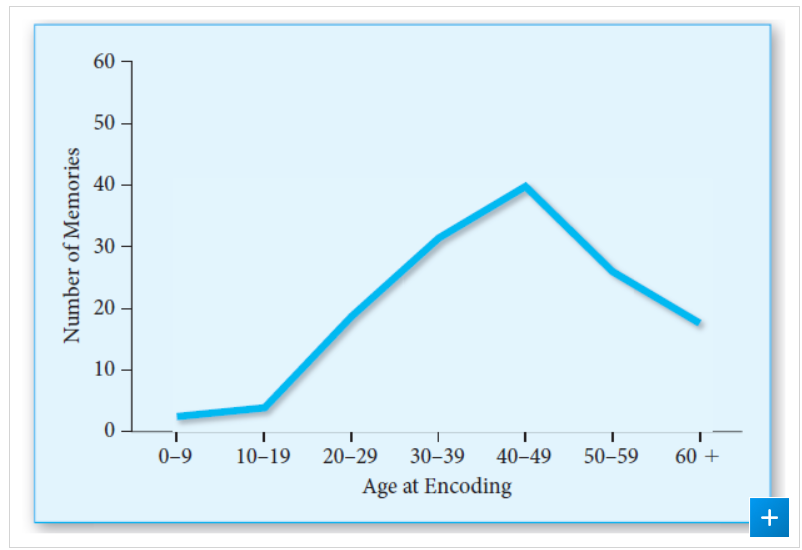
What is it about some people that enables them to develop a sense of generativity while others do not?
One way to answer this question is to look at the life stories people tell. Compared to adults who fail to develop a sense of generativity, highly generative adults are likely to provide stories in which bad situations lead to good outcomes (McAdams & Gao, 2015; McAdams, Reynolds, Lewis, Patten, & Bowman, 2001). In these stories, a personal tragedy, such as the death of a loved one, eventually leads the storyteller to an increased sensitivity to the suffering of others and a commitment to help those going through similar experiences. Not surprising then, stories from highly generative adults tend to contain more themes about friendship, sharing, affiliation, nurturance, and being prosocial (Mansfield & McAdams, 1996; McAdams & Guo, 2015). It’s not difficult to see how middle-aged adults who have lived such lives—or who at least recall their lives in this way—would be concerned about helping and nurturing the next generation.
Burger Section Quiz 5.7
The concept of personal narratives is described in the text with the analogy of your life being made into a movie. Which question would illustrate a personal narrative?
What scenes would be included to show people your life?
Which actors would be included in the movie?
How long would the movie need to be?
Would the movie get favorable or unfavorable reviews from critics?
What scenes would be included to show people your life?
Dr. Pemberton is working on a form of research in which participants are asked to describe different scenes from their lives. In order for Dr. Pemberton to turn these narratives into usable data, several steps will have to take place. What will be her first task?
Reducing the responses to common information.
Coding the responses for specific themes.
Analyzing the responses for statistical interpretation.
Transcribing the interviews into writing.
Transcribing the interviews into writing.
The use of personal narratives in the study of Erikson’s stages of development have looked carefully at the topic of generativity. According to Conway and Holmes (2004), the age group where personal narratives had the highest rate of “generativity themes” was blank 1 years.
50–59
60+
40–49
30–39
40-49
Strengths of Neo-Freudian Theories
Some of the neo-Freudian theories are supported with questionable evidence. In particular, support for Jung’s description of the collective unconscious comes from myths, legends, dreams, occult phenomena, and artwork.
Other neo-Freudians relied heavily on information gleaned from their patients during psychotherapy when drawing their own conclusions about human personality.
These practices raise questions about biased interpretations and the applicability of the theories to normally functioning adults.
oversimplified or ignored important concepts. None dealt with so many topics in so much depth as Freud. Consequently, the neo-Freudians sometimes failed to effectively address questions central to psychoanalytic theory. This observation has led some people to criticize neo-Freudian works as incomplete or limited accounts of personality and human behavior.
For example, Erikson has been criticized for what some consider a superficial treatment of anxiety’s role in the development of psychological disorders. Similarly, Adler has been accused of oversimplifying in his attempt to explain many complex behaviors in terms of a single concept, the striving for superiority.
Criticisms of Neo-Freudian Theories
primary strength of the neo-Freudian theories is their elaboration of important concepts that Freud had ignored or de-emphasized. Most of these theorists identified the role social factors play in the formation and change of personality. Many described the ways personality develops beyond the first few years of life.
much more optimistic and flattering picture of humankind than Freud had. They described the positive functions served by the ego rather than restricting its role to arbitrator between the demanding id and superego.
introduced many new concepts into the psychological literature. As with Freudian theory, many of these ideas have made their way into everyday language. People speak of identity crises, introverts, and inferiority complexes without recognizing the references to Erikson, Jung, and Adler.
references to Erikson, Jung, and Adler.
Another gauge of a personality theory’s value is the extent to which it influences later theorists and psychotherapists. In this respect, the neo-Freudians can claim some success.
The optimistic tone about humans that characterized many neo-Freudians’ views helped pave the way for the humanistic personality theories
Similarly, the emphasis on social aspects of personality development was undoubtedly a considerable step in the evolution of social learning approaches to personality (Chapter 13). And the techniques and approaches developed by each of the neo-Freudians have been adopted or adapted by many contemporary psychotherapists.
Burger Section Quiz 5.8
The primary strength of the neo-Freudians is their
elaboration of important concepts that Freud ignored or de-emphasized.
focus on the fact that personality develops almost entirely during childhood.
intense exploration of unconscious processes that extended Freud’s initial views.
introduction of scientific research that validated many of Freud’s previously unverified ideas.
elaboration of important concepts that Freud ignored or de-emphasized.
In what way do those who adhere to the humanistic approach to personality psychology owe a debt of gratitude to the neo-Freudian pioneers?
The founders of humanism, Rogers and Maslow, were both trained direction by Carl Jung and Alfred Adler, both of whom were neo-Freudians.
Neo-Freudian thinking completely eliminated the emphasis on environmental influences on behavior and introduced the topic of free will and individual choice that typify humanistic thinking.
Neo-Freudians were more optimistic than the early Freudian model, and that optimism and positivity is a theme of the humanistic model.
Humanism was actually an offshoot of neo-Freudian thinking, as Karen Horney and Erik Erikson broke from neo-Freudian thinking to establish the humanistic paradigm.
Neo-Freudians were more optimistic than the early Freudian model, and that optimism and positivity is a theme of the humanistic model.
A criticism of Alfred Adler’s neo-Freudian model is that he
failed to adequately reject Freud’s concepts of psychosexual crises.
overly reduced many complex behaviors in terms of a single concept.
limited the number of developmental stages to only eight.
ignored the psychological crises of women, just as Freud had.
overly reduced many complex behaviors in terms of a single concept.
 Note
Note  Flashcards (64)