Plant Physiology Chapter 3
 Studied by 10 people
 Call Kai
 Learn
Learn Practice Test
 Spaced Repetition
 Match
Match Flashcards
 Knowt Play
1/48

Earn XP
Description and Tags
Water and Plant cells
Name | Mastery | Learn | Test | Matching | Spaced | Call with Kai |
|---|
No analytics yet
Send a link to your students to track their progress
49 Terms
water potential is
the driving force for cellular water movement
the driving force of water movement is a difference in water potential between two regions (between cells, within and between tissues)
pressure potential
driving force for long distance bulk flow, applying positive physical pressure to a region inc water potential, negative pressure decreases it
osmotic (solute) potential
driving force for short distance water diffusion, adding dissolved solutes to a region decreases water potential
solute potential=RTCs
gravity potential
=Pw*g*h
water potential units
reference potential
measured in pressure units 1 megapascal (MPa)= 10 bars
reference potential is pure water in an open container (water potential=0)
water potential direction
water always moves to region with lower (more negative) water potential; movement stops when reaches equilibrium (water potential=0)
high—> low and ALWAYS passive (does not cost E)
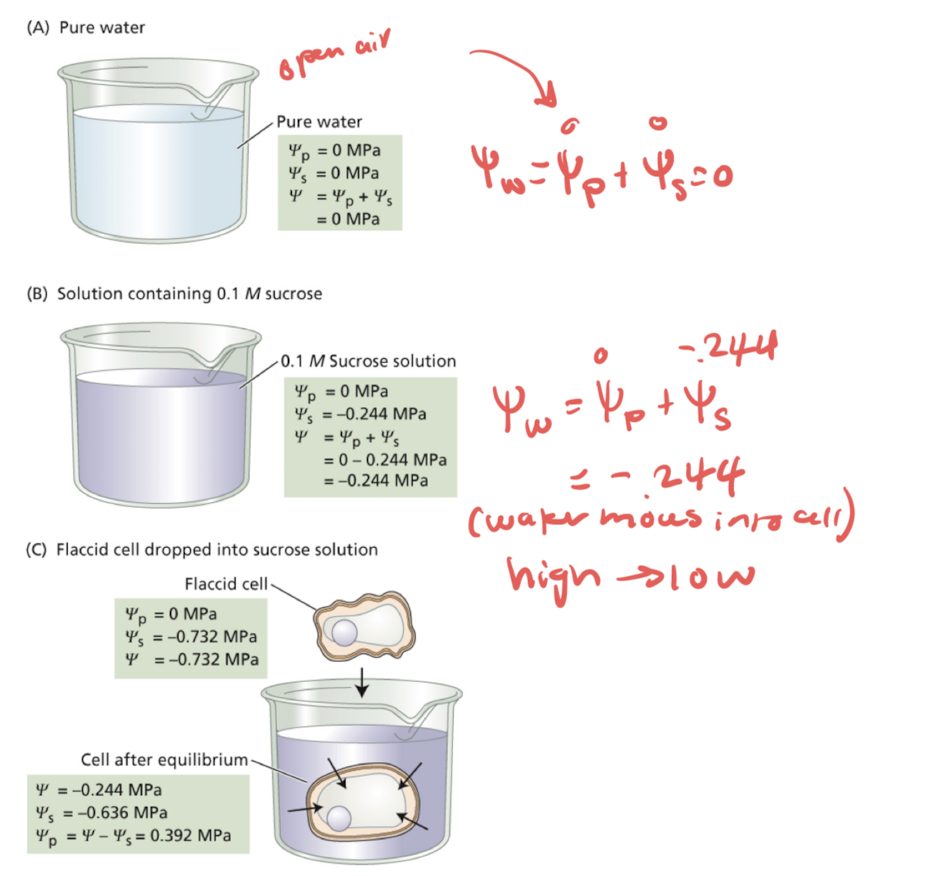
water potential of pure water in open air
P=0
S=0
W=0
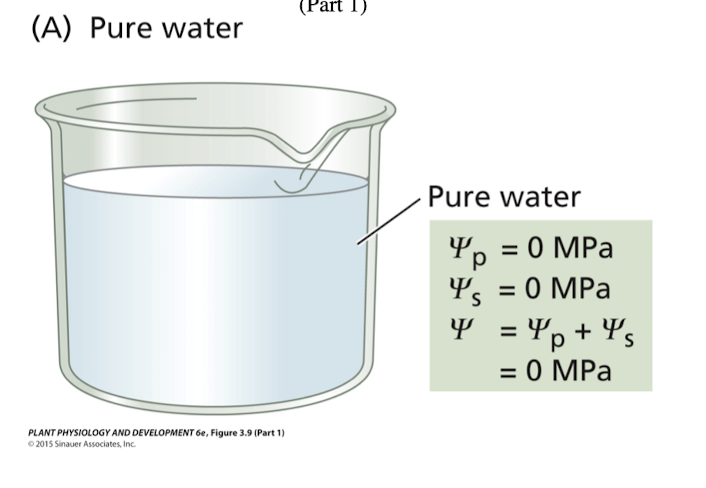
water potential of soln w/ .1 M sucrose in open air
p=0
s=-.244 mpa
w= 0+-.244=-.244
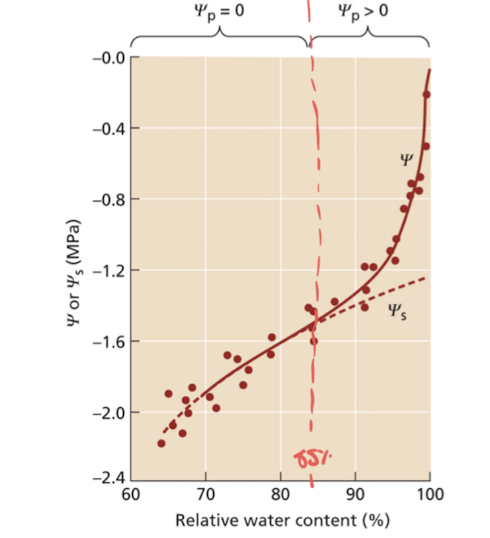
water potential of flaccid cell in .1m sucrose soln (solute inside cell is 3x)
potentials of flaccid cell in .1 M sucrose soln once reaches equilibrium
p=0 (no contact with wall)
s= -.244×3= -.732
w= 0+-.732=-.732
w= -.244 (potential as if in .1m sucrose)
s=-.732/115 (volume inc by 15%)=-.636
p=w-s= -.244- -.636 = .392
water potential of turgid cell (same as after flaccid cell reaches eq)
w= -.244
s= -.636
p=.w-s= 392
turgid cell after reaches eq water potential and if in sucrose soln
w=0+-.732= -.732
s=-.732 (flaccid again so 3x solutes)
p=0 (no contact with wall)
p=0
s=-.732 <—(3*-.244)
w= 0+-.732= -.732
cell initially at: in .1M sucrose soln
w=-.244
s=-.636
p= w-s= .392
what happens when applied pressure squeezes out half the water
doubles conc
w= -.244 (constant for .1 M sucrose)
s= -1.272 (doubled)
p= w-s= 1.028
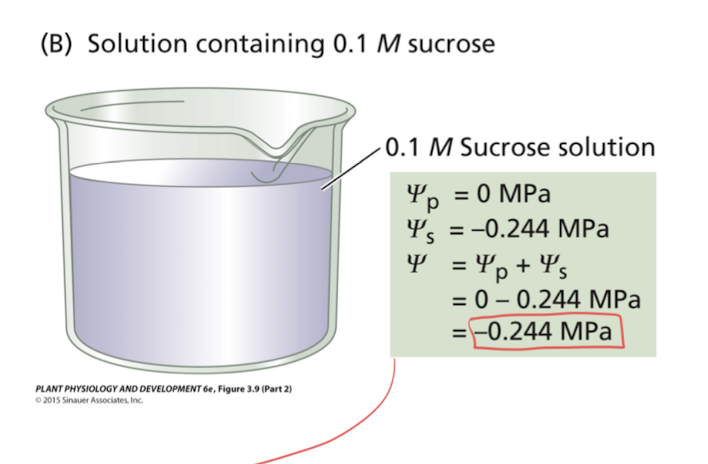
relation between water pot, solute pot, relative water content—what percent does pressure play a bigger role and thus inc
85%
what measures osmosis:
in real systems what expands and contracts w/ water uptake or loss
osmometer
simple osmometer consists of a U shaped tube separated by a semiperm memb
in real systems, the cell memb is the semiperm memb and protoplast expands and contracts w water uptake or loss
plasmolysis vs turgor pressure
P= when protoplast contracts away from cell wall, causing wilting
TP= dev when protoplast expands due to osmotic pressure and exerts pressure against cell wall until the physical pressure counterbalances the osmotic pressure
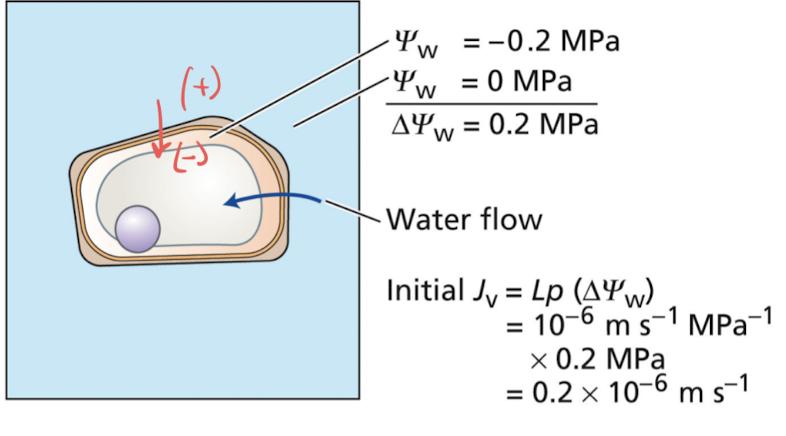
rate of water transport in a cell
.2 m/s
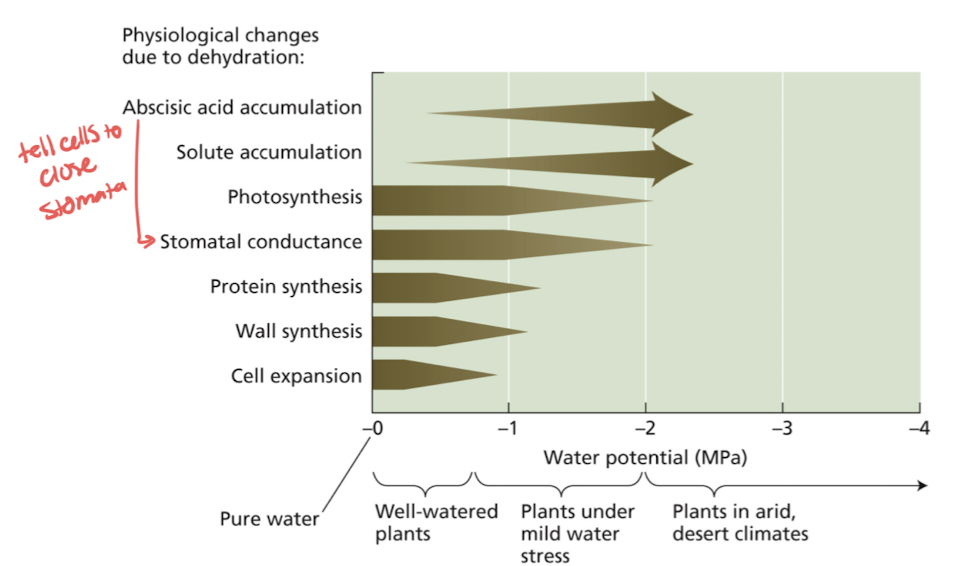
sensitivity of various physiological processes to changed in water pot under various growing cond
why is water movement necesary to plants
growth and expansion of cells, nutrient transport, cooling, much is lost to evap
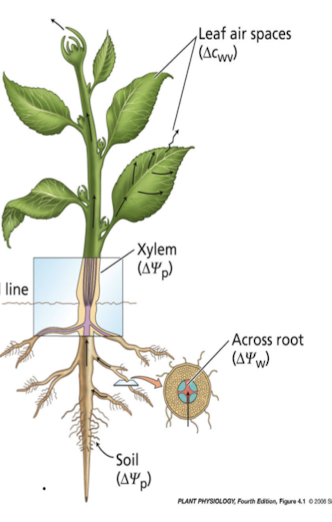
water flow overview
soil—>soil to root—>through living cells (cortex)—>long distance in stems—>leaf to air
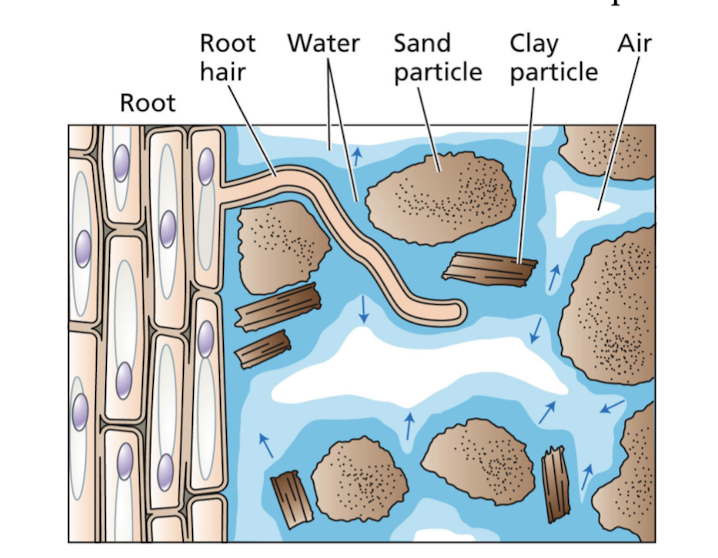
pattern of particle diameter of soil to surface area and why important to plants
smaller particle= more surface area so more root hairs make intimate contact w soil particles
how does water move through the soil; equation
by bulk flow (hydrostatic pressure)
water pot soil=-2T/r
T=surface tension of water (constant)
R= radius of curvature of air-water interface
water moves through soil predom via bulk flow driven by a pressure gradient. water will flow from regions of higher soil-water content (where water filled spaces are larger) to regions of lower soil-water content (where the smaller size of the water filled spaces are assoc w more curved air-water interfaces)
rate of water uptake compared to distance from root tip
growing vs non growing regions
growing tip>non growing regions of root
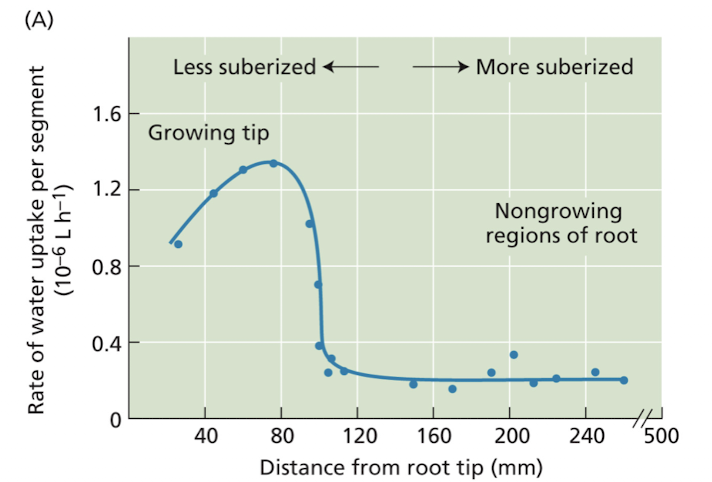
why is rate of water intake higher at tip
more flow
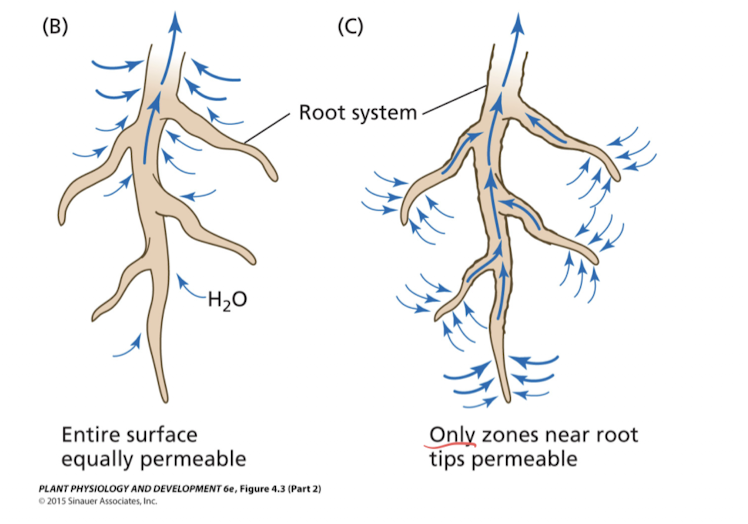
what causes dewdrops
solute accum in xylem can generate positive root pressure—>exudation of xylem sao through hydathodes leads to dewdrops
root pressure and flow of water is caused by
ions actively pumped into xylem decrease water potential and cause water to flow into stele, increasing pressure forces fluid up the stem a very limited distance
soil water pot=0, root water pot= - bc solutes inside
general pathways of water in root
apoplast,symplast, transmembrane pathways
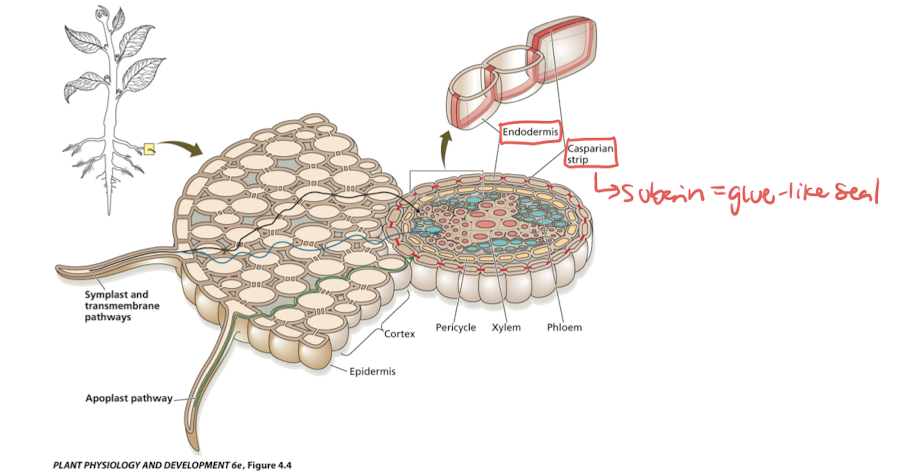
plasmodesmata
symplast
apoplast
casparian strip
suberin
Plasmodesmata: are tubular extensions of the plasma membrane, 40-50 nm in diameter, that transverse the cell wall and connect the cytoplasms of adjacent cells.
Symplast: a continuum of cytoplasms interconnected by plasmodesmata.
Apoplast: refers to outside space of symplast, such as cell walls, non-living xylem
Casparian Strip: a band of radial cell walls in the endodermis that is impregnated with the wax-like, hydrophobic substance suberin. Suberin acts as a barrier to water and solute movement.
root-soil interface:
water movement at soil vs at root
where is water and solute movement most active
water moves through soils by bulk flow (hydrostatic pressure) - water and solutes enter most actively near root tip, root hairs enhance uptake - at root interface, movement changes to diffusion
apoplast (2) vs symplast (3) movement of water- the structures involved
apoplast (through non-living-xylem, and cell walls),
symplast (through living protoplasts and phloem) and cellular pathways of diffusion toward stele
casparian Strip (a suberized layer) requires _______ and enter the ____ before entering the xylem in the stele
all solutes and water to cross a membrane and enter the symplast before entering the xylem in the stele
symplast
2 xylem tracheary elements
Tracheids: elongated, spindle-shaped cells that are arranged in overlapping vertical files. Water flows between tracheids by means of the numerous pits in their lateral walls.
Vessel elements: tend to be shorter and wider than tracheids and have perforation plate at each end of the cell, also have pits on their lateral walls. Unlike tracheids, the perforated end walls allow vessel members to be stacked end to end to form a larger conduit called a vessel.
elongated, spindle-shaped cells that are arranged in overlapping vertical files. Water flows between tracheids by means of the numerous pits in their lateral walls.
Tracheids
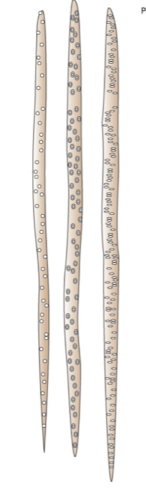
tend to be shorter and wider than tracheids and have perforation plate at each end of the cell, also have pits on their lateral walls. Unlike tracheids, the perforated end walls allow vessel members to be stacked end to end to form a larger conduit called a vessel.
Vessel elements:
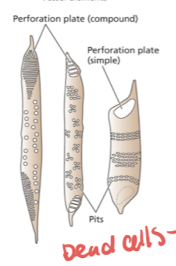
Water movement through the xylem requires (more or less) pressure than movement through living cell
less
purpose of gas filled cavitated vessle
when going through draught to prevent movement of H2O
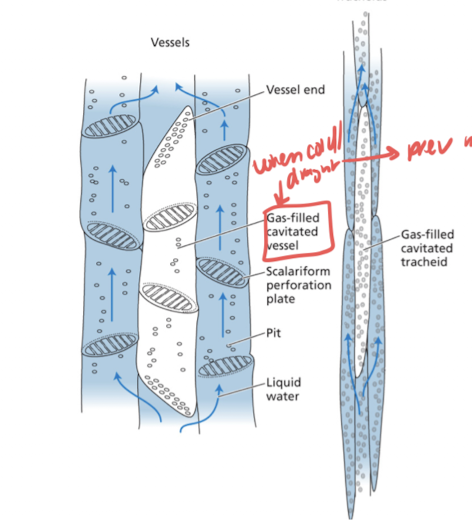
Pressure difference to lift water 100 meters to a tree-top (mPa)
pressure pot= .02 mpa/m *100m=2 mpa
gravity pot= .01 mpa/m *100m= 1 mpa
2+1=3 mpa—> ~475 PSI (lots of pressure)
Thus, the total pressure difference of roughly 3 MPa from the base to the top branches, is needed to carry water up the tallest tree.
Roots can develop positive hydrostatic pressure in their xylem. But root pressure is typically less than 0.1 MPa and disappears when the transpiration rate is high or when soils are dry.
The cohesion-tension theory of sap ascent: type of pressure in tree and effect on water
was first proposed towards the end of 19th century - the water at the top of a tree develops a large tension ( a negative hydrostatic pressure), and this tension pulls water through the xylem - explains water transport in the xylem
Transpirational pull and the ascent of xylem sap
relative water potentials at leaves vs root
- potential (w) gets increasingly negative from the soil solution, to roots, through xylem, to the atmosphere, where Yw is extremely negative (-100 Mpa)
- water lost to atmosphere is replaced by water from mesophyll, which is replaced by water from the continuous xylem stream
cohesion vs adhesion
cohesion allows chains of water molecules to stay intact - adhesion to xylem vessel walls fights gravity
cavitation
breaks in chain (of water ascending xylem) called cavitation can occur due to drought or freezing
diagram of water pathway through the leaf
travels down gradient through stomata
must balance CO2 gain and water loss via stomata
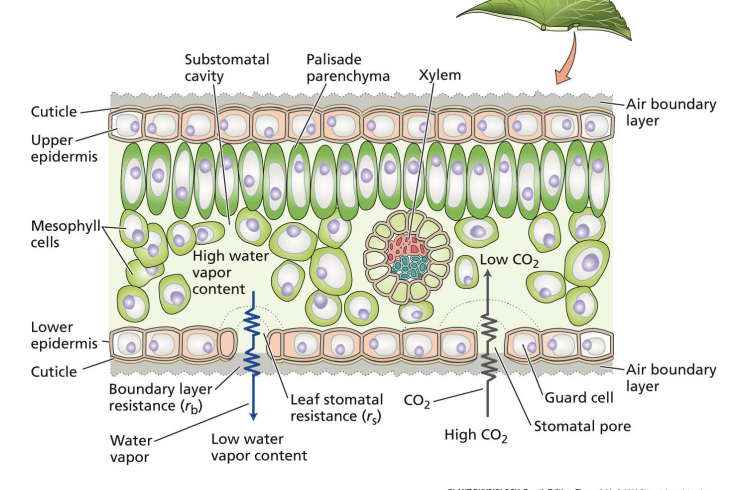
increased humidity leads to, (water pot)
dec
driving forces for water flow:
Leaf to Air:
Long-distance in the xylem:
Through living cells (cortex):
Soil to root:
In the soil:
Leaf to Air: gradients in water vapor concentration
Long-distance in the xylem: pressure gradients
Through living cells (cortex): complex, water potential gradients across tissues
Soil to root: water potential gradients
In the soil: pressure gradients
how does plant structure helps to resolve the need for water conservation and for CO2 assimilation
roots, xylem, cuticle, guard cells
- An extensive root system to extract water from the soil
- A low-resistance pathway through the xylem vessel elements and tracheids to bring water to the leaves
- A hydrophobic cuticle covering the surfaces of the plant to reduce evaporation - Microscopic stomata on the leaf surface to allow gas exchange
- Guard cells to regulate the diameter and diffusional resistance of the stomatal aperture
- stomata, ____ pores on undersurface of leaves, surrounded by ____ cells control gas exchange
- rest of leaf is covered by ____ to prevent water loss
- unique _____ allows guard cells to buckle and pore to open when cells are ___(flaccid/turgid)
- movement of ___ ions largely controls of Yp and Ys in guard cells, and thus the degree of opening
- stomata, regulatory pores on undersurface of leaves, surrounded by guard cells, control gas exchange
- rest of leaf is covered by cuticle to prevent water loss
- unique microfibril arrangement allows guard cells to buckle and pore to open when cells are turgid
- movement of K+ ions largely controls of Yp and Ys in guard cells, and thus the degree of opening
- ____ spaces in leaf, can make up 70% of leaf
- large _____ (pos/neg) Yw on mesophyll cell surfaces due to _____ and ____ draws water out of cells, which vaporizes in substomatal space; this drives ____through vascular tissue
- vapor pressure ___(inc or dec) from stomata to atmosphere, ____ (higher/lower) pressure at lower end pushes water up
- transpiration rate is regulated by ______ (4)-many of which can influence boundary layer thickness
- substomatal space-air spaces in leaf, can make up 70% of leaf
- large negative Yw on mesophyll cell surfaces due to adhesion and cohesion draws water out of cells, which vaporizes in substomatal space; this drives bulk flow through vascular tissue
- vapor pressure decreases from stomata to atmosphere, higher pressure at lower end pushes water up
- transpiration rate is regulated by humidity, temperature, wind speed, leaf shape-many of which can influence boundary layer thickness
Transpiration Compromise: balance of what
what induces stomatal opening and closing
water, CO2, light, ABA
- balance between CO2 uptake and water vapor loss
- low internal CO2 (often in high light) induces stomatal opening
- low water availability induces stomatal closure
- low light induces stomatal closure, because internal CO2 levels build up
- abscisic acid (ABA) induces stomatal closure, role in drought resistance
- water use efficiency - g H2O lost/g fixed carbon = 600:1 in C3 plants, 300:1 in C4 plants
wind inc or dec transpirational flux
inc
is plant cell differentiation into stomata cells from epidermal cells highly reg?
yes
stomata cell structure
heavily thickened guar cell wall
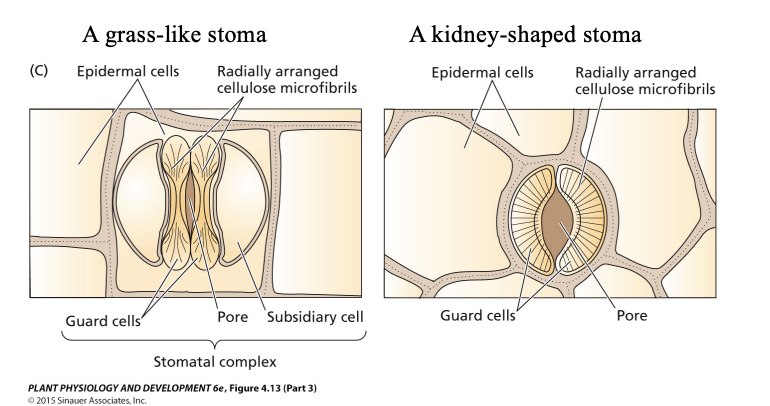
 Note
Note  Flashcards (46)