Prokaryotic Biology Lecture 2/Chapter 1
 Studied by 0 people
 Call Kai
 Learn
Learn Practice Test
 Spaced Repetition
 Match
Match Flashcards
 Knowt Play
1/75

There's no tags or description
Looks like no tags are added yet.
Name | Mastery | Learn | Test | Matching | Spaced | Call with Kai |
|---|
No analytics yet
Send a link to your students to track their progress
76 Terms
improved continuously
Light microscope invented in 1600s, quality __________
small eukaryotes (eukaryotic cells)(dead cells from plants)
mid-1600s: Robert Hooke observed ____________________
bacteria (prokaryotic cells)
1676: van Leeuwenhoek discovered ____________
Biogenesis
Living organisms arise from preexisting life
spontaneous generation
The alternative hypothesis is __________________—that living organisms can arise from non-living matter
Redi
1688: ______ shows that flies do not spontaneously
generate and therefore disproved spontaneous generation
John Needham
– Even after Redi’s experiments disproved spontaneous
generation for flies, many people thought that microbes
were an exception.
– _______________ (1745)put boiled nutrient broth into a sealed flask
Spallanzani
__________ (1765)—placed nutrient broth in a flask, sealed it and sterilized it by boiling—no microbes grew
– This same scientist argued that this disproved spontaneous generation for microbes
lack of air in the sealed flasks
after spallanzani’s experiment some argued that microbes were there, but had not been able to grow due to _______________. Definitive proof was lacking
spontaneous generation for microbes
– Pasteur performed a brilliant experiment (1861):
• S-shaped flasks kept microbial contaminants out, but let air in
• Pasteur demonstrated that microorganisms are present in the air, and contaminate the broth when the flask is open and they fall in.
This finally disproved ____________________________
• Disapproval of spontaneous generation.
• Microbes cause fermentation.(worked in a wine brewery)
• Early vaccine development.
• Pasteurization
Louis Pasteur(4)
-63 degrees C, 30 min
-72 degrees C, 15 sec(HTST)
-140 degrees C, 1 sec(UHT)
-Kill pathogen and spoilage microbes
Process of Paseuriztion
viruses, bacteria, fungi, or protozoa
Disease-causing organisms, what we usually mean when we
say “germs”, are ______, _______, _______, and __________
Germ
______ is not a useful word in microbiology
Archaea
no _________ have been demonstrated to cause human disease
• Rabies—transmitted to new host when bitten by an infected animal
• Anthrax—in the 1800’s people knew it was possible to
catch this from cattle
• Battlefield infections--significance of infection in warfare
was 1st recognized by the British nurse Florence
Nightingale (1820–1910)
• Wound sepsis—Lister found that sterilization of surgical
instruments reduced wound sepsis, gangrene, death
4 supporting observations of Germ-Theory
sterilization
pasteurization is not the same as ____________
Koch’s Postulates
• Provides means of testing hypothesis:
– “Does this germ cause that disease?”
– Causality?
• Organism must meet 4 criteria:
– 1. Microbe always present in diseased
• Absent in healthy
– 2. Microbe is grown in pure culture
• No contamination of other microbes.
– 3. Introduce pure microbe into healthy individual
• Individual becomes sick (same disease)
– 4. Same microbe re-isolated from now-sick individual
4 of Koch’s Postulates
• Some organisms cannot be grown in pure culture.
• Using humans in completing the postulates is
unethical (no animal model).
• Cofactors are needed for disease development
(ubiquitous pathogens, not every infected one
develops disease).
• Some diseases develop extremely slow.
• Molecular and genetic evidence may replace and
overcome these limits
Limitations of Koch’s Postulates
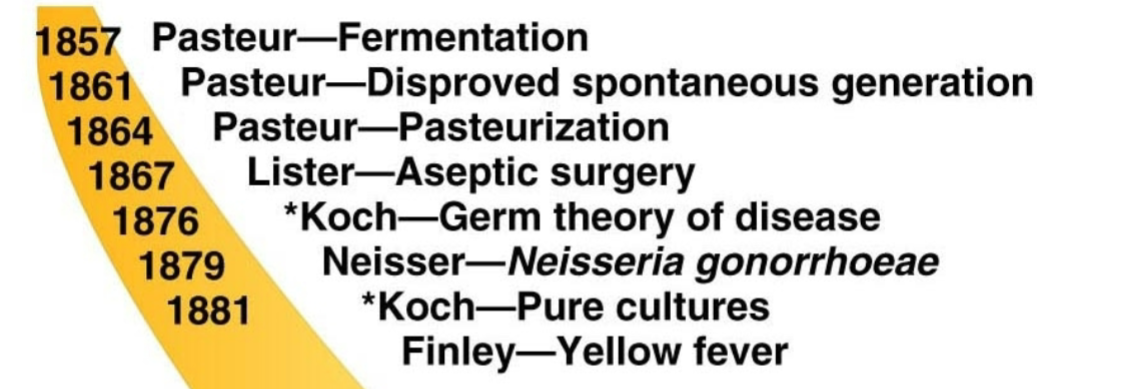
MEMORIZE THIS CHART(the golden Age of microbioogy)
Handwashing and Antiseptic surgery
2 antiseptic practices but into use in the 19th century to prevent disease and kill germs
Ignaz Semmelweis (1818-65)
discovered handwashing
Joseph Lister (1827-1912)
started Antiseptic surgery
Alexander Fleming
1929-1941: discovered Penicillin
-overtime bacteria became resistant
Variolation
powdered smallpox scabs were blown up the noses of healthy
-used by Turkish physicians, Lady Montagu, Edward
Jenner
– Black death/plague in Europe
– Smallpox in Americas
2 examples of microbial diseases change history
– Diseases destroying crops (Irish famine)
– Control of microbial growth to preserve food
– Fermentation in food/beverage production
• bread, wine, cheese
• Chocolate!
Examples of microbes affect food availability
plants and animals
Microbes lived before ______ and _______
• Anaerobic
– bottom of swamp, in our gut
• High pressure
– Bottom of ocean
• Hot or cold temperatures
– Below 0°C to 113°C
• No organic carbon
– Use light for energy, CO2 for carbon
4 varied conditions that microbes live in
Microbes
______________ are the only living organism for the first 2
billion years
-bacteria fix N2 to NH4
-Nitrify NH3 to NO3-
what happens in the nitrogen cycle
-Photosynthetic microbes fix most carbon
-Many other conversion
what happens in the carbon cycle
nitrogen carbon, sulfur, phosphorus cycle
4 cycles that microbes are involved in on earth
E. Coli
________ has the best understood genome
Botox
________ is a neurotoxin made by bacterium Clostridium botulinum
Botulinum (Latin botulus = "sausage”)
______________________ toxin is one of the most poisonous natural substances in the world
unable to contract for a period of 4 to 6 months
A small dose of Botox decreases muscle activity, so the muscle is _________________________
Recombinant DNA / Molecular Cloning
Beginning of Biotech
Genome editing with CRISPR / Cas9
(clustered regularly interspaced short
palindromic repeats)
Nobel Prize 2020 was awarded to Emmanuelle Charpentier and Jennifer A. Doudna "for the development of a method for genome editing."
Optogenetics: controlling the brain with light
5 amazing applications of microbiology
-most popular and diverse group of organisms
-found everywhere on earth
-important for recycling essential elements
-carries nutrients and some do photosynthesis
-helps society as they’re crucial for food and beverage production, medicines, and products needed for manufacturing
-decompose organic waste
-widely used in tools in biomedical research
-some cause disease in plants and animals
-the importance of microorganisms
-make fermented food
-make medicine(insulin, interferon, industrial products(biofuel))
-recycle waste
-biological control(BT as pesticide)
4 ways microbiology has lead humans to increase growth in microbes
-prevent food spoilage
-prevent disease occurrence(public health, personal hygiene, anti microbial drugs, vaccine)
4 ways microbiology has lead humans to decrease growth in microbes
von Behring - Diphtheria antitoxin
Nobel prize
1901
Ross Malaria - transmission
Nobel prize
1902
Koch TB - bacterium
Nobel prize
1905
Metchnikoff Ehrlich- Immunity
1908 Nobel Prize
Fleming, Chain, Florey - Penicillin
1945 Nobel Prize
Waksman - Streptomycin
1952 Nobel Prize
Delbrück, Hershey, Luria Viral - replication
1969 Nobel Prize
Tonegawa - Antibody genetics
1987 Nobel Prize
Prusiner - Prions
1997 Nobel Prize
Marshall, Warren - H pylori
2005 Nobel Prize
Hausen, Barré-Sinoussi, Montagnier - HPV, HIV
2008 Nobel Prize
Beutler, Hoffmann, Steinman - TLR, Dendritic cells
2011 Nobel Prize
Campbell, Omura, Tu, - Therapy for parasite/malaria
2015 Nobel Prize
Ohsumi - Autophagy
2016 Nobel Prize
Dubochet, Frank, Henderson - CryoEM
2017 Nobel Prize
Allison, Honjo - Cancer Immune Therapy
2018 Nobel Prize
Arnold, Smith, Winter- Enzyme artificial evolution/Phage display
2018 Nobel Prize
Charpentier, Doudna -CRISPR for genome editing
2020 Nobel prize
Alter, Houghton, Rice - HCV
2020 Nobel Prize
Drew Weissman, Katalin Karikó - mRNA Vaccine
2023 Nobel Prize
Edward Jenner(England)
Discoverer in 1798 that cowpox vaccinations prevent smallpox
Semmelweis
Discoverer in 1847 that chlorine as antiseptic wash for doctors hands decreases pathogens
Florence Nightingale
discoverer in 1855 that sanitation is correlation with mortality(Crimean war)
Louis Pasteur
discovered in 1864 that microbes fail to appear spontaneously
Joseph Lister
discovered in 1867 that antisepsis during surgery prevents death
Robert Koch
discovered in 1867 that bacteria are the causative agent of Anthrax
Louis Pasteur
discovered in 1881 the first artificial vaccine against anthrax
Peyton Rous
discovered in 1911 that viruses are found to cause cancer in Chickens
Fleming, Florey, Chain
In 1929, discovered penicillin, first widely used antiboitic, made by a fungus
Hans Kreb
In 1937, the tricarboxylic acid cycle is discovered by
Avery, Macleod, Mccarthy
discovers in 1944 that DNA is a genetic material that transforms S. pneumonae
Franklin and Wilkins
discovers in 1953 that the structure of DNA is identified by X-ray diffraction as a double helix
Watson and Crick
discovered in 1953 that DNA consists of antiparallel chains connected by hydrogen bonding of AT and GC base pairs
mitchel and moyle
discovered in 1961 the chemiotactic theory, which states that biochemical energy is the stored in a transmembrane protein, is proposed and tested
 Note
Note  Flashcards (42)