Lab 1
 Call Kai
 Learn
Learn Practice Test
 Spaced Repetition
 Match
Match Flashcards
 Knowt Play
1/61

There's no tags or description
Looks like no tags are added yet.
Name | Mastery | Learn | Test | Matching | Spaced | Call with Kai |
|---|
No analytics yet
Send a link to your students to track their progress
62 Terms
What are some defining characteristics of kingdom animalia?
multicellular eukaryotic organisms, lack cells walls plastids and photosynthetic pigments
Is ingestion or absorption of nutrients more common in kingdom animalia?
Ingestion of nutrients (and digestion in an internal cavity) is more common than absorption in animals
what are germ layers? what are the 3 germ layers?
Germ layers are 3 cellular layers that form during embryonic development and later differentiate to give rise to various tissues and organs. The three germ layers are the ectoderm, mesoderm and endoderm
Ectoderm
what part of the embryo?
What does it differentiate into? (2)
Present in triploblasts, diploblasts or both?
covers the outer surface of the embryo, later develops into the outer covering of the animal. Depending on the phylum, the ectoderm can also give rise to the central nervous system. The ectoderm is present in triploblasts and diploblasts
Endoderm
what part of the embryo?
What does it differentiate into? (3)
Present in triploblasts, diploblasts or both?
Is the innermost germ layer of the developing embryo, is a primitive stomach. The endoderm gives rise to the digestive tract lining. Depending on the animal, the endoderm may also line the respiratory tract and out pocketings of the digestive tract. The endoderm is found in both triploblasts and diploblasts
What are out-pocketings of the digestive tract?
small pouches or buds that grow from the wall of the gut tube and later grow more, specialize into organs (like the liver, lungs and pancreas)
Mesoderm
what part of the embryo?
What does it differentiate into? (3)
Present in triploblasts, diploblasts or both?
The mesoderm is the middle germ layer of the embryo, between the outer ectoderm and the inner endoderm. The mesoderm differentiates into muscles, organs not developed from the endoderm and lines the main body cavity. The mesoderm is only found in diploblasts
Diploblasts? Which phyla are diploblastic?
Diploblasts are animals with only 2 germ layers (endoderm and ectoderm) like Cnidarians
Triploblasts? Which Phyla are triploblastic?
Organisms with three germ layers (endoderm, ectoderm and mesoderm) like platyhelminthes, nematodes, annelids, arthropods, chordates
3 body plans, from simplest to most complex
acoelomate, pseudocoelomate, coelomate
Acoelomate body plan (2), +1 example
no cavity between the digestive tract (from endoderm) and the outer body wall (from ectoderm), instead, the space between the layers is filled with parenchyma (from mesoderm)
Central digestive cavity with endoderm wall
Ex. Platyhelminthes (flatworms)
Pseudocoelomate body plan (4), +1 example
fluid filled cavity between the digestive tract (from endoderm) and the outer body wall (from ectoderm)
Mesoderm lines the underneath of the ectoderm, but not the entire body cavity (does not surround the organs or cover the endoderm)
Organs float freely within the fluid of the pseudocoelom
“Tube within a tube body plan”
Ex. Nematodes (roundworms)
Coelomate body plan (2), + 1 example
true coelom, fluid filled cavity between the digestive tract (from endoderm) and the outer body wall (from ectoderm) that is completely lined with a layer mesodermal cells (surrounding the organs and also under the ectoderm)
The two layers of mesoderm are connected dorsally and ventrally by structures called mesentaries which suspend the internal organs within the coelom
Ex. Annelids (segmented worms) and all other phyla above
What is a coelom? What would happen if you didn’t have a coelom?
A coelom is a fluid containing body cavity completely lined with mesoderm, found in coelomates. If you didn’t have a coelom, every heartbeat or ripple of the intestines could deform the body surface and excercise could distort your internal organs
Why are body cavities important? name 2 reasons
fluid cushions the suspended organs which helps prevent internal injury
Internal organs can grow independently of the outer body wall
Phylum nematoda (5)
commonly known as roundworms
Pseudocoelomates
Bilaterally symmetric
Among the largest of animal phyla
Can be free living or parasitic
What are two advantages of nematodes over Platyhelminthes?
nematodes have a pseudocoelom (platyhelminthes are acoelomate) and a complete digestive tract with a mouth and an anus (Platyhelminthes have an incomplete digestive system)
What are dioecious animals?
Animals that have separate sexes (males and females)
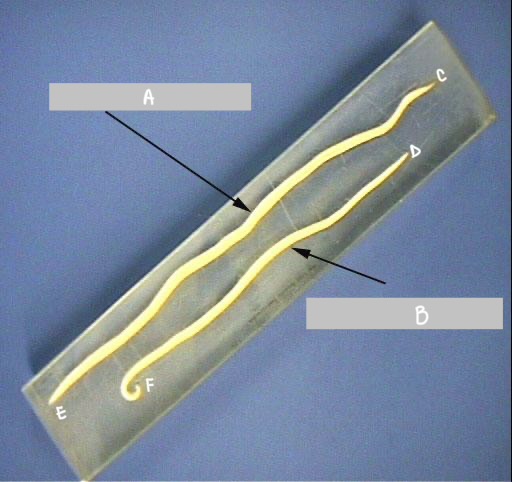
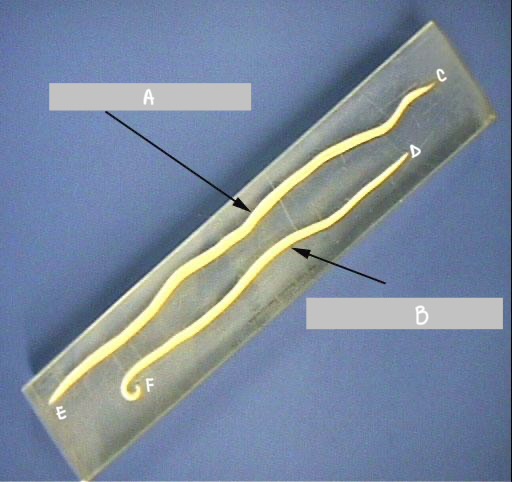
What is this species? Which phylum is it from? Which organism and male and which is female? Where is the posterior end of the male? What structure would be found near point D?
This is Ascaris lumbricoides, a parasitic roundworm from phylum nematoda.
The male is B, its posterior end is F, where the hooked tail and anus are located. The female is A.
Males are smaller than females and have a hooked tail.
Point D is the anterior end of the male, where the mouth and three lobes (lips) are located
Feeding and Digestion: Nematodes
Feeding habits? (Carnivorous/herbivorous/parasitic)
path of the digestive system?
How are digestive enzymes produced?
Great variation within the phylum, nematodes can be carnivorous or herbivorous or parasitic (like Ascaris)
mouth with three lobes (lips) → muscular pharynx (acts as a pump to bring food from mouth to intestine) → intestine (is dorso-ventrally flattened) → anus
Digestive enzymes are produced by epithelial cells lining the intestine
Nematodes __ (have, lack) nervous systems and __ (have, lack) circulatory systems
Lack, lack
Where do free living nematodes live? How do they obtain oxygen?
Where do parasitic nematodes live? How do they reproduce?
Free living nematodes are not parasitic and primarily live in interstitial spaces of soil and aquatic environments and obtain oxygen through diffusion
Parasitic nematodes live in the intestines (ex. Of humans) where they feed on intestinal contents. Males and females reproduce sexually, producing eggs that pass out through the feces. If these eggs contaminate food, they hatch in the intestines of a new host, burrow through the intestinal walls to the bloodstream where they are carried to the lungs. The larvae burrow through alveoli and make their way up the trachea and down the esophagus
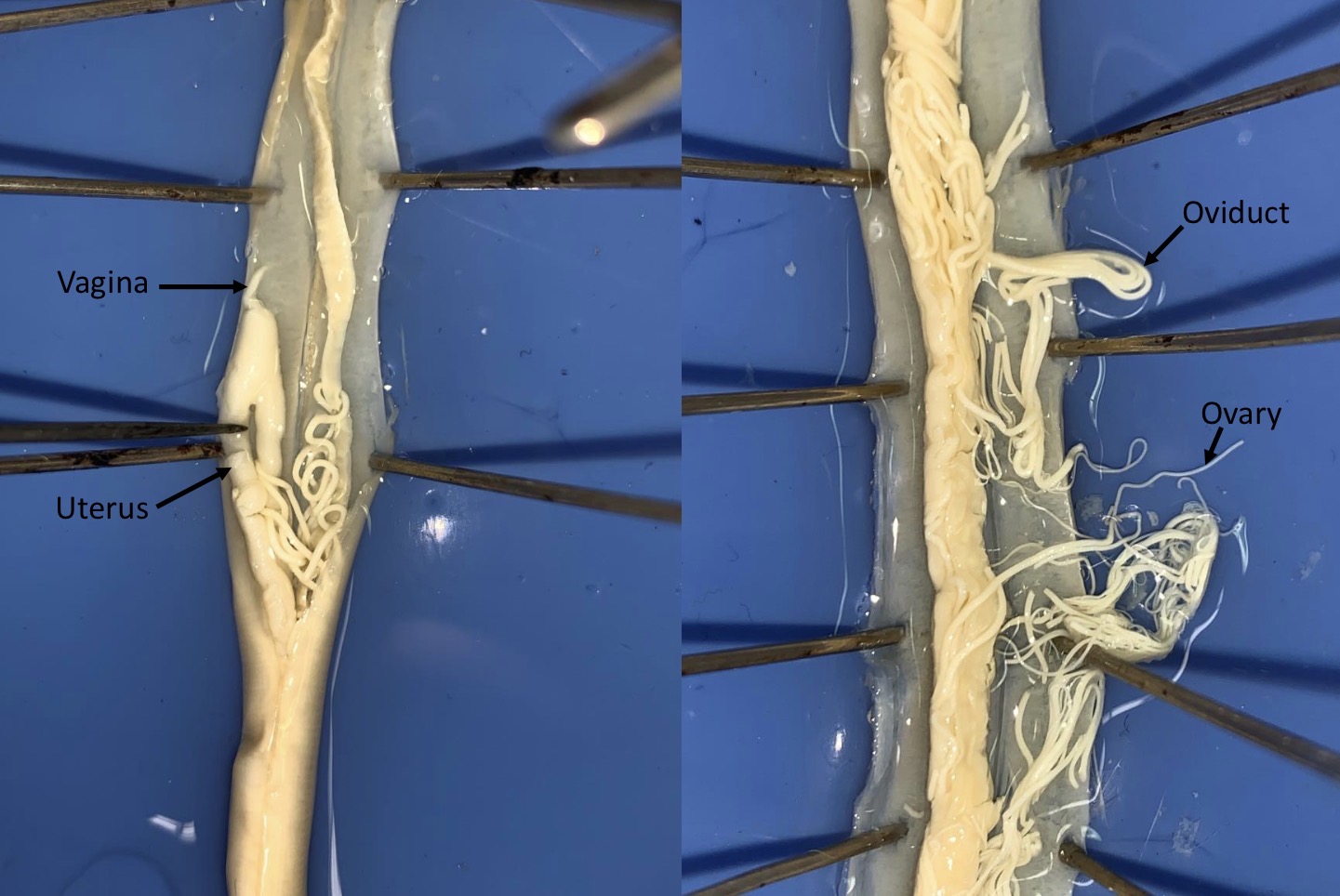
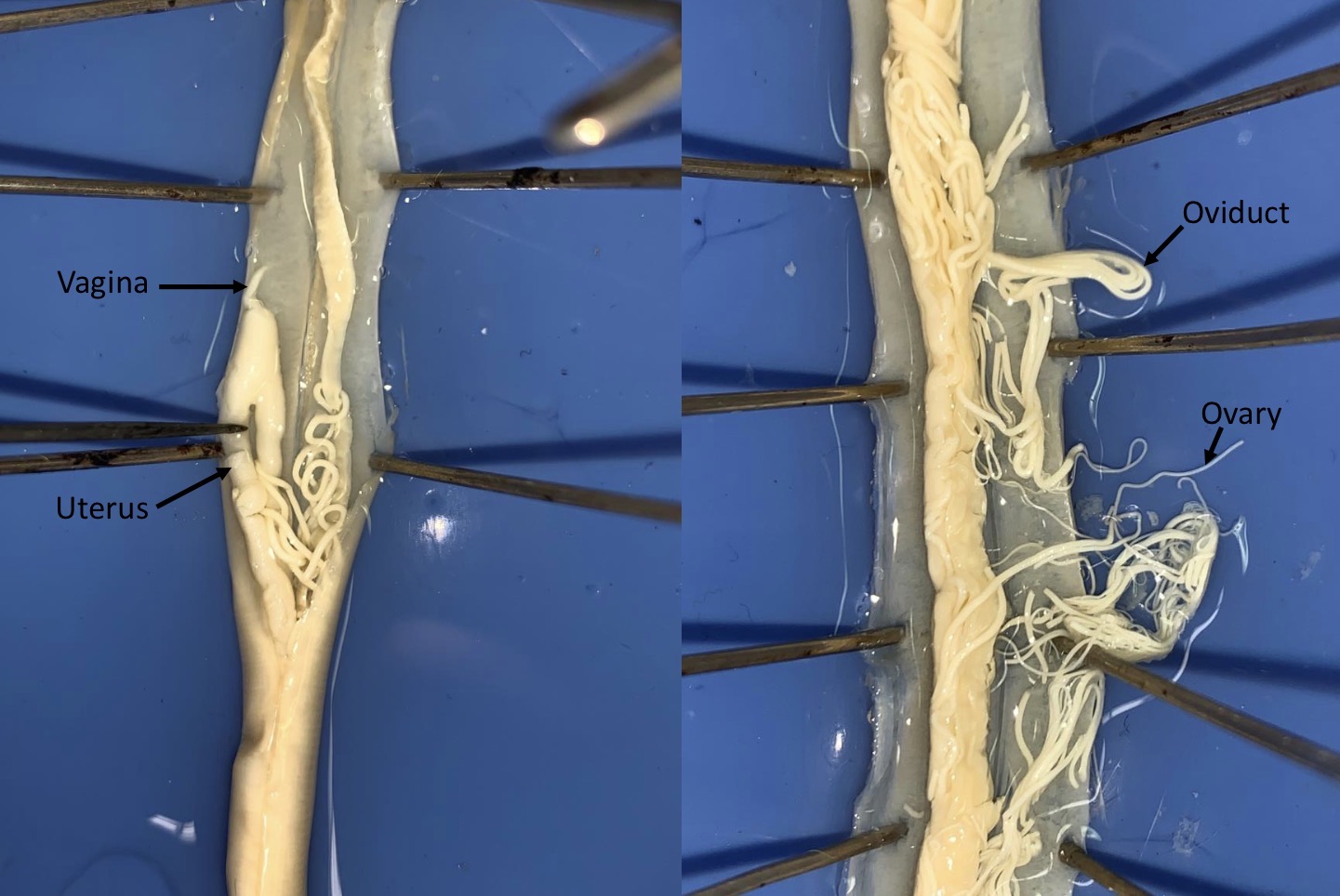
Females: females have a genital pole that is sometimes visible closest to the anterior end (mouth). Genital pole → short vagina → two uteri → thin oviduct (at end of each uterus) → thread like ovaries (where eggs are produced through meiosis)
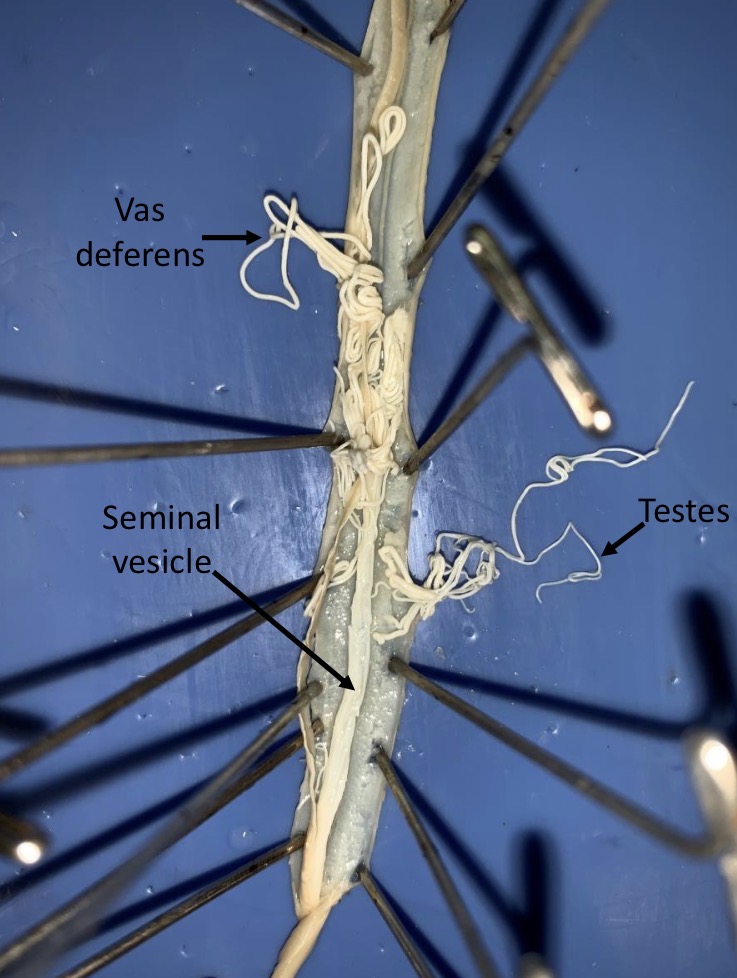
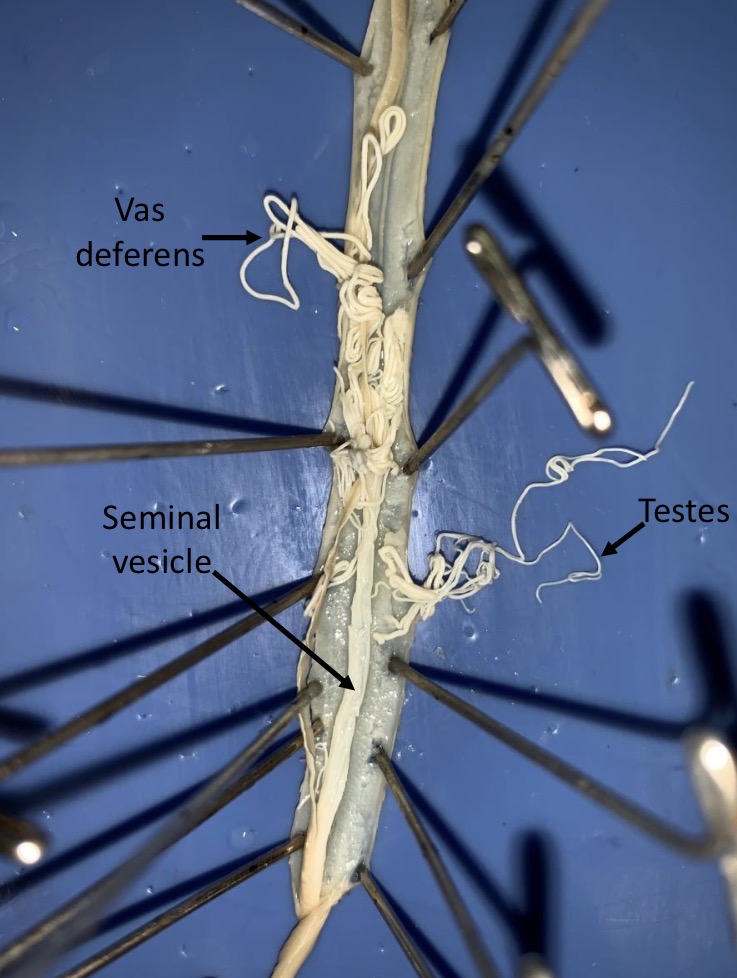
Describe the functions of the copulatory spicule, cloaca, anus, seminal vesicle, sperm ducts/vas deferens and testes in male ascaris
Copulatory spicule (= hook like appendage found at the edge of the anus used to hold the genital pole open during intercourse)
Cloaca (= the anus opens into the cloaca, a collecting area for feces from the intestine and spermatozoa/sperm cells from the seminal vesicle. Ameboid sperm enter the cloaca before entering the female)
Anus (= opens into the cloaca)
Seminal vesicle (= connected to the intestine by the cloaca, stores and maintains maturing sperm)
Vas deferens/ sperm ducts (sperm move from the testes to the seminal vesicle through the vas deferens)
Testes (the ameboid sperm of Ascaris are produced in the testes)
Phylum annelida
Common name?
Most distinctive feature?
Body plan?
Circulatory system? If so, open or closed?
Segmented worms
Rings/segments divide the body, a type of body segmentation called metamerism both externally and internally by septa
Annelids are coelomates (have a true coelom)
Annelids have a closed circulatory system
What are the four classes of Phylum Annelida? Name an example of three of the classes
oligochaeta (ex. Earthworm), polychaeta (ex. Clamworm, Aphrodita sp. /the sea mouse), hirudinea (ex. Leeches), archiannelida
External anatomy of Lumbricus terrestris
How do you identify the dorsal vs ventral surface?
How do you identify the posterior vs anterior end?
What is the clitellum? What is its function?
the dorsal surface is darker than the ventral surface, and setae, while present on both surfaces, are more visible on the ventral surface
The anterior end, where the mouth is, is the end that the clitellum is closest to. The anterior end (where the anus is) is much further from the clitellum
The clitellum is a saddle-like swelling most visible on the dorsal surface. It produces the mucus sheath which surrounds the worms during mating and then forms a cocoon where fertilized eggs are deposited
Earthworms (Lumbricus terrestris) and clam worms (Nereis sp.) are both members of Phylum ___. However, while earthworms are ___(herbivorous, carnivorous), clamworms are ___(herbivorous, carnivorous).
How do earthworms eat? What do they eat? What specialized structures do they have? (2)
Earthworms (Lumbricus terrestris) and clam worms (Nereis sp.) are both members of Phylum annelida. However, while earthworms are herbivorous, clamworms are carnivorous.
Earthworms are foraging herbivores, they consume soil and extract the nutrients as they pass through its digestive tract. Unlike clamworms, earthworms have a gizzard, where soil is ground up and churned (mechanical digestion). Earthworms also have a longitudinal groove on the dorsal surface of their intestine, which increases surface area for absorption of nutrients from the soil (relatively poor quality food compared to that of the clamworm)
Clamworms are carnivorous, they feed on small animals. Unlike herbivorous earthworms, clam worms have protrusible pharynx and mouth with sharp jaws for capturing prey.
digestive tract of Lumbricus terristus
mouth -> pharynx -> esophagus -> crop -> gizzard -> intestine with typhlosole -> anus
digestive tract of Nereis sp.
mouth and jaws -> protrusible pharynx -> esophagus and esophageal caeca -> stomach-intestine
Why is the use of diffusion sufficient for excretion in Platyhelminthes but not in Annelids?
Annelids are much larger and more complex than platyehlminthes, and the closed circulatory system of annelids requires more efficient waste removal methods

Excretory system of earthworms in phylum Annelida? What are the excretory organs? Which two functions does the excretory system serve?
structures called nephridia are responsible for both removal of nitrogenous wastes (excretion) and osmoregulation in earthworms. Most segments have a pair of nephridia. A nephrostome collects coelomic fluid from the segment anterior to where the nephridia are. This fluid moves through tubules which are surrounded by blood capillaries for the reabsorption of any water or useful nutrients back into the blood. the remaining fluid (urine) is stored in a bladder and exits the body through an opening called the nephridiopore.
Nematodes and Platyhelminthes have no respiratory system or circulatory system. Why do Annelids have both?
annelids are significantly larger, more complex and more active that nematodes or Platyhelminthes, diffusion is no longer sufficient for the transportation of gases, nutrients and waste throughout the body)

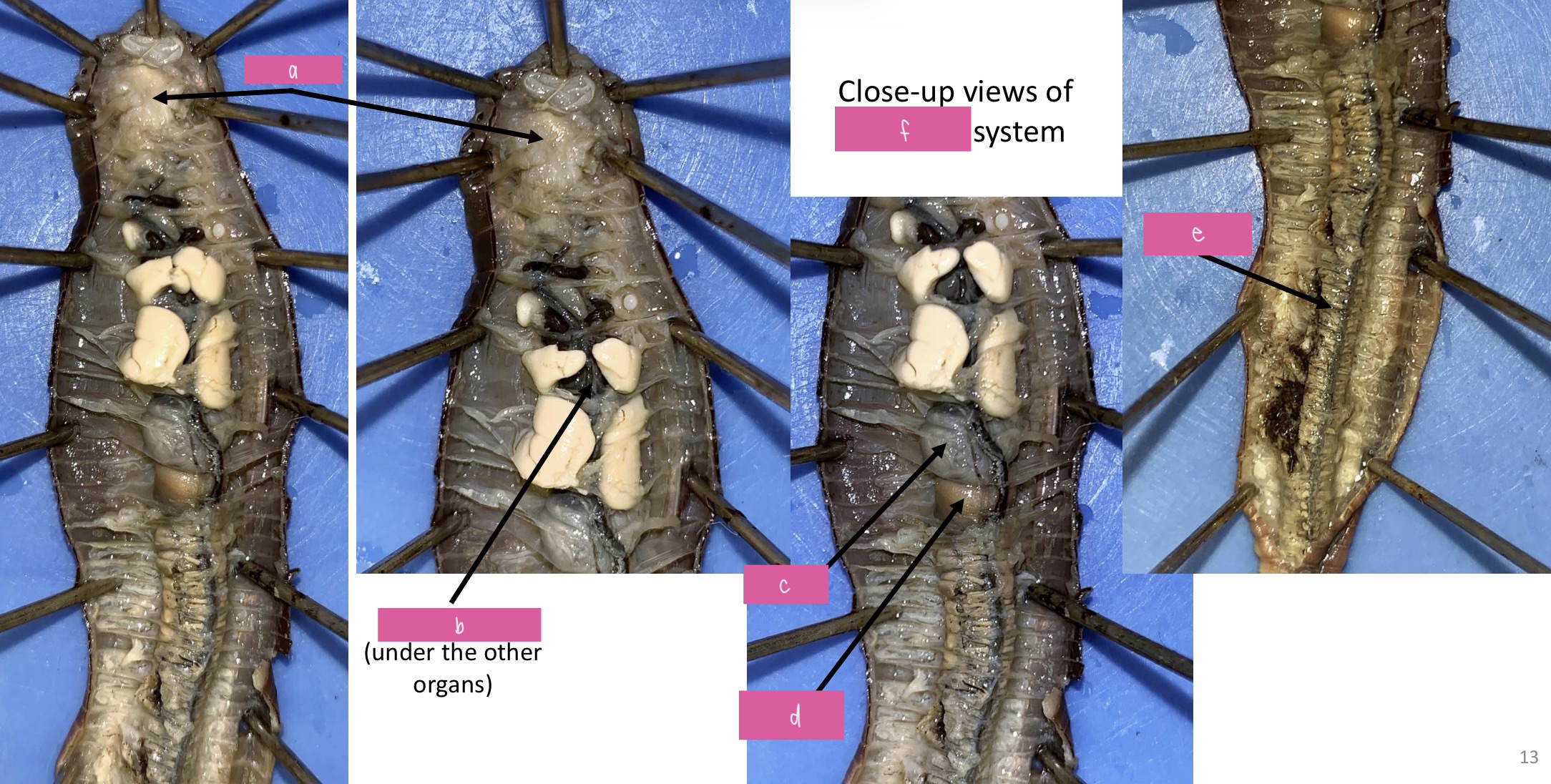
label
a) pharynx
b) esophagus
c) crop
d) gizzard
e) intestine
f) digestive system
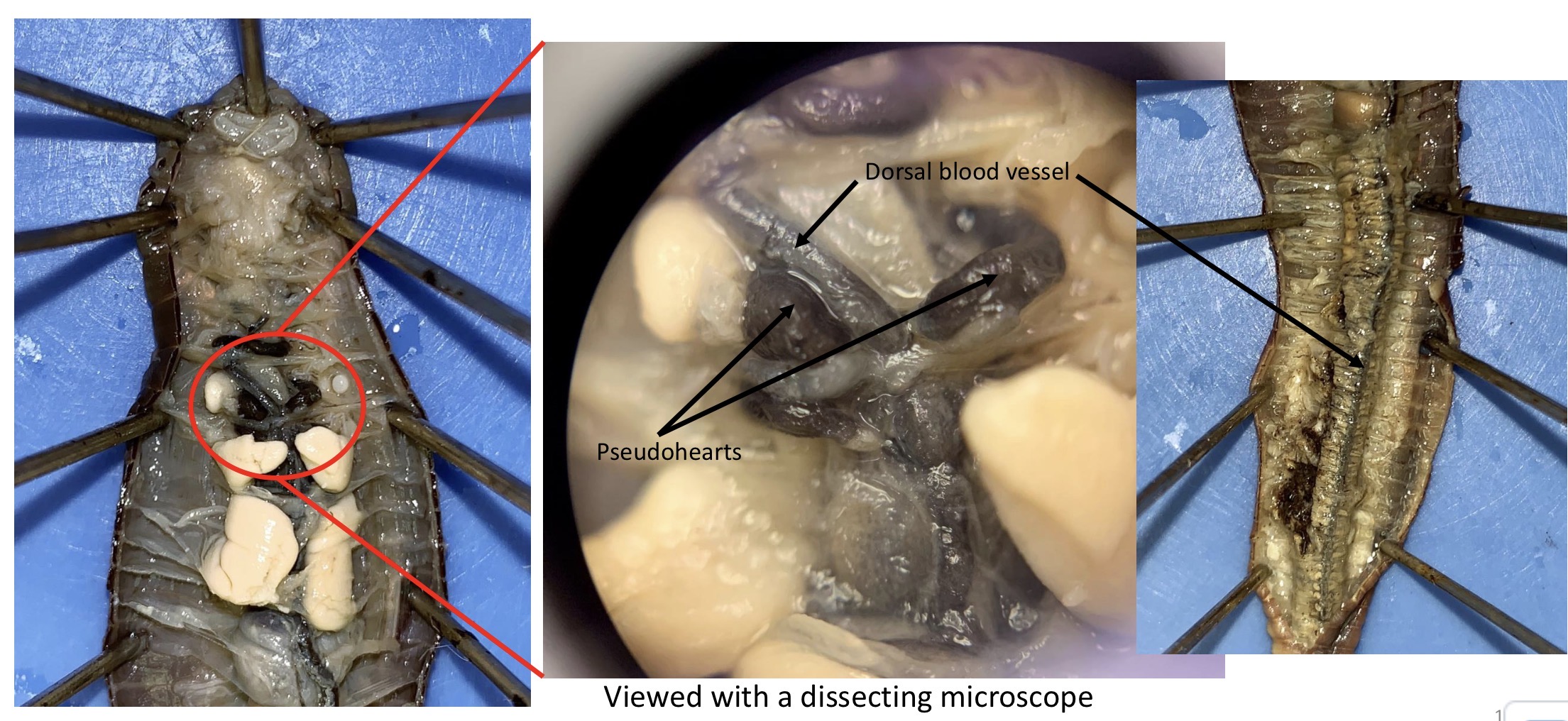
What are the two ways in which internal transport occurs in annelids? What type of pigments might both of these contain and why?
The movement of coelomic fluid initiated by contractions of the muscular body wall, the closed circulatory system. Both of these fluids may contain respiratory pigments like hemoglobin which increases their capacity to carry oxygen
What are the 3 main components of the circulatory system in earthworms? Describe the function of each part.
Dorsal blood vessel (=blood flows through the dorsal blood vessel anteriorly and is pumped downwards into the ventral blood vessel by the pseudohearts)
Ventral blood vessel (=blood is pumped into the ventral blood vessel by the pseudohearts and flows posteriorly. Smaller blood vessels in each segment allow blood to flow back up into the dorsal blood vessel)
5 pseudohearts (=pump blood down from the dorsal blood vessel into the ventral blood vessel)
Dioecious vs hermaphroditic
Dioecious animals like ascaris sp. have 2 separate sexes. Hermaphroditic animals like earthworms have complex male and female reproductive organs present in each individual
How do earthworms mate?
They attach at their clitella and exchange sperm (which is then stored in the seminal receptacle), then separate. The clitellum secretes a mucous cocoon which slides along the worm picking up eggs produced in the ovaries and the stored sperm. The cocoon slips off the anterior end and the embryos develop within it
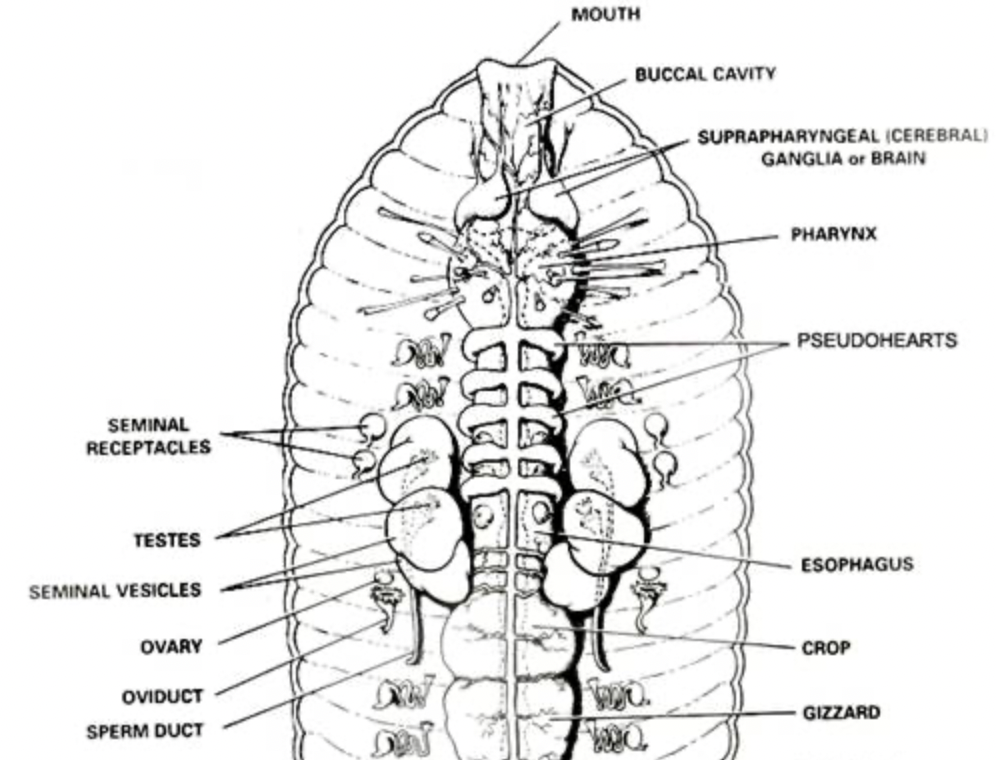
What segment do the reproductive structures of Lumbricus terrestris begin in? Label each structure and explain its function
the reproductive structures of Lumbricus terrestris begin in segment 9.
seminal vesicles contain the testes which produce sperm that is then stored in the seminal vesicle. During mating, sperm are transferred to the gonophone (male genital pole) through the vas deferens.
seminal receptacles are the bulb shaped organs which store sperm received in cross fertilization.
the ovaries (which are very difficult to see) produce eggs which exit through the female genital pore (gonophore)
What are some distinctive external features of the clamworm?
jaws, which are attached to the mouth and protrusible pharynx
Parapodia, each with many setae
Well developed head region which may have tentacles
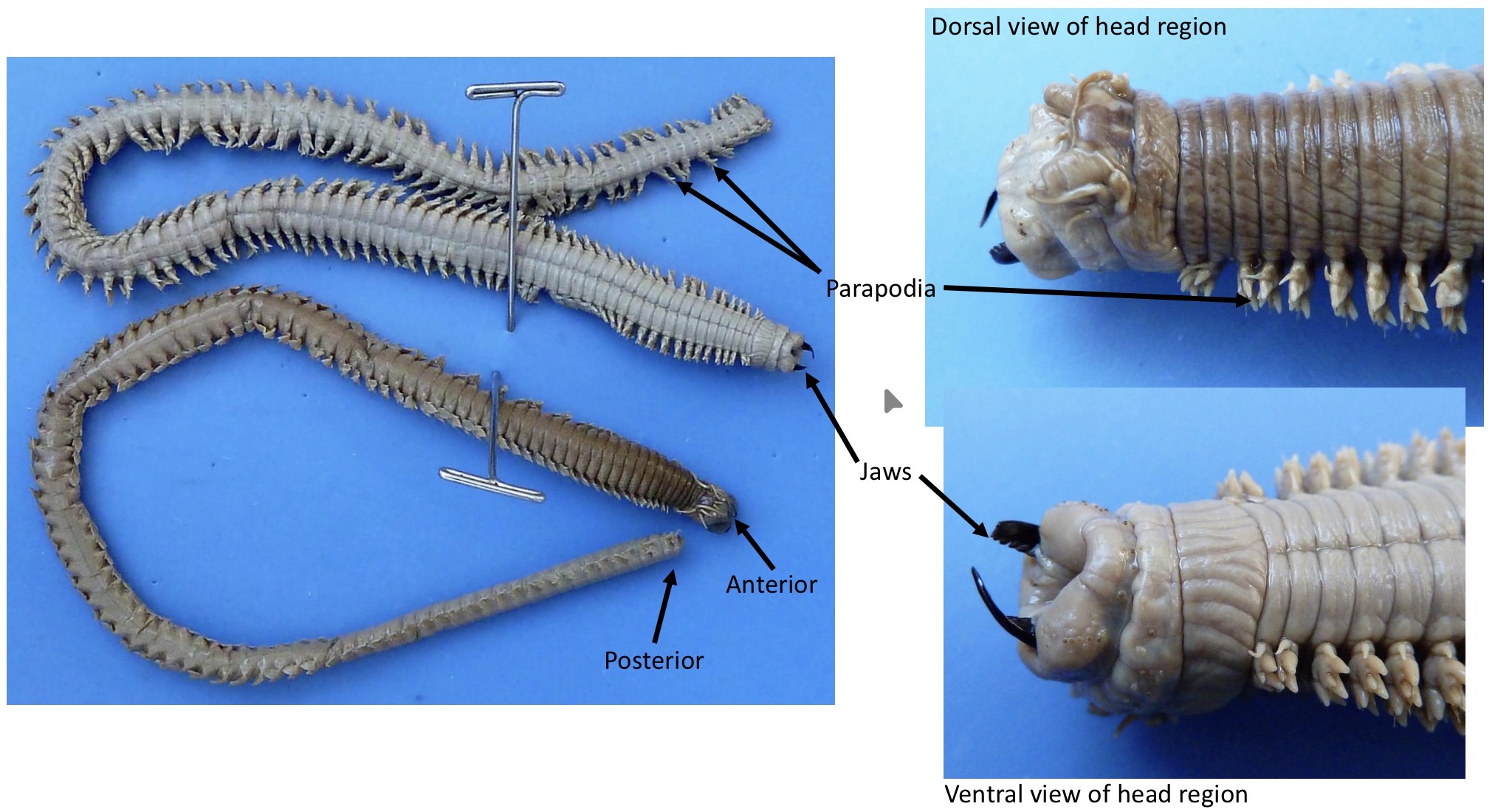
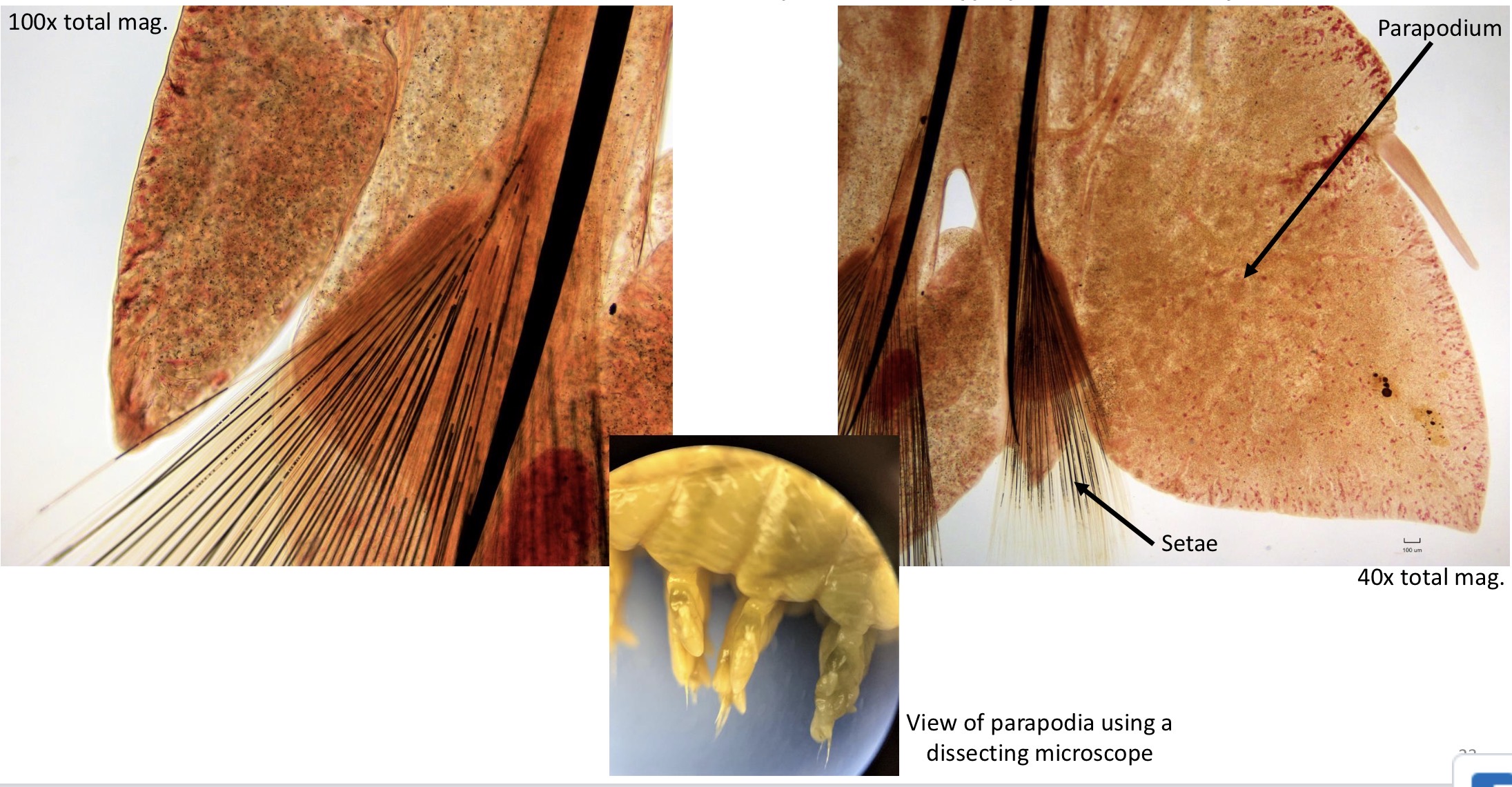
How do the parapodia of Nereis sp. factor in to their respiratory and circulatory systems?
The parapodia are well vascularized and have a large surface area, they are major sites of gas exchange. Movement of the parapodia also helps to keep fresh water with high oxygen concentration moving over the respiratory surface. Otherwise, clamworms have the same pseudoheart/dorsal blood vessel/ventral blood vessel arrangement as earthworms
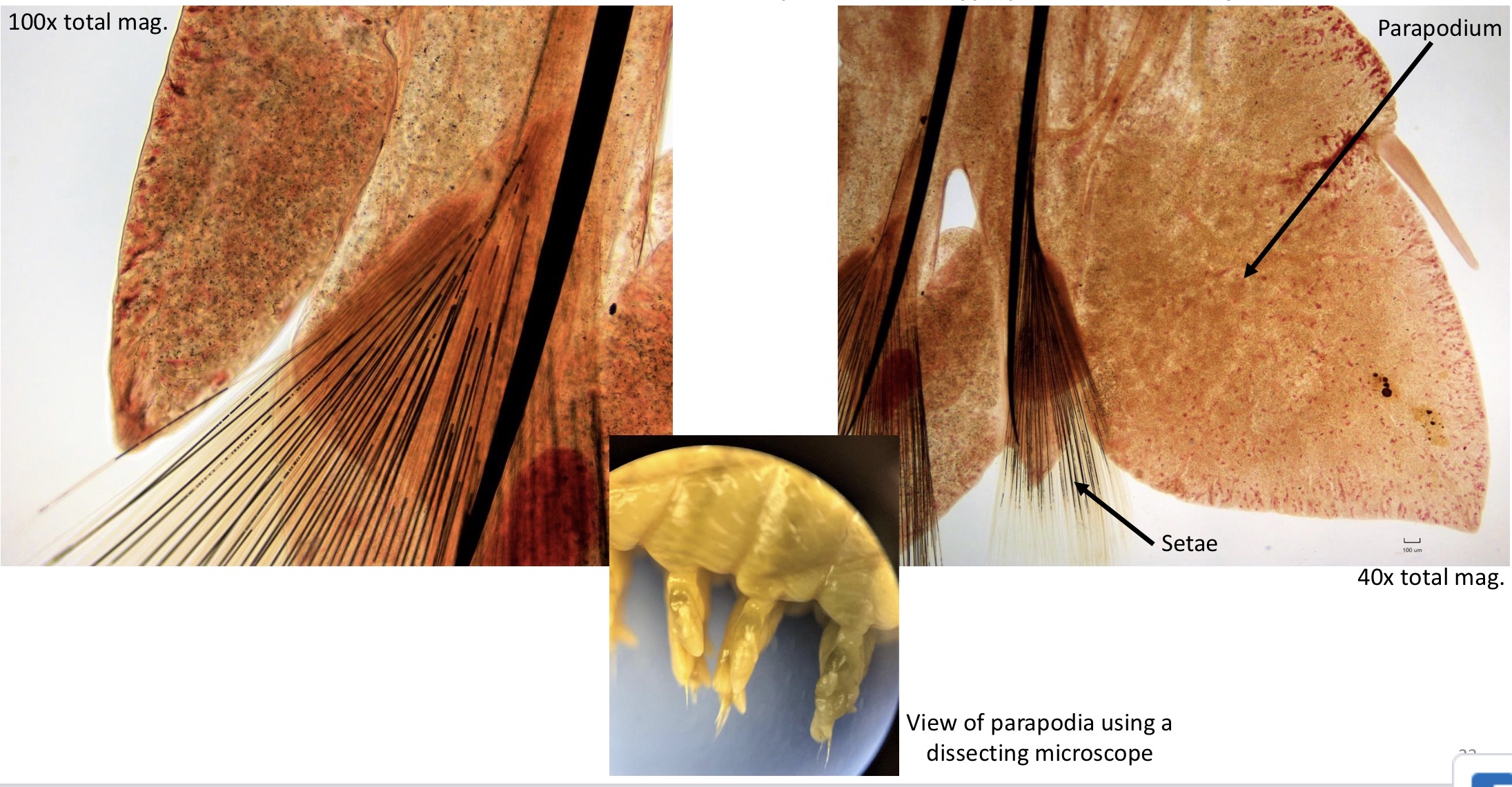
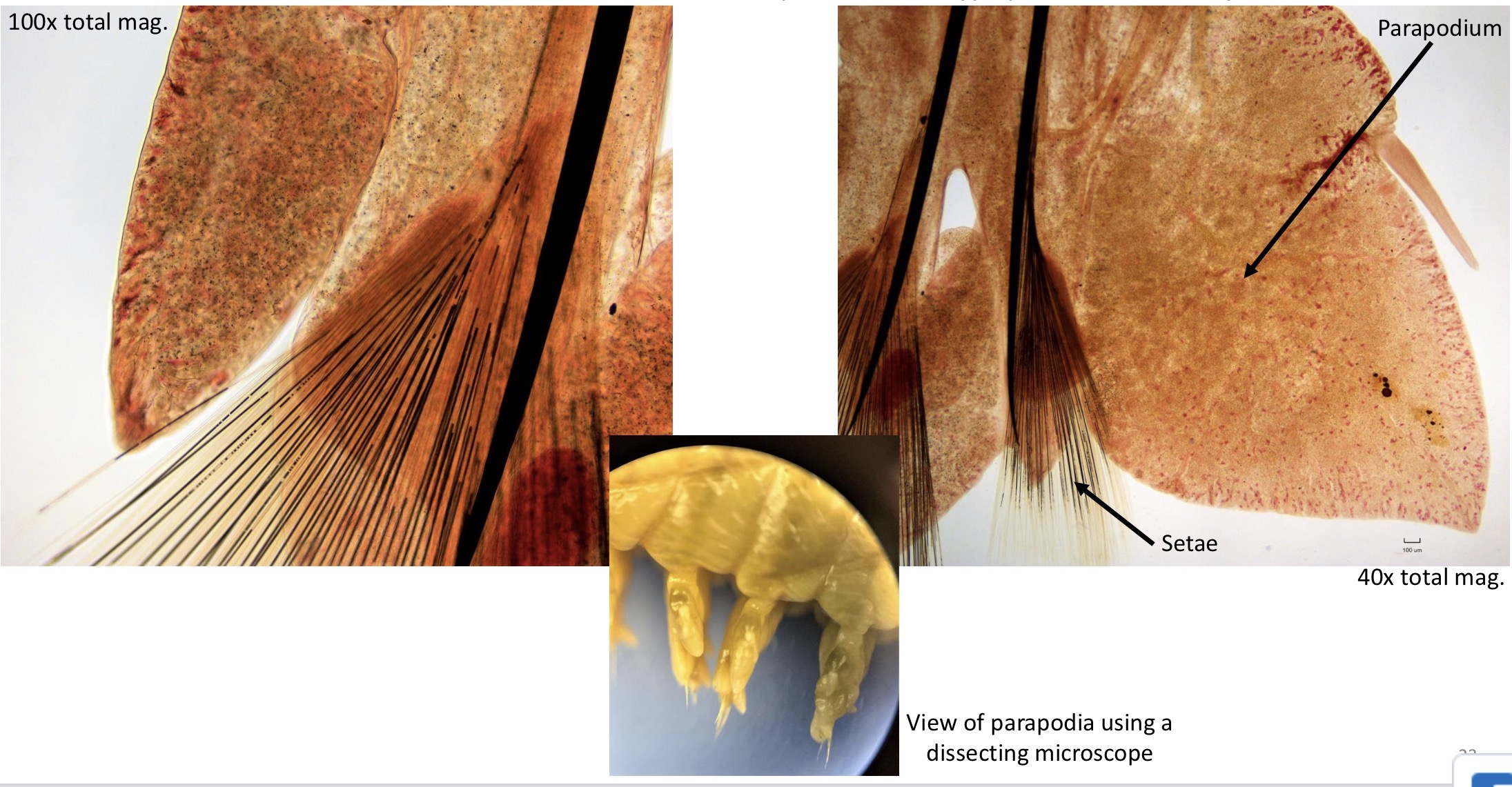
Name 3 uses of parapodia?
Parapodia can be considered primitive ___.
as oars for swimming
as legs for crawling
as the major site of gas exchange due to their large, well vascularized surface area
Parapodia can be considered primitive gills.
Why are aquatic arthropods generally much larger than terrestrial arthropods?
All arthropods must molt as part of their growth process. Molting is much easier in the water, allowing aquatic arthropods to be larger in size
What is the largest animal phylum?
Arthropoda
What are two characteristics of arthropods that have made the phylum so successful and widespread?
A rigid external skeleton/exoskeleton and jointed appendages (arthro=jointed, poda=foot)
Where are crayfish found?
What do they do during the night? What do they do during the day?
What do crayfish eat?
Majority of crayfish are found in almost any freshwater body with sufficient calcium salt levels
Crayfish are nocturnal, they feed at night. During the day, crayfish hide under rocks and in crevices
Crayfish will eat almost anything organic, whether it is alive or dead
What are the two main divisions of a crayfish body?
The two main divisions of a crayfish body are the cephalothorax (anterior) and the abdomen (posterior)
what is the difference in the external anatomy of male and female crayfish?
male and female crayfish both have the same number of swimmerets (5), but in males, the first two pairs of swimmerets (the most anterior) are modified so that they can form a channel for the transfer of sperm from the male to the female
what is the function of the digestive gland in crayfish?
digestive path of crayfish
what is the gastric mill? what is it made up of and what is its function?
the large digestive gland secretes enzymes for digestion and stores food (already broken down food, as a reserve)
mouth → esophagus → stomach and gastric mill → intestine → anus
the gastric mill is a structure within the stomach of crayfish (which is found in the most anterior region of the cephalothorax) made up of chitinous teeth used to grind up and mechanically digest food
what are green glands? where can they be found?
green glands are found beneath and anterior to the stomach, and are the excretory system of crayfish
do arthropods have an open or closed circulatory system?
are the circulatory systems of cnidarians, platyhelminthes, nematodes, annelids and chordates open or closed?
all arthropods have an open circulatory system.
cnidarians, Platyhelminthes and nematodes have no circulatory system. Annelids and chordates have closed circulatory systems
which structures form the respiratory system in the majority of aquatic arthropods?
most aquatic arthropods have gills, well vascularized structures which are the site of gas exchange.
circulatory system of aquatic arthropods (crayfish), what is the hemocoel?
crayfish have an open circulatory system, with a prominent heart with ostia (small holes) pumps blood from the hemocoel (the large blood sinus/large open space in the body of the crayfish)
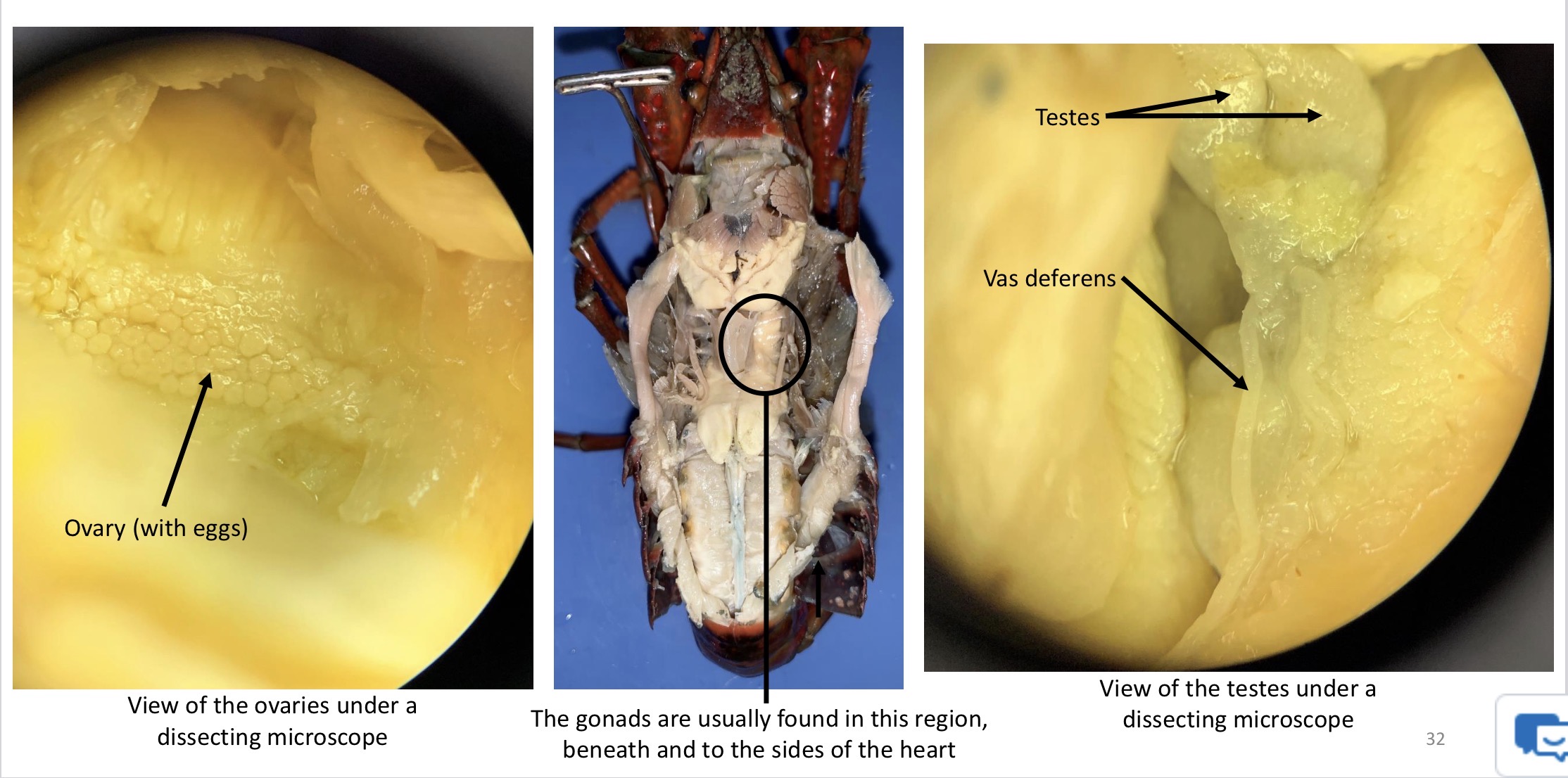
where are the gonads of crayfish located? what do they look like?
the gonads of crayfish are located laterally to to an anterior portion of the intestine. the testes are usually white, while the ovaries are usually darker orange in colour and coarser in texture.
What are the 3 main characteristics of class insecta?
3 body regions (head, thorax and abdomen)
6 legs
1 pair of antennae
How many abdominal segments are found in Romalea? Which segment bears gonads and reproductive genitalia?
Romalea has 10 abdominal segments, the last of which (the terminal abdominal segment) contains the gonads and bears the reproductive genitalia
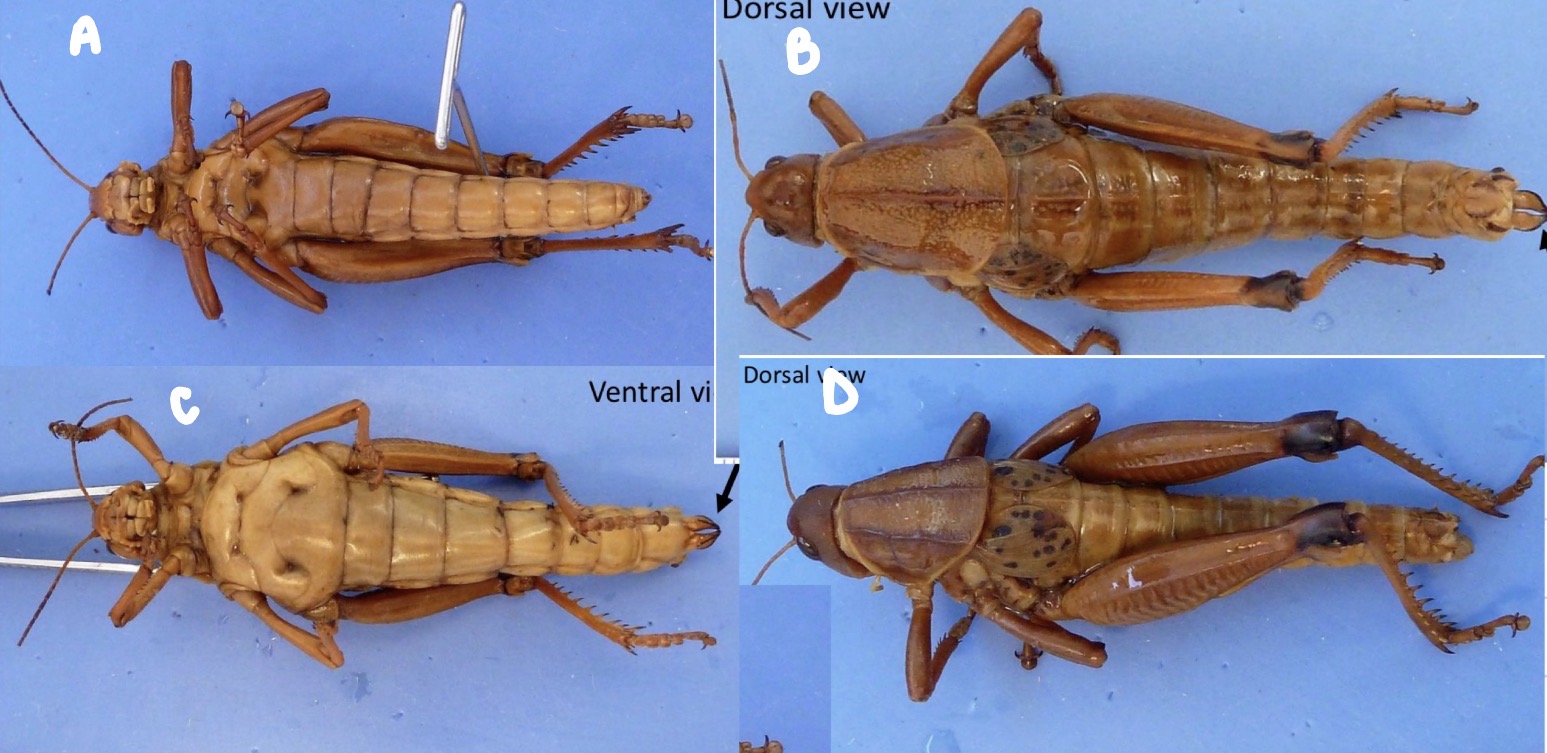
Which images show male Romalea? Which images show female Romalea?
images A and D are male, images B and C are female
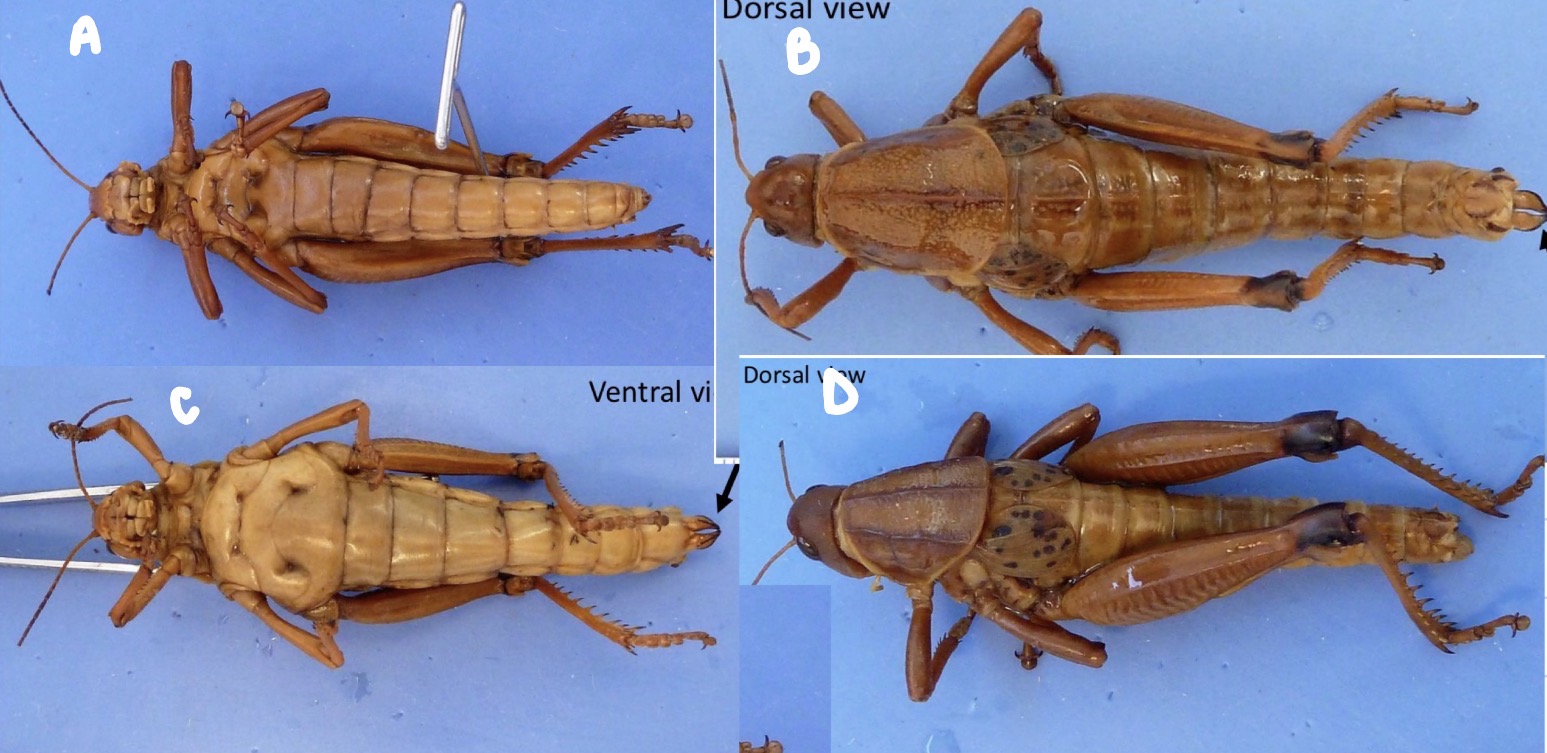
How is the terminal segment of female grasshoppers different from that of males? What is it called and why?
The terminal segment of female grasshoppers is called an ovipositor and is modified to lay eggs. The terminal segment of males grasshoppers ends bluntly.
Digestive pathway of the Romelea sp.? (7)
What do the gastric caecae do?
Most of the digestive tract is lined with __, except the stomach and crop, so those two places are where most __ occurs
The function of the crop is to…?
The hair-like tubules lying over the intestine are called ___, they are part of Romelea’s ___ system
Mouth → pharynx → crop → stomach and 6 gastric caeca → intestine → rectum → anus
In grasshoppers, gastric produced digestive enzymes that are secreted into the stomach to aid in digestion
Most of the digestive tract is lined with chitin, except the stomach and crop, so those two places are where most digestion and absorption occurs
Store chewed food
The hair-like tubules lying over the intestine are called malpighian tubules, they are part of Romelea’s excretory system
Malpighian tubules (3)
serve as excretory organs in terrestrial arthropods like insects, centipedes, millipedes and arachnids
Blind pouches that are protrusions from the gut
Bathed in blood in the sinuses of the open circulatory system, wastes enter the tubules and exit into the hindgut (and then through the rectum and anus)
How does the musculature of Ascaris sp. differ from that of Lumbricus terrestris?
Ascaris sp. has only one layer of longitudinal muscle. Lumbricus terrestris has two layers of muscle, a more external “circular” muscle layer and a more internal longitudinal muscle layer.

