Invertebrates
 Studied by 0 people
 Call Kai
 Learn
Learn Practice Test
 Spaced Repetition
 Match
Match Flashcards
 Knowt Play
1/30

Earn XP
Description and Tags
egan lecture 21
Name | Mastery | Learn | Test | Matching | Spaced | Call with Kai |
|---|
No analytics yet
Send a link to your students to track their progress
31 Terms
Where did animals likely evolve from?
single-celled eukaryotes similar to present-day choanoflagellate protists
What are ediacaran biota?
they are soft-bodied, mostly sessile animals who formed the earliest seafloor communities of large multicellular life including Porifera and cnidarians
How do sponges’ body work?
like a sac perforated with pores
it captures particles suspended in water that pass through its body — the spongocoel — and flows out through osculum
What are cnidaria?
they are carnivores and ecological engineers: think corals, hydras, sea jellies
What is the cnidarian body plan?
they are diploblastic with radial symmetry and a simple nerve net
they also evolved a gastrovascular cavity
cnidocytes make them the first active predators and engineers
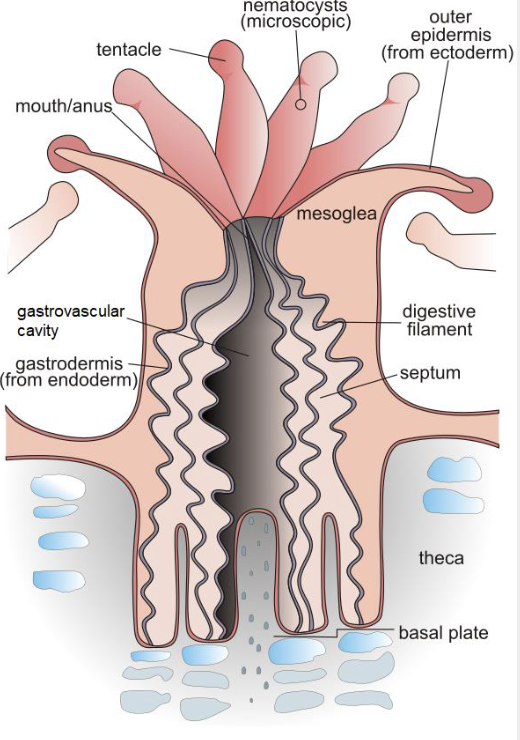
cnidarians use what to capture and consume prey?
tentacles armed with cnidocytes — nematocysts are specialized organelles within cnidocytes that eject a stinging thread
What two variations form the cnidaria body plan?
polyps and medusa
What entail polyps?
they are sessile, adhering to the substrate by the aboral end of the body
What entail medusa?
a free-swimming form that has a bell-shaped body with the mouth on the underside
What happens for medusozoans?
the life cycle alternates between polyp and medusa body forms and reproduce asexually (through budding) and sexually (through production of medusae)
What happens during the Cambrian Explosion?
diversity of large animals increased dramatically
What rose from/during the Cambrian Explosion, and what is its effect?
Atmospheric O2 increased — animals can support larger, more active bodies and enabled complex tissues and skeleton to form and maintain
What evolved from the Cambrian Explosion, altering animals?
The expansion of the Hox gene complex:
allowed precise control over body patterning along head-tail axis
modular segments to specialize
small changes in hox regulation generate many new body plans quickly
What relationships came out of the Cambrian Explosion?
new predator-prey relationships:
evolutionary arms race
selected for shells, spines, burrowing, and better senses in predators/prey
created new ecological niches and lifestyles
What did lophotrochozoan body plans innovate?
segmentation in annelids provided repeated, modular body units that could specialize
molluscan body plan generated range
lophophore and trochophore stages represent key innovations in feeding and larval dispersal
Why are lophotrochozoans important?
They are major ecosystem engineers, important players in food webs, and help reconstruct past oceans and mass extinctions
How did nervous systems evolve?
early animals had diffuse nerve nets
early bilaterians concentrated at two ends of the body
then these centers expanded and linked along the body axis, giving rise to centralized brains and nerve cords
Ecdysozoans have an external what?
cuticle that must be shed or molted and replaced to grow (ecdysis)
What is the largest phyla out of the ecdysozoans?
arthropods
What is the arthropod body plan?
segmented body, hard exoskeleton, and jointed appendages (think trilobites!)
What and how did arthropods evolve?
segments united to form “body regions” specialized for feeding, walking, or swimming
they likely evolved due to changes in sequence/regulation of existing Hox genes
How did arthropods terrestrialize?
they were the first animals to colonize land following the Cambrian explosion (think trilobites), and “followed plants”
What are advantages and challenges to life on land?
higher O2
new sources of food and decreased competitors
scarce water
greater fluctuation in temperatures
no support against gravity
Why did arthropods colonize land first? What challenges to land did their traits have that allowed them to live on land first? (4)
Challenge: Scarce water > desiccation risk
waterproof exoskeletons
Challenge: gravity > need support structures and movement
exoskeleton and pre-existing jointed limbs
Challenge: protecting gametes
early internal fertilization
Challenge: gas exchange
tracheal breathing system that derived with the transition to land
What advances do arthropods have?
eyes, olfactory receptors, and antennae that function in both touch and smell
open circulatory system uses a heart to pump hemolymph to cavity surrounding tissues and organs (the hemocoel)
What lineages do arthropods diverge into?
chelicerates (sea spiders, horseshoe crabs, scorpions, ticks, mites, spiders)
myriapods (centipedes and millipedes)
pan crustaceans (insects, lobsters, shrimp, barnacles, and other crustaceans)
What clade includes insects and their relatives?
hexapoda
What evolution caused rapid diversification?
flight
Why were arthropods (especially insects) so successful on land?
protective, waterproof exoskeleton
highly effective movement and flight
flexible life histories and diets
What two clades display strong co-evolutionary patterns?
insects and angiosperms
When were ediacaran biota living?
~575-542 mya

