Exercise 14 - Mamm Phys Lab
 Call Kai
 Learn
Learn Practice Test
 Spaced Repetition
 Match
Match Flashcards
 Knowt Play
1/46

Earn XP
Description and Tags
Exam 1
Name | Mastery | Learn | Test | Matching | Spaced | Call with Kai |
|---|
No analytics yet
Send a link to your students to track their progress
47 Terms
Which underlined term is correct?
The potential difference, or voltage, across the plasma membrane is the result of the difference in membrane permeability to anions/cations, most importantly Na+ and K+
cations
The _______ wave follows the depolarization wave across the sarcolemma
a. hyperpolarization
b. refraction
c. repolarization
repolarization
True or False: The voltage at which the first noticeable contractile response is achieved is called the threshold stimulus
True
True or False: A single muscle is made up of many motor units, and the gradual activation of these motor units results in a graded contraction of the whole muscle
True
A sustained, smooth, muscle contraction that is a result of high-frequency stimulation is:
a. tetanus
b. tonus
c. twitch
tetanus
What are the three events of the contraction of skeletal/cardiac muscle fibers?
Electrical excitation of the muscle fiber
Excitation contraction coupling
Shortening of the muscle fiber due to sliding of the myofilaments within it
What is the potential difference of the inner face of the membrane?
-60 to -90 millivolts (mV)
Where is potassium and sodium more commonly found?
Potassium concentration is higher intracellular, sodium concentration is higher extracellular
What is the cell’s resting membrane potential, and what is it more permeable to?
It is more negative outside than inside; the membrane is more permeable to K+ than to Na+
What is depolarization?
A sudden influx of Na+ alters the membrane potential to become less negatively charged
What is repolarization?
When K+ ions move out of the cell and restore the resting membrane potential, but not the original ionic conditions
What is action potential?
The rapid depolarization and repolarization of the membrane that is propagated along the entire membrane from the point of stimulation
What is the absolute refractory period?
The period of time required for the Na+ channel gates to reset to their resting potentials
What is important to note about the absolute refractory period?
There is NO possibility of generating another action potential
What is the relative refractory period?
When Na+ permeability is gradually restored to resting levels during repolarization, an especially strong stimulus to the muscle fiber may provoke another action potential
What causes the release of Ca2+ ions?
Propagation of the action potential down the T tubules of the sarcolemma
Where is Ca2+ released from?
From storage in the sarcoplasmic reticulum within the muscle fiber
What does Ca2+ bind to?
The regulatory protein troponin on the actin myofilaments
What happens after Ca2+ binds to troponin?
They act as an ionic trigger that initiates contraction, and the actin and myosin filaments slide past each other
What occurs to Ca2+ after the action potential ends?
They are almost immediately transported back into the sarcoplasmic reticulum and the muscle fiber relaxes
What differences do you see? What zones (or bands) disappeared during contraction?
The contracted fiber appeared wider and the edges appear scalloped. The I and H zones (or bands) have disappeared
What conclusions can you draw about the importance of ATP, K+, and Mg2+ to the contractile process?
Generally, there is little or no contraction with ATP alone.
There is no contraction with the salt solutions alone.
Maximum contraction occurs in the presence of ATP and the proper concentrations of potassium and magnesium ions.
What is a muscle twitch?
A single contraction of skeletal muscle
What are the three phases of a muscle twitch?
Latent, contraction, and relaxation
What is the latent period?
The interval from stimulus application until the muscle begins to shorten
What occurs during the period of contraction?
The muscle fibers shorten; a tracing shows an increasingly higher needle deflection and the tracing peaks
What occurs during the period of relaxation?
The muscle fibers relax and lengthen; represented by a downward curve of the tracing
What is the threshold stimulus?
The voltage at which the first perceptible contractile response is obtained
What is the subthreshold stimulus?
All stimuli applied prior to the voltage needed to trigger the threshold stimulus; at those lower voltages, no response was elicited
What is maximal stimulus?
The weakest stimulus at which all muscle fibers are being stimulated
What is wave summation (or temporal summation)?
When a muscle is stimulated with a rapid series of stimuli of the same intensity before it has had a chance to relax completely, the response to the second and subsequent stimuli will be greater than to the first stimulus
What is fused tetanus (or complete tetanus)?
Demonstrates the maximum force generated by a skeletal muscle
What is muscle fatigue?
A reversible physiological condition; a muscle is unable to contract even though it is being stimulated
How can muscle fatigue occur?
With short-duration maximal contraction or long-duration submaximal contraction
What can you conclude about the effect of load on muscle fatigue?
As load increases, the period of contraction shortens as the muscle fatigues more quickly
What is recruitment (multiple motor unit summation)?
The gradual activation of more and more motor units
What are graded muscle contractions?
Increasing levels of force generated by a muscle, which depend on the gradual activation of more motor units, and increasing the frequency of action potentials (summation) for each active motor unit
Muscle fiber in the resting state: There is a greater concentration of Na+ ________
outside the cell
Muscle fiber in the resting state: There is a greater concentration of K+ _________
inside the cell
Muscle fiber in the resting state: When the stimulus is delivered, the permeability of the membrane at that point is changed; and ________, initiating the depolarization of the membrane
Na+ diffuses into the cell
Muscle fiber in the resting state: Almost as soon as the depolarization wave has begun, a repolarization wave follows it across the membrane. This occurs as _______.
K+ diffuses out of the cell
Muscle fiber in the resting state: Repolarization restores the ________ of the resting cell membrane
electrical conditions
Muscle fiber in the resting state: The ________ is (are) reestablished by ________.
relative ionic concentrations on the two sides of the membrane; activation of the sodium-potassium pump, which moves K+ into the cell and Na+ out of the cell
What is the order of the contraction mechanism in a skeletal muscle fiber?
Depolarization occurs; AP generated
AP, carried deep into the cell by the T Tubules, triggers the release of Ca2+ ions from the sarcoplasmic reticulum
Ca2+ ion concentrations at the myofilaments increase; the myofilaments slide past one another, and the cell shortens
Ca2+ ion concentrations at the myofilaments decrease as they are actively transported into the sarcoplasmic reticulum
Muscle cell relaxes and lengthens
What were the observations of the muscle fiber contraction activity?
Optimal muscle contraction requires Mg2+, K+, and ATP. Without ATP (the energy source), no contraction can occur once energy stores are exhausted. Mg2+ and K+ are necessary for ATPase activity.
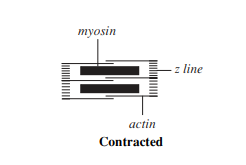
What does a relaxed sarcomere look like?
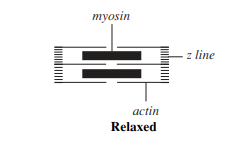
What does a contracted sarcomere look like?