KK13: Types of Sanctions & Their Purposes
 Studied by 0 people
 Call Kai
 Learn
Learn Practice Test
 Spaced Repetition
 Match
Match Flashcards
 Knowt Play
1/34

There's no tags or description
Looks like no tags are added yet.
Name | Mastery | Learn | Test | Matching | Spaced | Call with Kai |
|---|
No analytics yet
Send a link to your students to track their progress
35 Terms
Types of sanctions
fine
cco
imprisonment
Fine
are a type of sanction, that requires the offender to pay an amount of money to the state (of Victoria)
monetary penalties, expressed in penalty units
a fine can be imposed as the only sanction, or can be imposed in conjunction with any other sanction.
The amount of a fine will depend on the maximum penalty that may be imposed for an offence, as specified in the statute.
Factors considered when a court determines the amount of a fine
Under the Sentencing Act 1991 (vic), a court must consider:
The offender’s financial circumstances, and the burden it will impose on the offender.
Applies when determining the amount of the fine, rather than whether a fine should be imposed
Whether any other orders have been made in relation to the taking of an offender’s property, or orders requiring the offender to pay compensation to the victim
An order for the offender to pay compensation to the victim or restore property should be given preference over a fine, although a fine can still be imposed.
Any loss or destruction of, or damage to, property suffered by a person as a result of the offence.
The value of any benefit to the offender as a result of the offence
what happens if a fine cannot be paid, or is not paid?
the court can allow a fine to be paid in instalments
a court can also vary or discharge the fine if the circumstances of the offender changes, for example, a fine can be converted into a requirement to perform unpaid community work if:
The offender is no longer able to afford the fine.
The fine is not greater than 100 penalty units.
If an offender refuses to make payment on the fine:
Warnings and notices may be issued to enforce
payment.
Court can order up to 500 hours of community work.
Warrant can be issued to seize (take) the offender’s property to settle the outstanding fine.
Imprisonment for up to 1 day per unpaid penalty unit,
up to 24 months (only if no other appropriate option).
purposes of sanctions - fines
fines can achieve the purposes of sanctions to an extent
achieves:
punishment
deterrence
denunciation
limited in achieving:
protection
rehabilitation
punishment - fines
A fine punishes the offender by requiring payment to the court, but its effectiveness diminishes for wealthier individuals, as it causes them less financial loss.
factors to considering when assessing the ability of fines to achieve their purpose:
the financial circumstances of the offender and their ability to pay; need to be high enough to act as a punishment, however is a fine is too high (and the offender does not have the ability to pay), the offender may not ever pay it ot may commit another offence (such as theft) to be able to pay it
the amount of the fine; must be high enough to impose a burden on the offender, although a smaller fine could be appropriate depending on the offenders social and financial circumstances
whether the fine is paid and/or enforced. an unpaid fine that is not enforced may not act as a punishment
specific deterrence - fines
Specific deterrence through fines discourages reoffending by threatening financial loss, but may be less effective for wealthier offenders.
factors to consider:
the financial circumstances of an offender and their ability to pay - the amount of a fine needs to be high enough to have an impact on the offender and deter them from from committing further crimes. if offender cannot afford to pay the fine, it may not deter the offender
the amount of the fine - must be high enough to impose a burden on the offender, although a smaller fine could be appropriate depending on the offender’s social and financial circumstances
whether the offender is a person or a company - when a company is fined, the people who are responsible for the company’s offending may not be deterred as it is not them who has to pay
whether the fine is paid and/or enforced - not enforced no impact on the offenders financial circumstances
general deterrence - fines
fines can act as a general deterrence by discouraging other members of the public from committing a similar offence because they can see the consequence of offending, but it is only effective if the fine imposed on the offender is widely known.
factors:
the amount of the fine and the circumstances of the people in the community, smaller fine may not deter, a larger fine is more likely to act as a general deterrent, although, this is dependent on each individuals personal circumstances
whether the fine is enforced - less likely to be deterred if they know there will be no repercussions if the fine is not paid
the extent to which the sentence is known to the community - fines are easily understood, members of the community will appreciate the personal impact of receiving a fine, which will vary depending on their circumstances and whether they are aware of the fine being imposed
denunciation - fines
Large fines can effectively denounce an offender’s actions, but to do so, the fine must be considered substantial by both the public and the offender.
Factors:
the nature of the offence and the fine imposed. large fine = stronger message of disapproval than a smaller fine - which may not be sufficient enough to send a strong message to the community
whether the fine is enforced - imposed = strong message of disapproval, the message can be weakened if a fine is not enforced
rehabilitation - fines
Fines do not rehabilitate offenders as they do not require offender to engage in programs that reform their behaviour.
a fine is not intended to address the underlying causes of behaviour, it could assist in rehab as it may help ‘condition’ the offender to avoid similar types of behaviour
protection - fines
protection is unlikely to be a primary consideration when imposing a fine
factors:
long term protection could be achieved if an offender is deterred from reoffending
a fine could assist in protection if it is imposed on a company that is willing to address the reason why it was given the fine
Community correction orders (CCO), and their specific purposes
is a flexible, non-custodial sanction that the offender serves in the community, with conditions attached to the order
cco’s can be tailored to the offender - based on their offending and circumstances
every cco has core conditions and at least one additional conditions
cco can be imposed for up to 2 years in the Magistrates’ Court for a single offence, up to 4 years for two offences, and up to 5 years for three or more offences
if the higher courts, the maximum length of a CCO is 5 years
CCO can be combined with fine or up to one year in prison
eligibility for a CCO
the offender is guilty of an offence punishable by more than 5 penalty units
the offender consents to the order
the court has received a pre-sentence report (e.g. social, medical)
the court is satisfied that the CCO is appropriate for the type of offence and the offender’s conduct
not appropriate for serious indictable offences, such as murder or manslaughter, kidnapping, arson causing death ect.
conditions attached to CCOs
every cco includes the following core conditions:
the offender must:
not commit another offence punishable by imprisonment
report to a specified community corrections centre within two working days of the order coming into the force
report to and receive visits from a community corrections officer
notify an officer of a change of address
not leave Victoria without permission
comply with any directions of the community corrections officer
what happens if an offender cannot or does not comply
breach of an order
a person will breach their order if they:
do or don’t do something required by the order; or
do or don’t do something required of them by their supervising corrections officer; or
commit another offence while the order is in place.
It is an offence to breach (or contravene) a CCO.
An offender who breaches a condition of a CCO may be resentenced for the original offence, and may face up to 3 months additional imprisonment for the breach.
purposes of sanctions - cco
rehabilitation
denunciation
deterrence (specific & general)
protection
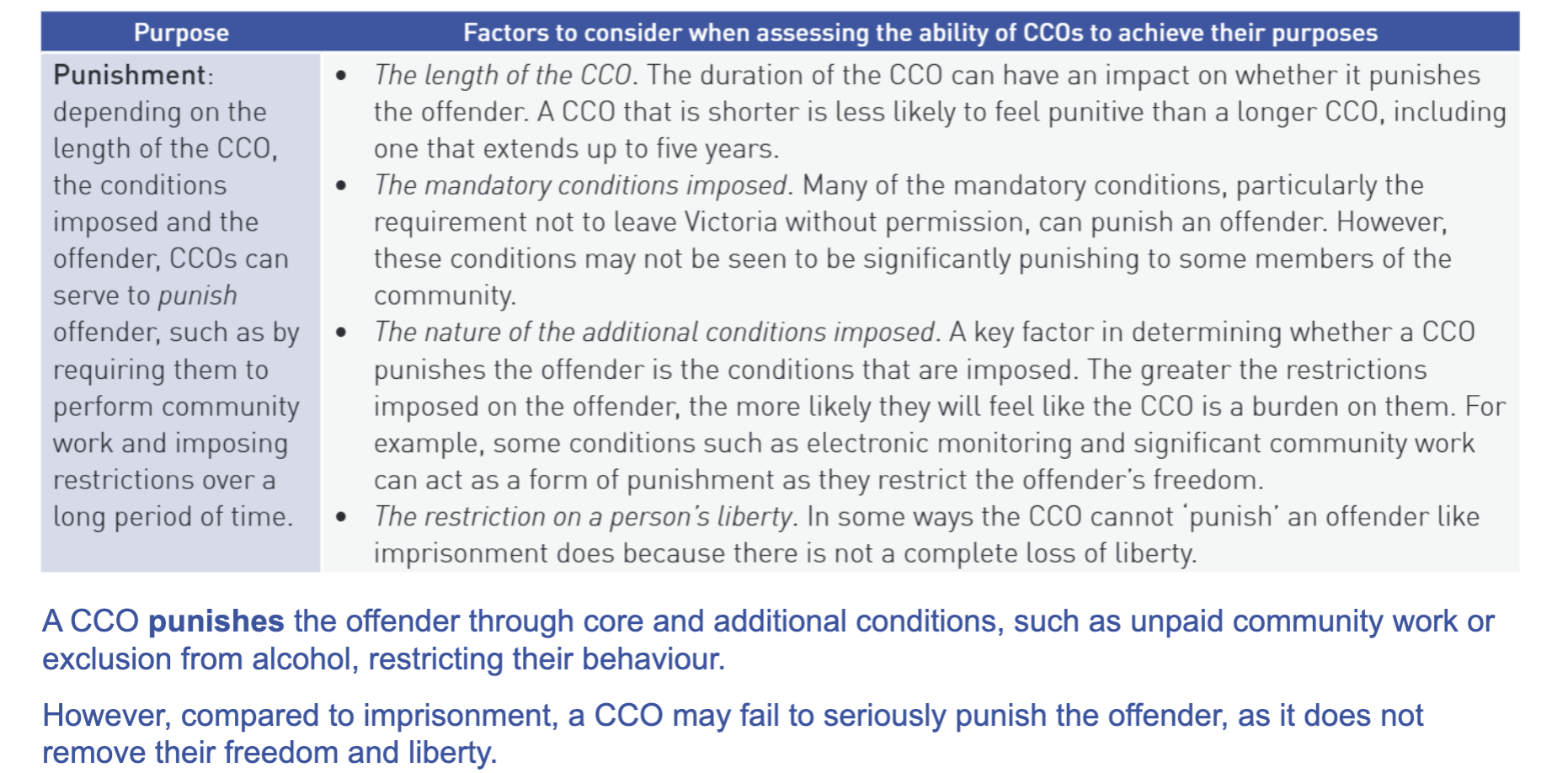
punishment
punishment - cco
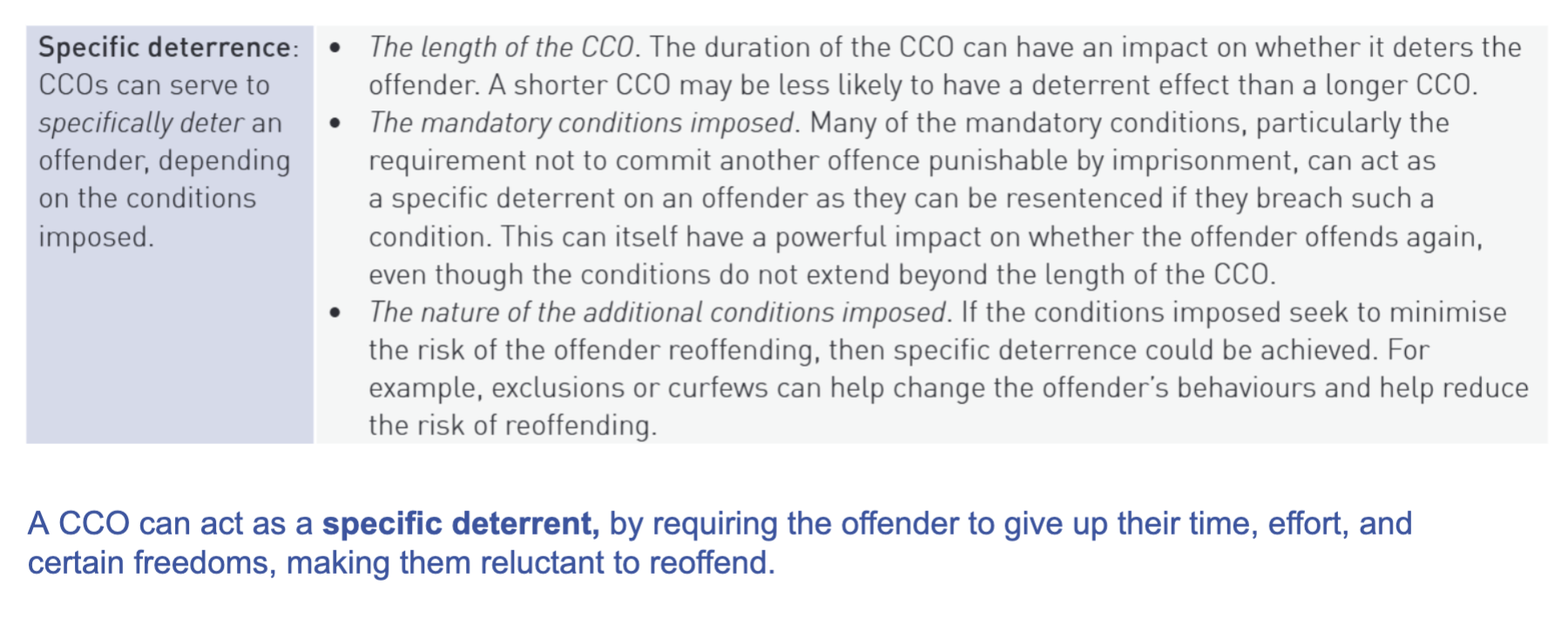
specific deterrence - cco
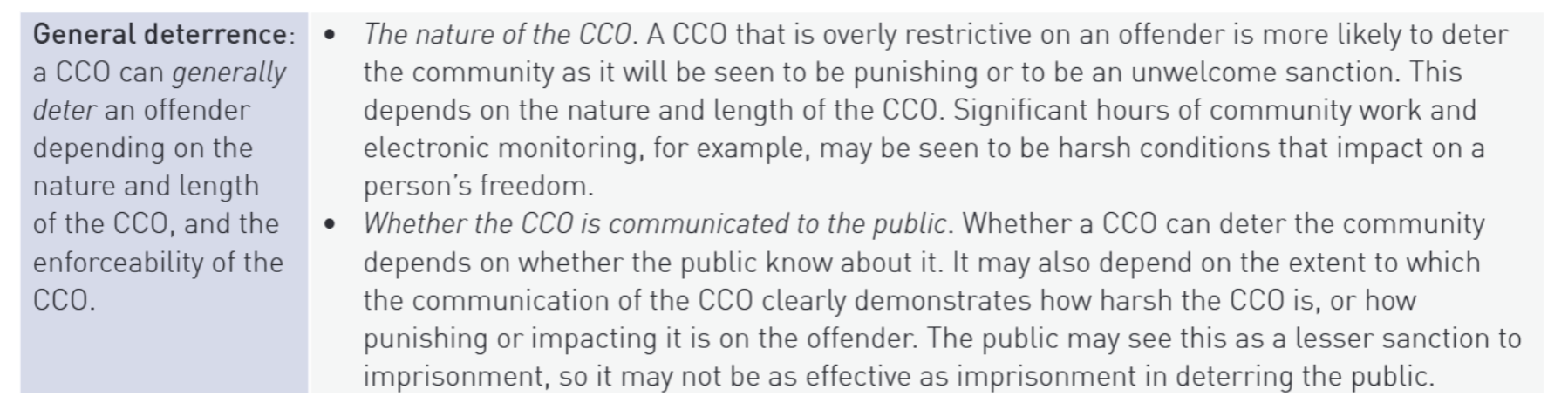
general deterrence - cco
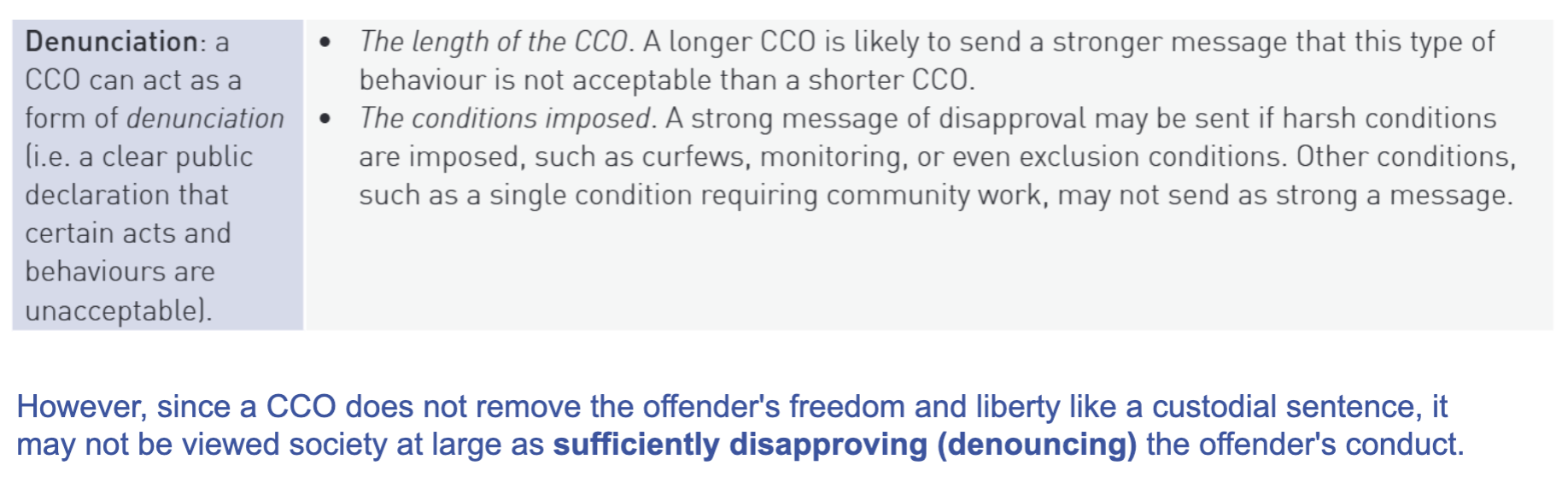
denunciation - cco
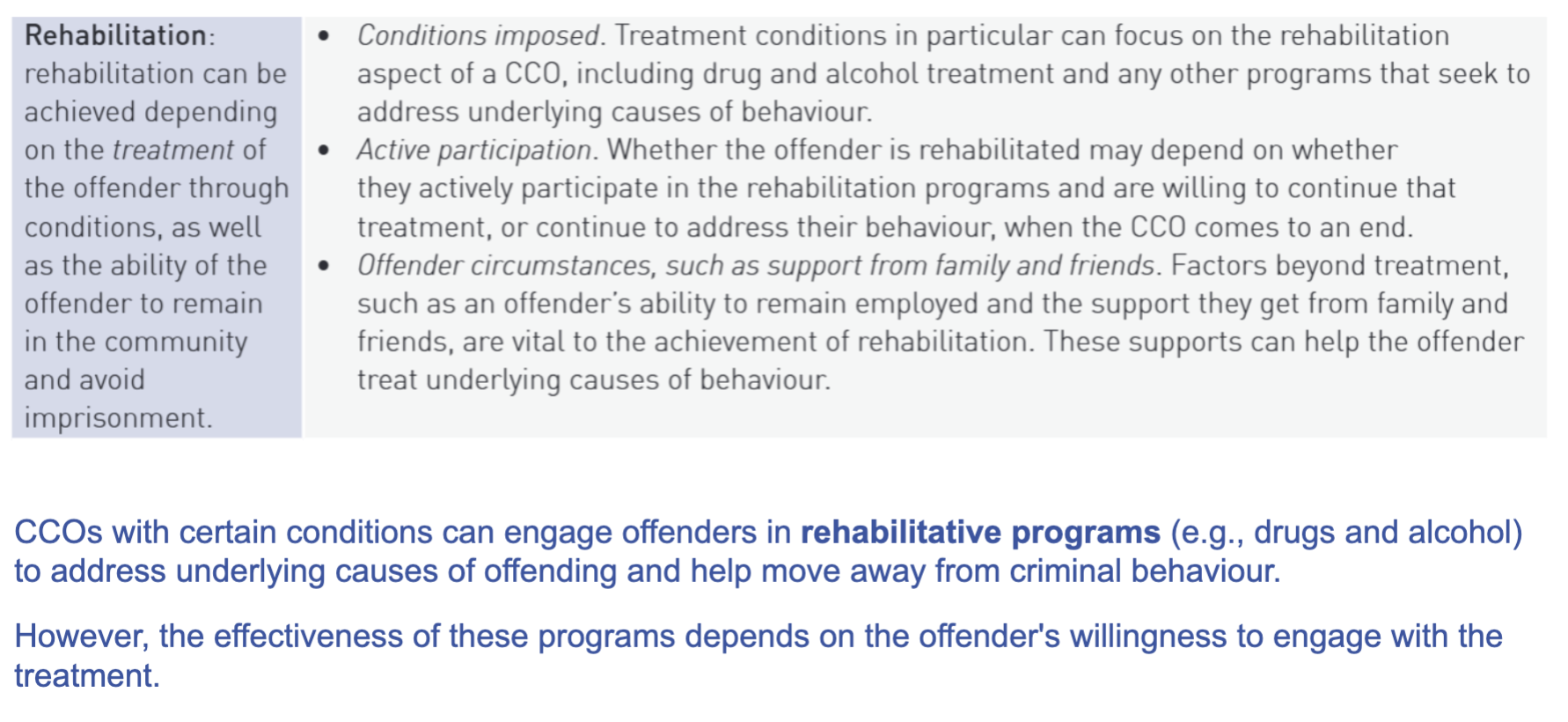
rehabilitation - cco
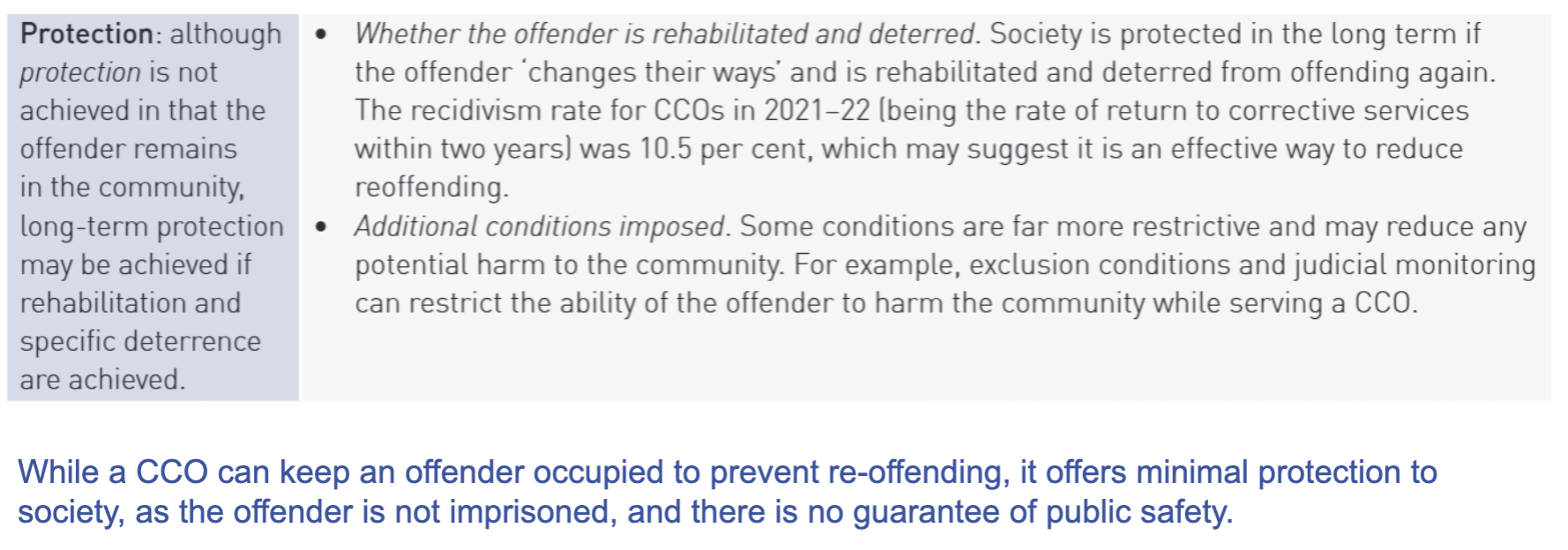
protection - cco
imprisonment
a sanction that involves removing an offender from society for a stated period of time and placing them in prison
A sanction of ‘last resort’
The most severe punishment available under Victorian law.
the offender losses their freedom and liberty, being physically separated from society
remand
What is remand?
A situation where an accused person is held in custody before their trial.
If denied bail, they will stay in remand until their case is decided.
Reasons for denying bail and placing someone in remand:
They pose a risk to the community.
They might commit more offences while on bail.
They may attempt to flee the country before trial.
Time served in remand counts toward the final prison sentence if convicted.
Parole
A conditional early release from prison.
Prisoners must apply to the Parole Board after serving their non-parole period.
Concurrent Sentence
Multiple sentences are served at the same time.
Example:
5 years for aggravated burglary.
2 years for assault.
If served concurrently, the total time in prison = 5 years.
Cumulative Sentence
Multiple sentences are served one after the other.
Example:
5 years for aggravated burglary.
2 years for assault.
If served cumulatively, the total time in prison = 7 years.
Indefinite Sentences
Definition: A prison sentence with no set end date.
Who can receive an indefinite sentence?
Offenders convicted of serious violent or sexual offences.
Examples of serious offences:
Murder, rape, child homicide, threats to kill, armed robbery, kidnapping, sexual offences against children under 16.
The court must be satisfied that the offender is a serious danger to the community, based on:
Character and past criminal history.
Nature and gravity of the offence.
Health, age, and mental condition.
Periodic Review:
Courts must review indefinite sentences periodically to determine if the offender remains a risk.
purposes of sanctions - imprisonment
punishment
denunciation
deterrence (specific & general)
protection
rehabilitation
punishment - imprisionmnet
Imprisonment punishes the offender by depriving them of their freedom, liberty, and normal way of life, effectively removing them from society.
However, the length of the prison sentence the judge hands down may impact the extent to which an offender is punished, for example, a more lenient sentence may not sufficiently punish.
factors:
the length of the imprisonment term - a longer prison term acts as a greater restriction on freedom and therefore may act as a greater punishment
the offenders circumstances - for example, an offender with a mental disability may not understand the impact of a term in prison and therefore punishment may not be achieved
specific deterrence - imprisonment
Aims to deter the offender from reoffending by exposing them to the harsh conditions of prison, such as loss of freedom and liberty.
However, high recidivism (reoffending) rates suggest imprisonment is not always effective at specific deterrence.
factors:
the length of the imprisonment term - a longer prison term acts as a greater restriction on freedom and therefore may specially deter an offender from offending again
the offenders circumstances - for example, an offender with a mental disability may not be specifically deterred as they may not be able to understand the nature of imprisonment
the nature of the imprisonment - time spent in prison can normalise violence and reinforce criminal behaviour
general deterrence - imprisonment
society at a larger will be deterred, as the possibility of going to prison and losing one’s freedom discourages others from committing similar offences.
factors:
the circumstances of the offender - may not be appropriate purpose or may not be achieved if the offender has particular circumstances that would mean that the sentence ot the offending will not deter the general public
the length of the sentence - longer sentences may act more as a general deterrent, sending a strong message to the community that this type of behaviour is not acceptable
Denunciation - imprisonment
The severity of imprisonment successfully denounces the offender's actions by removing them from society, and the court can further demonstrate its disapproval through the imposition of a longer term.
factors:
the length of the sentence - longer term in prison is likely to send a stronger message.
communication of the sentence to the public - sentences must be communicated to the public in a way that makes people understand that particular types of behaviour are unacceptable and may result in jail time for others who engage in similar behaviour.
Protection - imprisonment
Imprisonment removes dangerous individuals from the community.
Protects society from violent, repeat, or high-risk offenders.
factors:
the length of the sentence - longer sentences mean longer time during which the offender cannot harm the community
circumstances of the offender - if the offender is reluctant to be treated and has many prior convictions, then it is possible that they may harm again once they are released
whether the offender is treated - community benefits is the offender participated in rehab programs and is treated so once they are released, they will not commit further crimes. depends on the offenders willingness
Rehabilitation - imprisonment
Rehabilitation: rehabilitation can be achieved depending on the offender and the programs.
Programs available: whether an offender is rehabilitated may depend on the programs available and whether they are tailored to their individual needs.
Whether the offender is willing to participate: voluntary participation is required. An individual who is forced to participate may not be willing to address underlying causes of behaviour, but rehabilitation may be achieved if a person voluntarily participates.
The offender’s prospects of rehabilitation: the court will generally make comments, as part of sentencing, about the offender’s prospects of rehabilitation. Factors such as remorse and a person’s criminal record can give indications of an offender’s prospects.
Whether the offender has any addictions: whether the offender is prepared to face their addictions may be relevant to rehabilitation. For example, if the offender does not address an addiction to drug and alcohol, their prospects of rehabilitation may be lower.
The length of the sentence: the custodial nature of imprisonment and the restrictions imposed on the offender may mean that rehabilitation is harder to achieve. ‘Crushing’ sentences may impact on an offender’s prospects of rehabilitation. A shorter prison term may allow a greater focus on rehabilitation and avoid the individual spending a long time in a custodial environment. However, whether a shorter prison term is available or acceptable will depend on the offending and the offender. Having a short non-parole period may also be an incentive for a person to be rehabilitated.
 Note
Note  Flashcards (52)