Social Psychology Exam 2
 Call Kai
 Learn
Learn Practice Test
 Spaced Repetition
 Match
Match Flashcards
 Knowt Play
1/41

There's no tags or description
Looks like no tags are added yet.
Name | Mastery | Learn | Test | Matching | Spaced | Call with Kai |
|---|
No analytics yet
Send a link to your students to track their progress
42 Terms
Natural selection
The evolutionary process by which nature selects traits that best enable organisms to survive and reproduce in particular environments
Evolutionary psychology
the study of the evolution of cognition and behavior using principles of natural selection
Human purpose according to evolutionary psychology
survive and reproduce
Norms
Standards for accepted and expected behavior, prescribed proper behaviors, as well as what is normal
Personal space
The buffer zone we like to main around our bodies. Its size depends on our familiarity with whomever is near us. Adults maintain more distance than children, and men keep more distance than woman
Norm formation
Appear to show an urge to conform
Autokinetic effect
whereby a point of light in an otherwise totally dark environment will appear to move randomly, such as stars.
What is the autokinetic effect and what does it have to do with norm formation?
In the study, it appears to show an urge to conform to others in the group as the distance they thought the lights to travel converged
Obedience is
compliance to an explicit command. In an unequal relationship, often a less powerful person in submits to the demands of the more powerful person
Acceptance is
both acting and believing in accord with social pressure. Acceptance sometimes follows compliance; recall that attitudes can follow behavior
Compliance is
Publicly acting in accord with an implied or explicit request while privately disagreeing. Primarily to avoid punishment or to reap a reward
Conformity
a change in behavior or belief to accord with others
Persuasion’s goal is
Attitude or behavior change
Central route to persuasion
Occurs when interested people focus on the arguments and respond with favorable thoughts and is more likely to lead to attitude and behavior changes that “stick”/when mentally elaborating on issues, people rely on less of the persuasive appeals and none of their own appeals
Peripheral route to persuasion
Occurs when people are influenced by incidental cues, such as a speaker’s attractiveness and may lead to superficial and temporary attitude change/Occurs when people are influenced by incidental cues, such as a speakers attractiveness
elements of persuasion
The communicator, The message, How message is communicated, and The audience
Recency effect
a cognitive bias in which those items, ideas, or arguments that came last are remembered more clearly than those coming first. Forgetting creates this effect when enough time separates the two messages and when the audience commits itself soon after the second message
Primacy effect
the tendency to recall information presented at the start of a list better than information at the middle or end. When the two messages are back to back, followed by a time gap, a primacy effect usually occurs, esp. when the first message stimulates thinking
Group
Two or more people who, for longer than a few moments, interact with and influence one another and perceive one another as “us.”
normative influence
Social comparison: we want to evaluate our opinion and abilities, influence based on a person’s desire to be accepted or admired by others, and most influenced by people in our reference groups
informational influence
influence that results form accepting evidence about reality, discussion elicits a pooling of ideas, most of which favor the dominant viewpoint, and active participation in discussion produces more attitude change
mere presence of others
-people are not competing, do not reward or punish, and do nothing except be present as a passive audience or as co-actors
-The presence of others will arouse or energize people
-Arousal facilitates dominate responses:
+Boosts performance on easy tasks
+Hinders performance on difficult tasks
social facilitation effect
-Original meaning - the tendency of people to perform simple or well-learned tasks better when others are present
-Current meaning - the strengthening of dominant (prevalent, likely) responses in the presence of others
evaluation apprehension
concern for how others are evaluating us
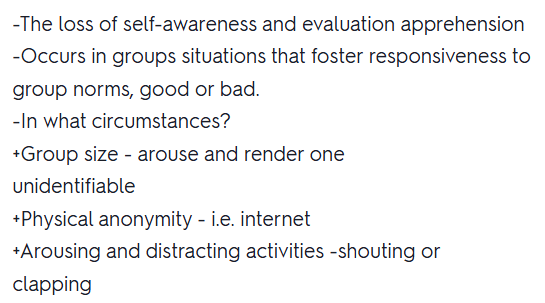
deindividuation is
The loss of self-awareness and evaluation apprehension. It occurs in group situations that foster responsiveness to group norms, good or bad
Groupthink
the mode of thinking that persons engage in when concurrence-seeking becomes so dominant in a cohesive in-group that it tends to override realistic appraisal of alternative courses of action/an amiable, cohesive group, relative isolation of the group from dissenting viewpoints, a directive leader who signals what decision he/she favors
Symptoms of groupthink
overestimate their groups might and right; an illusion of invulnerability. Following leads group members to behave close-minded; stereotyped view of opponent; rationalization and discount of challenges. Group suffers from pressure toward uniformity; conformity pressure; self-censorship; illusion of unanimity
Group polarization
group produced enhancement of members preexisting tendencies, a strengthening of the members average tendency
Hindsight bias
A phenomenon in which people exaggerate the predictability of an event after it has already happened
Social loafing
the tendency for people to exert less effort when they pool their efforts toward a common goal than when they are individually accountable. People loaf less when the task is challenging, appealing or involved or with their friends.
driven to distraction
when we wonder how co-actors are doing or how an audience is reacting, we get distracted
Arousal
strengthening of dominant responses, enhancing easy behavior, impairing difficult behavior
Two sided - persuasive communication that presents two points of views better with those who disagree
-primarily advocates one side but additionally recognizes, and at times, rejects, the other side pertaining to an issue
-A two-sided appeal is better with those who disagree
Brainstorming (stroebe)
- group members saw the ideas as their own even though they had not previously thought of the idea
- 80% of these participants predicted that a person working in a group word be more productive than working alone
- results indicated participants produced fewer ideas when in groups
- an explanation was the illusion of group effectivity, group members could not differentiate between the ideas they had themselves
- Groups may cause people to lose self-awareness, with resulting loss of individuality and self-restraint
One sided - persuasive communication in favor of a specific position ignoring countering arguments
-a message consisting of arguments which solely advocate one side of a problem
-more effective with those who already agree.
Robert Cialdini’s six principles of persuasion
Triplett study
-two conditions: the child alone and children in pairs but working alone.
-Their task was to wind in a given amount of fishing line- reported that many children worked faster in the presence of a partner doing the same task.
-demonstrates the co-actor effect, a phenomenon whereby increased task performance comes about by the mere presence of others doing the same task.
Asch study (1955)
- participators looked at lines and estimated which were the same (AB or C), 5 out of the 6 people were not actually participants but actors.
- When interviewed afterwards, participants all said that they had been influenced by the "pressure" from the rest of the group.
- Many said that they did not want to appear silly (social respect)
- This is an example of "normative social influence"
Following the perceived group norms to be accepted
- A new social reality
Sherif study (1935, 1937)
- Participants were invited to estimate the amount of 'movement' they observed.
- Estimates made in groups where each member could hear the others' estimates.
- Ultimately, the group members' estimates converged on a middle-of-the-road 'group estimate'
- This would appear to show an urge to conform.
- Our views of reality are not ours alone
Milgram study (1965)
- The experimenter (E) persuades the participant (S) to give what the participant believes are painful electric shocks to another participant (A), who is actually an actor. Many participants continued to give shocks despite pleas for mercy from the actor.
- "These predictions were unequivocally wrong. Of the 40 subjects in the first experiment, 25 obeyed the orders of the experimenter to the end, punishing the victim until they reached the most potent shock available on the generator.
- After 450 volts were administered three times, the experimenter called a halt to the session.
Many obedient subjects then heaved sighs of relief, mopped their brows, rubbed their fingers over their eyes, or nervously fumbled cigarettes. Others displayed only minimal signs of tension from beginning to end."
- explains holocaust because of the obedience of authority when there is littler personal connection with the afflicted person
Buss (1995)
Latane et al. (1979)
-Addressed issues with Ringleman "Tug-o-War" experiment
-participants clapped and shouted by themselves and in groups
-The average sound generated per person decreased with larger group size

