Platythelminthes
 Call Kai
 Learn
Learn Practice Test
 Spaced Repetition
 Match
Match Flashcards
 Knowt Play
1/21

There's no tags or description
Looks like no tags are added yet.
Name | Mastery | Learn | Test | Matching | Spaced | Call with Kai |
|---|
No analytics yet
Send a link to your students to track their progress
22 Terms
Organization
Organ Lvel
Embryonic Development
Triploblastic
Protostomes
Acoelomates
Deutorstomes
Symmetry
Bilateral
Skeleton
Parenchyma fills blastocoel, provides hydrostatic skeleton
Movement
Hydrostatic Skeleton
Longitudinal Muscles in the mesoderm
Circular muscles in the mesoderm
Cilia on ventral surface
Sensory/Nervous
Cephalization, ventral nerve cord
Digestion/Feeding
Gastrovascular Cavity (GVC)
Free living
Ectoparasites
Endoparasites
Excretory
Diffusion
Circulation
Diffusion
Respiration
Diffusion
Reproduction
Asexual (Regeneration)
Sexual monoecious (Hermaphroditic)
- Internal fertilization
Penis-fencing (Class Polycladida)
Classes of Platyhelminthes
Tricladida
Trematoda
Cestoda
Polycladida
Monogenea
Class Tricladida
Planaria
Triply-branches intestine
Free living omnivores
Protruding pharynx to feed
Ocelli (eyespots)
Auricles (chemosensory receptors)
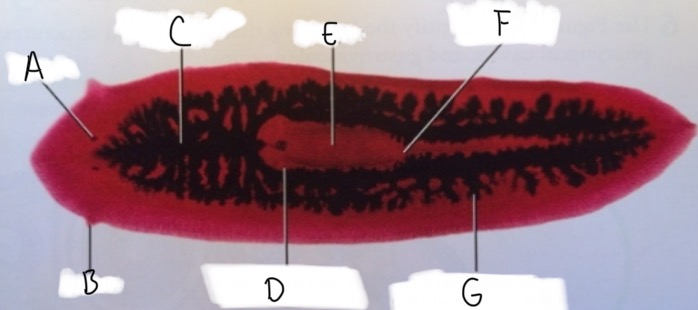
What organism is this? Class and Phyla? Identify the labelled parts below.
Planaria
Phylum Platyhelminthes
Class Tricladida
A. Ocelli (eyespots)
B. Auricles (Chemosensory receptors)
C. Gastrovascular cavity (GVC)
D. Pharyngeal cavity
E. Pharynx
F. Mouth
G. Diverticulum of GVC
Polycladida
Almost all marine
Elongated Branching intestine
Free living
Brightly colored and toxic
Penis-fencing
Class Trematoda
Flukes
Endoparasites
Lack sensory and locomotor functions of planaria
Two suckers
i. Oral sucker for feeding
ii. Ventral for attachment
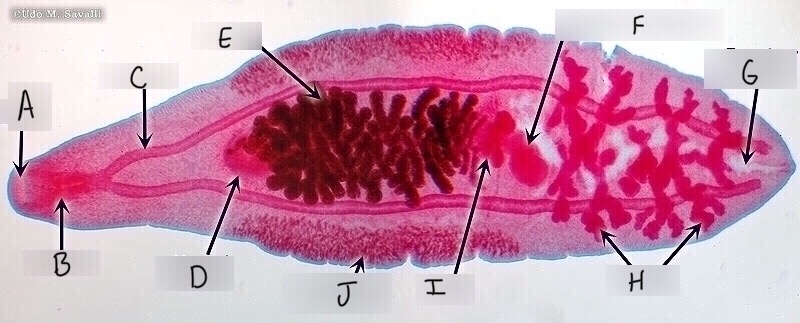
What phylum and class is this organism? Identify the parts with their corresponding letter.
Phylum Platyhelminthes
Class Trematoda
A. Oral sucker
B. Pharynx
C. Intestine
D. Ventral sucker
E. Uterus
F. Seminal Receptacle
G. Excretory Bladder
H. Testes
I. Ovary
J. Yolk glands
Class Monogenea
Ectoparasites of fish
Single host in life cycle
Cestoda
Tapeworms
Endoparasites
No gut; absorb nutrients through cuticle
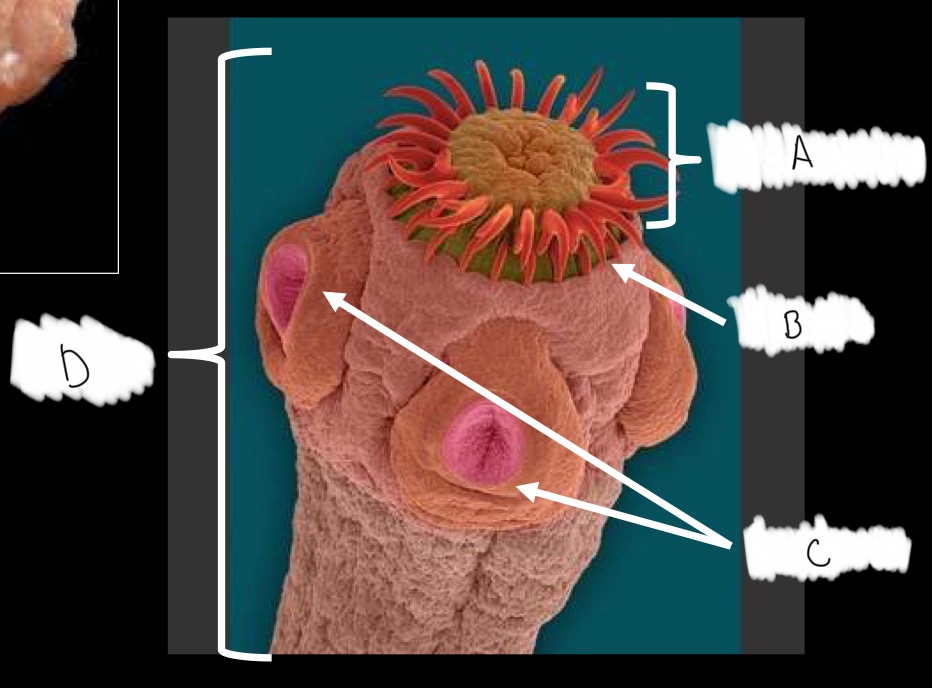
What phyla and class does this organism belong to? Identify the parts that correspond to each letter.
Phylum: Platyhelminthes
Class: Cestoda
A. Rostellum
B. Hooks
C. Suckers
D. Scolex
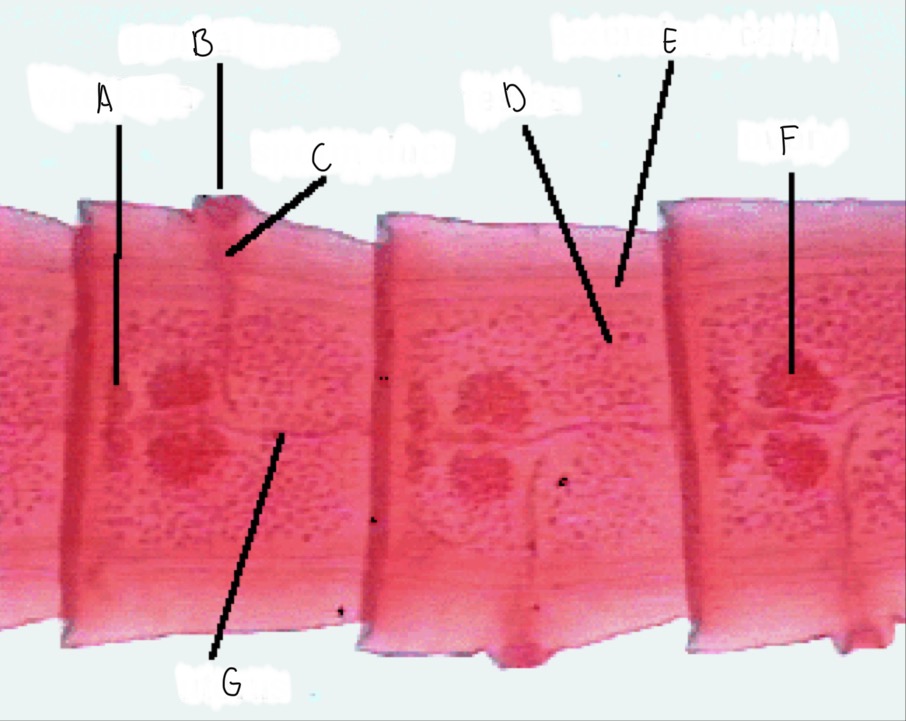
What phyla and class does this organism belong to? Identify the parts that correspond to each letter.
Phylum Platyhelminthes
Class: Cestoda
A. Vitelline Gland
B. Genital Pore
C. Sperm Duct
D. Testes
E. Excretory Canal
F. Ovary
G. Uterus
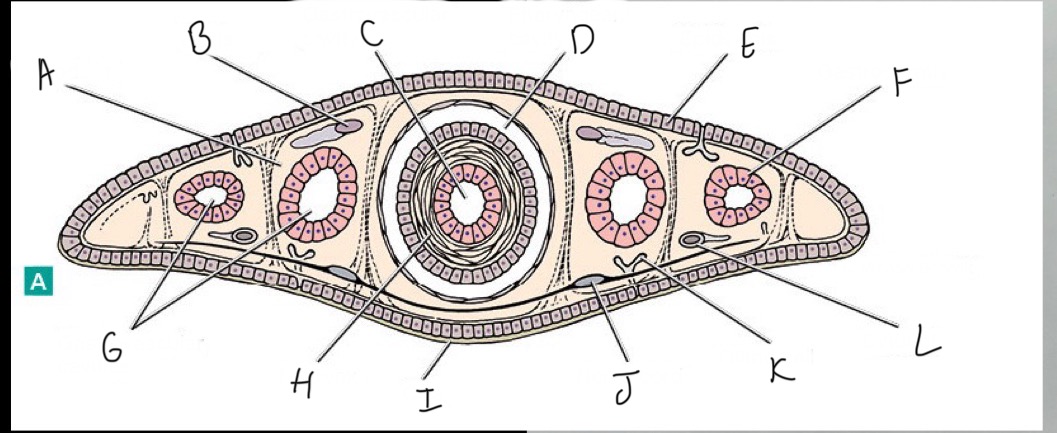
What phyla and class does this organism belong to? Identify the parts that correspond to each letter.
Phlyum: Platyhelminthes
Class: Tricladida
A. Mesoderm
B. Testis
C. GVC
D. Pharyngeal Cavity
E. Epidermis
F. Gastrodermis
G. GVCs
H. Pharynx
I. Cilia
J. Ventral nerve cord
K. Gland cell
L. Oviduct

