Glycolysis Cycle
 Studied by 0 people
 Call Kai
 Learn
Learn Practice Test
 Spaced Repetition
 Match
Match Flashcards
 Knowt Play
1/9

There's no tags or description
Looks like no tags are added yet.
Name | Mastery | Learn | Test | Matching | Spaced | Call with Kai |
|---|
No analytics yet
Send a link to your students to track their progress
10 Terms
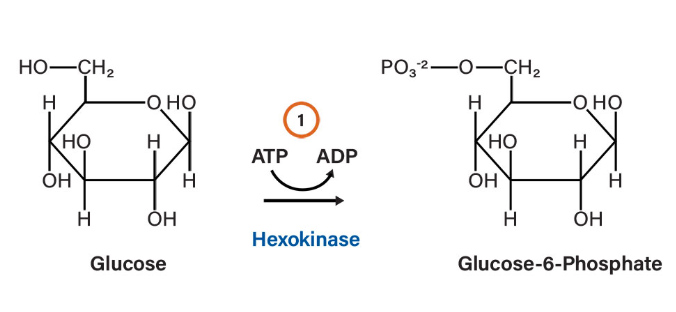
Reaction 1
phosphorylation step where a phosphate group is added to glucose by the enzyme hexokinase as glucose enters the cell
phosphate group comes from an ATP molecule that donates a single phosphate that results in forming ADP
phosphate keeps glucose in cell/tags it for use
glucose becomes glucose-6-phosphate
on its own not favorable — coupled phosphorylation of glucose with ATP degradation reaction
SINGLE ARROW
delta G = -16.7kJ/mol (spontaneous)
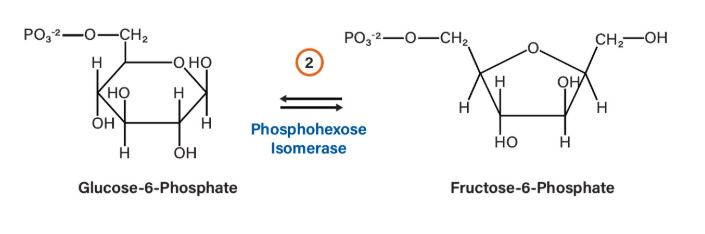
Reaction 2
glucose-6-phosphate is converted from pyranose ring to furanose ring —> becomes fructose-6-phosphate
catalyzed by enzyme phosphohexose isomerase (changes bonding within the molecule)
equilibrium arrows — delta G +1.7 kJ/mol BUT can become favorable if high enough glucose-6-phosphate concentration
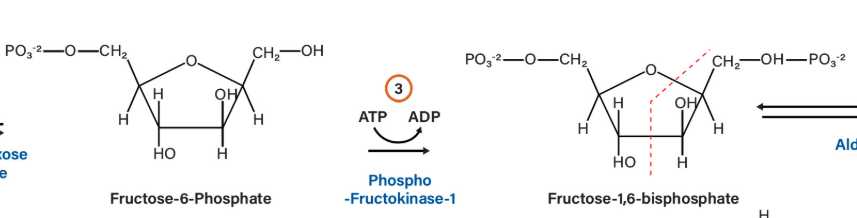
Reaction 3
another phosphate is added from another ATP (SECOND INVESTMENT)
enzyme = phosphofructokinase-1
becomes = fructose-1,6-bisphosphate

Reaction 4
6-carbon glucose splits into 2 3-carbon compounds
result = GAP (glyceraldehyde 3-phosphate) & DHAP (dihydroxacetone phosphate)
enzyme = aldolase
both has phosphate group to keep in glycolysis pathway
equilibrium arrows
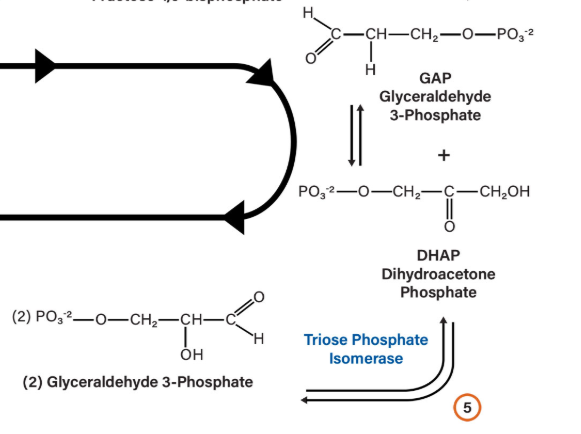
Reaction 5
DHAP molecule is converted to GAP —> now 2 GAP molecules
enzyme = triose phosphate isomerase
end of preparatory phase
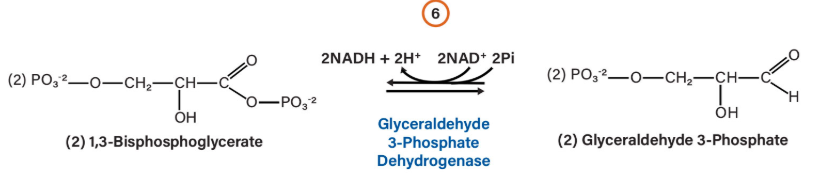
Reaction 6
start of payoff phase
2 GAP molecules from glucose
2 NAHD molecules are produced (each provides 2.5 equivalents of ATP in ETC) and 2 H+
energy conversion/phosphate group added (2 Pi and NAD+ added)
enzyme = glyceraldehyde 3-phosphate dehydrogenase
product = (2) 1,3-bisphosphoglycerate
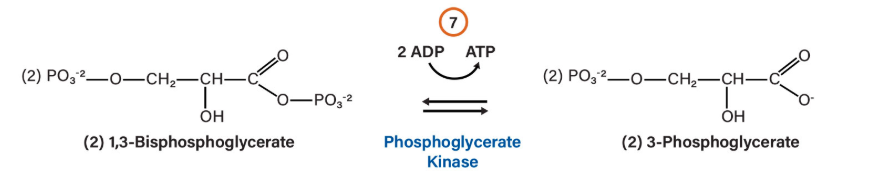
Reaction 7
added phosphate groups and transferred to make 2 molecules of ATP directly (substrate-level phosphorylation)
enzyme = phosphoglycerate kinase
product = (2) 3-phosphoglycerate
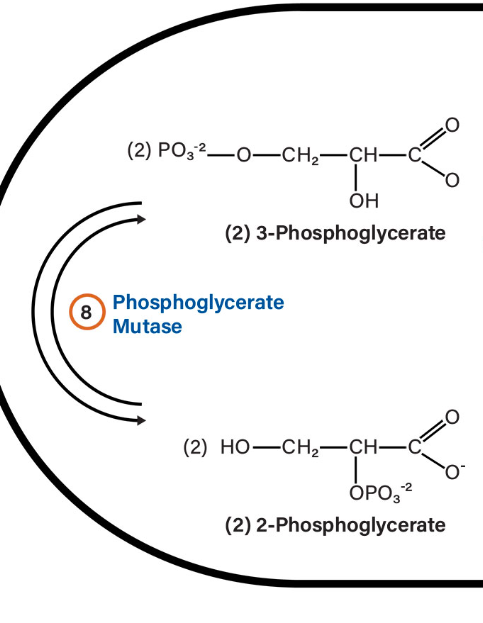
Reaction 8
moving phosphate to a different carbon where it is more likely to be added to an ADP
enzyme = phosphoglycerate mutase
product = (2) 2-phosphoglycerate
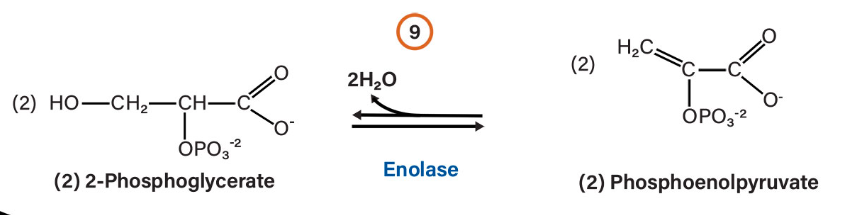
Reaction 9
removing water and creating double bond to form phosphoenolpyruvate
enzyme = enolase
product = phosphoenolpyruvate
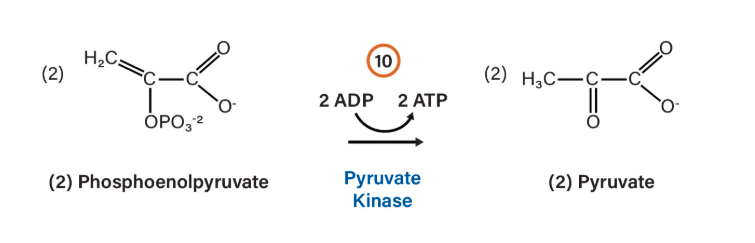
Reaction 10
final phosphate group on each phosphoenolpyruvate is transferred to ADP to make ATP by substrate-level phosphorylation
product = final molecule of glycolysis ( 2 pyruvate) + 2 ATP
enzyme = pyruvate kinase
 Note
Note  Flashcards (21)